By
Justin Wong
—
Jenni AI vs ChatGPT: Which Gets the Right Paper Into Your Draft?

Justin Wong
Head of Growth
Graduated with a Bachelor's in Global Business & Digital Arts, Minor in Entrepreneurship
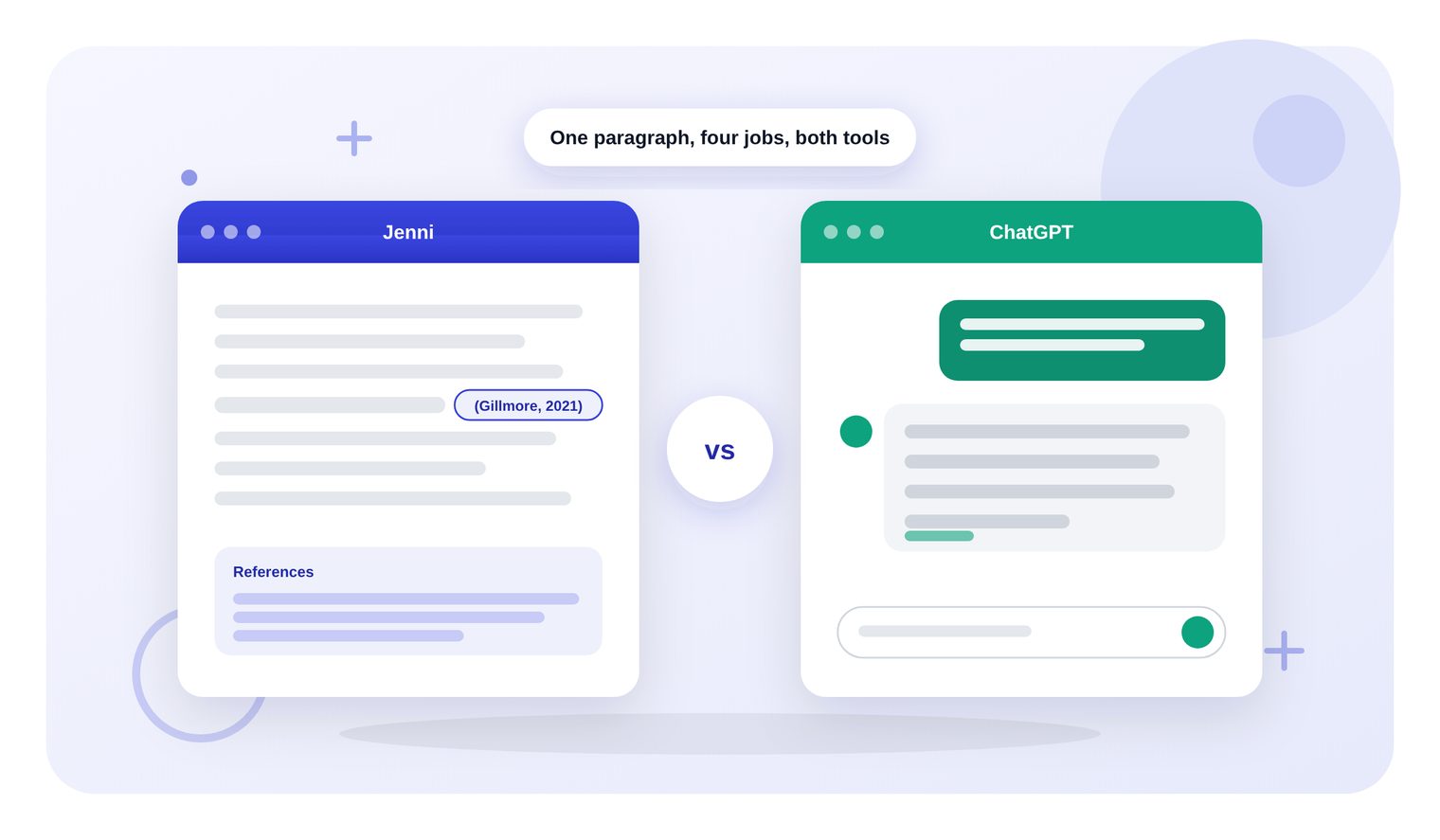
One reference broke. ChatGPT named the right paper for a claim about lipid nanoparticles, then attached a DOI that opens a different study altogether. The correct record was the same one Jenni had put on screen twenty minutes earlier, before anything had been typed into a search box.
That is the whole argument between these two tools in one incident. ChatGPT is a very good reader of a paragraph. Jenni is a place where the paragraph becomes a paper, with the sources attached as you go.
The same 201-word paragraph went through both on 16 September 2026, on four jobs: fix a clunky sentence, cite a checkable claim, check the argument, get the file out. Jenni ran on Plus; ChatGPT ran GPT-5.6 Luna.
<CTA title="Write with the sources in view" description="Find the paper, cite it and build the reference list without leaving the editor, then export to Word or LaTeX" buttonLabel="Try Jenni Free" link="https://app.jenni.ai/register" />
TLDR: Jenni or ChatGPT?
Jenni for the paragraph that still has to become a paper: the trial was on its citation list before a search term existed, and one click filed both the citation and the formatted reference. ChatGPT for the argument about the paragraph: a claim-by-claim critique no other tool matched, and three of its eight references needed fixing first.
Jenni | ChatGPT | |
Verdict | The better place to write it. Sources suggested at the cursor, citation and reference list in one click, export with live Word citation fields | The better second reader. An eleven-row critique of the argument, delivered as chat text that has to be carried across by hand |
Fix a clunky sentence | One command, a diff, and Replace Selection puts it in the document | The rewrite in a card plus four before and after pairs. Copied back by hand |
Cite a claim | The NEJM trial was already on the Discover list, with 1.6K citations and its impact factor on the card. One click inserted the citation and the APA entry | Found the right paper and placed the citation correctly. No reference list exists to file it in |
Check the argument | Claim confidence returned three suggestions, each with a real record attached | Eleven claims assessed, two rewrites, eight references of which five were right |
Get the file out | Word with native citation fields, or LaTeX, with four layout presets. No PDF | A .docx built in the chat, containing ChatGPT's rewrite rather than your document |
Free plan | 10 autocompletes a day, 3 AI edits, 5 chat messages, 3 reviews, unlimited citations | Unlimited text chats on GPT-5.6 Luna, limited uploads and research |
Paid billed yearly | Plus $144 a year, Pro $348 a year | None for individuals. Go $8, Plus $20, Pro $100 or $200, monthly only |
Best for | Writing the draft with its sources attached | Arguing with a draft that already exists |
How this was tested
One paragraph, written for the test, pasted into both tools cold:
The paragraph - 201 words on lipid nanoparticles as a CRISPR delivery vehicle.
Two planted faults - a sentence opening "There is a lot of things that still needs", and a hedge stacked three deep, "could perhaps maybe".
One checkable claim - a mean 87 percent drop in serum transthyretin at the higher dose, which is Gillmore et al., NEJM 2021.
Same conditions - nothing uploaded, the four jobs in the same order, Jenni on Plus and ChatGPT on GPT-5.6 Luna, both in Chrome on the same day.
One limit - the file job stops at the export dialog. Nothing was downloaded from either tool.
Task by task
1. Fix the clunky sentence
ChatGPT - the prompt was the paragraph plus one instruction: "Fix the clunky sentence that starts 'There is a lot of things', and only that sentence. Show me exactly what you changed." The reply put the new sentence in a card and listed the edits under it.
"Several things still need to be worked out, though, including how the particles behave outside the liver, whether repeat dosing causes an immune response, and what the long-term editing outcomes look like at off-target sites."
Under it, four before and after pairs: the opening clause, "for example" to "including", and the two hyphens. It touched only that sentence, as asked, and the list is easy to check against the original.
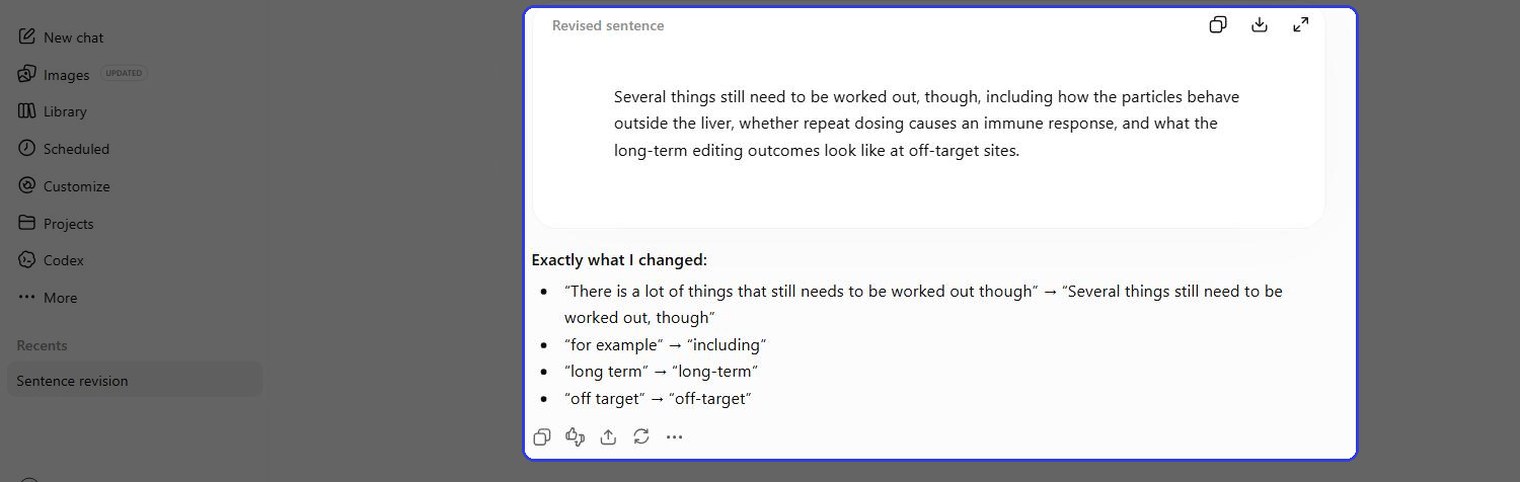
ChatGPT on GPT-5.6 Luna: the revised sentence in its own card, with the four before and after pairs listed underneath.
Jenni - highlighting the sentence brings up a menu at the selection, with AI Edit and Improve fluency under it. The card reported its thinking time, showed the change as strikethrough and insertion, and explained what it had done in two lines. Replace Selection put the new sentence into the document.
Winner - even. Both sentences are sound and ChatGPT's list of changes is the easier one to audit. The difference is where the sentence ends up: in the document on one side, in a chat window on the other.
<ProTip title="💡 Pro Tip:" description="Tell ChatGPT which sentence to touch and ask it to show exactly what changed. That phrasing returned the one sentence plus a list of edits, which is far easier to check than a rewritten paragraph" />
2. Cite the transthyretin claim
Jenni - with the cursor after the claim, Cite opens a search panel inside the text. The search box was still empty, and the Discover tab had already drawn papers from the sentence around the cursor.
The NEJM trial - Gillmore et al., 2021, the study the sentence describes: cited by 1.6K, impact factor 24.39, Open Access.
Above it - a 2018 Cell Reports paper on single-dose CRISPR LNP delivery, so the journal line is the thing to read before clicking.
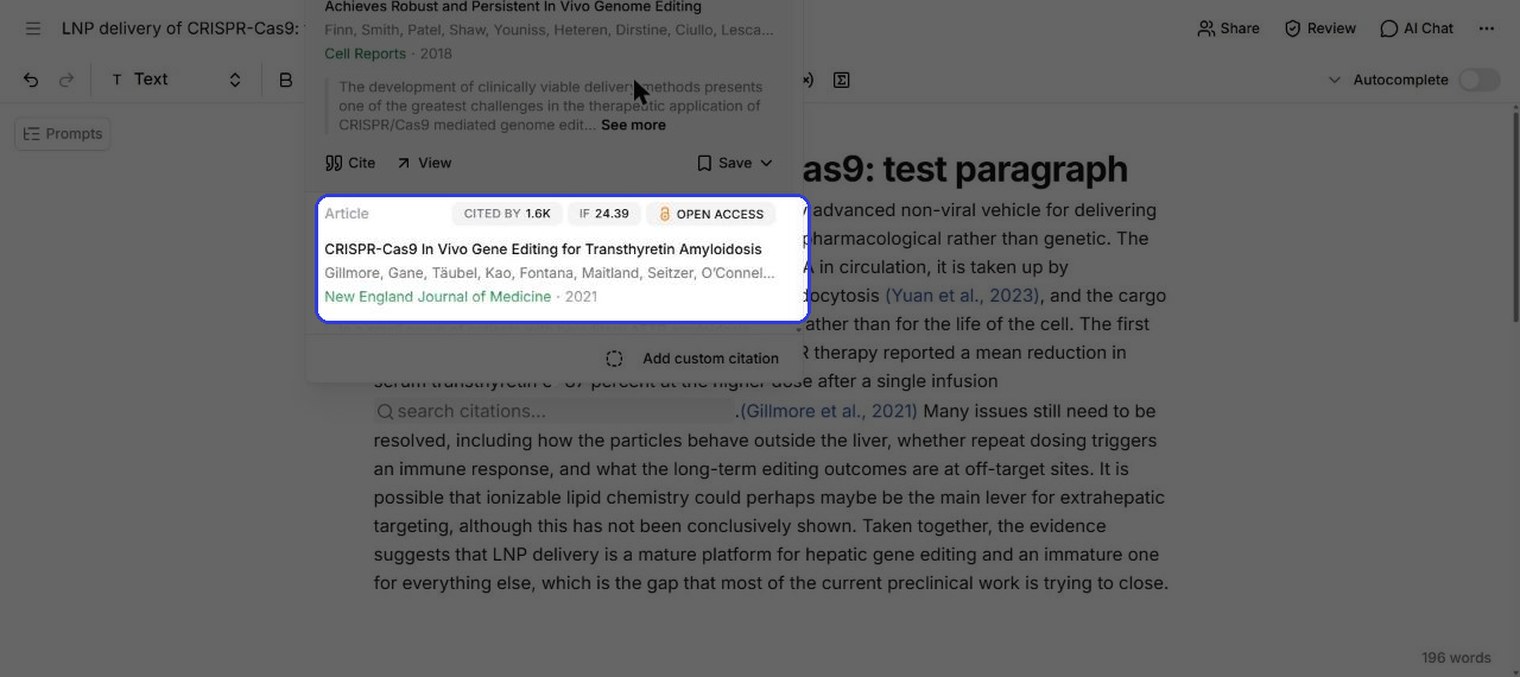
The Cite panel open at the cursor with the search box still empty. The NEJM trial is boxed: 1.6K citations, impact factor 24.39, Open Access.
Cite on that card did two things at once. The in-text citation went in at the cursor, and a References section appeared at the foot of the document carrying the full APA 7th entry with its DOI, a style dropdown and a Sources counter.
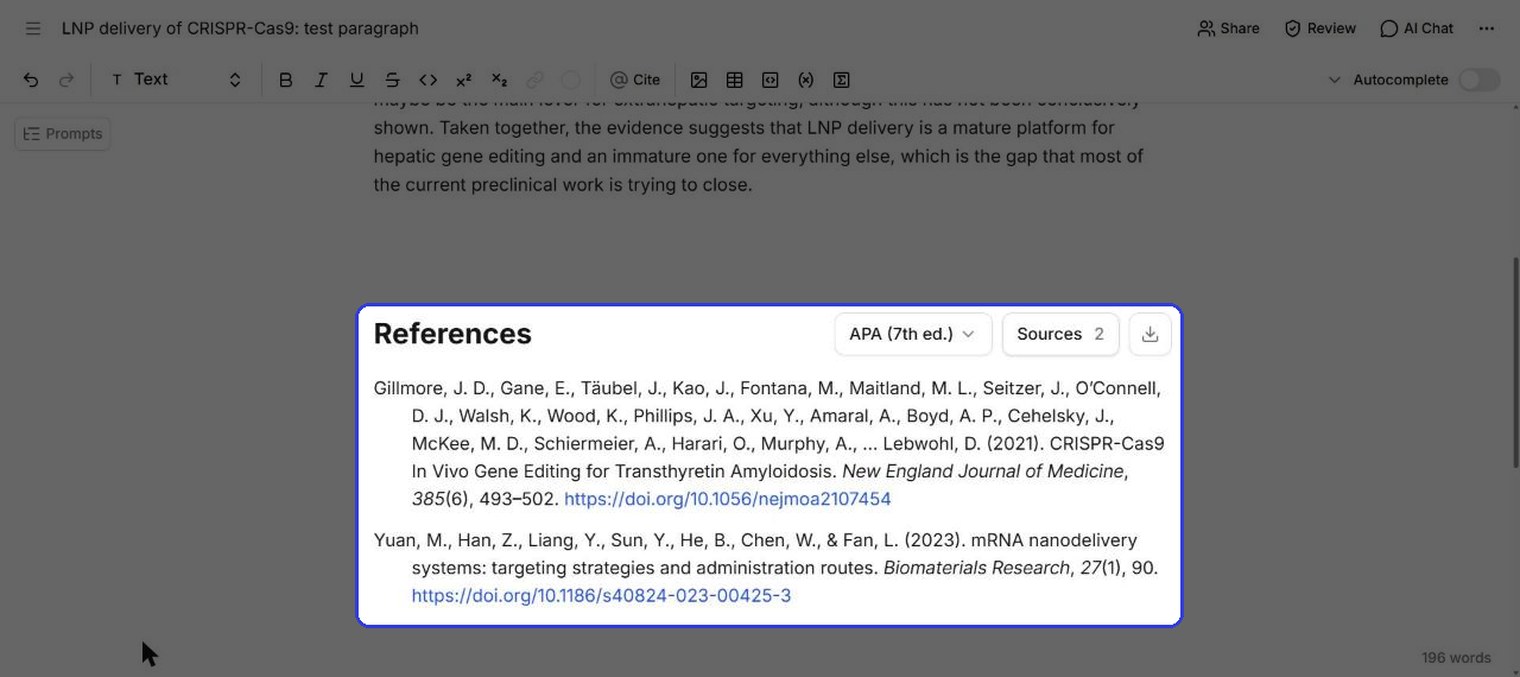
The References section at the foot of the document: the APA 7th entry with its DOI, the style dropdown and the Sources counter. The second entry was filed later by the review.
ChatGPT - asked for the same citation in APA 7th with a DOI, it searched the web and named the right study, adding a detail the paragraph lacked: the 87 percent was measured at day 28 in the 0.3 mg/kg group. The citation was placed before the full stop, where APA wants it.
The catch is that all of it is text in a chat. No reference list builds anywhere, and the umlaut in "Täubel" did not survive the trip.
Winner - Jenni. ChatGPT got the paper, the DOI and the placement right, and its day 28 note is worth copying into the sentence. Jenni had the same paper on screen before a search term existed and built the reference list in the same click, which is the part a chat window cannot do.
<ProTip title="📌 Remember:" description="A citation in a chat is not in your paper yet. Paste the in-text citation and the full reference across in the same minute, and check the author names against the DOI landing page" />
3. Check the argument
ChatGPT - asked which claims were unsupported or overstated, and for a real paper with a DOI for each, it produced the most thorough read of the paragraph in the test.
A claim-by-claim table with eleven rows: Claim, Assessment, Why, and the paper you could cite.
Calls the other side did not make, including the closing line rated as overstated and the 87 percent figure marked supported but in need of its dose and time point.
Two rewrites for the claims it would change most, and a list of six references with DOIs.
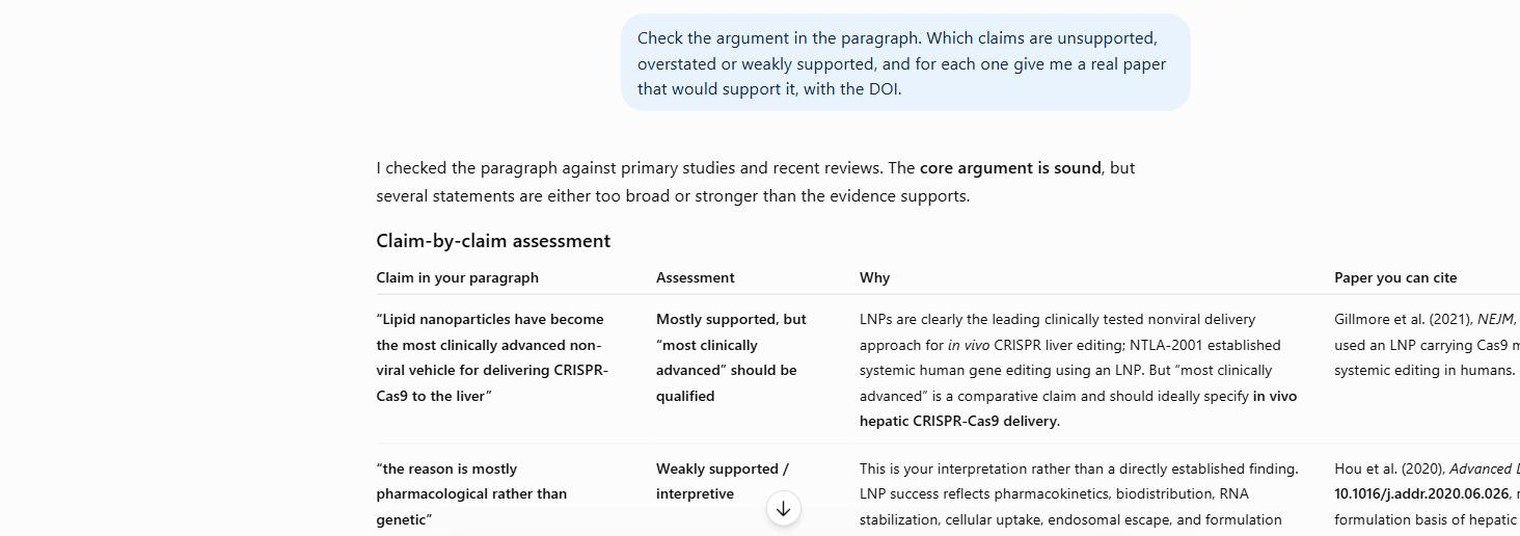
The top of the eleven-row claim-by-claim table: Claim, Assessment and Why, with the fourth column running off the edge of the chat column.
Then the references were opened one by one. Of the eight in the answer, five resolve to the papers named. Two carry the right DOI with the wrong first author. One points somewhere else entirely.
The Finn et al. entry carries DOI 10.1016/j.celrep.2018.04.096, which opens a Cell Reports paper on capping protein by different authors. The real Finn paper is 10.1016/j.celrep.2018.02.014, the same record Jenni's Discover list had shown, correctly, earlier in the session.
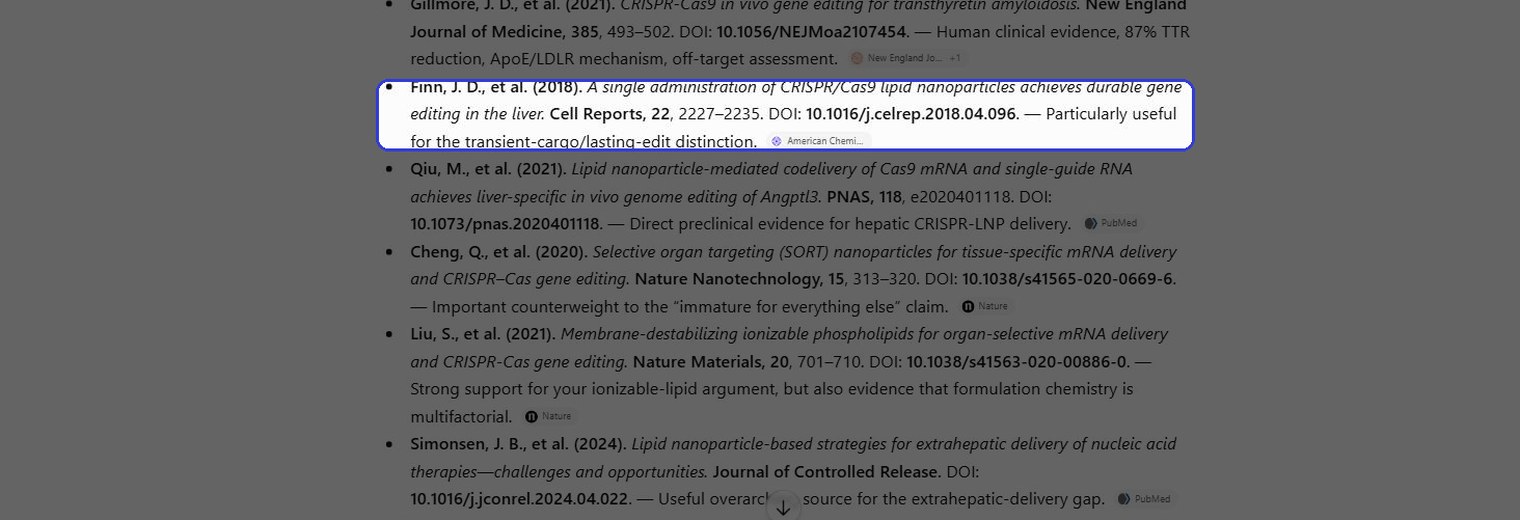
The references under the table. The boxed Finn et al. entry carries a DOI that opens a different Cell Reports paper.
Jenni - Claim confidence sits in the Reviews panel and returned three suggestions, each pinned to a sentence with a proposed source carrying its citation count and impact factor.
One was accepted and filed into the reference list. Two were refused with one click each, including a swap of the NEJM citation for a 2022 reprint of the same paper.
Winner - depends on the job. For sourcing, Jenni: three real records, judged and filed without leaving the document. For a critique, ChatGPT went further into the logic of the paragraph than anything else in the test, and three of its eight references needed fixing before use.
<ProTip title="⚠️ Caution:" description="Open every DOI a chatbot gives you at doi.org before it goes near a reference list. Of the eight references here, two carried the wrong first author and one opened a different paper entirely" />
4. Get the file out
Jenni - Export sits under the three-dot menu and offers two formats, Word and LaTeX. The Word tab asks one useful question first: whether the in-text citations should travel as native Word citation fields, so they stay linked through Word's References tab, or as hyperlinks for Google Docs.
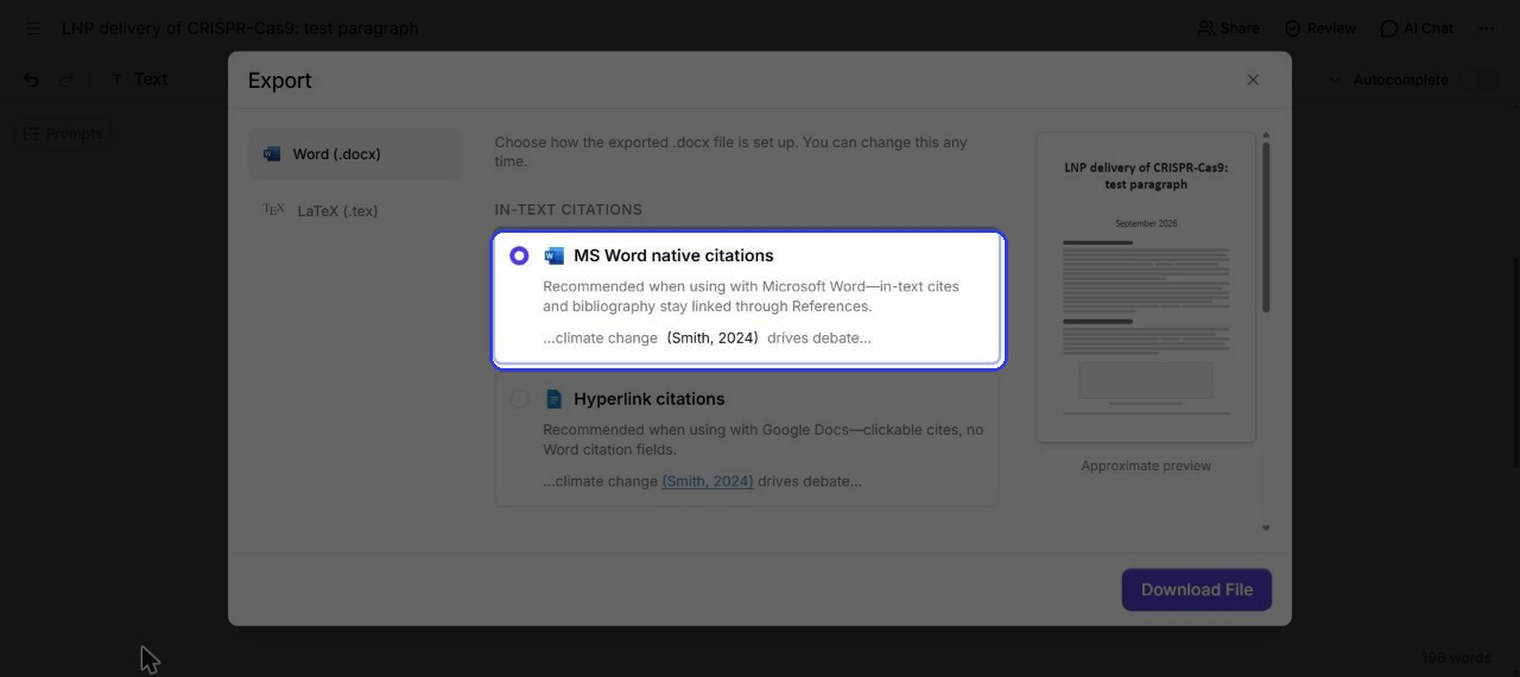
The Export dialog: Word or LaTeX on the left, and the choice between MS Word native citations and hyperlink citations. There is no PDF option.
Below that sit four layout presets and an approximate page preview. What it does not have is PDF, and the docs note that the free plan leaves the bibliography out of the file.
ChatGPT - asked for the corrected paragraph and reference list as a Word document, it produced a real .docx with a download link in the chat. Asked to paste the exact text back, it showed a paragraph changed well beyond the sentence fixed in task one, with the opening line extended and two closing sentences replaced.
Winner - Jenni. Its dialog sends out the document that was written, citations still live. ChatGPT's file is a genuine .docx, and it is ChatGPT's version of the paragraph, so it has to be read against the original before any of it is kept.
<ProTip title="🔗 Next step:" description="When ChatGPT hands back a corrected .docx, read it against your original before pasting anything. In this test it changed the opening sentence and both closing sentences beyond the one it was asked to fix" />
Where Jenni is ahead
Four things the test showed on this side that ChatGPT did not match:
Sources before a search term - the Cite panel listed papers drawn from the sentence with the search box still empty, and the NEJM trial was one of them. ChatGPT finds a paper when it is asked for one.
Citation and reference list in one click - the in-text cite and the formatted APA entry with its DOI arrived together, inside the document. The chat answer had to be carried across by hand.
A review that files what it finds - each accepted suggestion put a citation in the text and an entry in the list, with the citation count and impact factor visible before accepting.
The file is your file - Word with native citation fields or LaTeX, as written. ChatGPT's .docx was its own rewrite of the paragraph.
Where ChatGPT is ahead
Three things ChatGPT did that the other side did not, checked on the day:
It argues with the paragraph - eleven claims assessed, two rated overstated, two rewrites offered, and a note that the 87 percent figure needs its dose and time point. Claim confidence proposed a source for every flag rather than telling the writer to cut anything.
A caveat with the citation - the answer flagged that the figure comes from a small phase 1 study, and placed the citation before the full stop where APA wants it.
Everything in one thread - the sentence fix, the citation, the critique and the .docx all came from one conversation with one model.
What each tool costs
Both pricing pages were read on 16 September 2026. ChatGPT sells no yearly plan to individuals, so its column is monthly throughout.
Plan | Jenni | ChatGPT |
Free | $0. 10 autocompletes a day, 3 AI edits, 5 AI chat messages, 3 reviews, 10 PDF uploads, unlimited citations, body-only export | $0. Unlimited text chats on GPT-5.6 Luna, limited uploads, limited deep research and memory |
Second tier | Plus, $30 monthly or $12 a month billed yearly ($144): 5,000 autocompletes a month, unlimited PDF uploads, 500 AI edits, 500 chat messages, 10 reviews a month, full export | Go, $8 a month in the US, monthly only |
Third tier | Pro, $73 monthly or $29 a month billed yearly ($348): unlimited autocomplete, uploads, edits, chat and reviews, priority support | Plus, $20 a month: newer models, more messages and uploads, projects and custom GPTs |
Fourth tier | None | Pro, $100 a month or $200 a month for the largest usage allowance |
Yearly billing | Plus $144, Pro $348 | None for individuals; yearly plans are Business and Enterprise only |
September 2026 pricing, read on 16 September from jenni.ai/pricing and chatgpt.com/pricing.
On the Jenni side the tiers buy writing volume: autocompletes, edits, chat, reviews and export. On the ChatGPT side they buy newer models and more usage: more messages, more uploads, longer context.
<ProTip title="⏳ Timing:" description="Run the argument check before you ask either tool for the file. ChatGPT folds its critique into the .docx it builds, and Jenni files each source you accept as you go, so the order of the jobs changes what the file contains" />
Which one should you use?
The default for anyone with a paragraph still to write is Jenni. ChatGPT earns its place as the second reader, the one that argues back. Three readers, one pick each.
The PhD student mid-thesis, with 40 papers in a folder and 30,000 words to go
Jenni - three jobs eat a thesis year, and all three happen inside the document here:
The citation panel at the cursor, with papers suggested before a search term is typed.
The reference list that builds itself with every Cite click.
Claim confidence, run once per chapter, with each accepted source filed as you go.
If the folder is a Zotero library, it imports. Paste the chapter's shakiest paragraph into ChatGPT for the claim-by-claim read before a supervisor sees it.
The postdoc submitting to a journal next week
Jenni for the manuscript, ChatGPT for the argument - the export with native citation fields and the double-spaced preset are the submission jobs. The claim-by-claim table is the pre-review, and every DOI it names gets opened at doi.org before it goes anywhere near the reference list.
The person writing one essay this term
Jenni on the free plan - unlimited citations, ten autocompletes a day and three reviews cover an essay; keep the three AI edits for the sentences that matter. ChatGPT will read the finished essay back for its logic, and there is a longer guide to ChatGPT for essay writing on the blog.
<CTA title="Draft the next paragraph with the paper attached" description="Search, cite and review inside one editor, then export to Word or LaTeX with the citations kept live" buttonLabel="Start Writing Free" link="https://app.jenni.ai/register" />
ChatGPT read the paragraph more critically than anything else in the test. It also produced a reference that pointed at the wrong paper, and none of its citations are in the document until someone types them there.
Jenni's version of the same session was quieter. The trial was on the list before the search, the citation and the reference went in together, and the accepted source was filed with a click.
The export dialog was ready to send that document out with its citations still live. Write where the sources are, and let the chat window argue with the result.