







From draft to peer review feedback in three steps
Drop in your draft
Run Peer Review
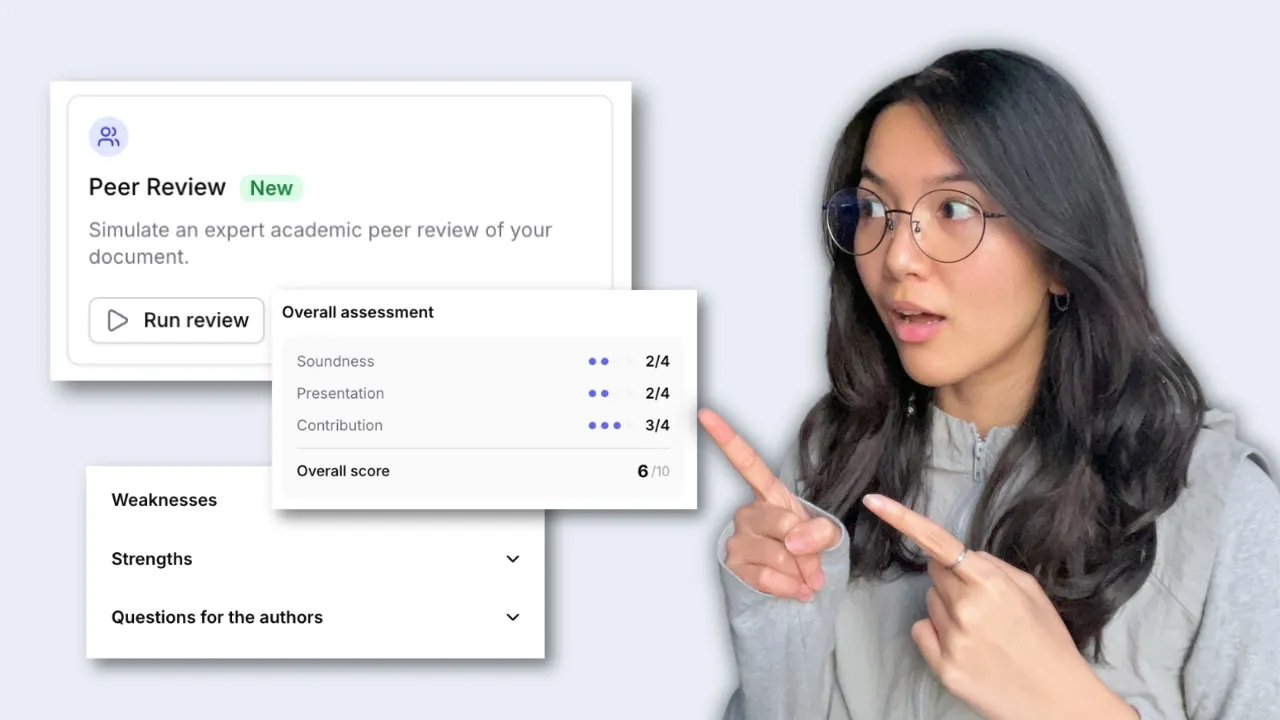
Jenni reviews your manuscript against standard peer review criteria, scores key areas, and flags actionable improvements directly in your draft.
Resolve, re-run, repeat
Comments land directly in your manuscript, tied to the exact passages that need work. Address each issue, and watch your score improve.
See Peer Review in action
Watch how Jenni reads a real manuscript, scores it against the rubric, and leaves comments where each section needs work.
Built for academic rigor
Most AI tools give you generic writing feedback. Peer Review evaluates your manuscript like a reviewer would.

Reads the full manuscript
Peer Review reads your full draft cover to cover, capturing every claim, every method note, and every transition, so feedback reflects the whole document.

Same criteria reviewers use
Peer Review fills out the same review form top journals use, with scores on soundness, contribution, and presentation plus written feedback.

Comments tied to passages
Jenni anchors every comment to a specific sentence, with a reason and a suggested fix. You know what to change & where, not just that something's off.
Your full pre-submission citation review
Peer Review is one of four Review tools that catch issues before reviewers do. Run them together for a complete pre-submission pass.
Peer review8 / 10
Manuscript scored against a peer-review rubric with reviewer comments on each section.
Soundness
3/4
Presentation
4/4
Contribution
3/4
Results
Strengths
Weaknesses
Claim confidence10 issues
The claim confidence analysis addressed issues of redundant, weak, or missing citations, alongside instances of contradiction in citation arguments.
Misrepresented
Contradicted
3Unsupported
4Weakly supported
2Overstated
Unverifiable
Outdated
2Self-citation heavy
Predatory source
Citation mismatch
1Proofread18 edits
Whilst generally sound, the text contains some areas for improvement to comply with academic best practices.
Word choice
AllThe majority of participants reported improved outcomes.
Formality
Yang (2024) found a negative correlation which was interesting..
Grammar
These results indicate that early intervention be effective. appears to be effective.
Transitions
Also, In addition, Jones (2022) found similar results.
Overgeneralized
AllThe majority of participants reported improved outcomes.
The results provesuggest that X has an effect on Y.Tone of voice22 notes
Suggestions across vocabulary, syntax, punctuation, tone and flow to keep a consistent academic voice.
All Suggestions
22Vocabulary
6Syntax
5Punctuation
4Tone
3Flow
4Peer Review
Claim Confidence
Proofread
Tone of Voice


Our users have published papers in 100+ journals
Real research, published in journals such as IEEE, Springer, Elsevier –planned and written in Jenni.