






How it works
From draft to verified citations in three steps
Drop in your draft
Paste a section, upload your .docx, or work directly in Jenni's editor. Claim Confidence reads each in-text citation and finds the source it points to.
Run the review
Jenni cross-references each citation against its source — verifying claims against your library plus CrossRef, PubMed, and OpenAlex. Verdicts in under a minute.
Edit and re-verify
Each flagged claim shows you the exact passage from the source and a suggested rewrite. Accept, edit, or dismiss, then re-run the review to confirm the fix.
Six ways your citations can fail — and how Jenni catches them
Claim Confidence verifies every cited claim against its source and sorts issues into six categories — so you know exactly what kind of fix is needed.
Misrepresented
The claim distorts what the cited source actually says.
EXAMPLE
"Smith (2022) demonstrated that GPT-4 outperforms human teachers" — when Smith only measured grading speed, not teaching quality.
Contradicted
The cited source argues the opposite of the claim.
EXAMPLE
"Continuous fasting accelerates cellular repair (Lin et al., 2023)" — but Lin's findings show repair plateaus after 72 hours.
Unsupported
The cited source doesn't address the claim at all.
EXAMPLE
"CRISPR-Cas9 has been ethically endorsed by the WHO (Doudna, 2020)" — Doudna discusses mechanism, not WHO policy.
Weakly supported
Evidence in the source is thin or limited in scope.
EXAMPLE
"Resistance training improves cognition across populations (Conan, 2020)" — Conan studied only collegiate athletes.
Overstated
The claim goes further than the source warrants.
EXAMPLE
"LLM tutors significantly improve student outcomes (Park, 2024)" — Park reports a small effect on one task.
Unverifiable
The cited source can't be located or accessed.
EXAMPLE
"(Nakamura et al., 2019)" — DOI doesn't resolve, and no record exists in any indexed database.
See Claim Confidence in action
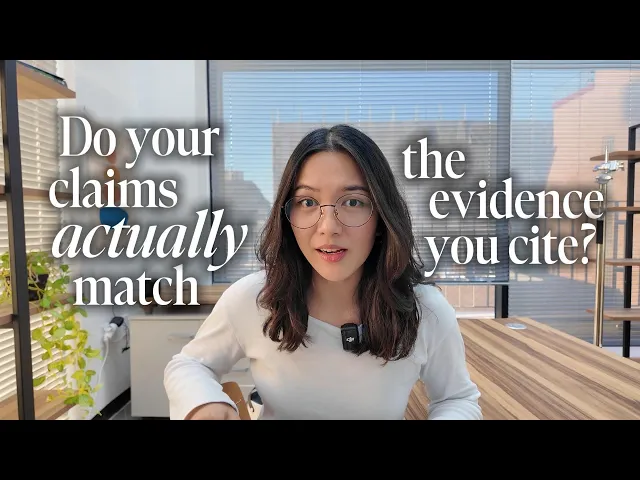
Watch Jenni's AI citation checker verify a real draft, flag weak and unsupported claims, and surface the source passages — in just over a minute.
Built for substance, not just metadata
Other AI citation tools either fabricate references or just format them. Claim Confidence verifies every claim against the source it cites.
Reads the full source
Other AI citation checkers verify metadata — does the paper exist, is the DOI valid, is the author real. Claim Confidence reads the full text of every cited source, so verdicts come from what the paper actually says.
Six verdicts, not pass/fail
A binary "verified" stamp doesn't tell you how to fix a problem. Six categories pinpoint exactly what kind of edit each claim needs.
Suggested rewrites grounded in the source
When a claim falls short, Claim Confidence surfaces the actual passage from the cited source and proposes a rewrite that fits what the source supports.
Your full pre-submission citation review
Peer Review is one of four Review tools that catch issues before reviewers do. Run them together for a complete pre-submission pass.
Peer review8 / 10
Manuscript scored against a peer-review rubric with reviewer comments on each section.
Soundness
3/4
Presentation
4/4
Contribution
3/4
Results
Strengths
Weaknesses
Claim confidence7 issues
Every cited claim verified against its source — sorted into seven verdicts so you know exactly what kind of fix each one needs.
Supported
23Misrepresented
Contradicted
1Unsupported
3Weakly supported
2Overstated
Unverifiable
1Proofread18 edits
Whilst generally sound, the text contains some areas for improvement to comply with academic best practices.
Word choice
AllThe majority of participants reported improved outcomes.
Formality
Yang (2024) found a negative correlation which was interesting..
Grammar
These results indicate that early intervention be effective. appears to be effective.
Transitions
Also, In addition, Jones (2022) found similar results.
Overgeneralized
AllThe majority of participants reported improved outcomes.
The results provesuggest that X has an effect on Y.Tone of voice22 notes
Suggestions across vocabulary, syntax, punctuation, tone and flow to keep a consistent academic voice.
All Suggestions
22Vocabulary
6Syntax
5Punctuation
4Tone
3Flow
4Peer Review
Claim Confidence
Proofread
Tone of Voice


Frequently asked questions
Our users have published papers in 100+ journals
Real research, published in journals such as IEEE, Springer, Elsevier –planned and written in Jenni.