Par
Justin Wong
—
6 exemples d'essais sur la santé mentale (avec des conseils d'écriture)

Justin Wong
Responsable du développement
Diplômé d'un baccalauréat en affaires mondiales et arts numériques, avec une mineure en entrepreneuriat

La santé mentale touche tous les aspects de la vie. Elle façonne la manière dont les gens pensent, ressentent et agissent. Elle influence l’école, le travail, les amitiés et la famille. Écrire sur la santé mentale peut sembler vaste et intense. Faut-il expliquer les causes, décrire les traitements ou raconter une histoire personnelle ? Faut-il utiliser des faits, des exemples ou un mélange des deux ? La plupart des dissertations ont aussi besoin d’une thèse claire pour que les lecteurs comprennent votre idée principale.
Les exemples aident. Voir de vraies dissertations offre une feuille de route claire. Ils montrent comment commencer, quoi inclure et comment conclure. Si vous rédigez un texte pour défendre un meilleur soutien ou un changement de politique, nos exemples percutants de dissertations argumentatives peuvent vous aider à construire un argument fondé sur des preuves. Voici six dissertations modèles sur la santé mentale. Chacune met l’accent sur un angle différent. Servez-vous-en pour élaborer votre propre texte clair, équilibré et agréable à lire.
<ProTip title="📝 Conseil de rédaction :" description="Affinez les grands sujets de santé mentale en points de dissertation ciblés pour rendre votre structure plus facile à gérer" />
6 exemples de dissertations sur la santé mentale
Explorez ces dissertations d’exemple qui abordent la santé mentale de la définition au traitement, en passant par la prévention, les politiques et l’expérience personnelle. Chaque exemple illustre la structure, le ton et la clarté pour inspirer votre rédaction.
Exemple n°1 : Ce que signifie la santé mentale (≈350 mots)
Introduction :
La santé mentale, ce n’est pas seulement ne pas être malade. Elle englobe le bien-être émotionnel, psychologique et social. Elle détermine la manière dont nous gérons le stress, interagissons avec les autres et prenons des décisions. Une définition claire aide les lecteurs à comprendre pourquoi la santé mentale est importante dans la vie quotidienne.
Idée principale :
Au fond, la santé mentale influence l’humeur, la pensée et le comportement. Elle peut évoluer au fil du temps. Une personne peut avoir une bonne santé mentale la plupart du temps et tout de même traverser des difficultés après des événements éprouvants. La santé mentale est aussi influencée par de nombreux facteurs, comme les gènes, les événements de vie et les personnes qui nous entourent.
Points clés :
Bien-être émotionnel : Cela signifie reconnaître et gérer ses émotions. Cela aide les personnes à réagir avec calme face au stress.
Santé psychologique : Elle concerne la manière dont une personne pense et résout les problèmes. Une pensée saine soutient l’apprentissage et le travail.
Bien-être social : Des relations solides apportent du soutien dans les moments difficiles. Elles rendent la vie plus sûre et plus significative.
Pourquoi la distinction est importante :
La santé mentale n’est pas la même chose que la maladie mentale. Le terme maladie mentale désigne des troubles diagnostiqués comme la dépression ou la schizophrénie. Mais une personne vivant avec une maladie mentale peut tout de même mener une vie épanouie avec les bons soins. Dire santé mentale permet de garder l’accent sur le bien-être et les compétences, et non sur les étiquettes.
Exemple pratique :
Pensez à la santé mentale comme à la forme physique. Tout comme les gens peuvent entraîner leur corps, ils peuvent aussi renforcer leur résistance mentale. Des compétences comme la gestion du stress et le maintien du lien avec les autres sont de véritables exercices mentaux. De petites habitudes quotidiennes font une grande différence.
Conclusion :
Une définition claire et simple aide les lecteurs à comprendre le sujet. Elle ouvre la porte à l’étude des causes, de la prévention et des soins. Quand vous rédigez, définissez les termes dès le début. Utilisez des exemples du quotidien pour que les lecteurs puissent s’y reconnaître.
<ProTip title="🌟 Conseil de pro :" description="Commencez vos dissertations par une définition claire et un court exemple pour rendre les idées complexes plus simples." />
Exemple n°2 : Troubles courants de santé mentale et signes (≈350 mots)
Introduction :
Les troubles de santé mentale sont fréquents. Connaître les principaux types et leurs signes aide les personnes à demander de l’aide plus tôt. Cette dissertation propose un bref guide des troubles courants et de leur apparence.
Troubles anxieux : Ils comprennent l’anxiété généralisée, le trouble panique et les phobies. Les signes incluent une inquiétude constante, des troubles du sommeil et des crises de panique.
Troubles dépressifs : Les symptômes incluent de longues périodes de tristesse, une faible énergie, des changements d’appétit et une perte d’intérêt pour les activités.
Trouble bipolaire : Il implique des variations d’humeur allant d’une dépression profonde à une manie élevée. La manie peut inclure une énergie très forte, peu de sommeil et des comportements à risque.
Schizophrénie et psychose : Elles peuvent provoquer des voix entendues, de fausses croyances et des difficultés à distinguer le réel. Une prise en charge précoce aide beaucoup.
Troubles liés à l’usage de substances : L’usage problématique d’alcool ou de drogues coexiste souvent avec d’autres problèmes de santé mentale.
Troubles du neurodéveloppement et troubles alimentaires : Le TDAH et les troubles alimentaires commencent souvent pendant l’enfance ou l’adolescence et affectent la vie quotidienne.
Comment repérer un problème :
Observez les changements de comportement ou de routine. Remarquez les variations de sommeil, d’appétit, de travail scolaire ou de vie sociale. Si les difficultés durent plus de deux semaines et perturbent les tâches quotidiennes, il est temps de demander de l’aide.
Pourquoi une aide précoce est importante :
Un soutien précoce réduit les dommages à long terme. La thérapie et des outils simples peuvent empêcher les symptômes de s’aggraver. Les amis et la famille jouent un rôle essentiel pour remarquer les changements et offrir de l’aide.
Conclusion :
Quand vous écrivez sur les troubles, gardez un langage simple. Évitez les mots effrayants ou trop techniques. Expliquez les signes clairement afin que les lecteurs sachent quand demander de l’aide. Proposez des prochaines étapes précises, comme parler à un médecin ou appeler une ligne d’assistance locale.
<ProTip title="🔎 Conseil de pro :" description="Listez des signes clairs et des prochaines étapes simples pour aider les lecteurs à agir s’ils ou si quelqu’un d’autre a besoin de soutien." />
Exemple n°3 : Causes et facteurs de risque (≈350 mots)
Introduction :
La santé mentale résulte de nombreux éléments qui agissent ensemble. La biologie, les événements de vie et l’environnement jouent tous un rôle. Cette dissertation explique les causes courantes en termes simples.
Facteurs biologiques :
Les gènes et la chimie du cerveau comptent. Certaines personnes héritent d’un risque plus élevé pour certains troubles. Une maladie physique, une blessure ou des changements hormonaux peuvent influencer l’humeur et la pensée.
Facteurs psychologiques :
Les expériences précoces façonnent les compétences d’adaptation. Les traumatismes, les pertes ou le harcèlement peuvent augmenter le risque de problèmes durables. La manière dont une personne a appris à gérer le stress joue aussi un rôle.
Facteurs sociaux et environnementaux :
La communauté, la famille et le travail d’une personne influencent sa santé mentale. La pauvreté prolongée, l’isolement ou la discrimination augmentent le risque. Un logement sûr et un emploi stable le réduisent.
Événements de vie et déclencheurs :
De grands changements comme une rupture, une perte d’emploi ou le décès d’un être cher peuvent déclencher une détresse. Même des changements positifs, comme un déménagement pour un emploi de rêve, peuvent être stressants.
Pourquoi les causes interagissent :
La plupart des difficultés naissent de la combinaison de plusieurs petits facteurs. Par exemple, un risque génétique ajouté à un événement stressant peut mener à la dépression. Voir les causes comme des couches aide à éviter de tout attribuer à une seule raison.
Comment rédiger cette partie :
Utilisez de courts paragraphes et des exemples. Évitez le jargon technique. Offrez de l’espoir : de nombreuses causes peuvent être traitées ou prises en charge. Orientez les lecteurs vers du soutien et des stratégies d’adaptation simples.
Conclusion :
Expliquer les causes aide les lecteurs à comprendre le risque et à réduire la culpabilisation. Cela favorise une vision plus bienveillante de la santé mentale et des mesures de prévention claires.
<ProTip title="🧩 Conseil de pro :" description="Utilisez une courte liste pour montrer les causes biologiques, psychologiques et sociales afin que les lecteurs suivent facilement." />
Exemple n°4 : Prévention et auto-soins au quotidien (≈350 mots)
Introduction :
La prévention consiste à créer des habitudes et des soutiens qui protègent la santé mentale. De bonnes routines quotidiennes, des liens sociaux sûrs et une aide précoce font énormément. Cette dissertation présente des moyens pratiques de prévenir les difficultés et de rester en forme.
Habitudes quotidiennes utiles :
Sommeil : Essayez de garder une routine de sommeil régulière. Le manque de sommeil augmente le stress et les problèmes d’humeur.
Bougez votre corps : L’exercice améliore l’humeur et réduit les inquiétudes. Même de courtes promenades aident.
Mangez équilibré : Des repas équilibrés soutiennent la santé du cerveau. De petits changements, comme ajouter des fruits et des légumes, comptent vraiment.
Limitez les écrans : Trop de réseaux sociaux peut augmenter l’anxiété. Fixez des limites simples pour le temps d’écran.
Compétences à pratiquer :
Pleine conscience et respiration : Elles réduisent le stress immédiat. Faites de courtes pauses respiratoires dans la journée.
Résolution de problèmes : Découpez les gros problèmes en petites tâches. Accomplir une petite étape peut améliorer l’humeur.
Soutien social : Gardez le contact avec vos amis et votre famille. Demandez de l’aide quand vous en avez besoin.
Programmes communautaires et scolaires :
Les écoles peuvent enseigner les compétences émotionnelles. Les lieux de travail peuvent proposer des services de conseil et des horaires flexibles. Les centres communautaires peuvent organiser des groupes de soutien et des espaces sécurisés.
Action précoce :
Repérer les signes tôt permet d’obtenir de l’aide rapidement. Un échange avec un conseiller ou un médecin généraliste est souvent la première étape. Une thérapie simple peut prévenir des problèmes plus graves par la suite.
Conclusion :
La prévention n’a pas besoin d’être parfaite. De petites habitudes régulières s’additionnent. Encouragez les lecteurs à choisir une habitude et à l’essayer pendant un mois. Ce changement peut mener à une vraie amélioration.
<ProTip title="🌿 Conseil de pro :" description="Quand vous rédigez des conseils de prévention, donnez aux lecteurs une petite action qu’ils peuvent essayer cette semaine." />
Exemple n°5 : Options de traitement et soutien (≈350 mots)
Introduction :
Lorsqu’une personne a besoin d’aide, de nombreuses options sûres et efficaces existent. Cette dissertation présente les traitements courants dans un langage clair. L’objectif est de réduire la peur et d’indiquer une voie à suivre.
Thérapies par la parole :
Thérapie cognitivo-comportementale (TCC) : Elle aide à modifier les pensées et les comportements peu utiles. Elle est courte et concrète.
Conseil psychologique : Un conseiller formé écoute et aide à trouver des moyens d’adaptation. Cela fonctionne bien pour le stress et les changements de vie.
Thérapie familiale et de groupe : Elles impliquent des proches ou des pairs et peuvent améliorer le soutien et la compréhension.
Médicaments :
Les médecins peuvent prescrire des médicaments contre la dépression, l’anxiété ou la psychose. Les médicaments peuvent rééquilibrer la chimie du cerveau. Ils fonctionnent mieux avec une thérapie et un suivi.
Soutien communautaire et entre pairs :
Les groupes de soutien et les aidants pairs offrent une expérience partagée. Ils réduisent la solitude. Les pairs peuvent montrer des étapes concrètes de rétablissement et donner de l’espoir.
Prise en charge de crise :
Les lignes de crise, les services d’urgence et les équipes mobiles de crise aident en cas de danger immédiat. Connaissez les numéros d’urgence et les coordonnées des lignes d’assistance locales.
Outils numériques :
Les applications et le conseil en ligne peuvent rendre l’aide plus accessible. Ils conviennent à beaucoup de personnes, mais ne remplacent pas les soins en personne quand ils sont le plus nécessaires.
Freins et solutions :
Les freins incluent le coût, la stigmatisation et le manque de professionnels. Les solutions incluent le financement public, la télésanté et la formation de davantage de conseillers. De simples mesures politiques peuvent élargir l’accès.
Conclusion :
Quand vous écrivez sur le traitement, soyez clair et calme. Dites que la thérapie et les médicaments sont des outils, pas des étiquettes. Proposez des prochaines étapes faciles, comme appeler une clinique ou consulter un médecin de confiance.
<ProTip title="📞 Conseil de pro :" description="Mentionnez des premières étapes précises que les lecteurs peuvent suivre, comme contacter une clinique locale ou une ligne d’assistance." />
Exemple n°6 : Témoignages personnels et rétablissement (≈350 mots)
Introduction :
Les témoignages personnels rendent la santé mentale concrète. Le rétablissement est un mot que beaucoup de personnes utilisent pour décrire le fait de vivre bien après une épreuve. Cette dissertation montre comment raconter une histoire personnelle avec soin et respect.
Pourquoi les histoires comptent :
Les récits réduisent la stigmatisation. Ils montrent que l’aide fonctionne et que le rétablissement est possible. Ils enseignent aussi aux lecteurs à quoi s’attendre des soins.
Comment structurer un récit :
Commencez par un moment : Ouvrez sur une scène ou une émotion claire — des techniques comme celles de nos exemples de dissertations descriptives peuvent vous aider à montrer les émotions sans trop expliquer. Cela capte le lecteur.
Décrivez la difficulté : Dites ce qui s’est passé et comment cela a affecté la vie quotidienne. Gardez des détails courts et pertinents.
Partagez le tournant : Racontez le moment où l’aide a été recherchée ou où une petite victoire a eu lieu.
Expliquez la suite : Décrivez la thérapie, les habitudes, le soutien et les rechutes. Le rétablissement n’est presque jamais linéaire.
Terminez avec de l’espoir et une leçon simple : Concluez en nommant un conseil concret qui a aidé.
Conseils pour partager en sécurité :
Évitez les détails graphiques sur l’automutilation.
Utilisez des avertissements de contenu si nécessaire.
Concentrez-vous sur les compétences d’adaptation et les ressources.
Respectez la vie privée des autres personnes mentionnées.
Exemple (court) :
« J’ai manqué l’école pendant deux semaines après le début de mes crises de panique. Un ami m’a aidé à appeler un conseiller. J’ai appris des exercices de respiration et comment répartir ma journée. J’ai encore des jours difficiles, mais je sais maintenant vers qui me tourner. »
Conclusion :
Les dissertations personnelles doivent équilibrer honnêteté et sécurité. Visez à informer et à inspirer les lecteurs à demander de l’aide s’ils en ont besoin.
<ProTip title="🧡 Conseil de pro :" description="Lorsque vous partagez des histoires de rétablissement, ajoutez une brève liste de ressources ou une ligne d’assistance à la fin pour aider les lecteurs à passer à l’action." />
Comment rédiger une dissertation sur la santé mentale avec Jenni
Écrire sur la santé mentale n’a pas à être difficile. Jenni vous aide à transformer rapidement vos idées en une dissertation claire. Suivez ces étapes :
Étape 1 : Démarrer un nouveau document
Rendez-vous sur Jenni.ai et cliquez sur Start Writing sur la page d’accueil. Si vous êtes déjà connecté, choisissez New Document pour ouvrir un espace de travail vierge.

Étape 2 : Commencer avec une consigne
Dans votre nouveau document, cliquez sur Start with a Prompt.
Utilisez une consigne ciblée de plan uniquement, par exemple :
« Créez un plan qui explique les principales causes de la dépression chez les adolescents et propose des mesures de prévention en milieu scolaire. »
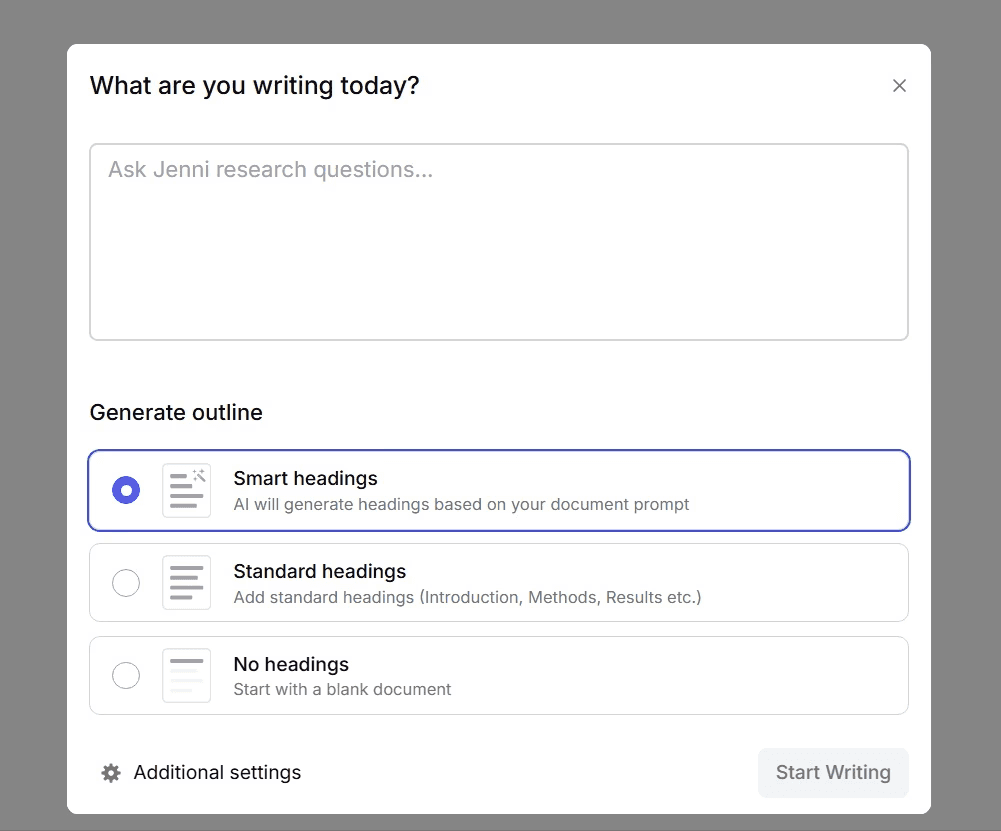
Jenni générera un plan structuré avec des titres et des transitions clairs.
Choisir une consigne de plan solide vous aide à :
Définir une direction claire
Éviter les sujets trop vastes
Construire une progression propre et logique
Étape 3 : Laissez Jenni commencer à écrire
Cliquez sur Start Writing.
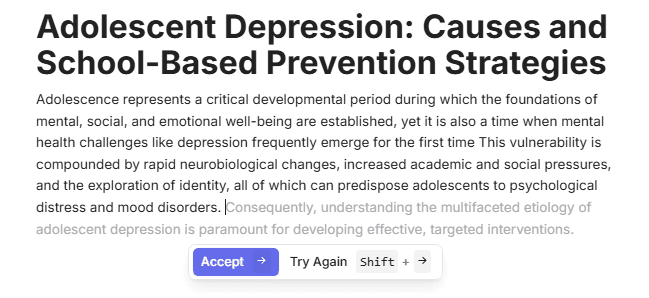
Jenni commencera à remplir votre plan avec des paragraphes, des explications et des transitions basés sur votre structure.
Servez-vous de cette étape pour :
Ajouter des exemples personnels ou des recherches
Développer ou réorganiser des sections
Ajuster le plan pour qu’il corresponde à votre voix
Étape 4 : Gardez l’élan
Passez en revue les suggestions dans l’éditeur. Cliquez sur Accept pour conserver une suggestion ou sur Try Again pour obtenir une autre version.
Vous pouvez continuer à écrire avec votre propre style à tout moment.
Sensibilisation à la santé mentale
La santé mentale est un sujet vaste. Ces six exemples de dissertations offrent différentes façons de l’aborder. Chaque modèle montre une introduction claire, un développement solide et une conclusion porteuse d’espoir. Utilisez des sections courtes, des mots simples et une action pratique pour les lecteurs.
<CTA title="Commencez votre dissertation sur la santé mentale maintenant" description="Créez en quelques minutes une dissertation claire et bienveillante sur la santé mentale avec Jenni." buttonLabel="Essayez Jenni gratuitement" link="https://app.jenni.ai/register" />
Écrire sur la santé mentale doit être clair et bienveillant. Visez à informer et à guider. Proposez des ressources et de petites actions que les gens peuvent entreprendre immédiatement. Avec cette approche, votre dissertation aidera les lecteurs à comprendre et à agir.