By
Justin Wong
—
Thesis vs Research Article: Key Differences Explained

Justin Wong
Head of Growth
Graduated with a Bachelor's in Global Business & Digital Arts, Minor in Entrepreneurship

A thesis and a research article can report exactly the same study and still be almost entirely different documents. The reason is that they are built for different jobs. A thesis is assessed. An article is used.
Everything else follows from that: who reads it, how long it runs, how much method detail belongs in it, and who has the power to reject it.
<CTA title="Write for the Reader You Actually Have" description="Jenni helps you structure documents for the audience that will judge them" buttonLabel="Try Jenni Free" link="https://app.jenni.ai/register" />
The Six Differences That Matter
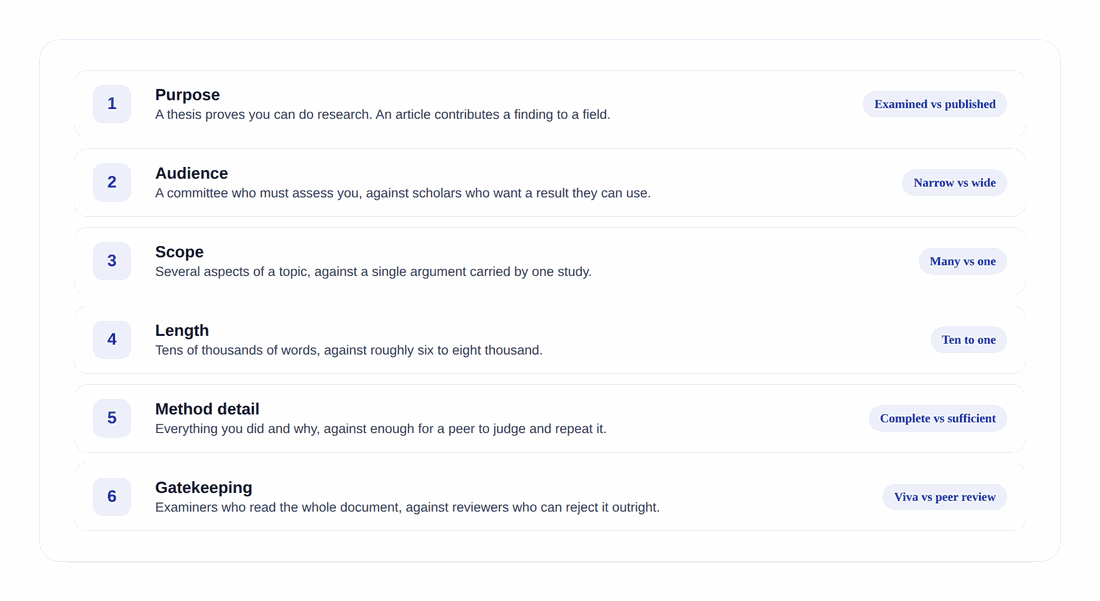
Purpose. A thesis proves you can do research to a required standard. An article contributes a finding to a field. The first is about you, the second is about the result.
Audience. A committee who must assess you, against scholars who want a result they can use. The University of Toronto's research guide puts it directly: the audience for a thesis is your committee, whereas an article may be read by fellow researchers, professionals, policymakers, educators, or a general audience, and your manuscript will need to be modified accordingly.
Scope. The Chicago School's library guide summarizes it as several aspects of a topic discussed in a dissertation, against a single aspect of a topic in an article. An article is organized around one central message.
Length. Roughly ten to one. The same guide gives approximate maxima of 20,000 words for a dissertation and 8,000 for a journal article; the Open University describes theses of up to 100,000 words becoming articles of about 6,000. The exact figures vary by discipline and by degree, but the order of magnitude does not.
Method detail. A thesis explains everything you did and why you chose it, because your judgment is being examined. An article gives enough for a peer to evaluate and repeat the work. Justification aimed at examiners is the first thing to go.
Gatekeeping. Examiners read the whole document and can require corrections. Reviewers can reject it outright, often having read the abstract and the figures first. That difference in power shapes how each document has to open.
Side by Side
Thesis or dissertation | Research article | |
Assessed by | Examiners, often with a viva | Peer reviewers and an editor |
Typical length | Tens of thousands of words | Roughly 6,000 to 8,000 words |
Arguments carried | Several, across chapters | One |
Literature review | One or more full chapters | A few paragraphs positioning this study |
Authorship | You, alone | Usually a team, with authorship order that has to be agreed |
Outcome | A degree, and a deposit in a repository | A citable contribution to the literature |
Reflection | Often expected | Rarely welcome |
<ProTip title="👥 Authorship:" description="Agree author order with your supervisor before you write the article, not after. A thesis has one author by definition and an article usually does not, and that conversation is much easier before the work than after it" />
<ProTip title="🔬 Method detail:" description="Ask of every methodological sentence whether it helps a peer repeat the study or whether it was there to prove to an examiner that you had considered the alternatives. Only the first kind belongs in an article" />
The Structural Differences Nobody Warns You About

The abstract does different work. A thesis abstract summarizes a document. An article abstract is a screening device: it decides whether an editor sends the paper out and whether a researcher reads further. It has to carry the finding, not describe the study.
The introduction inverts. A thesis introduction sets up a project, often over many pages. An article introduction narrows from a field to a gap to a contribution, usually inside 800 words, and gives the contribution away early rather than saving it.
Limitations move. In a thesis, extensive limitations demonstrate self-awareness and earn credit. In an article, they are necessary but brief, and a limitations section that undermines the contribution invites rejection. Say what constrains the claim, not everything that could have gone better.
Reflexivity may not survive. Depending on the field and the journal, the reflective voice many thesis programs require has no home in an article at all.
One Thing They Share
Both are examined by people who will check. A thesis is scrutinized by examiners who read every page, and an article by reviewers chosen for knowing the literature you cite. In both, a misrepresented source or a claim stronger than its evidence does more damage than any amount of clumsy prose.
<ProTip title="🎯 One message:" description="Write the single sentence your article proves before you draft it. If your thesis produces three such sentences, that is three papers, and trying to fit them into one is the most common reason a converted chapter gets rejected" />
<ProTip title="📰 Abstract first:" description="Rewrite the abstract before anything else when moving to an article. It forces you to name the single finding, and once you have that sentence the rest of the cutting becomes obvious" />
Which One Are You Writing?
If the answer is a thesis, write for examiners: demonstrate judgment, defend your choices, and show the working. If it is an article, write for a reader who is deciding within thirty seconds whether to continue: lead with the contribution, keep one argument, and cut everything that was there to prove you were being careful.
<CTA title="Write the Version the Reader Needs" description="Structure, draft, and cite for the audience that will actually judge the document" buttonLabel="Try Jenni Free" link="https://app.jenni.ai/register" />
If you are moving from one to the other, the companion piece on converting a thesis into a research paper covers the conversion sequence, the prior publication question, and what COPE says about reusing your own text. Both rest on the same foundations: knowing what each part of a document does and keeping every claim inside what your sources support.