By
Justin Wong
—
The PhD Survival Guide: How to Plan, Write and Actually Finish Your Thesis

Justin Wong
Head of Growth
Graduated with a Bachelor's in Global Business & Digital Arts, Minor in Entrepreneurship

In the Council of Graduate Schools PhD Completion Project, only 56.6% of doctoral candidates had finished 10 years after starting. A PhD is a long research project with a book-length argument at the end, and talent alone does not keep it on track.
This PhD survival guide turns that project into 10 habits you can start this week, from planning backwards to preparing for the viva. The checklist at the end puts all of them on one page.
<CTA title="Keep your papers next to your draft" description="Jenni keeps your library, your PDFs and your chapters in one workspace, so the source you need is a click away from the sentence you are writing." buttonLabel="Try Jenni Free" link="https://app.jenni.ai/register" />
How do you survive a PhD?
Treat it as a long project rather than a test of intelligence. These 10 steps cover the habits that keep one moving:
Treat your thesis as one argument
Plan backwards from the thesis
Turn the PhD into small outputs
Give your PhD one home
Read with a question, not a highlighter
Write before you feel ready
Run supervision like a working meeting
Plan for the research to go wrong
Protect deep work and time off
Finish, then prepare to defend
For a first-hand account of a whole PhD, Andrej Karpathy's A Survival Guide to a PhD is a good companion read.
Step 1: Treat your thesis as one argument
A thesis is one long argument. It names something the field does not understand well enough, shows how you investigated it, reports what you found and says what that adds.
Every chapter has a job inside that argument. The literature review shows what is known and where the gap sits, and the methodology explains how the question was investigated.
The results report the evidence, and the discussion says what it means and where it stops. The conclusion states what the thesis adds to the field.
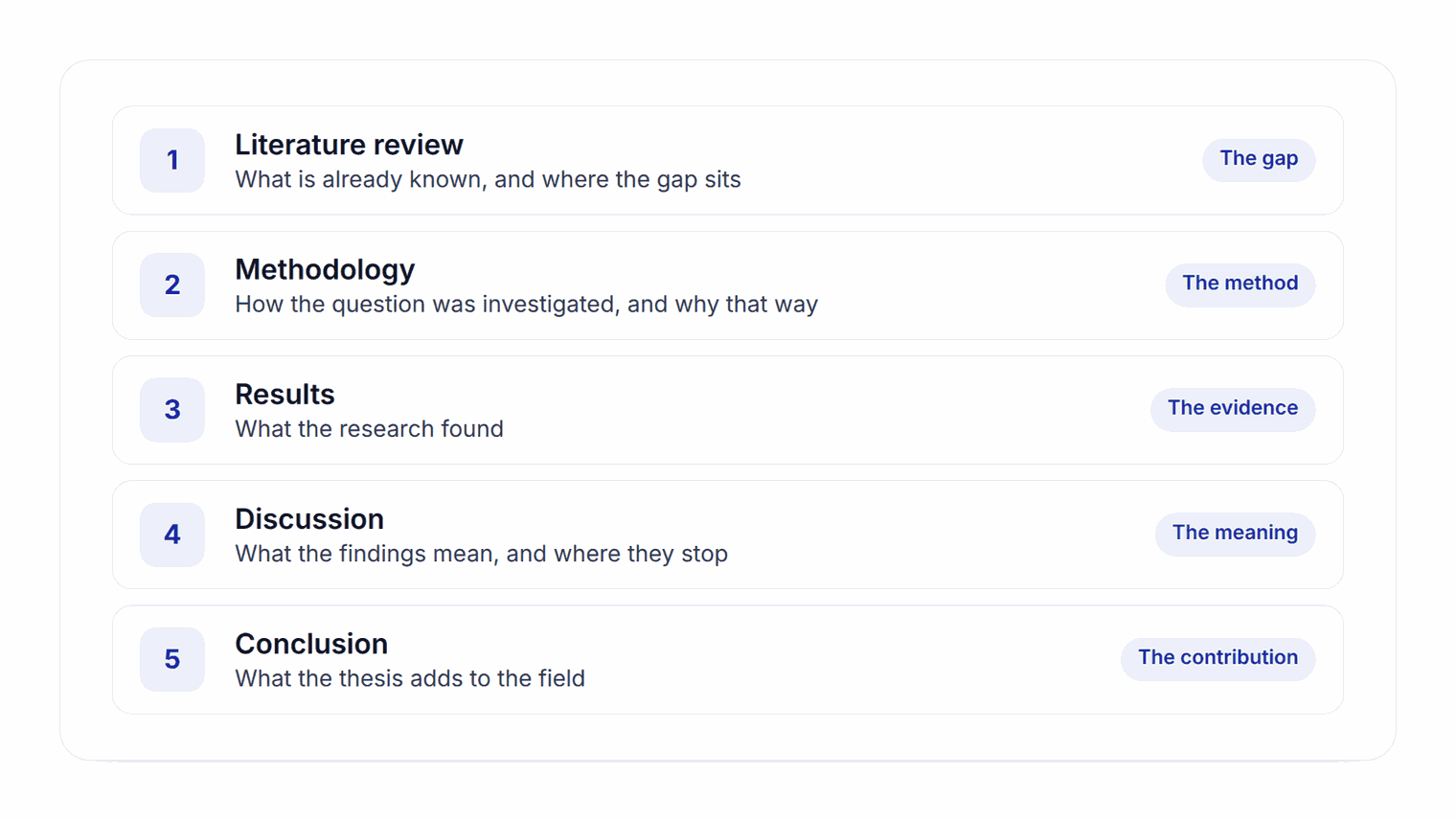
Once that is clear, the PhD stops being a pile of tasks. Each piece of work either moves the argument forward or it can wait. The thesis structure guide shows how the chapters fit together.
<ProTip title="💡 Pro Tip:" description="After every major finding, ask so what, then why it matters, then what it adds to existing knowledge. Those three answers turn a description into analysis." />
Step 2: Plan backwards from the thesis
Before the first literature search, sketch the thesis you expect to submit. The answers will change, and that is normal. A first plan is a map of the route, not a contract.

Start with five questions:
What is the central research question?
What problem does it address?
What is missing from the existing literature?
What will the research contribute?
What are the likely chapters, and what does each one need to show?
If the question is still fuzzy, how to write a research question walks through tightening it. For the third question, see how to identify research gaps.
Come back to these answers every few months. A changed research question is a reason to update the plan, not a sign the plan failed.
Step 3: Turn the PhD into small outputs
“Do the PhD” is not a task, and neither is “work on Chapter 2”. Tasks that big have no obvious first step, so they are easy to put off.
Turn each one into an output you could finish in a sitting:
Vague task | Concrete output |
Work on Chapter 2 | Draft 750 words comparing studies A and B |
Do the reading | Identify three theoretical approaches to your topic |
Do the analysis | Analyse 20 interviews |
Write the methods | Write 400 words on why you chose this method |
Sort out the figures | Create Figure 4 |
End every planning session with a verb and an output, never with “work on X”. Small outputs also make progress visible, which matters in the weeks when nothing seems to move.
Step 4: Give your PhD one home
Your PhD needs one place where everything lives. The exact software matters less than using the same system every time for:
papers and reading notes
data and analysis
chapters, references and presentations
admin and deadlines
You should be able to answer two questions in under a minute:
Where is the latest version of this?
Why did you make this decision six months ago?
The second question is why a research diary matters. Note down:
what you did and what you found
decisions, with the date and one line on why
problems, ideas and changes of method
questions for your supervisor
Keep a done list next to it. When it feels like nothing has moved for months, the list shows what has.
In Jenni - the Library sits next to the draft. Papers live in collections, each entry showing its journal and impact factor, with a Cite button beside it.

The Jenni Library open beside a draft, showing a Chapter 2 collection with impact factor and open access badges.
For a system worth copying, see how to organize sources for a literature review.
<ProTip title="📌 Remember:" description="Log every big decision with the date and one line on why. In six months it will be the fastest answer for a supervisor or examiner who asks." />
Step 5: Read with a question, not a highlighter
Trying to read everything is an easy way to lose months. Read to answer five questions about the field:
What is already known?
What is not known yet?
Where do researchers disagree?
What assumptions are being made?
Where does your research fit?
Highlighting can feel like progress. A 2021 meta-analysis of 242 studies compared 10 learning techniques. Underlining and summarising came out least effective, though still helpful, while practice testing and distributed practice came out on top.
Work through the literature in stages instead:
Stage | What you do |
Search | Run your search terms and save anything that looks relevant |
Screen | Keep only what answers your question, judging by title and abstract |
Read | Read the papers that pass in full |
Extract | Note the question, method, findings and limitations |
Organise | Group papers by theme, method or position |
Compare | Put studies side by side and mark where they agree and conflict |
Synthesise | Turn the comparison into claims about the field |
Write | Draft the argument, citing as you go |
A literature review matrix keeps those notes comparable from paper to paper. A literature review is not a list of papers. It is an argument about the state of knowledge.
In Jenni - AI Chat can read an open PDF with you. Ask what the authors list as limitations, and the answer quotes the paper and cites it after each point.

AI Chat in Jenni listing the limitations of an open meta-analysis, quoting the paper and citing it after each point.
<ProTip title="✅ Quick check:" description="At the end of each day, ask what exists now that did not exist this morning. Reading counts when it produces something, such as notes in your matrix, a new figure or 300 words." />
Step 6: Write before you feel ready
Writing is part of the research, not the last stage of it. Explaining an idea in full sentences is how you find the gaps and contradictions in it.
Leave placeholders and keep going
Write early, and let it be rough. When something is missing, mark it and move on:
[NEED SOURCE]
[EXPLAIN THIS]
[CHECK DATA]
[COME BACK TO THIS]
Placeholders let you write in the order the ideas come, and a quick search finds every one of them later.
Give every section a job
Before writing a section, put one sentence at the top saying what it has to do. For example:
Section 3.2 shows that the sampling method fits the research question.
Inside the section, each paragraph should make a claim, back it with evidence, explain the evidence and say why it matters.
Draft now, polish later
Perfectionism can pass for high standards. If a paragraph nobody else has read has taken three days, ask whether it needs to be excellent now or simply needs to exist.
Take one pass at a time, in this order:
Draft → Structure → Argument → Evidence → Edit → Polish
A first draft only has to give you something to improve.
In Jenni - put the cursor at a [NEED SOURCE] and press Cite. A citation search opens right there, with suggested papers listed under the sentence.

Cite opened at a [NEED SOURCE] placeholder in a rough Jenni draft, with suggested papers listed under the sentence.
Step 7: Run supervision like a working meeting
Arrive with an agenda, not a general update. Your supervisor brings expertise, challenge and perspective, but you own the project.
What should you bring to a supervision meeting?
Use five headings:
Done - what you completed, analysed or drafted since last time
Learned - what you found, including problems
Stuck on - what you cannot explain or decide yet
Need - the advice, feedback or decision you want from the meeting
Next - what you will finish, and by when
Send it a day ahead. The meeting can then start with decisions instead of a status report.
Step 8: Plan for the research to go wrong
Something will probably fail. That is research, not proof that you cannot do a PhD. Common examples:
a dataset you counted on is not available
an experiment does not work
participants do not respond
the original hypothesis does not hold
a paper gets rejected

For each risky step, write down a Plan B before you need it. Then tell your supervisor early when something slips. A small problem raised now is easier to fix than a big one hidden for six months.
Uncertainty is part of the job. You are studying something nobody has answered yet, so the aim is to reduce it step by step, not to remove it on day one.
<ProTip title="⚠️ Caution:" description="Do not wait for a fix before you report a problem. A supervisor who hears about it early can help you plan around it." />
Step 9: Protect deep work and time off
Not all PhD work needs the same kind of attention. Some of it needs long, unbroken focus, and some fits between meetings.
Deep work | Shallow work |
Writing | |
Analysis | Admin |
Coding | Formatting |
Reading difficult theory | Routine meetings |
Block deep work first, at the time of day you think best, and fit the shallow work around it.
Watch the productivity trap too. Conferences, committees and teaching can all be worth doing, but each one takes hours from the thesis. Ask whether it helps your research or career enough to justify them.
In Jenni - reference formatting stops being a task. The reference list builds itself from your citations, and the style is one setting: APA, Chicago, Harvard, IEEE, MLA or any of 10,000+ styles from the search.

A reference list in Jenni, formatted in APA 7th, with the style picker in its header.
Protect time off the same way. In Nature's 2019 survey of more than 6,300 PhD students, 36% had sought help for anxiety or depression caused by their studies.
Sleep, exercise, see people and take real holidays. If the pressure keeps building, your university's counselling or student support service is the right place to start.
<ProTip title="⏳ Timing:" description="Put your deep work blocks in the calendar before the week starts and treat them like supervision meetings. Shallow work fills whatever time is left." />
Step 10: Finish, then prepare to defend
The question you ask changes over a PhD:
Early on - what could you investigate?
In the middle - what does the evidence show?
In the final year - what has to be in the thesis for you to submit?
New ideas will keep arriving right up to submission. Learn to tell “this would improve the thesis” from “this would take another two years”.

When is a PhD finished?
When the research question has been answered well enough and the contribution is clear. It is not finished when every interesting question has been explored.
Prepare for the viva before the viva
By the end, you should be able to explain the thesis without opening it. That means knowing:
the research question and the central argument
the contribution
the methods and the key decisions behind them
the main findings and their limitations
what you would change, and what should come next
Practise explaining it at three lengths:
One sentence - the question and the answer
One minute - add how you found it
Five minutes - add what it means and where it stops
The Jenni guide to preparing for your thesis defense covers the run-up, and the UK Council for Graduate Education publishes a viva guide for doctoral candidates.
The PhD survival checklist
Save it, print it, or send it to someone starting their PhD.

State your argument - write the thesis argument in two sentences
Plan backwards - list the chapters and what each one must show
Shrink every task - end each planning session with a verb and an output
Give it one home - keep papers, notes, data and drafts in one system
Read with a question - record the method, findings and limits of every key paper
Write every week - leave placeholders where the gaps are and keep going
Run your supervisions - send an agenda before every meeting
Have a Plan B - write one for your riskiest step before you need it
Guard your time - block deep work first and protect your days off
Rehearse the viva - explain the thesis in one sentence, one minute and five minutes
Keep the PhD moving
A PhD rarely goes to plan. The research question will probably shift, and so will the methods and the chapters. Most weeks bring no breakthrough, only the next piece of work.
Surviving it does not mean always knowing what to do. It means you can still pick the next small output when you do not, and finish it.
<CTA title="Draft rough, cite as you go" description="Leave the placeholder, press Cite and pick the paper. Jenni inserts the citation and builds the reference list in the style you choose." buttonLabel="Try Jenni Free" link="https://app.jenni.ai/register" />
Start with Step 3 today. Pick the vaguest task on your list and rewrite it as a verb and an output.