By
Nathan Auyeung
—
Naturalistic Observation for Research: Methods and Examples

Nathan Auyeung
Senior Accountant at EY
Graduated with a Bachelor's in Accounting, completed a Postgraduate Diploma of Accounting
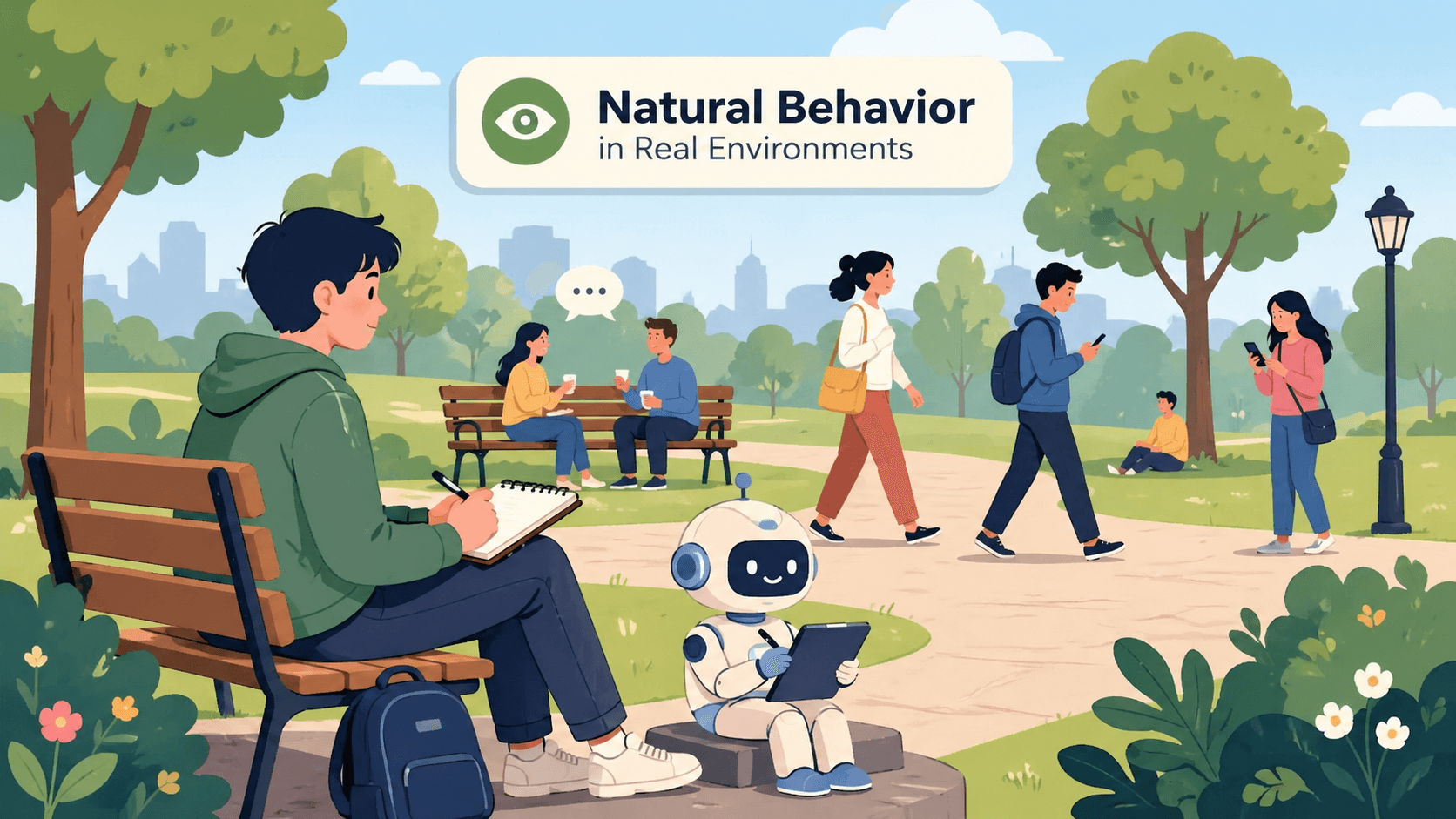
Naturalistic observation studies how people behave in their everyday environments, without researchers interfering. According to American Psychological Association (APA) guidelines on observational research, studying behavior in natural settings improves ecological validity because it reflects real-world conditions rather than controlled environments.
This article explains the method's process, when it's useful, and how to do it well. We'll cover its advantages, drawbacks, and reliable data collection techniques. Read on for the full guide.
<CTA title="Plan Strong Observation Studies" description="Structure observation methods and research notes with guided writing and clear frameworks" buttonLabel="Try Jenni Free" link="https://app.jenni.ai/register" />
What Is Naturalistic Observation in Research
Naturalistic observation means watching how people or animals act in their usual surroundings, without changing anything. It's a core part of qualitative vs quantitative research and gathering qualitative data.
The point is to see events unfold naturally, not to set up an experiment. Researchers just document what happens.
The National Institutes of Health notes that these studies are often the first step. They spot patterns that later get tested in controlled experiments.
This method is fundamental for ethnographic research, field observation, and studying social behavior. The goal is to grasp the whole picture of a situation, not just pieces of it.
For a comprehensive overview of how this fits into your study design, you can explore this guide to naturalistic observation.
<ProTip title="💡 Pro Tip:" description="Use naturalistic observation to explore behavior before designing experiments" />
Core Types of Naturalistic Observation
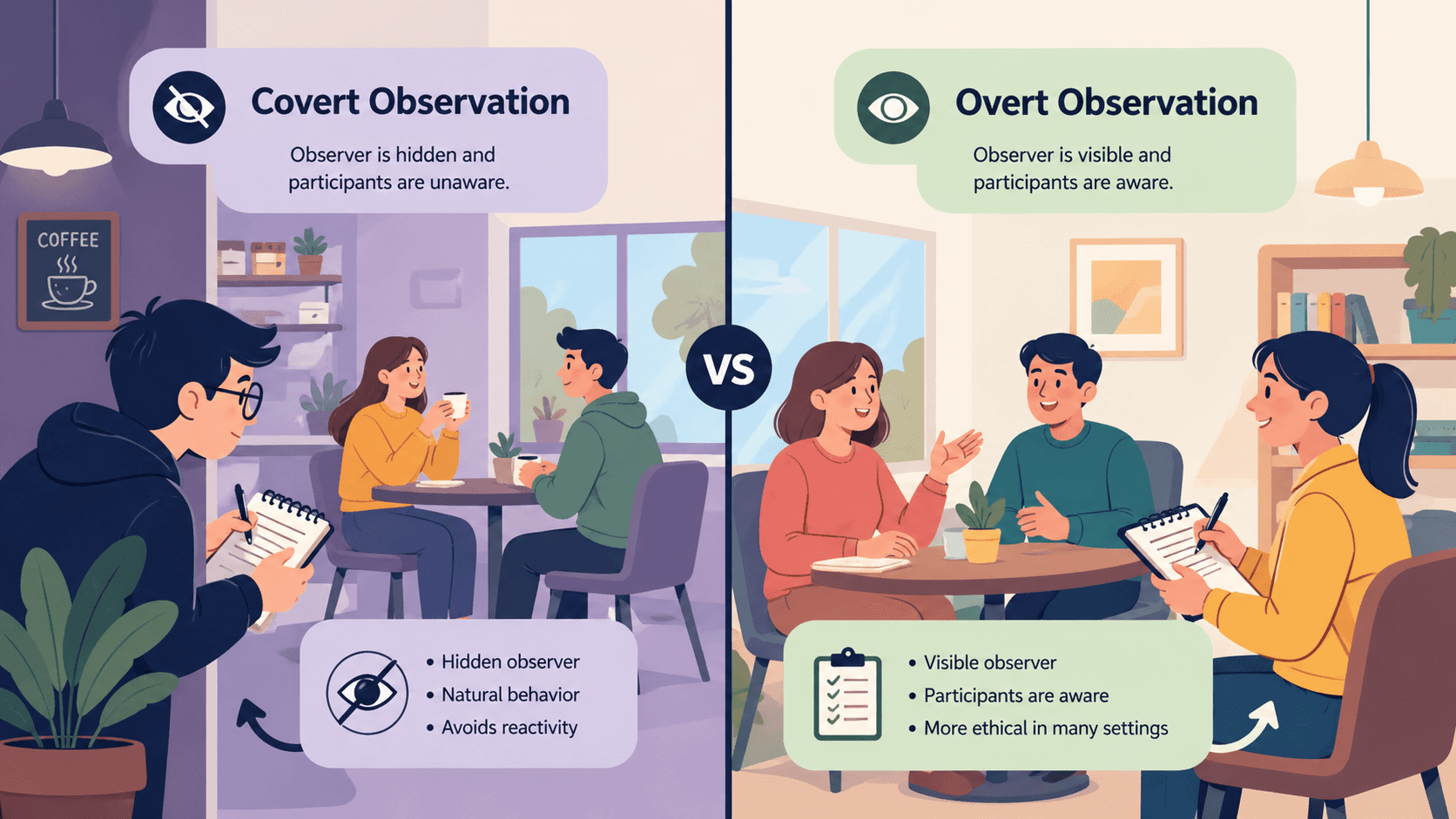
Researchers can choose from several observation styles depending on their research goals, setting, and ethical requirements. The main differences involve whether participants know they're being watched and how involved the researcher becomes in the group.
Researchers use different styles of observation. The main differences are how much they talk to the people they're watching, and whether those people know they're part of a study.
The choice you make here shapes both the quality of your data and the ethical questions around it.
Covert vs. Overt Observation
Covert observation happens when the people being studied don't know a researcher is present. This avoids the "Hawthorne effect," where people act differently because they know they're being watched.
Overt observation is the opposite, the participants are aware of the observer. This is usually mandatory in places like hospitals or schools.
For instance, watching customers in a mall without telling them is covert. Observing a classroom with the teacher's permission is overt.
Participant vs. Non-Participant Observation
In participant observation, the researcher joins the group. This can lead to a richer understanding, but it also means the researcher's own presence might influence things.
In non-participant observation, the researcher stays on the outside, just watching and recording.
Think of it this way: participant observation is like playing on the team to learn its inner workings. Non-participant observation is like studying the game from the stands.
Both of these approaches are common in anthropology and sociology and are often dictated by the broader research paradigms a scientist follows.
How Naturalistic Observation Works in Practice
To work in practice, naturalistic observation needs a clear plan and a system for recording information. Without that structure, your notes are just stories, not useful data.
A Step-by-Step Process
A solid observational study usually follows these steps:
Define your research question.
Pick your setting and who you'll watch.
Decide on your observation type (like covert or participant).
Set up your method for recording data.
Analyze what you've collected.
This basic framework works whether you're studying a classroom, a workplace, or how people shop.
Recording the Data
Getting the details right is everything. Researchers often use a mix of tools, but the key is consistency. A simple observation sheet can make your data far more reliable.
Example (Retail Behavior Study):
Time: 14:05
Subject: Male, ~30
Action: Picks up product → reads label → returns item
Duration: 12 seconds
Context: No staff interaction
Two common approaches:
Event sampling: Record specific behaviors when they occur
Time sampling: Record what happens at fixed time intervals
Using a structured format like this makes your observations easier to compare and analyze.
Structured vs. Unstructured Observation
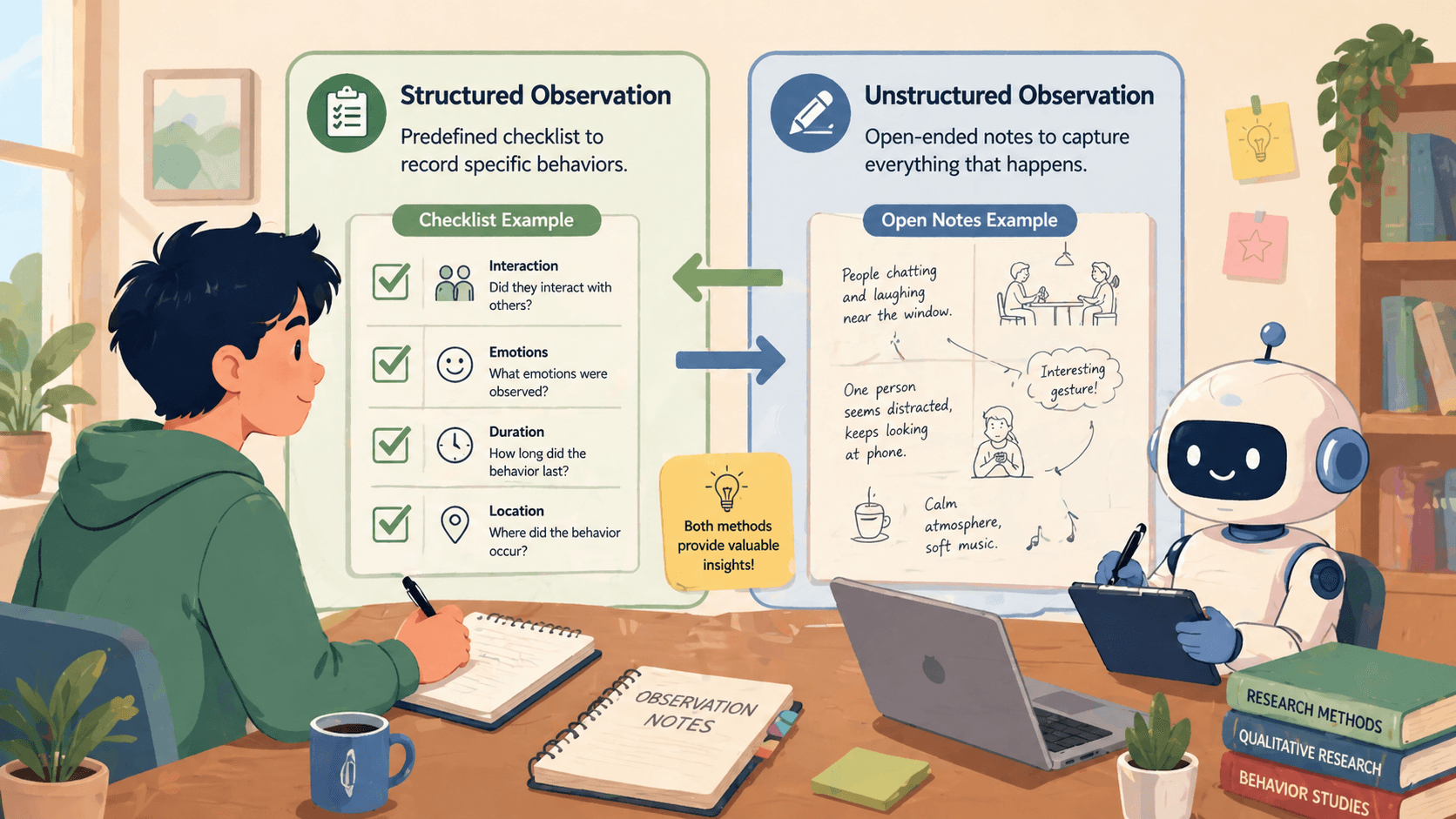
The main choice here is about control. Structured observation means you have a set list of things to look for and note. This makes your findings more consistent and reliable.
Unstructured observation is more free-form. You write down whatever seems important as it happens.
This approach can reveal surprising details and richer meaning. The trade-off is that comparing notes between different observers becomes much more difficult.
<ProTip title="📌 Note:" description="Combine structured checklists with open notes for balanced data collection" />
Real-World Examples of Naturalistic Observation
Here are a few concrete examples that show how naturalistic observation is used in different fields.
Psychology and Human Behavior
Psychologists who study child development watch kids play in places like a schoolyard. You see things in that messy, real setting that a clean, quiet lab could never show you.
This is often categorized under broad observational research protocols designed to ensure scientific rigor.
Observing children in real-world settings reveals spontaneous interactions and social dynamics that controlled lab environments often miss.
Animal Behavior Studies
Jane Goodall's work with chimpanzees in Gombe, Tanzania, is probably the most famous example.
By living among them for years, she recorded details of their social lives that completely changed what we knew about primates. This is the ultimate form of long-term, immersive animal observation.
Digital Naturalistic Observation
The method has moved online. Today, researchers study what people do online. They look at social media posts, how someone uses an app, or how groups talk to each other in forums. It's a blend of classic real-world data collection with modern technology.
Advantages and Limitations of Naturalistic Observation
Naturalistic observation has clear strengths, but it's not perfect. You get some things you can't get from a lab, and you miss out on others.
The Main Advantages
The biggest benefit is that you see behavior in its actual context. This gives your findings high ecological validity, they reflect real life, not an artificial setup.
You capture what people or animals do in real time, without them rehearsing or modifying their actions for a study.
This approach is great for the very start of a project. It helps you describe what's happening and come up with ideas to test later.
The Key Limitations
The main downside is the lack of control. Since you're not manipulating any variables, you can't prove that one thing causes another. You can only describe what you saw. Another significant problem is observational bias.
Two people watching the same thing can see it in completely different ways. Their own beliefs and past experiences shape what they think they saw.
A Quick Comparison
Feature | Advantage | Limitation |
Environment | Real-world, authentic context | No control over external variables |
Data Collected | Rich, detailed, nuanced insights | Can be subjective, hard to standardize |
Research Use | Excellent for generating hypotheses and describing phenomena | Cannot establish definitive causation |
The lack of control is a major hurdle; because you aren't manipulating variables, you cannot prove one thing causes another. To understand the clinical implications of these limitations, you can review case study and observational data.
<ProTip title="⚠️ Reminder:" description="Use multiple observers to reduce bias and improve reliability" />
Ethical Considerations in Observation Research
Ethical questions are unavoidable in naturalistic observation, particularly when people are the subjects.
Informed Consent and Privacy
Most studies involving human subjects require informed consent. Participants should know they're being observed and what the research is for. But there's a gray area in public spaces, like a park or a shopping mall.
Observing people without them knowing can sometimes be okay. This usually applies in public places, like a park or a town square.
Even in public, researchers must be careful. They need to protect people's privacy, keep their data safe, and always respect their rights.
The Ethics of Covert Observation
Covert observation, where people don't know they're being watched, is ethically tricky. Researchers need a strong reason for doing it.
Imagine trying to study shoplifting, or how people use illegal drugs at home. If those people knew a researcher was watching, the behavior would simply disappear. Even then, such studies must follow strict ethical protocols and are often heavily reviewed.
Balancing Ethics with Accurate Data
There's a constant trade-off between getting "pure" data and respecting participant rights. Once your ethical framework is solid and your study is complete, your next step is to choose a journal for research that aligns with your methodological approach.
On the other hand, covert methods might give you more realistic results, but they come with serious ethical concerns.
Finding the right balance between getting good data and respecting your subjects is one of the central challenges in this type of research.
<ProTip title="🧠 Pro Tip:" description="Always document ethical decisions clearly in your research methodology" />
How to Improve Reliability and Validity
The credibility of your observational study depends entirely on its reliability and validity.
Reducing Observer Bias
A major problem is observer bias, when a researcher's own expectations or perspectives influence what they see and record. To minimize this, you can use multiple observers and compare their notes.
Establishing a clear, detailed coding system for behaviors beforehand is also crucial. Finally, properly training all observers in using that system helps ensure everyone is on the same page. These steps directly improve inter-observer reliability.
Using Data Triangulation
You can make your findings much stronger by combining different types of data. Don't just rely on your observations.
Don't just rely on your notes. Combine them with other information. Talk to the people you observed afterward, or check things like their phone logs, to get the full picture.
This process, called data triangulation, helps confirm that what you saw is consistent with other evidence.
Maintaining Consistent Protocols
Consistency is everything. Your observation protocol needs to be standardized. To do this right, you need to make some strict rules and follow them.
Decide exactly when you'll watch, how you'll write things down, and what you're looking for, then don't change the plan.
A loose, changing protocol leads to messy, unreliable data. A tight, consistent one makes your research solid.
What This Means in Practice
In practical terms, naturalistic observation is a tool for discovery, not proof.
Its main job is to help you understand how people or animals behave in their normal environment. You use it to explore a topic and generate ideas before you move on to more controlled experiments that test specific hypotheses.
When applying it, you should:
Use it for exploratory, descriptive work.
Combine it with other research methods later.
Always be clear about its limitations in your reporting.
This approach is standard in mixed-methods research, applied psychology, and environmental studies. This method shows you how people actually behave, in a lot of detail. But there's a catch: you have to be very careful when you try to make sense of what you've found.
Wrapping Up Naturalistic Observation
You’ve seen how observing real behavior in real settings can get messy fast, with notes piling up and small biases creeping in. It takes focus to stay objective and still make sense of what you’re seeing. That’s the hard part.
<CTA title="Build Better Research Frameworks" description="Organize observation methods and research insights with structured writing support" buttonLabel="Try Jenni Free" link="https://app.jenni.ai/register" />
That’s where Jenni can help you move faster without losing clarity. It keeps your notes organized and your thinking on track, so you can turn raw observations into solid conclusions without getting stuck in formatting.