By
Nathan Auyeung
—
Journal Selection Checklist: Choose the Right Journal Faster

Nathan Auyeung
Senior Accountant at EY
Graduated with a Bachelor's in Accounting, completed a Postgraduate Diploma of Accounting
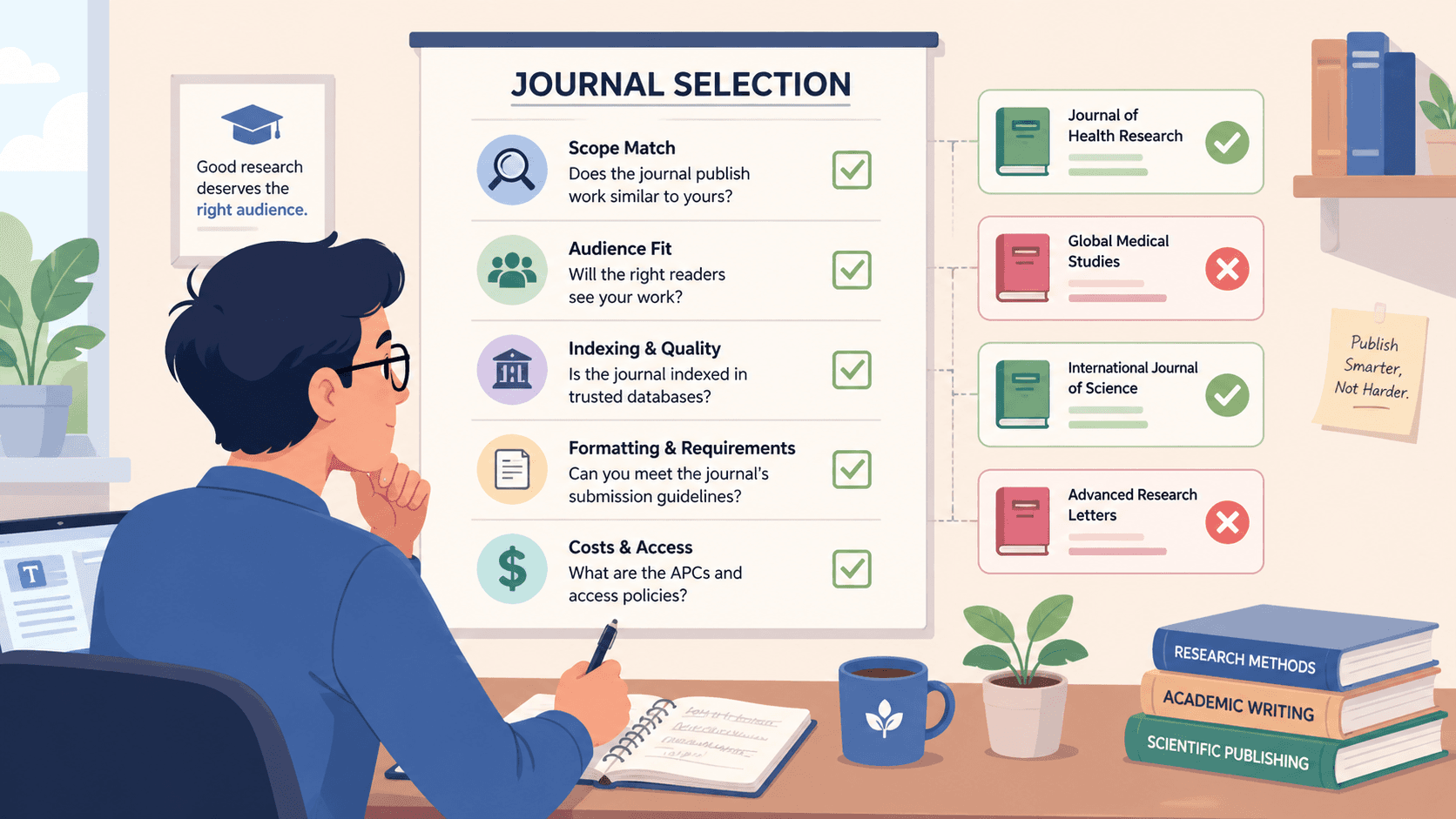
Choosing the right journal is more important than chasing a prestigious name. A good match means your paper is more likely to be accepted, needs fewer revisions, and actually reaches the people who should read it.
This checklist gives you a clear, step-by-step method to pick the best journal. We’ve combined standard criteria with advice from real researchers to help you avoid common mistakes and submit with confidence.
<CTA title="Find the Right Journal Faster" description="Use structured prompts to shortlist journals and refine your submission strategy in minutes." buttonLabel="Try Jenni Free" link="https://app.jenni.ai/register" />
What Is a Journal Selection Checklist?
A journal selection checklist is a practical tool for evaluating potential journals. You assess factors like scope, quality, and practical fit before you submit.
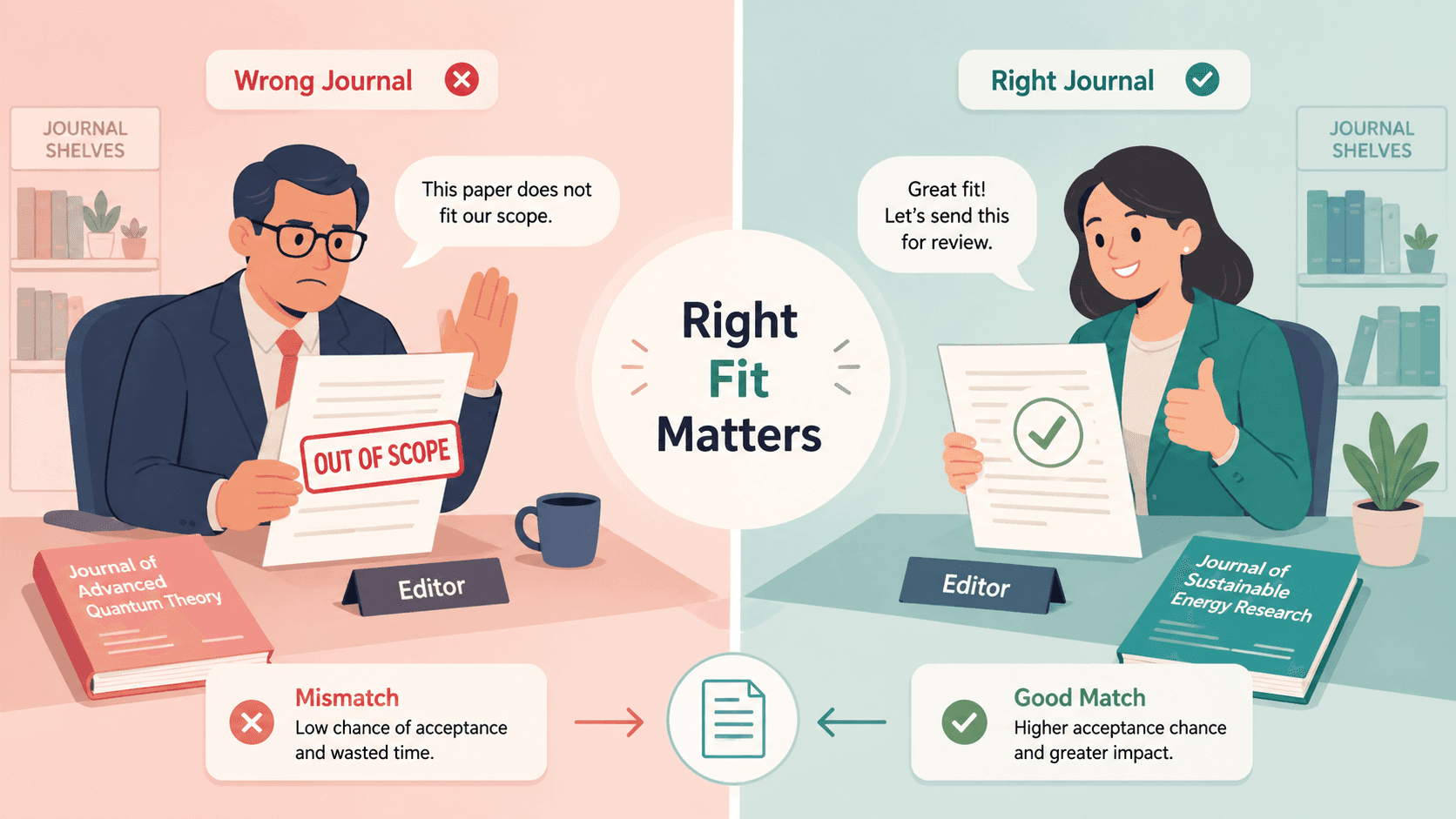
Many researchers just go by instinct or their supervisor's suggestion. While that can work, it often leads to problems. Reports on the desk rejection rate by journal found that more than 40% of immediate rejections are due to the paper simply being out of scope for the journal.
Using a checklist removes the guesswork. It creates a reliable process to check if your manuscript actually fits the journal's stated aims, reaches the right readers, and meets their editorial standards.
It's like making sure you're giving a speech to the right audience; great content won't matter if it's in the wrong room.
<ProTip title="💡 Pro Tip:" description="Scan the last 12 months of journal articles to quickly test scope alignment." />
Step 1: Confirm Scope and Manuscript Fit
The single biggest reason for rejection is a mismatch in scope. If your paper isn't on a topic the journal covers, the editor will likely reject it quickly, Springer Nature notes some decisions happen in just three to seven days.
Check recent articles first
Don't just read the journal's official aims. Look at what they've actually published in the last year or two. Are the topics and methods similar to yours? Does your article type fit? A journal dedicated to clinical trials, for instance, rarely wants a purely theoretical review.
Match the article type
Journals have strict preferences for format. Common types include original research, case studies, and short communications.
If you are submitting a narrative literature review, ensure the journal accepts that specific format. Sending a review to a journal that only publishes original research is an easy way to get a desk rejection.
Align with your target audience
Consider who you need to reach. A specialized journal might have a smaller readership, but your work will be highly relevant to them.
A broader, more prestigious journal offers wider visibility, but your chances of acceptance are much lower. You have to choose the right room for your speech.
<ProTip title="📌 Reminder:" description="Use your reference list to identify journals already publishing similar work." />
Step 2: Evaluate Journal Quality and Credibility
You need to protect your work from predatory publishers and low-quality outlets. The number of questionable journals has grown fast; one study cited in Nature identified thousands operating worldwide.
Signs of a reputable journal
Look for clear signals of professionalism. A good journal has a transparent peer review policy and an editorial board with verifiable institutional affiliations.
To protect your academic reputation, you can use the think check submit journals initiative to verify the integrity of a publication before you commit.
Indexing matters
Where a journal is listed directly affects who sees your work. Key databases include:
Scopus: Offers broad visibility across many disciplines.
Web of Science: Often used as a marker of high credibility.
PubMed: This is critical for life sciences and biomedical research. The National Institutes of Health (NIH) notes that indexing in such databases greatly improves how easily other researchers can find and cite your paper.
Watch for predatory signals
Be wary of clear red flags. These include promises of acceptance in just a few days, receiving aggressive, generic email solicitations, unclear or hidden article processing charges, and editorial boards that list experts who have no real connection to the journal.
These publishers trade on speed but will harm your academic standing.
<ProTip title="⚠️ Warning:" description="Always verify ISSN and publisher reputation before submitting your manuscript." />
Step 3: Analyze Practical Submission Factors
Beyond quality, practical details influence your decision more than expected.
Submission success depends on operational factors like timelines, acceptance rates, and formatting requirements.
Review Turnaround Time
A typical journal turnaround time ranges from 4 to 12 weeks, depending on discipline.
Fast review is helpful, but extremely fast decisions can indicate weak peer review.
Acceptance Rate Reality
Acceptance rates vary widely:
Top-tier journals: below 10%
Mid-tier journals: 20 to 40%
Specialized journals: up to 60%
Choosing a realistic target improves your chances.
Submission Requirements
Each journal has strict formatting rules regarding citation style, word count, and structure. If your paper requires a complex critique, following a critical review structure that aligns with the journal's guidelines can prevent administrative rejections.
Citation style (APA, MLA, Chicago)
Word count limits
Structure guidelines
Ignoring these details often leads to desk rejection.
<ProTip title="🧠 Note:" description="Create a reusable submission checklist to avoid missing formatting requirements." />
Step 4: Understand Costs and Access Models
Publishing almost always involves some cost, either for you or your readers. Getting this wrong can lead to budget problems or restrict who can see your work.
Open access vs. subscription
You’re generally choosing between three paths.
Open Access (OA): Anyone can read your article for free. The cost is typically covered by an Article Processing Charge (APC) paid by you or your institution.
Subscription: Readers or their libraries pay for access, usually through a journal subscription. Authors often don’t pay a fee to publish.
Hybrid: This is a subscription journal that offers an optional OA route if you pay an APC.
The push for open access is strong. Organizations like UNESCO argue that removing paywalls is crucial for equitable global knowledge sharing. Furthermore, studies on PubMed Central suggest that open-access articles may receive more diverse citations over time.
Article Processing Charges (APC)
If you go the OA route, fees vary dramatically. Some reputable society journals charge a few hundred dollars. More common fees for standard journals sit between $1,000 and $3,000.
Top-tier, high-impact journals can charge over $5,000. The key is to find the fee information on the journal's website before you submit, so there are no surprises.
Copyright and archiving
Don’t just agree to the first copyright form you see. Pay attention to what rights you keep. Can you post a copy of your accepted manuscript on your university's website or a preprint server? What are the rules for sharing data?
Journals have different policies on self-archiving and data availability. Use tools like SHERPA/RoMEO to quickly check a journal's standard policies on these points.
Step 5: Evaluate Metrics Without Over-Relying on Them
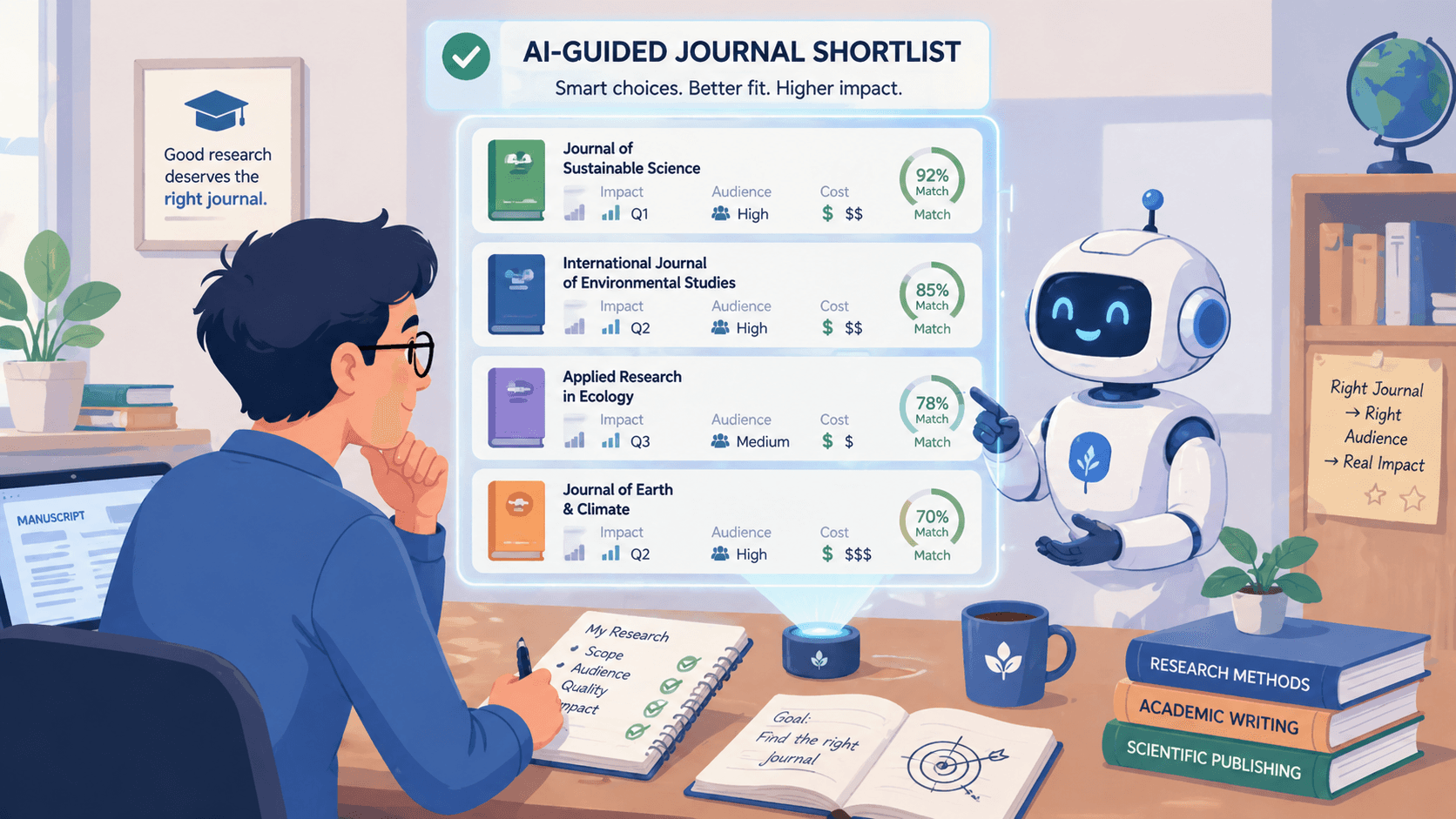
Journal metrics are useful signals, but they’re often given too much weight. Using them as your primary filter can lead you to submit to the wrong place.
Impact factor vs. relevance
The journal impact factor (JIF) shows how often, on average, its articles are cited. It says nothing about whether your specific paper is a good fit.
Choosing a journal with a lower JIF that perfectly matches your topic is usually smarter than forcing your work into a prestigious journal where it’s out of place.
The first option has a much higher chance of acceptance and of actually reaching the right readers.
Key metrics to consider
You’ll see a few common numbers:
Impact Factor: The classic citation average.
h-index: Attempts to measure both productivity and citation impact.
Quartile (Q) Ranking: Journals are ranked within their category (Q1 is the top 25%, Q4 is the bottom 25%).
Altmetrics: Tracks attention beyond academia, like news mentions or social media shares.
These numbers tell you about a journal's visibility and influence within the publishing ecosystem. They do not predict whether an editor will send your manuscript out for review.
What this means in practice
The goal is balance. A journal with high relevance to your work and solid, mid-tier metrics is often the strongest strategic choice. It’s a viable target with a good audience fit.
Conversely, a journal with stellar metrics but poor fit is a high-risk gamble that usually ends in a quick desk rejection. The metrics should inform your decision, not make it for you.
Quick Journal Selection Checklist
Use this table as a final filter before you submit. It covers the essential points without overcomplicating things.
Category | Key Checks |
Scope & Fit | Does your topic and article type match the journal's stated aims and recent publications? |
Quality & Indexing | Is the peer review process clear? Is the journal indexed in Scopus, Web of Science, or PubMed? |
Operations | What is the average review timeline and acceptance rate? Is the publication schedule consistent? |
Costs & Access | Are there any Article Processing Charges (APC)? What are the copyright and self-archiving policies? |
Metrics | Are you checking the impact factor and quartile ranking after confirming a good fit? |
Run your top candidate journals through these points. If one fails a critical check, like being unindexed or having a completely mismatched scope, it's probably not the right choice.
Early-career academics often trip over the same hurdles when picking a journal. Looking at discussions in forums and among peers, a few mistakes come up again and again.
Overvaluing the impact factor
It's common to aim for the most prestigious journal in your field right away. The problem is, this usually leads to a string of quick rejections, which wastes time and morale.
The acceptance probability for a top journal is low to begin with, but it drops to near zero if your paper's scope isn't a perfect match. Chasing prestige first is a bad strategy.
Ignoring your own reference patterns
Your manuscript's reference list is a cheat sheet. The journals you cite most frequently are the ones your ideal audience reads.
If you find yourself citing many reviews, knowing how to write literature review outline for those specific target journals is essential.
Fear of that first submission
This is big for master's students and new PhD candidates. The uncertainty about the entire process, from formatting to peer review, can be paralyzing.
While a supervisor's advice is valuable, relying on a structured checklist can build confidence and create a sense of independent control.
Rejection is part of the process
It helps to remember that rejection is the default outcome in academic publishing, not a personal failure.
Some researchers even talk about going through stages similar to an emotional cycle after a rejection: frustration, then analysis, then adjustment. The key is to use the feedback, if you get any, to logically adjust your target journal for the next submission.
<ProTip title="🚀 Strategy:" description="After rejection, refine your abstract and retarget journals with closer scope alignment." />
How to Build Your Shortlist of Journals
To build your journal shortlist, start by gathering a pool of potential candidates. You'll want to find around 8 to 10 journals at first.
A good way to do this is by looking at the reference lists in articles similar to your work, running searches in academic databases like Scopus or Web of Science, and using the manuscript matching tools some publishers offer.
Next, you need to narrow that list down. Aim for a final shortlist of 3 to 5 journals. The main things to consider are:
Scope alignment: Does the journal actually publish papers on your specific topic?
Indexing: Is it included in the major databases (e.g., PubMed, SCIE) that matter for your field?
Acceptance likelihood: What's its acceptance rate? How long does peer review typically take?
Once you have your shortlist, give each journal a simple rank:
Your top choice, the best fit.
A solid alternative, a moderate fit.
A reliable backup option.
Following this method helps you avoid wasting time submitting to the wrong places and can cut down on those frustrating desk rejections.
Stop Guessing Where Your Paper Should Go
You’ve got solid research, but picking the right journal can feel like a slow loop of doubt and second guessing. It’s frustrating. One wrong fit can mean delays or rejection, even when your work is strong.
<CTA title="Plan Your Journal Strategy Smarter" description="Organize your research and select the right journals with guided AI prompts." buttonLabel="Try Jenni Free" link="https://app.jenni.ai/register" />
That’s where Jenni helps you stay focused and make smarter choices from the start. It guides how you organize your work and match it to the right journals without overthinking every step. Instead of trial and error, you move forward with a plan that gives your paper a real shot.