By
Justin Wong
—
Formal Phrases Instead of Idioms in Essays

Justin Wong
Head of Growth
Graduated with a Bachelor's in Global Business & Digital Arts, Minor in Entrepreneurship
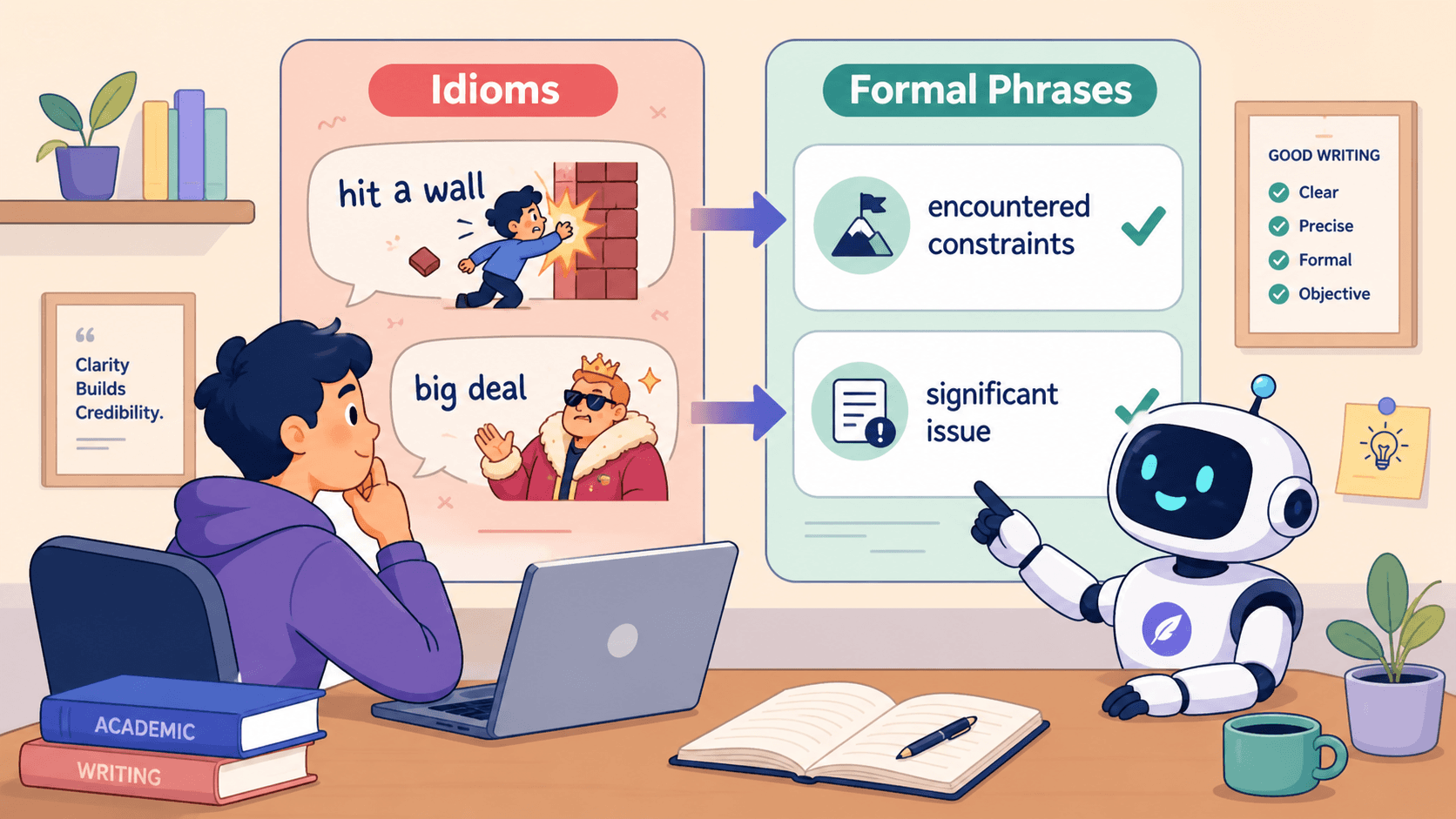
Using formal phrases instead of idioms in your essay ensures your ideas are communicated with clarity and precision, meeting expected academic standards. This approach prevents confusion by replacing metaphorical language with neutral, direct expressions.
A common reason students lose marks isn't weak arguments, but a casual tone that undermines credibility. This guide will show you how to replace idioms, use academic paraphrasing, and build a consistent formal style. Keep reading to learn the specific techniques.
<CTA title="Write Formal Essays with Confidence" description="Transform casual phrases into clear academic language using structured prompts and guidance." buttonLabel="Try Jenni Free" link="https://app.jenni.ai/register" />
What Formal Phrases Instead of Idioms Actually Mean
Using formal phrases means swapping out idioms for literal, precise language. This makes your ideas clearer and prevents cultural misunderstandings.
The University of Manchester's Academic Phrasebank recommends this approach, noting academic readers need explicit, structured language that everyone interprets the same way.
This shift is a key part of mastering academic style, which prioritizes objectivity over creative flair.
Idioms fail in essays because they depend on shared cultural knowledge, which academic writing avoids. Here's why they're a problem:
Ambiguity: Their meaning can shift between readers.
Informality: They create a conversational, not scholarly, tone.
Imprecision: They use imagery instead of stating the exact point.
Take this example:
Idiomatic: “At the end of the day, education is a double-edged sword.”
Formal: “Ultimately, education has both advantages and disadvantages.”
The formal version uses neutral, academic vocabulary to state the idea directly.
<ProTip title="💡 Pro Tip:" description="Always replace metaphor with literal meaning when converting idioms into formal writing" />
Common Idioms and Their Formal Alternatives
This list offers direct replacements to use in your writing. These are practical substitutions and academic paraphrases.
Time and Conclusion Expressions
Phrases that signal closure or a final point.
“At the end of the day” → Ultimately / In the final analysis
“When all is said and done” → In conclusion / Overall
“From day one” → From the outset
A quick example shows the shift:
Informal: “At the end of the day, the policy failed.”
Formal: “Ultimately, the policy was unsuccessful.”
Difficulty and Limitations
Idioms can overstate problems. Academic writing should name them exactly. If you are writing a problem solution essay, using precise language for obstacles is vital for a professional tone.
“Bite off more than you can chew” → Exceed one’s capacity
“Run out of steam” → Lose momentum
“Hit a wall” → Encounter significant constraints
Here's how that looks in a sentence:
Informal: “The project hit a wall.”
Formal: “The project encountered significant constraints.”
Importance and Impact
This moves emotional language toward objective phrasing. To truly master academic language, you must learn to quantify impact rather than describing it with metaphors.
“Big deal” → Significant issue
“Game-changer” → Transformative development
“Make a big difference” → Have a substantial impact
<ProTip title="📌 Note:" description="Use words like significant substantial and considerable to replace emotional idioms" />
Agreement and Comparison
Academic writing favors explicit comparison over figures of speech.
“See eye to eye” → Agree / Hold similar views
“On the same page” → Share a common understanding
“Apples and oranges” → Not directly comparable
For instance:
Informal: “These ideas are apples and oranges.”
Formal: “These concepts are not directly comparable.”
Why Students Get Marked Down for Idioms
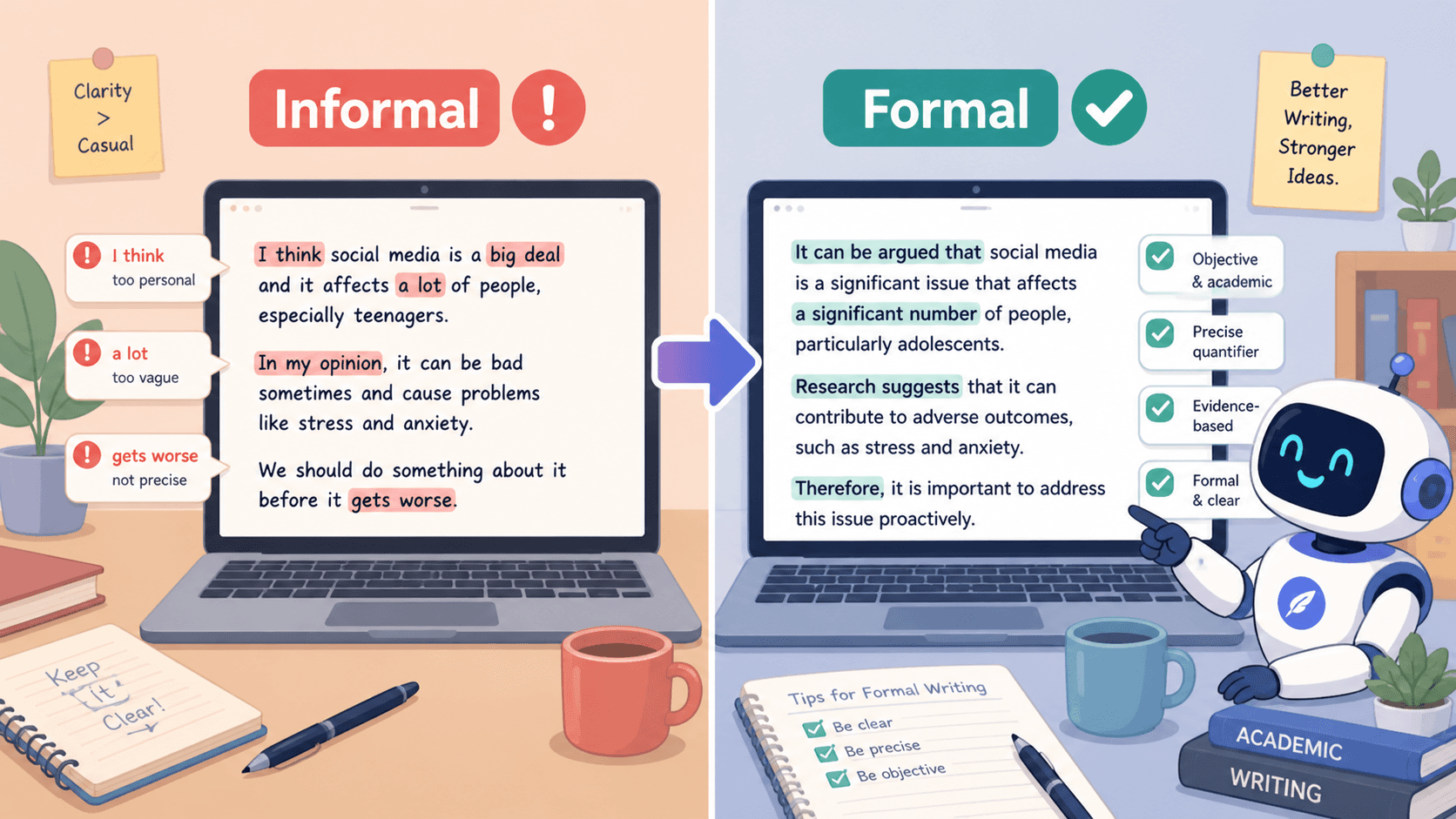
Students often get marked down for informal language, even with clear ideas. This isn't arbitrary; it's a core academic standard. Understanding different levels of formality helps you identify when a phrase is too casual for a university-level paper.
Discussions among English learners show frustration over penalties for phrases like "a lot" or "I think." Formal writing guidelines consistently stress impersonal language and objective phrasing.
The British Council's IELTS criteria, for example, require a formal tone, clear argumentation, and accurate vocabulary for higher scores.
The Core Problem: Tone, Not Intelligence
Using idioms doesn't strengthen your argument. It usually signals a lack of control over a formal style.
Imagine academic writing as a courtroom. Your arguments need to be precise, supported by evidence, and neutral. Idioms sound like casual conversation, which weakens that evidence-based reasoning.
A Quick Comparison
Before: “I think this issue is a big deal and affects a lot of people.”
After: “This issue is a significant concern that affects a large number of individuals.”
The revised version uses formal expressions, impersonal constructions, and precise vocabulary.
<ProTip title="💡 Pro Tip:" description="Remove I think statements and replace them with evidence based or impersonal phrasing" />
Moving From “In My Opinion” to Academic Sentence Starters
Replacing idioms means cutting out overly personal expressions too. Formal writing isn't about your personal view; it's about building an objective case.
Formal Alternatives for Stating an Opinion
Swap out personal phrases for academic sentence starters and stance expressions. Here are some direct swaps:
“In my opinion” → It can be argued that…
“I believe” → This suggests that…
“To my mind” → It is widely accepted that…
This transition is much easier once you understand how to structure an essay guide, as a strong structure naturally supports objective claims.
Look at the difference in a short example:
Informal: “I think social media is harmful because it affects teenagers.”
Formal: “It can be argued that social media has a detrimental impact on adolescents.”
The second version doesn't just sound more formal. It frames the idea as a position open to discussion, which is how academic arguments work.
Why This Change Matters
This shift aligns with what academic writing values: impersonal language, evidence-based claims, and logical phrasing. Starting a sentence with "I think" immediately anchors the idea to you, the writer.
Starting with "It can be argued" or "Research indicates" anchors it to evidence or a logical line of reasoning, which is far more credible.
A Simple Pattern to Follow
You can structure sentences using a basic pattern that improves your argumentation:
Claim: It can be argued that social media use correlates with increased anxiety.
Evidence: Research indicates that adolescents reporting high social media engagement also report higher levels of stress.
Explanation: This suggests that the curated nature of online platforms may contribute to psychological pressure.
This pattern, claim, evidence, explanation, uses formal reasoning vocabulary and keeps the focus on the argument itself, not the person making it.
YouTube and the Confusion Around Idioms
Students get a lot of mixed advice. Some teachers say to avoid idioms at all costs. Others recommend using so-called "advanced idioms." It's confusing.
You're basically told two opposite things: replace every idiom with a formal phrase, or try to find "acceptable" idiomatic expressions. The practical answer is somewhere in between.
What Actually Works
Some phrases are safe and commonly accepted in academic writing. They aren't casual idioms; they're formal connectors or set phrases.
On the one hand… on the other hand…
In light of…
With regard to…
These are standard academic collocations. They help structure your argument without sounding informal.
What You Should Definitely Avoid
Steer clear of idioms that are based on slang, specific cultural references, or pure emotional exaggeration.
Avoid: “This policy blew up in their face.”
Use: “This policy resulted in unintended negative consequences.”
The second version states the outcome directly and neutrally, which is what matters for your grade.
<ProTip title="📌 Reminder:" description="Not all idioms are equal use only those accepted as formal academic expressions" />
A Step-by-Step Strategy to Replace Idioms
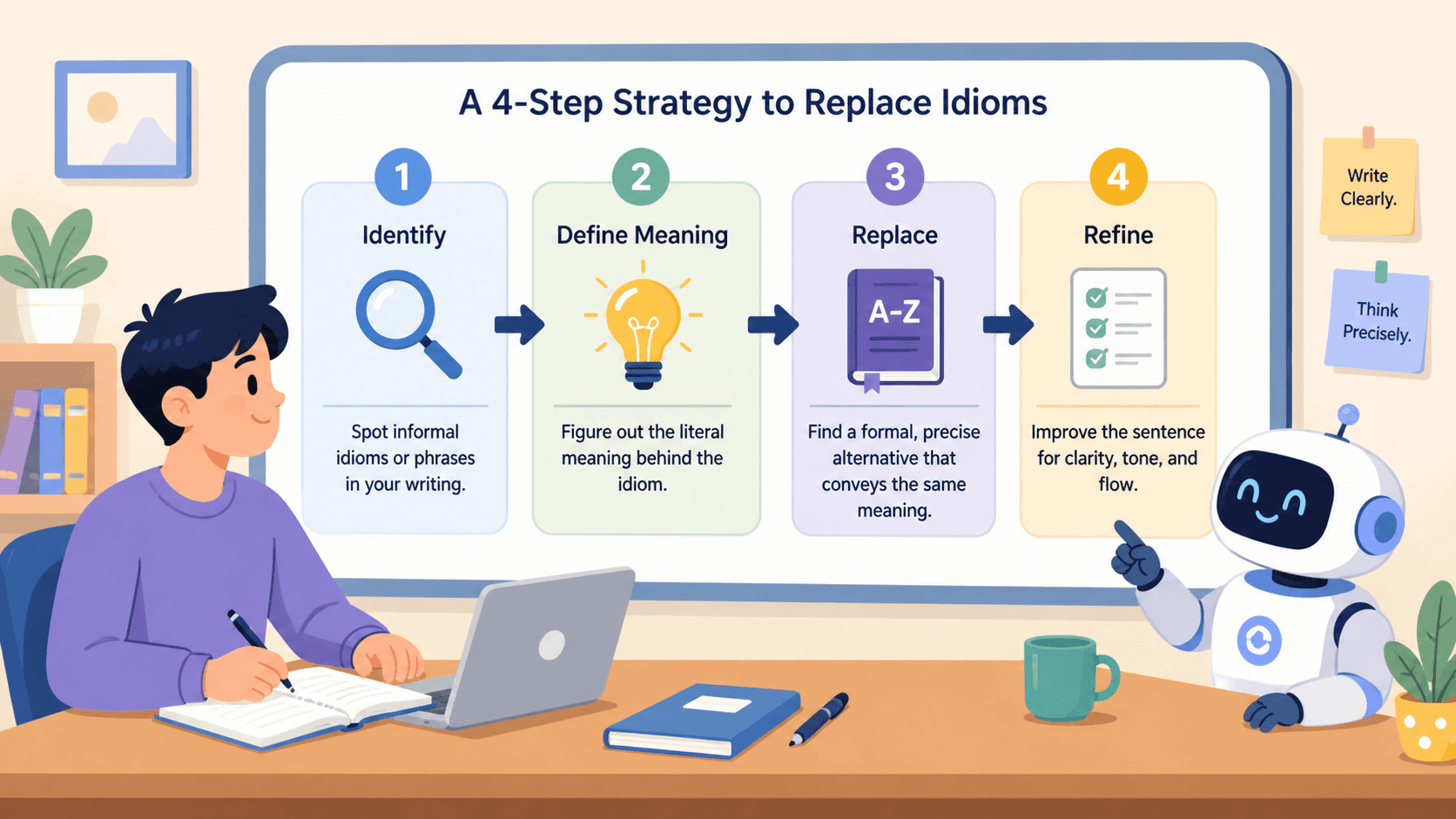
This is a practical process for revising your own essays. It's systematic, so you can apply it to any draft.
Step 1: Identify Informal Language
First, read through your text and underline anything that sounds conversational.
Common idioms (e.g., "at the end of the day")
Slang or overly casual words
Very common phrasal verbs (like "get better")
Personal phrases ("I think," "we believe")
Step 2: Define the Exact Meaning
For each underlined phrase, ask yourself: what is the literal point I'm trying to make here? Ignore the figurative language.
Example: "Hit a wall" simply means you faced a difficulty or a limitation.
Step 3: Replace with a Formal Equivalent
Take that core meaning and find a neutral, precise word for it.
difficulty could become constraint or obstacle.
importance could become significance.
change could become development or shift.
You can find more options in this list of academic vocabulary for essays.
Step 4: Refine the Full Sentence
Plug your new word or phrase back into the sentence. Read it aloud. Does it sound natural and clear? Adjust the surrounding words if needed to make it flow.
Example of the Full Process:
Original Sentence: “The company hit a wall during expansion.”
Step 2 Meaning: The company faced a difficulty.
Step 3 Replacement: difficulty → constraint
Step 4 Refined Sentence: “The company encountered significant constraints during its expansion.”
Quick Reference Table
Idiom | Formal Phrase |
at the end of the day | ultimately |
a lot of | a significant number of |
big problem | major issue |
get better | improve |
deal with | address |
Why This Method is Effective
It works because you focus on the meaning first, not just swapping one phrase for another from a list.
This prevents your writing from sounding forced or unnatural. You're translating the idea into an academic register, not just performing a mechanical replacement.
<ProTip title="💡 Pro Tip:" description="Always revise sentences after replacing idioms to maintain natural flow" />
Building a Formal Vocabulary System
Good academic writing comes from a system, not just a memorized list of words. Research on language learning supports this: you get better results by focusing on academic collocations, words that naturally go together, and structured expressions, rather than trying to remember single, fancy terms.
What You Should Actually Learn
Forget about "advanced idioms." Focus on these categories instead:
Academic connectors: furthermore, consequently, however
Reporting verbs: argue, indicate, demonstrate, suggest
Evaluation vocabulary: significant, limited, plausible, flawed
Cause and effect phrases: as a result of, leads to, contributes to
Contrast expressions: in contrast, on the other hand, whereas
Work with Phrases, Not Just Words
Don't just learn the word "impact." Learn how it's actually used in sentences by studying common pairings.
significant impact
empirical evidence
fundamental assumption
considerable variation
Learning these chunks of language does two things. It makes your writing clearer, because you're using standard academic phrasing. It also improves cohesion, the way your sentences link together, because these phrases act as natural connectors for your ideas.
A Simple Routine to Build Your System
This isn't a quick trick. It's a habit.
Read academic articles in your field regularly, even just a few paragraphs.
Note useful phrases, not single words. Highlight or write down whole expressions like "this lends support to..." or "a widely held view is..."
Rewrite your own sentences using these new phrases. Actively try them out.
Reuse the phrases in your next essay. This is how they move from your notes into your active vocabulary.
This process builds a formal style over time. You're not just avoiding idioms; you're learning how academic ideas are conventionally packaged and presented.
Keep Your Writing Clear Without Overthinking It
You start second-guessing every phrase, swapping simple words for formal ones until your sentences feel stiff and harder to read. It slows you down. And it shows. But academic writing doesn't require forced complexity - just clear, direct meaning.
<CTA title="Improve Your Academic Writing Instantly" description="Turn informal phrases into structured academic language with guided writing support." buttonLabel="Try Jenni Free" link="https://app.jenni.ai/register" />
Focus on meaning first, then clean up the tone. Replace one idiom at a time. Define the literal meaning, find a precise alternative, and refine the sentence. Over time, this systematic approach builds natural, confident academic writing without losing your voice.