By
Nathan Auyeung
—
Essay Idioms: How to Use Them Naturally in Academic Writing

Nathan Auyeung
Senior Accountant at EY
Graduated with a Bachelor's in Accounting, completed a Postgraduate Diploma of Accounting
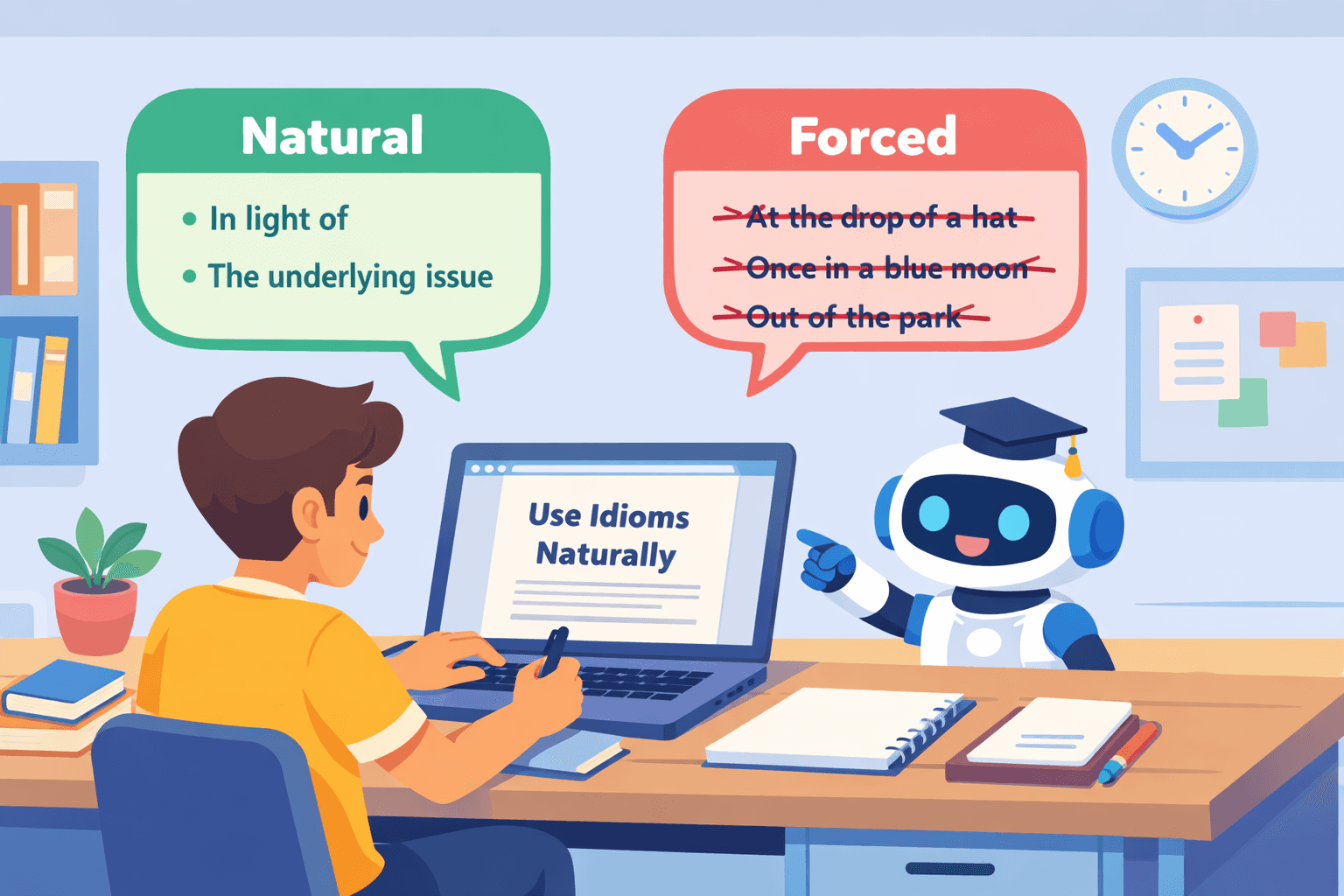
Essay idioms are those short, fixed phrases everyone knows, like "in light of" or "the crux of the matter" Used right, they can sharpen an argument or set a tone, making your point feel grounded in real conversation. The EAP Foundation and other studies point out that even serious academic papers sometimes use them.
Most students have a list of idioms memorized. The problem isn't knowing them. This guide cuts through that hesitation. It lays out the concrete rules: where an idiom actually helps, where it definitely doesn't, and how to weave it in so it sounds like you, not like a thesaurus. If you want your essays to sound less robotic and more persuasive, keep reading. We'll get into the specifics.
<CTA title="Use Idioms Without Sounding Forced" description="Build natural academic sentences with the right idioms and tone in minutes" buttonLabel="Try Jenni Free" link="https://app.jenni.ai/register" />
What Essay Idioms Actually Do in Writing
Essay idioms are shortcuts. They pack a complex idea into a few well-known words, which can make your writing easier to read and give it a specific tone. Think of them as linguistic zip files, compressing a lengthy explanation into a tight package. The blog from Affordable Dissertation notes how they can simplify a dense argument, a point also supported by EAP Foundation academic writing resources.
A good idiom replaces a whole sentence. "A double-edged sword" captures both benefit and risk instantly, saving you ten or fifteen words of clunky explanation.
The trouble comes when you use them poorly. Students often worry about the tone, especially in high-pressure situations like exams, and a misfired idiom can confuse everything.
Here's the difference:
Wordy: This policy has both advantages and disadvantages.
Idiomatic: This policy is a double-edged sword.
<ProTip title="💡 Pro Tip:" description="Use idioms only when they replace longer explanations clearly" />
Can You Use Idioms in Essays? What Students Get Wrong
You can use idioms in essays, but the context and tone matter. Teaching blogs and research agree they're acceptable in semi-formal writing, but they're a risky choice for highly technical sections.
This is a common student worry, echoed in many Reddit discussions. The fear is that an idiom will look forced, or worse, that it will actually lower your grade.
The “safe vs risky” distinction Idioms fit best in:
Argumentative essays
Reflective writing
IELTS or TOEFL tasks
They often fail in:
Scientific reports
Technical explanations
Formal academic research sections
Real learner behavior Students frequently follow this pattern:
Memorize 20–50 idioms.
Try to insert several into one essay.
Remove most of them before submission.
This "overload then delete" habit is noted in teaching resources like Scribd guides. The result is hesitation. Learners end up avoiding idioms entirely, or they overuse them and create a mess.
<ProTip title="📌 Note:" description="If an idiom feels unnatural when you read it aloud, remove it" />
How Many Idioms Per Essay Is Actually Safe?
The safe limit is one or two idioms in a whole essay, or maybe one per major section. Multiple sources on academic writing, including Purdue OWL’s academic writing guidelines, recommend this range.
A practical rule from idiom learning platforms is to use 1–2 idioms per 300–500 words. This keeps your writing clear and stops it from sounding like you just plugged in a memorized list.
If you're trying to refine this balance as part of your broader writing process, learning how to improve essay writing can help you make better decisions about clarity, tone, and word choice.
Why fewer idioms work better Using too many creates three clear problems:
It makes your writing less clear.
It sounds memorized and unnatural.
It damages the academic tone.
Think of idioms like salt. A pinch improves the flavor. A handful ruins the dish.
A simple rule you can follow
Introduction: Use one idiom if it fits, but it's optional.
Body: Use a maximum of one idiom across all your paragraphs.
Conclusion: Use one idiom if it fits, but it's optional.
Essay Section | Idiom Usage | Example |
Introduction | Optional | In light of recent changes |
Body Paragraph | Recommended (max 1) | A double-edged sword |
Conclusion | Optional | In essence |
This structure keeps your essay balanced and easy to read.
<ProTip title="💡 Reminder:" description="One strong idiom is more effective than three weak ones" />
The 5 Exam-Safe Idioms Most Teachers Accept

A few idioms show up often in academic writing and are generally considered safe. These come from teaching materials and corpus-based lists.
Common academic-friendly idioms
In light of – introduces reasoning or context.
Come into play – explains a factor's influence.
A double-edged sword – shows a two-sided outcome.
On the one hand / on the other hand – structures contrasting arguments (and works alongside transition words in academic writing).
The underlying issue – summarizes the key point.
Example usage in sentences
In light of the recent economic data, the policy requires review.
Increased automation is a double-edged sword for the workforce.
These idioms sound natural in essays because their tone aligns with academic writing. Unlike slang, which is why it helps to avoid informal writing in academic papers, they focus on logic and structure rather than vivid imagery.
Why these idioms work They share three key traits:
Abstract meaning: They describe concepts, not physical things.
High frequency in academic contexts: They're commonly seen in textbooks and journals.
Neutral tone: They don't carry strong emotional or casual connotations.
<ProTip title="💡 Pro Tip:" description="Prioritize abstract idioms over visual or dramatic ones" />
Why Students Learn Idioms But Never Use Them
Many students know idioms but can't seem to use them correctly. Research and online forums show a clear gap between memorizing a list and actually writing with one.
A recent study on university students found learners either avoid idioms altogether or put them in the wrong place when they try.
The memorization problem Students often treat idioms like any other vocabulary word:
Learn the definition.
Memorize an example sentence.
Forget the specific context it needs.
But an idiom isn't just a word. It's a phrase that depends completely on the right context and tone.
Real-world hesitation When writing, students usually ask themselves two questions:
Does this sound formal enough?
Will using this lower my grade?
The uncertainty leads to a simple choice: they just leave the idiom out.
A better mental model A more useful approach is to flip the process.
Instead of memorizing 50 idioms, pick 5 to 10 that are clearly academic and safe.
Use those same few idioms repeatedly in different practice essays.
This builds real confidence, and the usage starts to feel natural.
<ProTip title="📌 Note:" description="Master a small set of idioms deeply instead of memorizing many" />
Idioms as Style, Not a Shortcut to Higher Scores

Idioms can improve your writing's style, but they don't directly boost your score. The main factors in grading are still the clarity of your argument, its logical structure, and your control of grammar and vocabulary.
A lot of students think using an idiom will automatically earn them extra points. Exam evidence and teacher feedback consistently show this isn't the case, as explained in IELTS idioms usage guidelines.
What actually affects scores
Clarity of argument
Logical structure
Vocabulary accuracy
Grammar control
An idiom only matters if it supports one of these core elements.
When idioms help They enhance your writing when:
They clarify your meaning.
They fit the tone of the essay.
They improve the sentence's flow.
When idioms hurt They reduce quality when:
They sound forced or memorized.
They are outdated or cliché.
They mismatch the essay's formal tone.
Think of idioms as polish for a finished piece, not the foundation you build it on.
How to Practice Idioms Without Burning Out
Memorizing long lists of idioms is exhausting and ineffective. A better system focuses on repetition and practical use, not on volume.
The 5-idiom rotation method Pick five academic-friendly idioms, like the ones listed earlier. Use those same five across several practice essays.
Week 1: Practice using them only in your introduction paragraphs.
Week 2: Focus on placing them within your body paragraphs.
Week 3: Write full practice essays, using them wherever they fit naturally.
This method reduces the mental load. You learn the context for each phrase, not just its definition.
A mini practice system
Write one sentence using one of your chosen idioms each day.
Take a formal sentence from a textbook or article and rewrite it using an idiom.
Review your usage once a week to see if it sounds natural.
Example transformation exercise
Original: This factor influences the outcome.
Improved: This factor comes into play in the final outcome.
These small, regular exercises build real fluency much faster than trying to memorize fifty phrases at once.
<ProTip title="💡 Pro Tip:" description="Practice idioms in sentences before using them in full essays" />
Idioms Allowed vs Not Allowed by Essay Type
You can't use idioms the same way in every essay. The subject and the required tone determine what's acceptable.
Where idioms are acceptable
Argumentative essays
Reflective or personal writing
IELTS or TOEFL essays
Where idioms are risky
Scientific writing
Technical reports
Data-heavy research papers
Understanding where idioms fit also depends on how your essay is organized. If your structure is unclear, even a well-placed idiom can feel out of place.
That’s why it helps to understand how to structure essay guide before focusing on stylistic elements.
In technical contexts, clarity and precision are the absolute priority. A stylistic flourish like an idiom can muddy the meaning.
A simple checklist Before you decide to use an idiom, ask yourself:
Does it match the formal tone of this essay?
Does it make my point clearer, or more confusing?
Could I easily explain the idiom's meaning if asked?
If you answer "no" to any of these, it's safer to remove it.
How to Use Essay Idioms Step by Step
Using an idiom correctly isn't just about dropping it in. Follow this simple process.
Step 1: Choose the right idiom Pick an idiom that logically matches your argument. Don't just use one because you remember it.
This is especially important in the opening section of your essay, where tone matters most. If you're unsure how to begin effectively, reviewing how to write essay introduction hook can help you decide whether an idiom fits naturally or feels forced.
Step 2: Fit it into a full sentence Never insert an idiom on its own. It must be part of a complete, grammatical sentence.
Correct: The initial failure proved to be a blessing in disguise.
Incorrect: The project faced challenges (a blessing in disguise).
Step 3: Check tone and clarity Read the entire sentence aloud. If the idiom sounds forced or odd, rewrite the sentence.
Step 4: Limit usage Keep to your limit of one or two idioms for the entire essay. This maintains control and prevents your writing from becoming overloaded.
Keep Your Writing Clear and Easy to Follow
You can feel it when an essay gets heavy, sentences drag and the meaning starts to blur. It’s frustrating because you’re trying to sound smart, but the message gets lost. That’s the problem.
<CTA title="Write Clear Essays With the Right Tone" description="Improve clarity and use idioms naturally without overthinking your writing" buttonLabel="Try Jenni Free" link="https://app.jenni.ai/register" />
Stick to simple phrasing and let tools like Jenni, including its AI paraphrasing tool, guide your tone so your writing stays clear and natural. It helps you clean things up fast, without second guessing every line. You stay in control.