By
Justin Wong
—
Discursive vs Argumentative Essay: Key Differences Explained

Justin Wong
Head of Growth
Graduated with a Bachelor's in Global Business & Digital Arts, Minor in Entrepreneurship
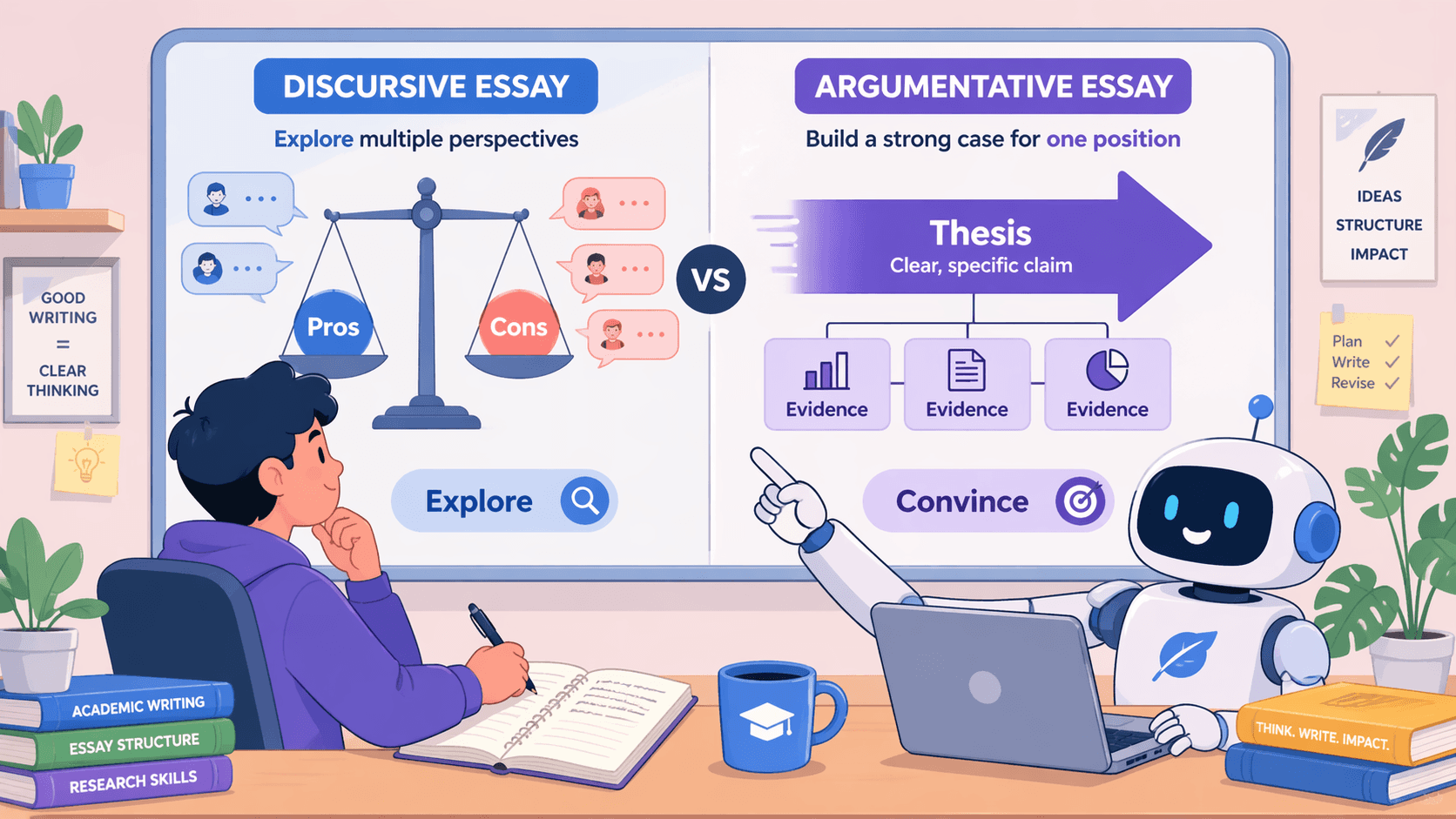
The core difference between discursive and argumentative essays is your stance. A discursive essay explores a topic from multiple angles, neutrally presenting different views.
An argumentative essay takes a firm position and defends it with evidence, actively rebutting counterarguments.
As Purdue OWL notes, one prioritizes balanced discussion, the other requires a clear thesis. Confusing the two is a common reason students lose marks.
The guide below clarifies both formats with examples and a simple framework to ensure you pick the right one for your assignment.
<CTA title="Structure Your Essay the Right Way" description="Turn confusing essay types into clear structured writing with guided outlines" buttonLabel="Try Jenni Free" link="https://app.jenni.ai/register" />
What Is the Difference Between Discursive and Argumentative Essays?
It boils down to your goal. Are you exploring a topic or trying to win an argument? The University of Melbourne's Writing Centre frames it clearly.
Discursive work lays out multiple views, while argumentative writing constructs a single, evidence-backed case. If you want a deeper breakdown, see this guide on writing a great essay.
Imagine the roles differently:
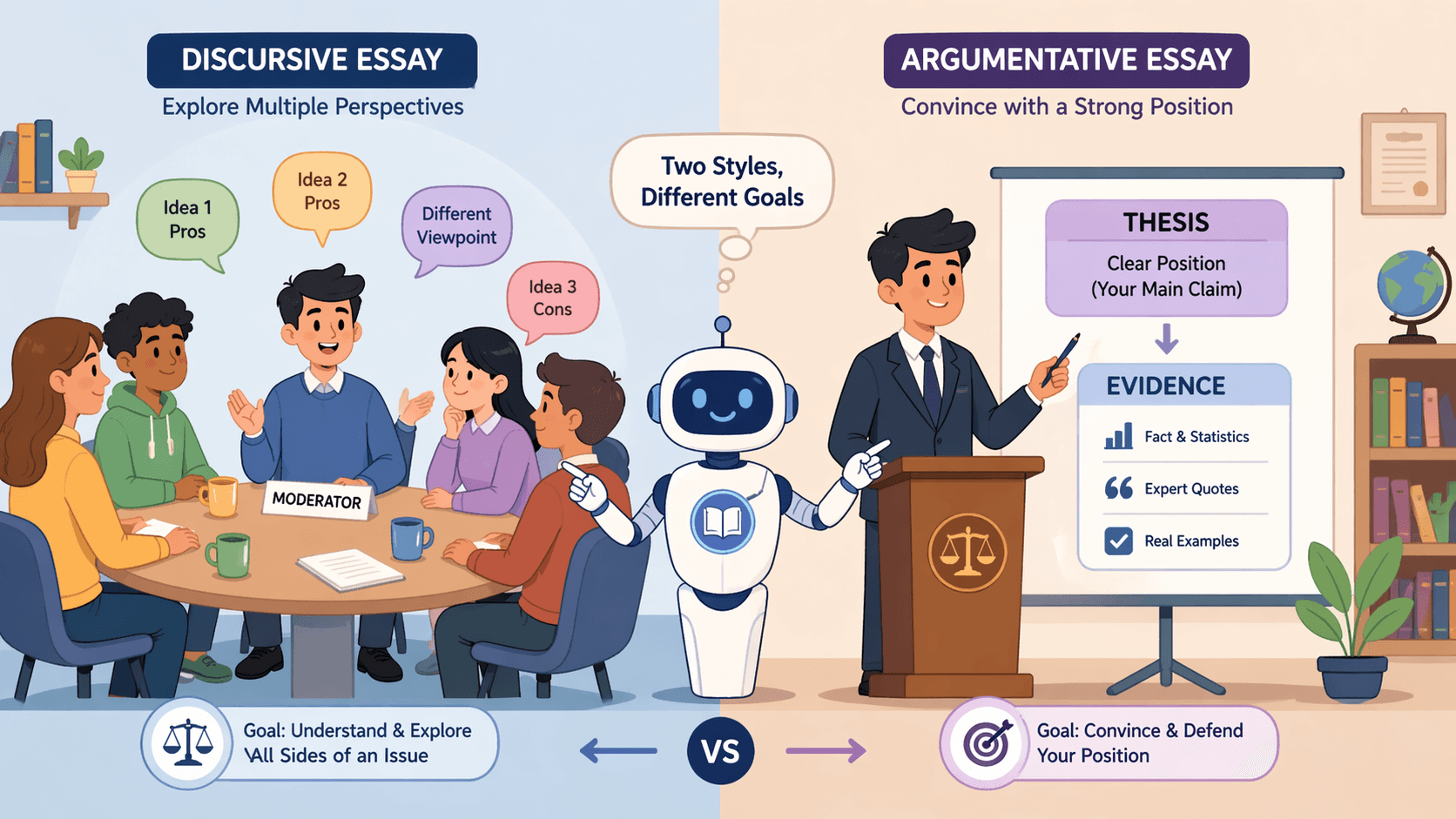
A discursive essay is like a fair moderator, ensuring every perspective gets a hearing.
An argumentative essay is like a dedicated lawyer, building the strongest possible defense for one side.
A Side-by-Side Comparison
Aspect | Discursive Essay | Argumentative Essay |
Purpose | To examine and explain all sides of an issue. | To convince the reader of a specific position. |
Your Stance | Neutral, objective. | Clearly stated and defended. |
Tone | Balanced, exploratory. | Persuasive, evidence-driven. |
Structure | Presents pros, cons, and varied viewpoints. | States a claim, provides supporting evidence, and rebuts counterarguments. |
Conclusion | Summarizes the discussion without taking a side. | Reinforces your thesis and its importance. |
Where Students Go Wrong
The mix-up happens because both essays tackle debatable subjects. The confusion starts there. It's a frequent complaint in study groups, students begin with the intention to be neutral but slip into advocating for one view.
That shift breaks the fundamental rule of a discursive essay, turning exploration into persuasion. Many of these issues come from not following clear essay writing principles early on.
<ProTip title="💡 Pro Tip:" description="If your conclusion takes a side you are writing an argumentative essay not a discursive one" />
When Should You Use Each Essay Type?
Your choice depends entirely on what the assignment asks you to do.
Use a Discursive Essay for Exploration
The core of a discursive essay is balanced discussion. You'll see this format when the prompt uses language like:
"Discuss the advantages and disadvantages..."
"Explore both sides of the issue..."
"Analyze the various perspectives on..."
Take the topic, "Should social media be regulated?" In a discursive essay, your role isn't to pick a winner.
Your job is to objectively lay out the case for regulation and the case against it, analyzing the merits of each position. The goal is a thorough, even-handed examination.
Use an Argumentative Essay for Persuasion
An argumentative essay has one mission: to convince. Look for directive prompts such as:
"To what extent do you agree or disagree?"
"Argue for or against the following statement..."
"Defend your position on..."
Now, the same topic becomes a stance: "Social media should be regulated to curb the spread of misinformation."
Here, your goal is clear. You must state a definitive thesis, support it with robust evidence, and directly refute potential counterarguments.
What This Looks Like on the Page
This distinction changes your writing at the sentence level.
A discursive writer says: "Proponents argue X, while critics counter with Y."
An argumentative writer says: "Although some claim Y, the preponderance of evidence demonstrates X."
A common reason students lose marks is using an argumentative, persuasive tone in an assignment that requires a neutral, discursive one. Matching your approach to the prompt's verb is the first critical step.
<ProTip title="🧠 Reminder:" description="Always check keywords like discuss or argue before choosing your essay type" />
Discursive Essay Structure Explained
A discursive essay is built to present a balanced discussion. Its structure is designed to maintain fairness throughout.
The Standard Format
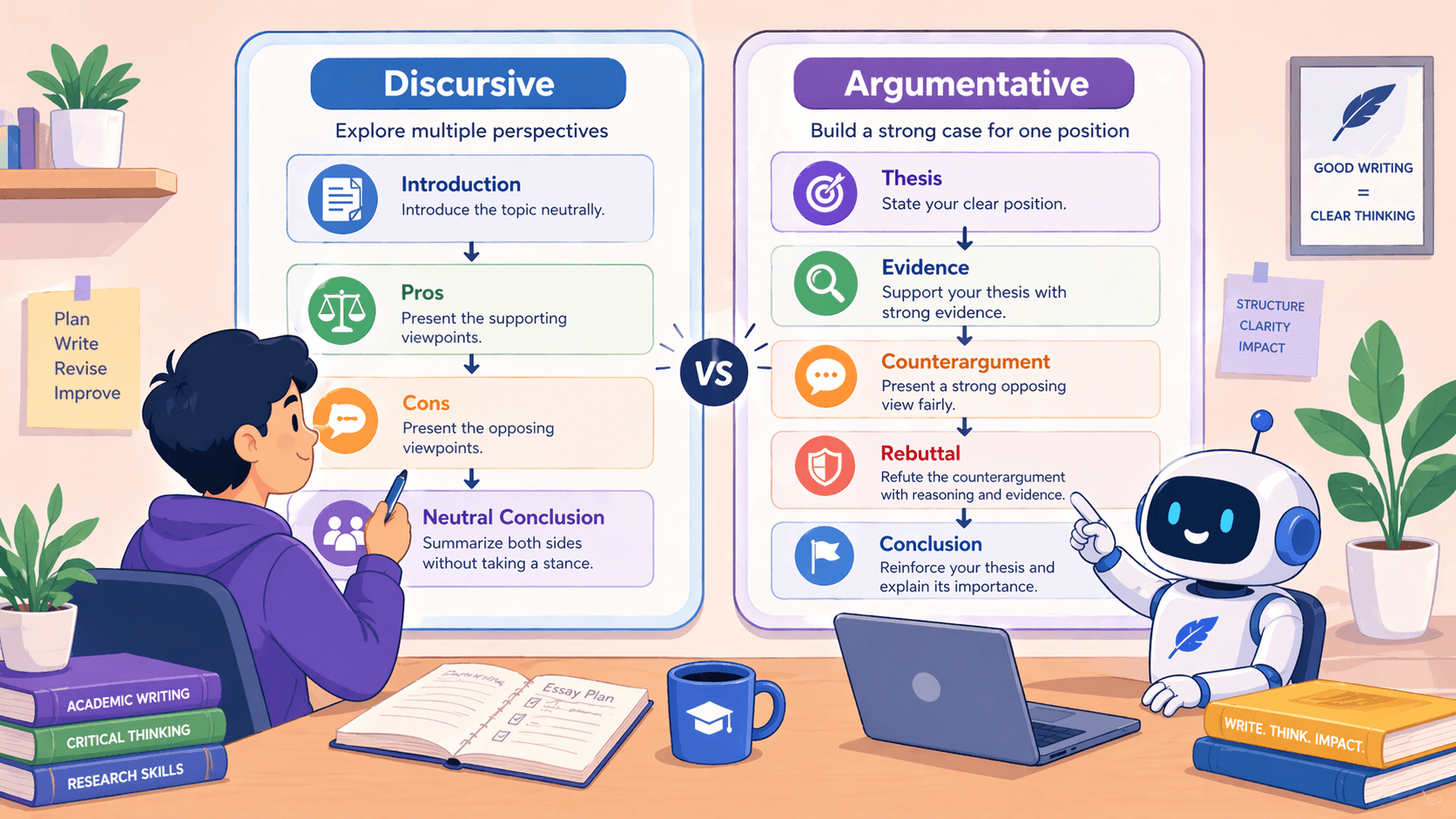
Most discursive essays follow a clear, four-part layout:
Introduction
Arguments 'For'
Arguments 'Against'
Conclusion
This classic pros-and-cons structure ensures you cover the topic from multiple angles. If you're unsure how to organize ideas clearly, reviewing a how to structure essay guide can help reinforce this framework.
Crafting the Introduction
The opening paragraph should introduce the topic neutrally. It states that a debate exists, but doesn't tip your hand.
If you struggle to hook your reader effectively, reviewing how to write essay introduction hook can help you build stronger openings without losing neutrality. For example:
"The role of social media in modern society is a subject of considerable debate. Its influence is viewed by some as overwhelmingly positive and by others as deeply problematic."
Building the Body: Presenting Both Sides
Each body paragraph should focus on a single viewpoint or argument. You might dedicate one section to the supporting perspectives:
"Advocates point to social media's power to connect people across vast distances and mobilize communities for social causes."
Then, a following section would address the opposing side:
"Conversely, detractors emphasize the platforms' role in amplifying hate speech and facilitating the rapid spread of false information."
The key is to give each side a fair and coherent presentation.
Writing the Conclusion
The conclusion synthesizes the discussion without declaring a winner. It acknowledges the complexity. A typical closing might state:
"In summary, social media presents a dual-edged reality. It enables unprecedented communication and activism yet also creates substantial challenges related to privacy and public discourse." The essay ends by reflecting the discussion, not by resolving it.
<ProTip title="⚖️ Balance Tip:" description="Give equal depth to both sides to maintain neutrality" />
Argumentative Essay Structure Explained
A good argumentative essay has one job: to make a clear, convincing case. You need to lay out your position and back it up, step by step. The standard format is a reliable way to do that.
The basic format Most argumentative essays follow a simple pattern.
Introduction: Start with your thesis. This is your main point in a single sentence.
Supporting arguments: Use body paragraphs to present your evidence.
Counterargument: Address a strong opposing view.
Rebuttal: Explain why that opposing view is wrong or incomplete.
Conclusion: Restate your thesis and show why it matters.
This isn't just busywork. It's the classic model for a structured critique, forcing you to think through your own argument and its weaknesses. If you're choosing a framework (like classical, Rogerian, or Toulmin), see our guide to the different types of argumentative essays.
Start with a punch: the thesis Everything hinges on your thesis statement. It defines your entire position. Don't bury it. Put it front and center. If you want help drafting a focused claim, the AI thesis statement generator can help you sharpen your stance.
A weak thesis is vague: "Social media has some problems." A strong thesis takes a stand: "Social media platforms should face government regulation to curb the spread of misinformation and its damage to public debate."
See the difference? The second one gives you a direction to follow.
Proving your point: the arguments Each paragraph after your intro should support your thesis with solid evidence. As the Harvard College Writing Center puts it, persuasion depends on credible data and sound logic. You can explore more practical techniques in strategies essay writing. Your paragraphs might include:
Relevant statistics from a trusted source.
Quotes or findings from experts in the field.
Analysis of a real-world case study.
Pick your best evidence. One strong, well-explained piece of data per paragraph is better than three weak ones.
The secret weapon: counterarguments This is where many essays fall short. A persuasive writer doesn't ignore other viewpoints; they tackle them head-on. First, fairly explain a good counterargument to your position.
For example: "Critics of regulation argue that it infringes on free speech and could be used for censorship."
Then, you rebut it. Show why that counterargument doesn't hold up. "However, targeted regulations focusing on verifiable falsehoods, like health misinformation during a pandemic, can reduce public harm without broadly limiting speech. The goal isn't to silence opinion, but to limit demonstrably false content."
Doing this doesn't weaken your case. It makes you look more credible and your argument more robust, because you've already answered the reader's biggest objection.
Ending with force: the conclusion Don't just repeat your introduction. Your conclusion should reinforce your stance by briefly summarizing the path you took. Then, take it a step further. Suggest an action, imply a consequence, or highlight the broader importance.
A flat conclusion re-states: "Therefore, social media should be regulated." A strong conclusion resonates: "Failing to establish clear rules for social media allows misinformation to distort democracy itself.
Regulation isn't about limiting ideas, but about protecting the factual ground on which healthy public discourse depends."
Be clear. Be direct. Leave them convinced.
<ProTip title="🔥 Argument Tip:" description="Always include at least one counterargument to strengthen your credibility" />
Side-by-Side Structural Comparison
The best way to understand these two essay types is to see them compared directly.
Section | Discursive Essay | Argumentative Essay |
Introduction | Presents a neutral overview of the topic. | Starts with a clear thesis statement, taking a firm position. |
Body | Explores the issue from multiple angles, presenting pros and cons in a balanced way. | Builds a case for one side of the issue, using evidence to support that single argument. |
Evidence Use | Cited to fairly support different perspectives within the discussion. | Cited specifically to back up and prove the chosen argument. |
Counterargument | Presented as one valid perspective among others, with equal weight. | Acknowledged and then strategically refuted to strengthen the main position. |
Conclusion | Summarizes the discussion neutrally, often without a personal stance. | Reinforces the original thesis and stance, aiming to persuade the reader. |
The core difference is simple. A discursive essay explores a topic, while an argumentative essay fights for a position. One is balanced writing, the other is opinion-based persuasion.
Common Student Mistakes and How to Fix Them
Knowing the theory is one thing. Applying it is another. Here are a few practical problems students run into, and straightforward ways to solve them.
Mistake 1: Arguing in a discursive essay It’s easy to slip into persuasion when you’re supposed to be explaining. Students often add subtle opinions without realizing it. That breaks the required neutrality.
Fix: Scrub persuasive language from your draft. Look for words that push a conclusion.
Remove phrases like "This proves..." or "Clearly...".
Replace them with neutral phrasing: "This suggests...", "One interpretation is...", or "Some argue that...".
Your job is to present the landscape, not to build a road through it.
Mistake 2: Being too neutral in an argumentative essay The opposite problem is just as common. Some essays fail because they hedge, presenting both sides equally and never committing to a strong stance. This creates a muddy, unfocused argument.
Fix: Pick a side. State your position in a clear, direct thesis statement right in the introduction. Then, reinforce that position in every single body paragraph.
Every piece of evidence should connect back to proving your point. If you find yourself writing "on the other hand" too often, you've probably drifted back into neutrality.
Mistake 3: Weak or missing structure Without a solid plan, essays fall apart. They become confusing for the reader to follow. Research from the Purdue OWL writing lab shows that clear structure directly improves readability and, frankly, your grade.
Fix: Don’t just start writing. Plan first. To map your sections quickly before drafting, you can use our essay outline generator.
Outline your main points before you write a single paragraph.
Assign one main idea to each paragraph. Don’t cram two arguments into one.
Use transitions between paragraphs. Words like "Furthermore," "In contrast," or "As a result" act as signposts, guiding your reader through your logic.
A good structure isn't a constraint; it's the frame that holds your argument up.
<ProTip title="📌 Structure Tip:" description="Outline your essay before writing to maintain logical flow" />
Writing Techniques That Improve Both Essays
Even though discursive and argumentative essays have different goals, the toolbox for writing them well shares a lot of the same tools. Mastering a few core skills will make both types stronger.
1. Use transition words for clarity These words are the glue that holds your paragraphs together. They show the relationship between your ideas, making your essay easier to follow.
In a discursive essay, you’ll use transitions to shift between perspectives: "On the other hand...", "Alternatively...", "Conversely..."
In an argumentative essay, transitions build logical connections: "However...", "Therefore...", "Consequently...", "For example..."
Without them, an essay feels like a list of disconnected statements.
2. Back it up with evidence and examples No essay is just an opinion. Both types need solid support to be credible. Your job is to show, not just tell.
Strong evidence usually falls into a few categories:
Research data and statistics from reliable sources.
Concrete, real-world examples that illustrate your point.
Quotes or insights from recognized experts in the field.
A paragraph with a claim but no evidence is just an assertion. Evidence turns it into an argument.
If you want to strengthen clarity and depth, improving fundamentals like structure and clarity through how to improve essay writing can make a big difference.
3. Keep a consistent academic tone Whether you're exploring or persuading, the writing itself needs to sound formal and controlled.
You should generally avoid:
Slang and casual phrases. Write "many people" not "a lot of folks."
Overly emotional language. Words like "disastrous" or "amazing" often sound exaggerated. "Problematic" or "significant" are more precise.
Aim for clear, direct, and precise wording. It makes you sound more authoritative, whether you're presenting a balanced discussion or making a case.
Quick Decision Framework
Stuck looking at an assignment prompt? Ask yourself these three simple questions.
Do I need to stay completely neutral, or can I pick a side?
Is my main job to persuade the reader of something?
What verb does the prompt use? Does it tell me to "discuss" or to "argue"?
Your answers will point you straight to the right format.
The decision table
If your answer is "yes" to... | Write a Discursive Essay | Write an Argumentative Essay |
Neutral tone required? | ✔ Yes | ✘ No |
Clear personal stance needed? | ✘ No | ✔ Yes |
Balanced viewpoints required? | ✔ Yes | ✘ No |
Persuasion is the main goal? | ✘ No | ✔ Yes |
Think of it this way: if the prompt asks you to explore or examine a topic, it's probably discursive. If it asks you to prove or defend a position, it's argumentative.
This framework cuts through the confusion and lets you start writing with the right approach.
<ProTip title="✅ Decision Tip:" description="If your teacher expects a position always choose argumentative structure" />
Choose the Essay Style That Matches What You’re Trying to Say
You sit there unsure if you should explore both sides or push one clear stance, and your writing starts to feel messy. It’s confusing. A discursive essay looks at different views, while an argumentative essay takes a position and supports it with clear reasoning.
<CTA title="Write Better Essays with Clear Structure" description="Organize arguments and discussions with guided academic writing support" buttonLabel="Try Jenni Free" link="https://app.jenni.ai/register" />
If you want to keep your structure clear from the start, Jenni can guide your writing without taking over your ideas. It helps you stay focused on your point while keeping everything organized, so your essay feels sharp and easy to follow.