By
Justin Wong
—
How to Avoid Literature Review Mistakes in Academic Writing

Justin Wong
Head of Growth
Graduated with a Bachelor's in Global Business & Digital Arts, Minor in Entrepreneurship
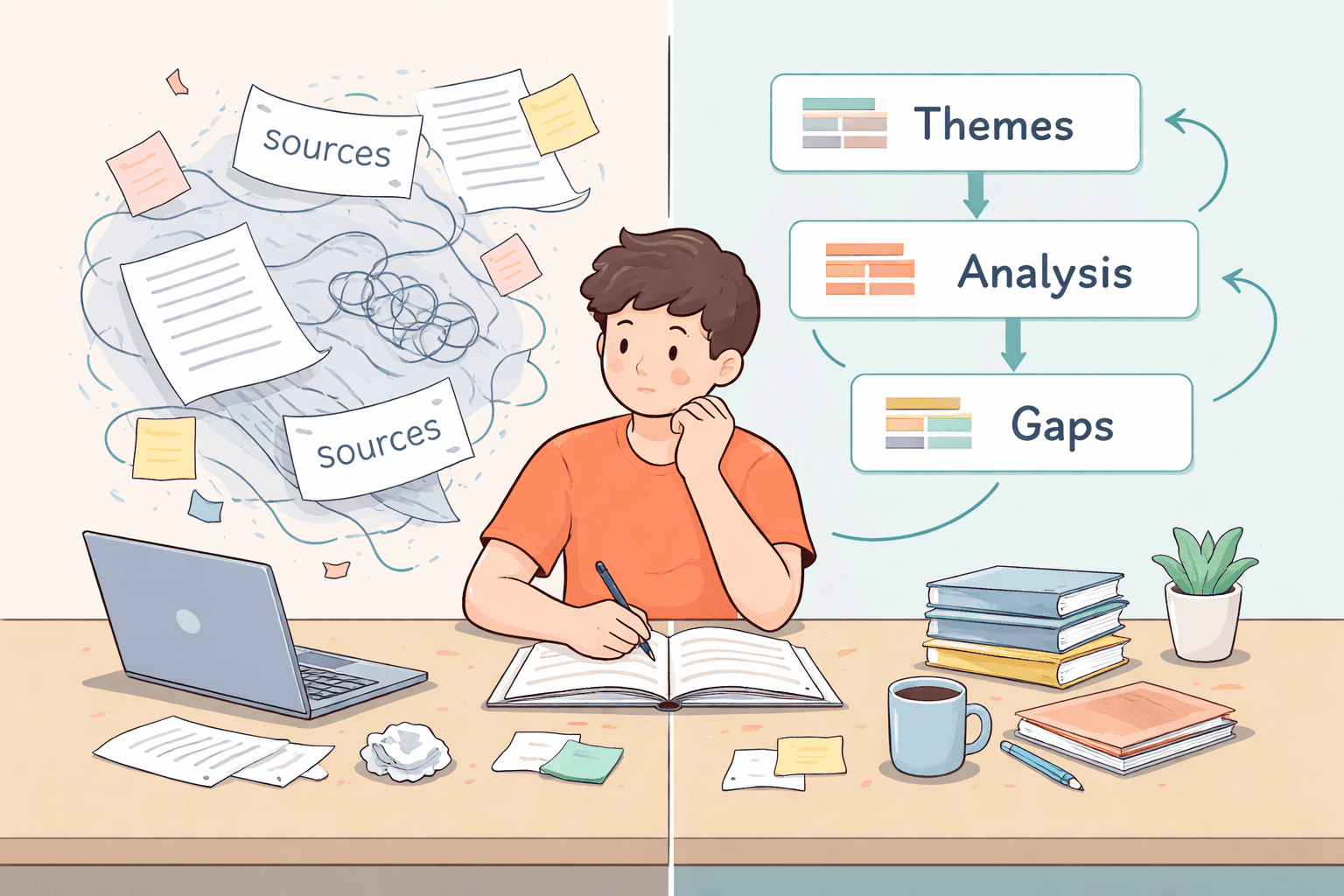
A bad literature review just lists sources, uses weak references, or has no clear direction. These errors hurt your paper’s clarity and credibility.
Students often find it hard to organize their sources, spot the gaps in existing research, or keep their argument on track.
This guide walks you through fixing those common mistakes with clear strategies, real examples, and a step-by-step process. Start building a stronger review right here.
<CTA title="Write Strong Literature Reviews Faster" description="Organize sources synthesize research and build clear academic arguments with guided structure" buttonLabel="Try Jenni Free" link="https://app.jenni.ai/register" />
What Makes Literature Review Mistakes So Common
Literature reviews require a tricky combination of skills. You need to research and write, but many people approach them wrong, they just summarize other studies instead of analyzing them.
A report from the literature review research process points out that a messy, unstructured review can make your entire paper unclear. A messy, unstructured review is one of the leading causes of manuscript rejection by peer reviewers.
The Main Issue: Summarizing, Not Synthesizing
A weak review sounds like a simple list: "Smith studied X in 2020. Jones looked at Y in 2021."
This just repeats what others found. It doesn't build anything new.
A strong review connects the dots. It creates a conversation: "While Smith's 2020 work focused on X, Jones challenged that idea a year later by showing how Y works in a completely different setting."
That's the difference. It's moving from a catalog to a critical discussion.
How Structure Falls Apart
Too often, the planning stage gets skipped. Students dive straight into writing. The result is predictable: paragraphs are jumbled, the same points get repeated, and the logical thread disappears entirely.
<ProTip title="💡 Pro Tip:" description="Group studies into themes before writing to avoid fragmented paragraphs" />
The Most Common Literature Review Mistakes
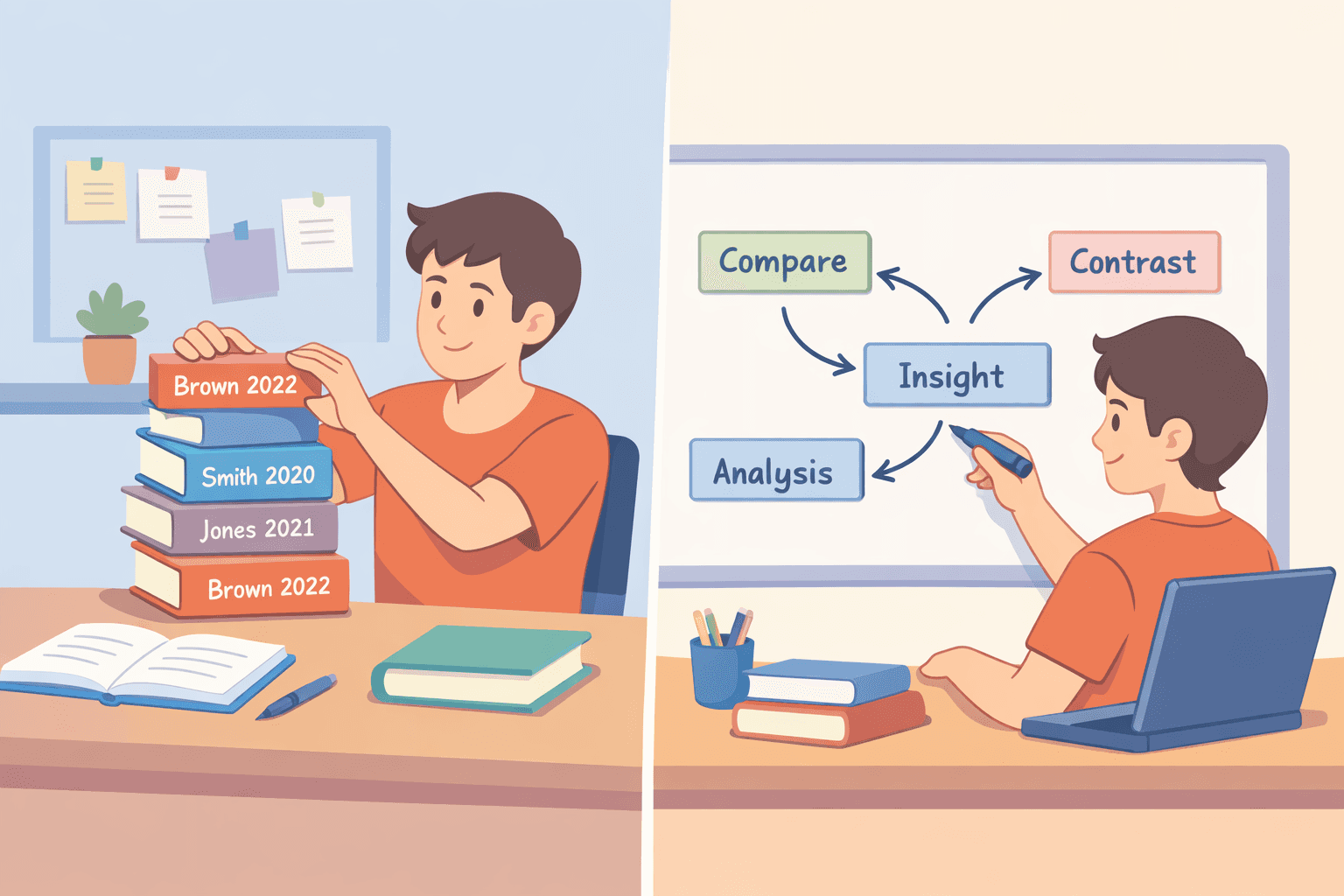
Knowing where things go wrong is the first step to fixing them. Let's break down the biggest pitfalls.
1. Weak or Outdated Sources
Your review's credibility crumbles if you use poor sources. This often means citing personal blogs instead of peer-reviewed journals, leaning on textbooks older than ten years, or missing the latest studies.
Harvard Library suggests a solid review balances landmark theories with research from the last five years. Strong source selection mixes foundational ideas, recent journal articles, and different viewpoints.
For instance, you could pair a classic theory with new studies that test it in modern settings, showing you understand the history and the current conversation.
This approach aligns with literature review writing guide recommendations for evaluating and selecting credible sources.
2. Summarizing Instead of Analyzing
A lot of reviews just describe what other people found. They list results without asking questions. You can spot this when there's no comparison between studies, no talk about their limitations, and no real argument being built.
To turn a summary into analysis, you have to connect the dots. Don't just say "Study A found X."
Instead, point out that "While quantitative studies show a strong link between X and Y, qualitative work reveals the limits of that connection in real-world situations." This builds a deeper understanding.
<ProTip title="📌 Reminder:" description="Always explain why studies matter not just what they say" />
3. A Flawed Search Strategy
If your search is bad, you'll miss important work. Common errors are searching only one database, using terms that are too narrow, and forgetting to try synonyms.
Research from Cambridge indicates that searching across multiple databases can boost your coverage by more than 50%.
An effective search uses structured techniques. Combine keywords with AND, OR, and NOT. Don't just use Google Scholar, try Scopus or Web of Science too. And use a reference manager like Zotero from the start—Jenni’s Zotero and Mendeley integration can help you import libraries and keep citations consistent—to keep everything organized.
4. Missing the Gaps
The whole point of a review is to figure out what's not known. If you don't identify a gap, your own research has no clear reason to exist. A simple example: plenty of studies look at education in cities, but very few examine what happens in rural schools. That's a clear gap.
5. Disorganized Structure
A messy structure makes your review hard to follow. This happens when studies are presented in a random order, there are no clear sections, and paragraphs don't connect.
The fix is thematic organization. Group your discussion by ideas, like different methodologies, conflicting findings, or major debates, not by listing authors one after another. This creates a natural, logical flow for your reader.
<ProTip title="💡 Pro Tip:" description="Use topic sentences to guide each paragraph and maintain clear direction" />
6. Citation Problems
Getting citations wrong hurts your credibility and can have serious consequences. The usual slip-ups are forgetting references altogether, using the wrong format (like APA instead of MLA), or quoting too much instead of paraphrasing.
As research citation guidelines stress, proper citation is non-negotiable for maintaining academic honesty and avoiding plagiarism.
Literature Review Best Practices (What Actually Works)
Moving from mistakes to solutions requires a practical plan. These workflows show you how to build a review that holds up.
Start with a Clear Outline
Never start writing from a blank page. Build a structured outline first. It acts as your roadmap and stops your writing from becoming a disorganized mess.
To make this process easier, you can follow a proven structure from this guide on how to write literature review outline, which breaks down each section step by step.
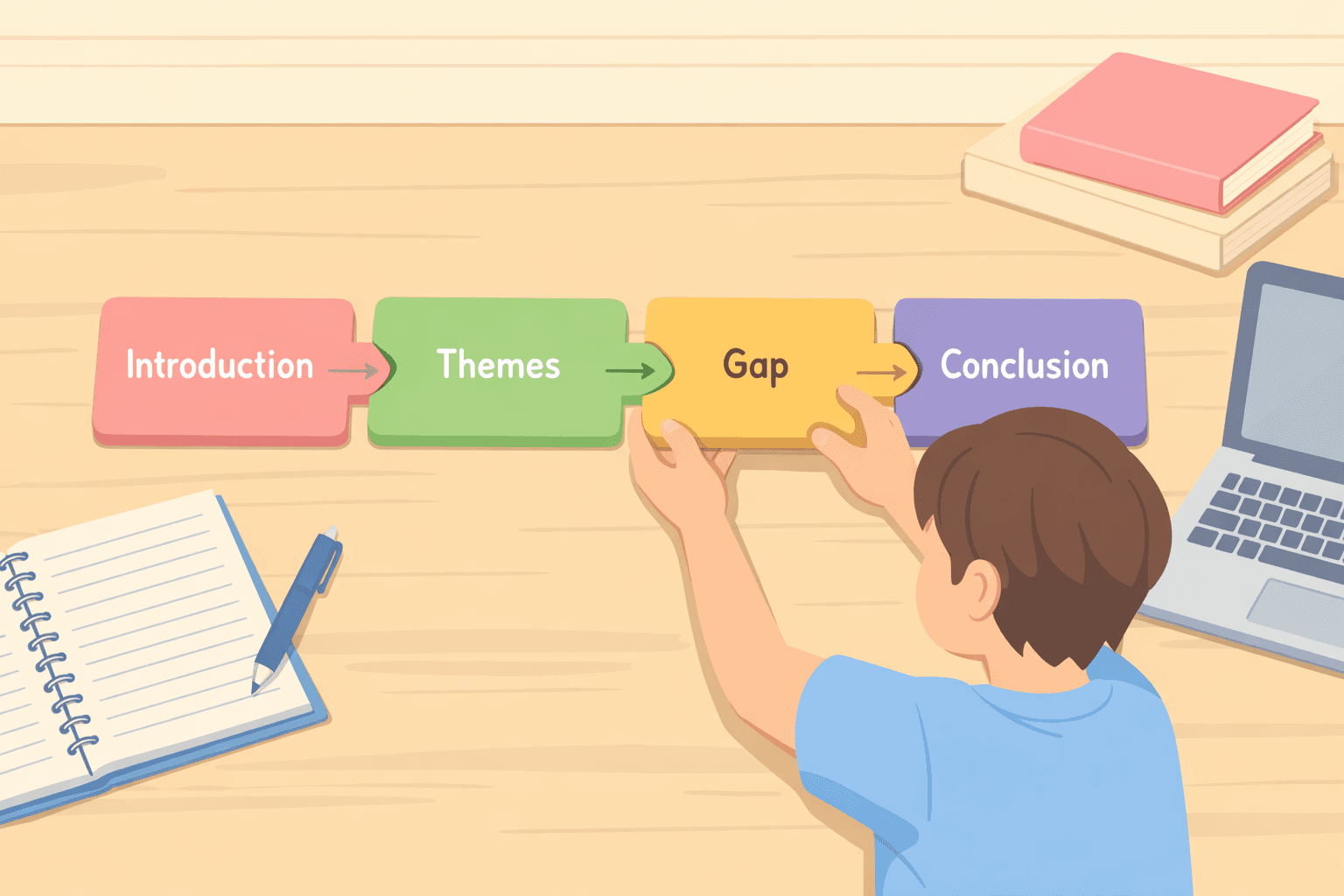
A solid outline typically includes these core sections:
Section | Purpose | Example |
Introduction | Defines the scope and focus of your review. | State your specific topic and the central research question you're addressing. |
Thematic Body | Analyzes and synthesizes the existing research. | Group studies by common ideas, debates, or methodologies, not by author. |
Gap Analysis | Identifies what is missing in the current research. | Clearly state the unanswered question or underexplored area your study will address. |
Conclusion | Summarizes key insights and looks forward. | Synthesize the main themes and explain how your research will build upon them. |
This framework forces you to think about connections and purpose from the very beginning. It turns a pile of notes into a coherent argument.
Use Thematic Grouping Instead of Listing Studies
Organizing your review by author name is a common trap. It leads to a choppy, disconnected list. A better approach is thematic grouping.
Instead of writing "Smith (2020) found X. Jones (2021) found Y," you create sections around ideas.
Theme 1: The benefits of technology in education.
Theme 2: The practical and financial barriers to its adoption.
This method forces you to compare and contrast studies within a shared concept, which is the essence of synthesis. It creates logical connections for your reader and highlights the actual conversation happening in the field.
This approach is commonly used in formats like a narrative literature review, where studies are woven together into a cohesive story rather than listed individually.
Balance Sources Carefully
Your review loses credibility if it leans too heavily on one researcher, a single school of thought, or only old studies. A balanced review demonstrates fairness and depth.
Aim to include a mix:
Foundational theories that established the field.
Recent peer-reviewed studies from the last 3-5 years.
Multiple perspectives, including studies that disagree with each other.
This shows you’ve done comprehensive research, not just found a few papers that support your pre-existing idea.
Maintain Academic Tone and Clarity
Academic tone isn't about using the most complex words. It's about being clear, direct, and precise. Avoid informal language, vague phrases like "some studies show," and claims you can't back up with a citation.
Read your sentences aloud. If they sound convoluted or unsure, simplify them. Use strong, active verbs. Instead of "It was observed by researchers that growth occurred," write "Researchers observed growth."
Edit and Revise Strategically
Your first draft is just that, a first draft. The real work happens in revision. Don't just check for typos; edit for logic and impact. Set your draft aside for a day, then return to it.
Focus on cutting repetitive points, smoothing the transitions between paragraphs so one idea flows to the next, and strengthening your core argument on every page. Ask yourself: Is my position clear? Does each paragraph serve that position?
<ProTip title="📌 Note:" description="Read your review aloud to identify awkward phrasing and weak transitions" />
Example: Weak vs Strong Literature Review Paragraph
Seeing the difference side-by-side makes it obvious.
Weak Version
Smith (2020) studied the impacts of climate change on agriculture. Jones (2021) researched adaptation strategies for farmers. Brown (2022) examined related policy challenges.
This is just a list. It tells us what each author did, but nothing more. The studies sit in isolation, with no connection, comparison, or critical thought. It's a summary, not a synthesis.
Strong Version
Research on climate change and agriculture reveals a disconnect between problem identification and practical solutions. Smith's 2020 work details the severe impacts on crop yields, establishing a clear threat.
Jones built on this in 2021, cataloging potential adaptation strategies for farmers. However, Brown's 2022 policy analysis shows a significant gap: these strategies often fail due to a lack of supportive legislation and funding.
This progression highlights a critical research gap between identifying adaptive techniques and the systemic changes needed to implement them.
This version does the real work. It connects the studies into a narrative, showing how one idea leads to another. It compares their focuses, from impacts, to solutions, to implementation barriers. Most importantly, it doesn't just describe; it analyzes the relationship between the findings and identifies a clear, meaningful gap in the knowledge.
Literature Review Checklist for Students
Run through this list to make sure your literature review is complete and holds up.
A Clear Research Question: Can you state the specific question your review addresses in one sentence?
Strong, Relevant Sources: Have you used recent, peer-reviewed studies and balanced them with key foundational works?
Thematic Organization: Is your review grouped by ideas and debates, not just a list of authors?
Evidence-Based Analysis: Does your writing compare, contrast, and critique the studies, rather than only describing them?
Proper Citations: Is every claim and reference correctly cited in the required format (APA, MLA, etc.)?
Logical Flow: Do your paragraphs connect smoothly, building a coherent argument from start to finish?
Checking these points helps you catch common errors and submit work that is clear, credible, and analytical.
Advanced Challenges in Literature Reviews
Even for experienced writers, literature reviews in complex areas present specific hurdles. Here’s how to tackle them.
The Interdisciplinary Hurdle
Merging research from different disciplines is tough. You’ll run into conflicting jargon, clashing research methods, and frameworks that don’t align. A study on community health might use "resilience" differently than a paper on urban planning.
The fix requires clarity and comparison. Start by explicitly defining the key terms you’re using for your specific review. Don’t assume they mean the same thing everywhere.
Then, dedicate a section to comparing the methodologies from each field, explain why a sociologist’s qualitative approach and an economist’s quantitative model lead to different kinds of insights.
Combating Selection Bias
It’s easy to only cite sources that support your hypothesis. This cherry-picking damages your objectivity and credibility.
To build a fair review, you must actively seek out and include significant studies that contradict your position. Discuss them seriously. Also, openly acknowledge the limitations of the studies you do cite, no single piece of research is perfect.
Part of this process also involves recognizing what’s missing in the literature. If you need a structured way to do that, this guide on how to identify research gaps can help you systematically spot gaps and strengthen your analysis.
Handling an Overwhelming Number of Sources
When you’re dealing with a hundred or more papers, it’s easy to get lost in the pile.
Effective management is key. Use a reference tool like Zotero or EndNote from day one. More importantly, don’t just collect PDFs. As you read, immediately categorize each source by its main theme, methodology, or position in a debate.
This early sorting turns a mountain of reading into a structured library, helping you quickly identify which sources are most relevant to each section of your argument.
<ProTip title="💡 Pro Tip:" description="Tag sources by theme to speed up writing and organization" />
Write Reviews That Actually Make Sense
Avoiding literature review mistakes requires clear structure, strong sources, and critical thinking. When you move beyond summary and focus on synthesis, your writing becomes more analytical and impactful.
<CTA title="Improve Your Literature Review Writing" description="Organize sources build strong arguments and refine academic writing with structured support" buttonLabel="Try Jenni Free" link="https://app.jenni.ai/register" />
Using tools like Jenni—such as an AI literature review & RRL generator—alongside these strategies helps you manage sources, structure ideas, and produce high-quality literature reviews that meet academic standards.