{{HeadCode}} What Is a Capstone Project? Meaning, Types, and Examples

通过

内森·奧勇

2025年10月31日

通过

内森·奧勇

2025年10月31日

通过

内森·奧勇

2025年10月31日

What Is a Capstone Project? A Simple, Step-by-Step Guide for Students

奥扬的个人资料图片

内森·奧勇

安永的高级会计师

获得会计学学士学位,完成会计研究生文凭

奥扬的个人资料图片

内森·奧勇

安永的高级会计师

获得会计学学士学位,完成会计研究生文凭

奥扬的个人资料图片

内森·奧勇

安永的高级会计师

获得会计学学士学位,完成会计研究生文凭

A capstone project is usually the final major assignment in a degree program. It appears near the end of your studies and brings everything you have learned into one focused project. Instead of exams or short papers, you work on a larger task over time to show how well you can apply ideas and skills in real or realistic situations.

This guide explains what a capstone project is, why schools require it, and how the process works. It breaks the project into clear stages, covers common formats, and shares practical tips to help you complete your work with confidence and less stress.

<CTA title="Build a Strong Problem Statement" description="Generate a precise, publication-ready statement in minutes, no stress, no fluff." buttonLabel="Try Jenni Free" link="https://app.jenni.ai/register" />

What a Capstone Project Is

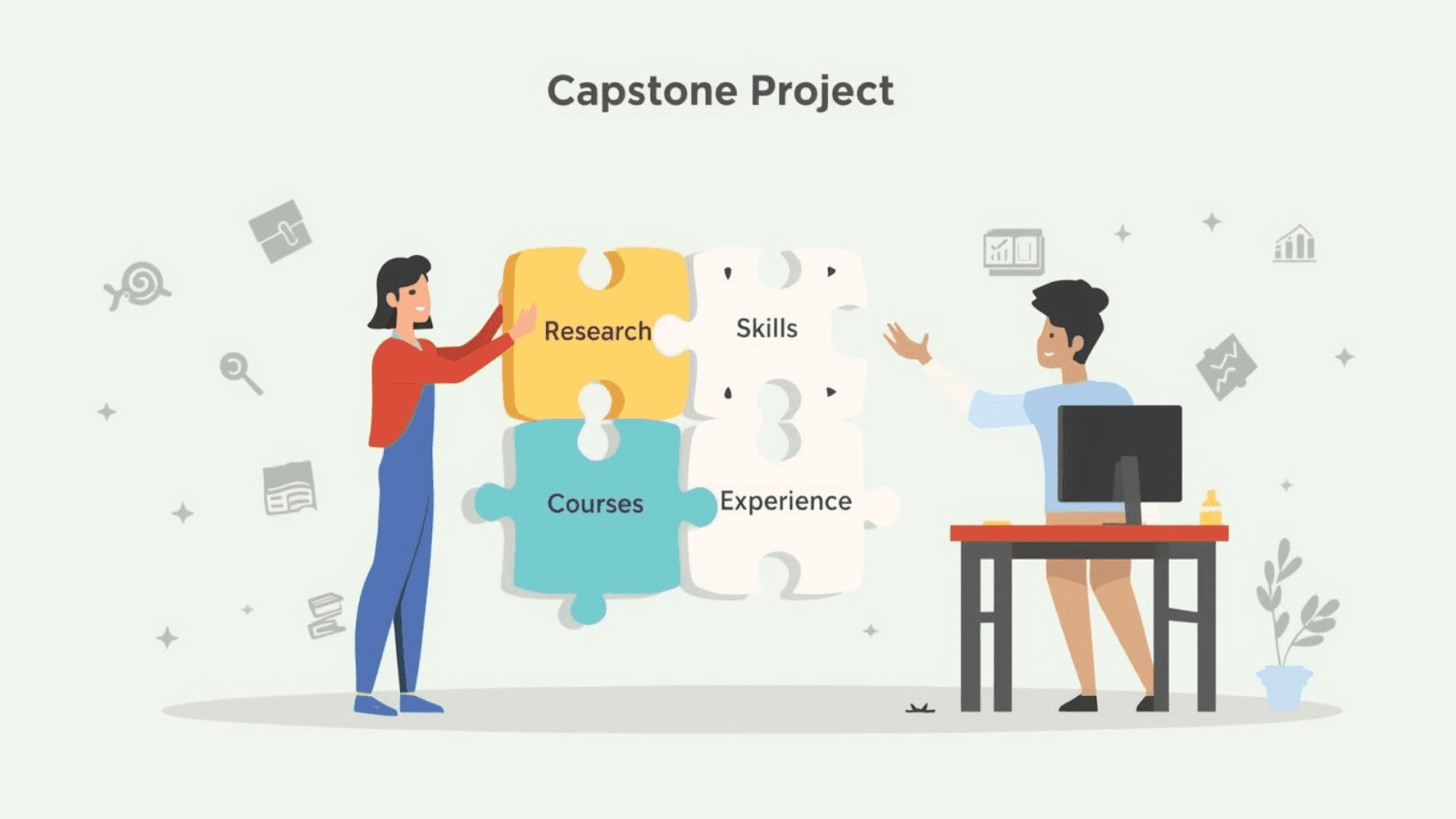
A capstone project is a final project that brings together the knowledge and skills you gained during your degree program. It is designed to test how well you can apply learning.

It’s not just about remembering information. Many programs use this project to move students from classroom theory into theory-to-practice work that reflects real professional tasks.

Most capstone projects focus on a real or realistic problem connected to your field of study. You may research it, design a solution, or work directly with people or organizations to apply what you have learned.

Capstone projects appear in many programs, such as:

  • Undergraduate degrees

  • Graduate degrees

  • Professional programs like business, nursing, education, and engineering

Some capstone projects are completed individually. Others are group projects. Both formats aim to test your ability to think, plan, and complete complex work.

In simple terms, a capstone project answers this question:

Can you use what you learned to solve a meaningful problem?

Why capstone projects matter

Capstone projects exist because they show learning more deeply. Exams and quizzes only measure short-term memory. A capstone project shows long-term understanding.

Schools use capstone projects to:

  • Measure overall learning outcomes

  • See how students connect ideas across courses

  • Prepare students for careers or further study

For students, capstone projects build confidence. They show that you can handle complex tasks and finish long projects.

<ProTip title="💡 Pro Tip:" description="Your capstone project often reflects your full degree. Treat it as a summary of your academic journey." />

How a Capstone Project Is Different From Other Assignments

A capstone project is not the same as a term paper or final exam. It is also different from a thesis, even though they can look similar.

Here are the main differences:

  • A capstone project covers many courses, not just one

  • It lasts months, not weeks

  • It focuses on doing and applying, not memorizing

  • It often ends with a presentation or defense

A term paper usually tests one topic from one class.
A thesis focuses on deep academic research.
A capstone project focuses on applying learning in real situations.

Because of this, capstone projects are sometimes called:

  • Final year projects

  • Culminating projects

  • Experiential learning projects

The Main Purpose of a Capstone Project

Capstone projects are built around clear goals that support student learning.

Showing full understanding

A capstone project shows that you understand the main ideas of your field. More importantly, it shows that you can use those ideas in the right way.

Connecting school to real life

In many classes, you learn theories, models, and concepts. A capstone project asks you to use them in real or realistic settings. This helps learning feel useful and practical.

Building long-term skills

Capstone projects help students build skills they will use after graduation, such as:

  • Problem solving

  • Critical thinking

  • Planning and organization

  • Writing and speaking clearly

Preparing for the future

Many students use their capstone project when applying for jobs or graduate programs. It becomes proof of their ability and effort.

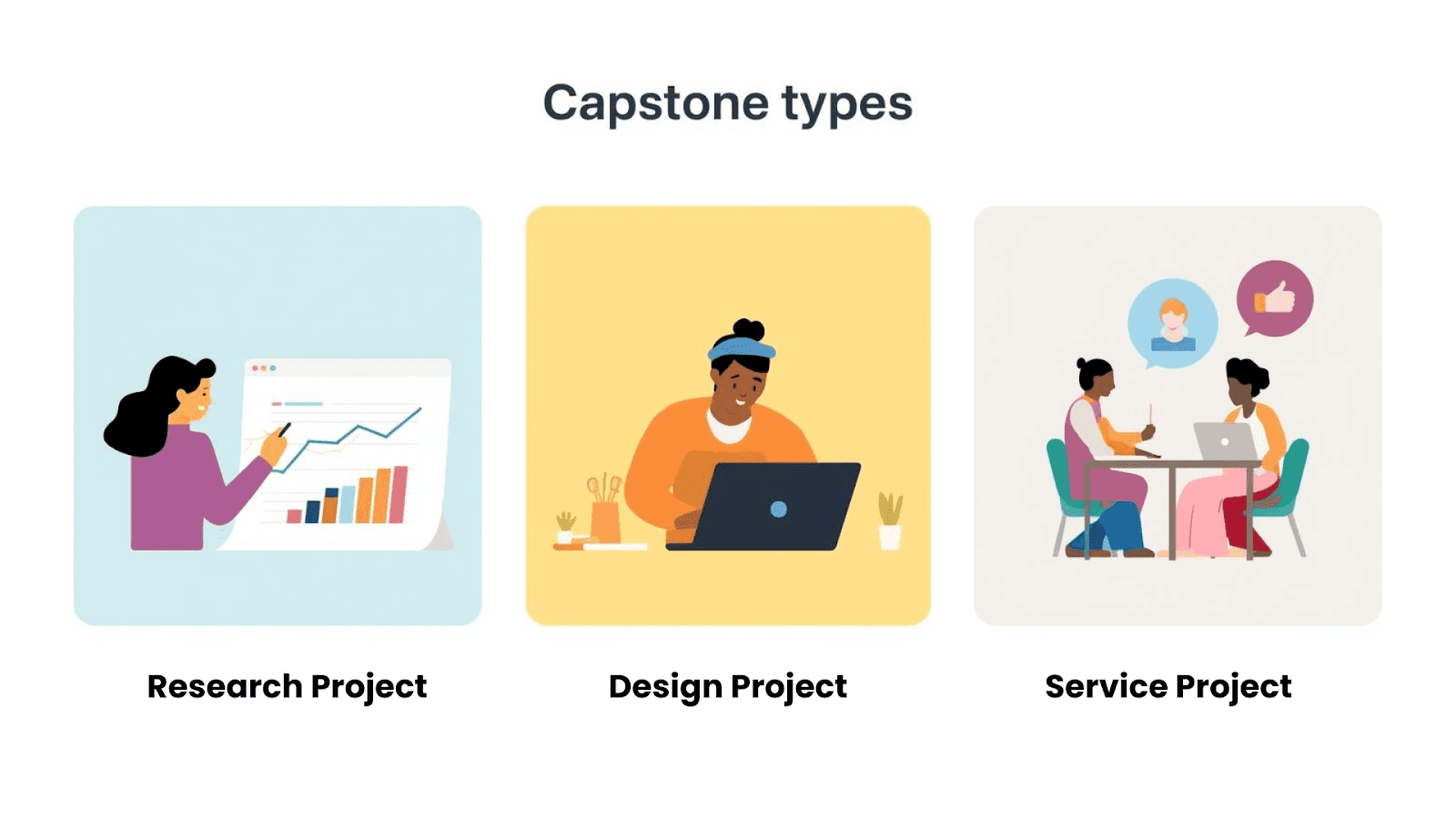
Common Types of Capstone Projects

Capstone projects come in many forms. The type depends on your major and program goals.

Research-based capstone projects

A capstone research project focuses on studying a question or problem using research methods. These projects are common in social sciences and education.

They often include:

  • A research question

  • A literature review

  • Data collection or analysis

  • A discussion of results

Example:

A psychology student studies how screen time affects sleep in college students.

Research-based capstones look like long research papers, but they focus more on applied learning than theory alone.

Design or prototype capstone projects

Design-based capstones focus on creating or improving something. These projects are common in technical and engineering fields.

They are often found in:

  • Engineering capstone projects

  • Computer science capstone projects

  • Information technology capstone projects

Students may create:

  • Software programs

  • Mobile apps

  • Devices or systems

  • Technical solutions

Example:

A computer science team builds an online tool to help students manage study schedules.

Service or practice-based capstone projects

Service-based capstones focus on real-world practice. Students work with real people in real settings.

These are common in:

  • Nursing capstone projects

  • Education capstone projects

  • Social work programs

Students may:

  • Design new programs

  • Improve existing services

  • Evaluate outcomes

Example:
A nursing student creates a health education program for patients with high blood pressure.

<ProTip title="📝 Reminder:" description="Applied projects often have real impact. Do not underestimate their value." />

Capstone Projects Across Different Majors

Capstone projects look different depending on the field of study.

Business and MBA capstone projects

A business capstone project usually focuses on real business problems. Students apply knowledge from finance, marketing, management, and strategy.

An MBA capstone project may include:

  • Business case analysis

  • Strategic planning

  • Consulting-style reports

  • Market research

These projects focus on leadership, decision-making, and problem solving.

Engineering and technology capstone projects

Engineering capstones are often team-based. Students work together over one or two semesters.

Key parts include:

  • Defining the problem

  • Designing a solution

  • Testing and improving

  • Presenting final results

Many engineering capstones involve real industry partners.

Health, education, and social science capstones

These capstones focus on people, services, and improvement.

Examples include:

  • A nursing capstone project on patient safety

  • An education capstone project on lesson design

  • A psychology capstone project on behavior change

Ethics and evidence-based practice are very important in these fields.

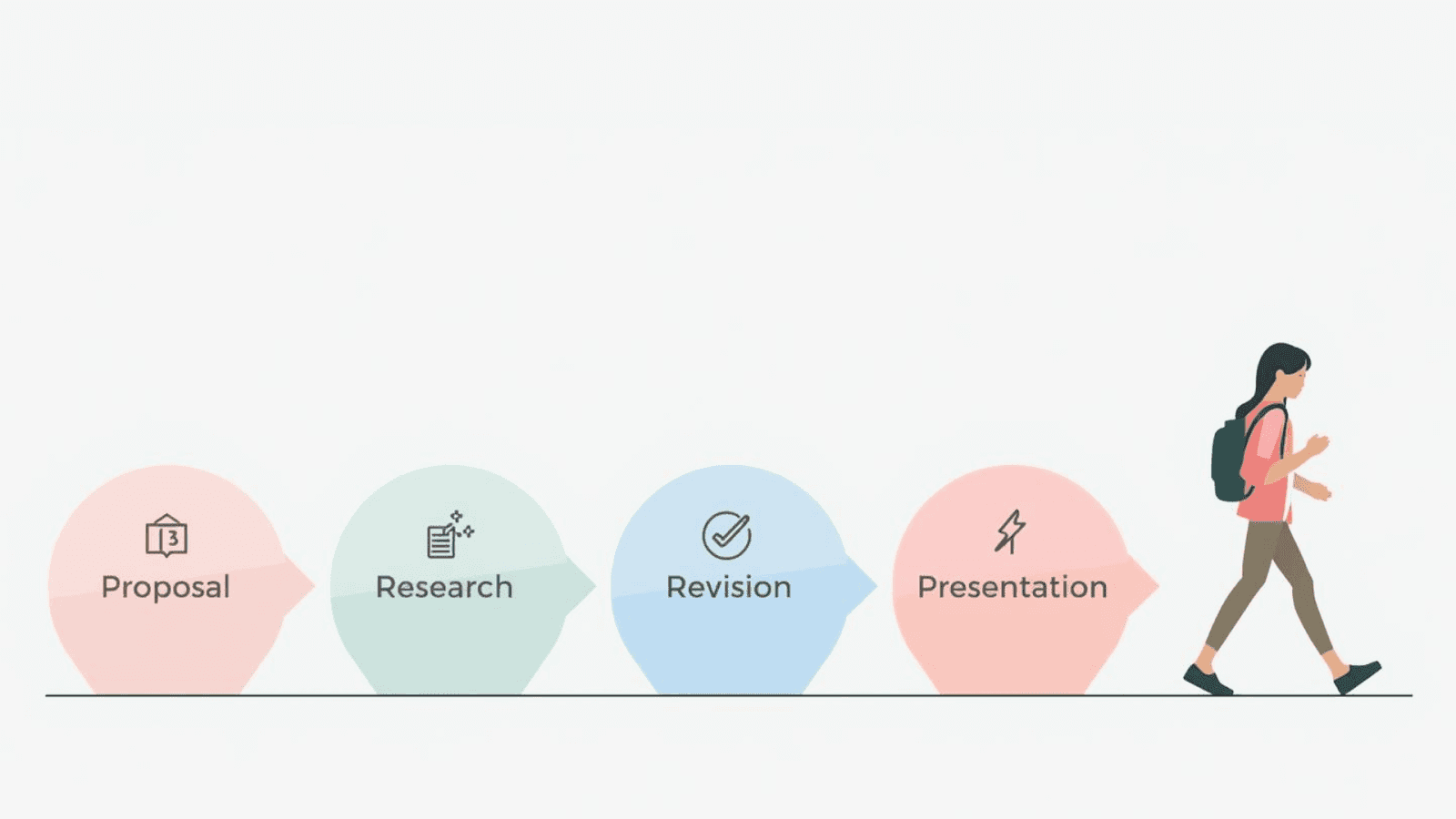
Key Stages of a Capstone Project

Most capstone projects follow the same main stages. Understanding the guidelines helps you stay organized.

Stage 1: Choosing a topic

Choosing the right topic is one of the most important steps. A strong topic is clear, focused, and realistic.

Good topics:

  • Solve real problems

  • Match your interests

  • Fit program goals

Weak topics are often too broad.

Too broad: “Mental health issues”

Better: “Stress management programs for first-year college students”

Stage 2: Writing a capstone project proposal

Most programs require a capstone project proposal. This document explains what you plan to do.

A proposal usually includes:

  • The problem or question

  • Project goals

  • Methods or approach

  • Expected outcomes

Your advisor reviews the proposal before you move forward.

<ProTip title="📌 Pro Tip:" description="A clear proposal saves time later and prevents major changes." />

Stage 3: Doing the main work

This is the longest stage. Depending on your project, you may:

  • Collect data

  • Build or test a product

  • Run a program

  • Analyze information

Regular check-ins with your capstone advisor are very helpful.

Stage 4: Revising and reflecting

Feedback is a normal part of capstone projects. You may revise your work several times.

Many programs also require a capstone reflection paper. This explains what you learned and how you improved.

Stage 5: Presentation or defense

Most capstone projects end with a presentation.

This may include:

  • An oral presentation

  • A poster presentation

  • A formal defense

  • A portfolio review

Clear speaking and simple slides make a big difference.

Capstone Project Structure and Format

While every program is different, many capstone project reports follow a similar structure.

Common sections include:

  • Title page

  • Abstract

  • Introduction

  • Literature review

  • Methodology or process

  • Results or outcomes

  • Discussion

  • Conclusion

Programs often provide a capstone project rubric or guidelines. Always follow them closely.

<ProTip title="✅ Pro Tip:" description="Write with the rubric in mind. It shows how your work will be graded." />

How Capstone Projects Are Graded

Capstone projects are graded using clear criteria.

Common grading areas include:

  • Clarity of the problem

  • Use of sources or evidence

  • Quality of analysis or design

  • Organization and writing

  • Presentation skills

Some programs also grade teamwork, planning, and professionalism.

Common Challenges in Capstone Projects

Even strong students face challenges with capstone projects.

Common problems include:

  • Topics that are too large

  • Poor time management

  • Limited access to data

  • Unclear instructions

  • Fear of public speaking

Most of these problems can be reduced with early planning and regular communication.

Best Practices for Capstone Project Success

Successful capstone projects usually follow the same good habits. These habits help students stay calm, focused, and on track from start to finish. They also reduce last-minute stress and improve the quality of the final work.

Start early

Capstone projects almost always take more time than students expect. Even small tasks can take longer when research, feedback, or revisions are involved. Starting early gives you breathing room.

When you start early, you can:

  • Explore your topic without pressure

  • Change direction if something does not work

  • Ask questions before deadlines

  • Revise your work more than once

Starting early also helps you avoid rushing. Rushed capstone projects often feel unclear or unfinished, even if the idea is good.

<ProTip title="⏰ Pro Tip:" description="Starting early gives you control over your schedule instead of reacting to deadlines." />

Break work into small steps

A capstone project can feel overwhelming if you look at it as one big task. Breaking it into smaller steps makes it easier to manage.

Create a capstone project timeline that includes:

  • Topic approval

  • Proposal submission

  • Research or design phase

  • Draft deadlines

  • Revision periods

  • Presentation preparation

Each step should have its own due date. This turns a long project into a series of short, clear tasks. Small progress each week adds up.

Stay organized

Organization plays a big role in capstone success. Losing files or forgetting feedback can slow you down fast.

Good organization habits include:

  • Keeping all drafts in one folder

  • Saving research sources as you find them

  • Labeling files clearly with dates or versions

  • Tracking advisor feedback in one document

Staying organized helps you write faster and revise with less stress. It also makes your final submission cleaner and more professional.

Keep writing simple

Clear writing is more important than complex writing in a capstone project. Long sentences and heavy language often confuse readers.

Simple writing helps you:

  • Explain ideas clearly

  • Stay focused on your main point

  • Make your work easier to grade

  • Improve your presentation and defense

Short sentences, clear headings, and direct language are strengths, not weaknesses. Good capstone projects are easy to follow, even when the topic is complex.

<ProTip title="✍️ Pro Tip:" description="If an idea is clear in simple words, it is usually strong enough for a capstone project." />

How Capstone Projects Help After Graduation

Capstone projects help students move from school to work by offering a project-based capstone experience that mirrors real professional environments.

They help you:

  • Manage long-term projects

  • Solve real problems

  • Communicate ideas clearly

  • Work independently

This hands-on approach helps students feel more prepared for both careers and further study. Many students use their capstone projects in:

  • Job interviews

  • Portfolios

  • Graduate school applications

Some projects even lead to real change or job offers.

Crafting Your Capstone Project with Confidence

A capstone project shows how well you can apply what you learned to a real or practical problem. It reflects your ability to plan, research, and complete a complex task from start to finish. With a clear topic, steady progress, and careful revisions, your capstone project becomes strong evidence of your skills and academic readiness.

<CTA title="Turn Your Capstone Idea Into a Clear Plan" description="Use Jenni to outline objectives, refine your proposal, and stay organized from start to finish." buttonLabel="Try Jenni Free" link="https://app.jenni.ai/register" />

If you want help along the way, Jenni can support every stage of your capstone project. From shaping your idea to organizing sections and improving clarity, Jenni helps you work faster, stay focused, and finish with confidence.

目录

今天就开启你的非凡写作之旅

从今天起,用 Jenni 写下你的 第一篇论文,开启全新篇章

免费开始

无需信用卡

随时取消

500万+

遍布全球的学者

5.2小时

每篇论文平均节省

超过1500万篇

在鉴研上完成的论文

今天就开启你的非凡写作之旅

从今天起,用 Jenni 写下你的 第一篇论文,开启全新篇章

免费开始

无需信用卡

随时取消

500万+

遍布全球的学者

5.2小时

每篇论文平均节省

超过1500万篇

在鉴研上完成的论文

今天就开启你的非凡写作之旅

从今天起,用 Jenni 写下你的 第一篇论文,开启全新篇章

免费开始

无需信用卡

随时取消

500万+

遍布全球的学者

5.2小时

每篇论文平均节省

超过1500万篇

在鉴研上完成的论文