{{HeadCode}} Types of Reliability in Research: Examples and Methods Explained

通过

内森·奧勇

Types of Reliability in Research: Examples and Methods Explained

奥扬的个人资料图片

内森·奧勇

安永的高级会计师

获得会计学学士学位,完成会计研究生文凭

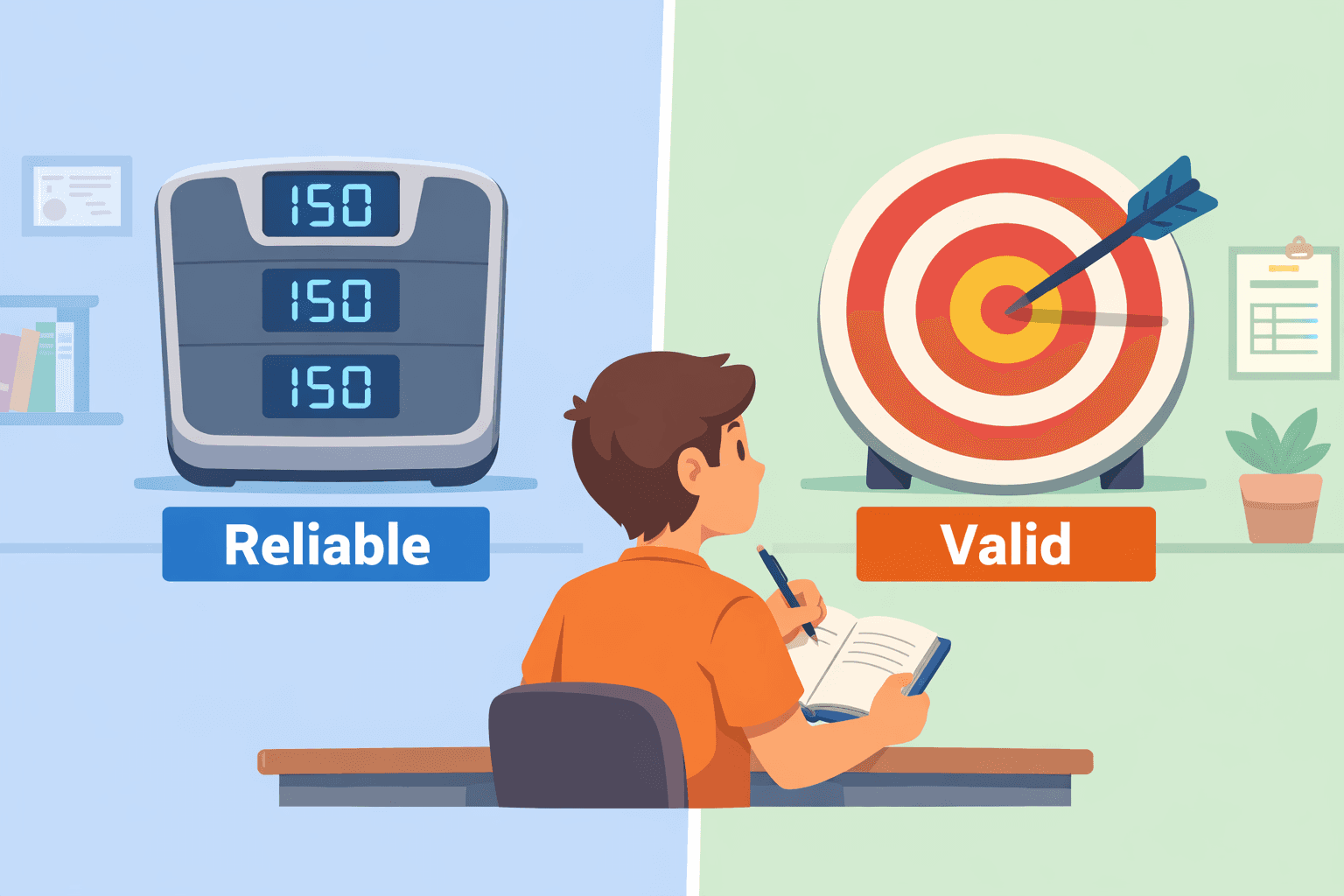
A reliable measurement gives you the same answer every time you use it. Think of it like a scale: step on it twice, it should show the same weight.

This guide explains the different ways to check for that consistency in your research, using straightforward examples from actual studies.

Want to learn how to apply these checks and strengthen your work? Let's get into the details.

<CTA title="Build Reliable Research Frameworks Faster" description="Generate structured research outlines and improve measurement consistency with clear workflows" buttonLabel="Try Jenni Free" link="https://app.jenni.ai/register" />

What Reliability Means in Research

Reliability is about getting a consistent score, not necessarily the right one. A bathroom scale might always show you're five pounds heavier than you are, that's reliable, but it's not accurate (or valid) — for a closer look at the different types of validity in research, see this companion guide.

As explained in reliability validity concepts, good reliability cuts down on random noise, which is crucial for any study, from medicine to sociology.

Reliability vs. Validity: The Core Difference People mix these up all the time. Here’s the split:

  • Reliability asks: "If I do this again, will I get the same number?" It's about consistency.

  • Validity asks: "Am I even measuring the thing I think I'm measuring?" It's about accuracy.

You can have one without the other. A clock that's always ten minutes fast is reliable; you can depend on that error. But it's not valid for telling the correct time.

This distinction is clearly explained in understanding research methods, where consistency and accuracy are treated as separate ideas.

Reliability vs Validity (Quick Contrast)

Aspect

Reliability

Validity

Focus

Consistency

Accuracy

Question

Are results stable?

Are results correct?

Example

Same test gives same score

Test measures what it claims

You can have one without the other. A clock that's always ten minutes fast is reliable; you can depend on that error. But it's not valid for telling the correct time.

Why Bother with Reliability?

Simple: if your measurements jump around randomly, your findings are built on sand. Other researchers won't be able to repeat your work, and you can't trust your own data. Reliability is the basic floor for credible research.

<ProTip title="💡 Pro Tip:" description="Check reliability before validity because inconsistent data cannot be accurate" />

Main Types of Reliability in Research

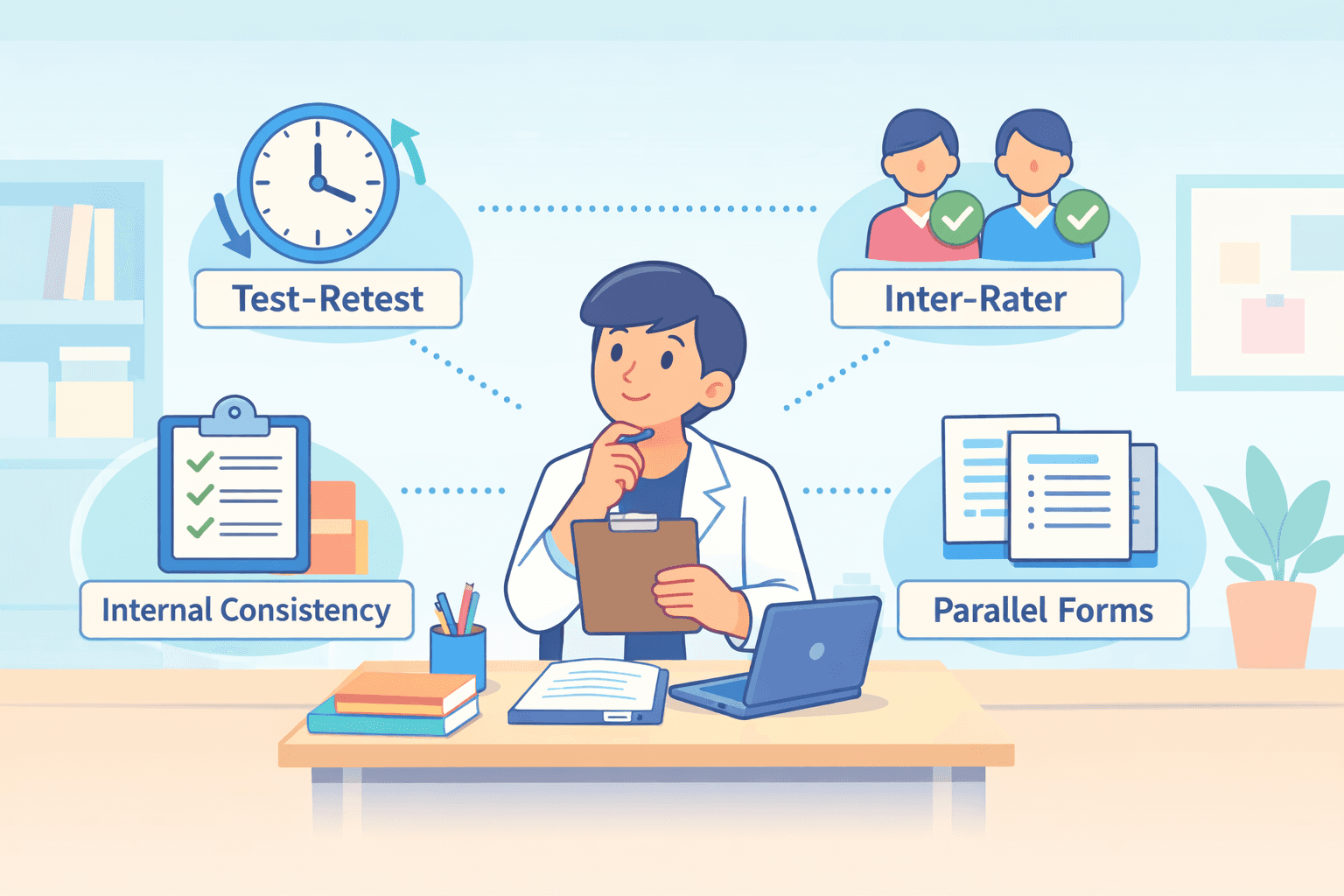
Each type of reliability test looks for consistency in a specific situation. You pick the one that fits your research design.

Test-Retest Reliability: Checking Stability Over Time This is the simplest check. You give the same test to the same people twice, then see if the scores correlate. A correlation above 0.7 usually means it's stable.

  • Example: A stress survey given today and again in two weeks. Similar scores mean it's reliable for measuring a stable trait.

  • Best for: Measuring things that shouldn't change quickly, like personality.

  • Watch out for: If people remember their answers from the first time, it can mess up the results.

<ProTip title="📌A Quick Note" description="Keep the time between tests consistent for everyone to avoid outside factors skewing your data." />

Inter-Rater Reliability: When Multiple People Judge This checks if different observers agree when rating the same thing. It's vital for behavioral studies or when coding interview transcripts.

  • Example: Two researchers watch a classroom and score student engagement. High agreement means the scoring system works.

  • How to measure it: Use statistics like Cohen's Kappa or a simple percentage agreement, commonly applied in inter rater reliability methods.

  • The problem: Low agreement usually means your rating criteria are too vague or subjective.

The Qualitative Research Hurdle Getting reliable data is a major headache in qualitative work. Different coders often see different themes in the same interview.

  • Why it happens: Personal bias, unclear rules, or just different interpretations.

  • How to fix it: Use a second coder to check your work, create a detailed coding manual, or use software like MAXQDA to track decisions.

<ProTip title="📌Practical Advice" description="Write down every coding decision you make. This transparency makes your process more consistent and believable." />

Intra-Rater Reliability: One Person's Consistency This measures how consistent a single observer is over time. It answers: if you judge the same data twice, will you give it the same score?

  • Example: A radiologist reviews the same set of X-rays a month apart. Consistent diagnoses show high intra-rater reliability.

  • It matters when: Only one person is doing all the evaluation or coding.

Internal Consistency: Do All Your Questions Measure the Same Thing? This checks if all the items in a survey or test are pulling in the same direction. The go-to statistic is Cronbach’s Alpha.

  • The rule of thumb: An alpha above 0.7 is acceptable; above 0.8 is good.

  • How it works: A 10-question anxiety scale should have all questions related to anxiety. If some are about diet, your alpha score will drop.

  • Other methods: Split-half reliability or average inter-item correlation.

<ProTip title="💡A Statistical Tip" description="If your Cronbach’s Alpha is low, look for weak questions that don't fit and remove them to improve your scale's reliability." />

Parallel Forms Reliability: Testing with Different Versions This method uses two different versions of a test that are designed to be equivalent. It checks if they produce similar results.

  • Example: Version A and Version B of a math test, with different problems of equal difficulty. Similar average scores mean the forms are reliable.

  • The main benefit: It avoids "practice effects," where people score better just because they've seen the test before.

Composite Reliability: For Complex Models This is a more advanced measure used in statistical modeling, like structural equation modeling. It's similar to Cronbach’s Alpha but is considered more precise for complex analyses because it accounts for how strongly each question relates to the overall concept.

Comparing Types of Reliability

Not all reliability checks do the same job. This table shows which one to use and when. Understanding how each type fits into your study design also relates to broader research paradigms, since different research approaches prioritize different forms of consistency and measurement.

Type

What It Checks

Best Used For

How You Measure It

Test-Retest

Stability over time

Studies where you measure the same people twice (longitudinal)

Correlation coefficient

Inter-Rater

Agreement between different people

Research with multiple observers or coders (qualitative, behavioral)

Cohen's Kappa, Percent Agreement

Intra-Rater

Consistency of one person over time

Tasks where a single expert does all the judging (e.g., medical diagnosis)

Correlation coefficient

Internal Consistency

How well test items fit together

Surveys, questionnaires, psychological scales

Cronbach’s Alpha

Parallel Forms

Equivalence of two different test versions

Situations where you need alternate test forms (e.g., exams)

Correlation coefficient

Matching the right type to your study design is the first step to getting trustworthy data.

How to Improve Reliability in Research

You can improve reliability by tightening up your methods. Small, deliberate changes often make a big difference.

1. Standardize Everything Variation in procedure creates random error. Lock it down.

  • Write crystal-clear instructions for participants and researchers.

  • Keep the testing environment, lighting, noise, time of day, as consistent as possible.

  • Train every observer or coder using the same manual and practice materials.

2. Sharpen Your Measurement Tools A confusing tool gives unreliable data. Scrutinize your instruments.

  • Example: A survey question like "Do you exercise regularly?" is vague. Does 'regularly' mean three times a week or once a month?

  • How to fix it: Use simple, direct language. Test your questions on a few people first and ask what they think you're asking. Cut or rewrite any item that causes confusion.

When designing better measurements, starting with a strong foundation like a clear how to write research question can significantly improve both clarity and consistency in your study.

3. Always Run a Pilot Test Never launch your full study without a small-scale trial first. A pilot with 10-20 people can reveal major flaws.

  • It helps you spot confusing questions, weak items that don't fit, or inconsistent response patterns.

  • This is your chance to fix problems when it's still cheap and easy.

<ProTip title="💡 Pro Tip:" description="Conduct a pilot test before you collect your main data. It's the most effective way to catch reliability issues you didn't anticipate." />

4. Let Statistics Do the Checking Use quantitative methods to prove your consistency. Common tests include:

  • Cronbach’s Alpha for survey scales.

  • Split-Half Reliability to compare halves of a test.

  • Intraclass Correlation for ratings from multiple observers. Software like SPSS, R, or even Excel can run these analyses. Don't just assume your tool is reliable, show the number.

To see how to describe these procedures and statistics in a paper, use this guide to writing the methodology section of a research paper.

Reliability in Quantitative vs Qualitative Research

The idea of reliability shifts dramatically between quantitative and qualitative research. If you're unsure how these two approaches differ in practice, this guide on qualitative vs quantitative research provides a clear comparison of their methods and applications.

Quantitative Research: The Numbers Game Here, reliability is about numerical consistency. The goal is to get the same number if you repeat the measurement. It's a technical check.

  • Examples: A survey's internal consistency, a physics instrument's precision, or a psychological test's stability.

  • How it's done: You use statistics. Tools like Cronbach's Alpha or correlation coefficients give you a clear score to prove your method is stable.

Qualitative Research: The Trustworthiness Problem In qualitative work, you can't just run a correlation. The data is words, observations, and interpretations. Reliability is about the trustworthiness and rigor of your analytical process.

  • The core challenges: Subjectivity is inherent. Two researchers might interpret an interview differently. Methods are flexible and adapt to context.

  • How you address it: You build a case for consistency through transparency, not a single statistic.

  • Reflexivity: You state your own background and potential biases upfront.

  • Audit Trail: You document every step, how you coded data, why you grouped themes a certain way.

  • Peer Review: Have another researcher check your coding or analysis to see if they reach similar conclusions.

As frameworks like the COREQ checklist emphasize, this transparency is what makes qualitative findings credible and reliable on their own terms.

Common Mistakes in Reliability Analysis

Even experienced people slip up on a few key points.

Mistake 1: Treating Reliability and Validity as the Same Thing This is the most common error. A measure can be perfectly reliable yet completely invalid. Think of that broken scale always reading five pounds heavy, consistent, but wrong.

You must test for both separately; a good reliability score doesn't automatically mean you're measuring the right thing.

Mistake 2: Forgetting the Messy Human Element Measurement error isn't just about the tool. People and situations change.

  • Examples: A participant's mood on test day, a noisy room during an observation, or an interviewer who gets tired and less attentive by the third hour. These factors introduce random noise that hurts reliability, and they're easy to overlook.

Mistake 3: Dismissing a Bad Reliability Score When your Cronbach's Alpha comes back at 0.5, you can't just shrug and move on. That low number is a direct warning: the items in your scale are not working together consistently.

Proceeding with the analysis anyway means your conclusions are built on shaky, unpredictable data. The only responsible move is to revise your measurement tool.

<ProTip title="📌 Reminder:" description="Always report reliability coefficients in research papers to support data credibility" />

Make Your Research Results Trustworthy

Reliability in research ensures consistent and repeatable results across different conditions, observers, and time periods. Each type, from test retest reliability to internal consistency, serves a specific purpose depending on the research design.

<CTA title="Create Clear Research Explanations Faster" description="Structure your research writing with reliable frameworks and improve clarity in minutes" buttonLabel="Try Jenni Free" link="https://app.jenni.ai/register" />

Using tools like Jenni alongside these concepts helps you organize complex ideas, apply reliability methods correctly, and produce structured academic writing that meets research standards.

目录

今天就开启你的非凡写作之旅

从今天起,用 Jenni 写下你的 第一篇论文,开启全新篇章

免费开始

无需信用卡

随时取消

500万+

遍布全球的学者

5.2小时

每篇论文平均节省

超过1500万篇

在鉴研上完成的论文

今天就开启你的非凡写作之旅

从今天起,用 Jenni 写下你的 第一篇论文,开启全新篇章

免费开始

无需信用卡

随时取消

500万+

遍布全球的学者

5.2小时

每篇论文平均节省

超过1500万篇

在鉴研上完成的论文

今天就开启你的非凡写作之旅

从今天起,用 Jenni 写下你的 第一篇论文,开启全新篇章

免费开始

无需信用卡

随时取消

500万+

遍布全球的学者

5.2小时

每篇论文平均节省

超过1500万篇

在鉴研上完成的论文