{{HeadCode}} Research Paper Introduction: Clear Steps to Write It

通过

内森·奧勇

2025年10月31日

通过

内森·奧勇

2025年10月31日

通过

内森·奧勇

2025年10月31日

How to Craft a Strong Introduction for Your Research Paper

奥扬的个人资料图片

内森·奧勇

安永的高级会计师

获得会计学学士学位,完成会计研究生文凭

奥扬的个人资料图片

内森·奧勇

安永的高级会计师

获得会计学学士学位,完成会计研究生文凭

奥扬的个人资料图片

内森·奧勇

安永的高级会计师

获得会计学学士学位,完成会计研究生文凭

Writing the introduction of a research paper sets the foundation for your entire study. It gives readers the context they need. Highlights the problem and shows why your topic matters. A clear introduction also helps people understand your goals and builds trust in the work that follows.

This guide explains how to write the introduction of a research paper using simple steps and proven academic structures like the funnel method and the CARS model. You will learn what to include, what to avoid, and how to make your introduction clear, relevant, and easy to read.

<CTA title="Write a Strong Research Paper Introduction" description="Create clear, high-impact introductions fast with structured guidance inside Jenni" buttonLabel="Try Jenni Free" link="https://app.jenni.ai/register" />

What the Introduction of a Research Paper Does

The introduction gives readers a first look at your research topic. More than just a summary, it prepares the reader by explaining the context of the study, highlighting previous work, and showing what gaps remain. 

This section builds the logical path that leads to your research question. A good research paper introduction explains the topic clearly, gives essential background, highlights what past work has explored, identifies the gap, and states your purpose.

  • Explain the general topic clearly.

  • Give essential background or definitions.

  • Show what research has already explored.

  • Identify a clear gap or unresolved issue.

  • Present the purpose or thesis of the paper.

When these parts are in place, the rest of your research makes sense.

Why a Good Introduction Matters

Readers usually decide within the first few paragraphs whether your study feels relevant or credible. A clear introduction shows that you understand the field, have a strong rationale, and can explain your purpose with precision.

A confusing introduction, on the other hand, makes your paper harder to trust. Even if your results are strong, the impact of your research is reduced if people struggle to understand the foundation.

This is why the introduction is often revised many times. It is the story of your research: where it starts, why it exists, and where it is going.

The Core Structure of a Research Paper Introduction

Before breaking down the steps, it helps to know the standard structure used in academic writing. Many journals and universities follow the CARS model (Create a Research Space).

Here is the most common structure:

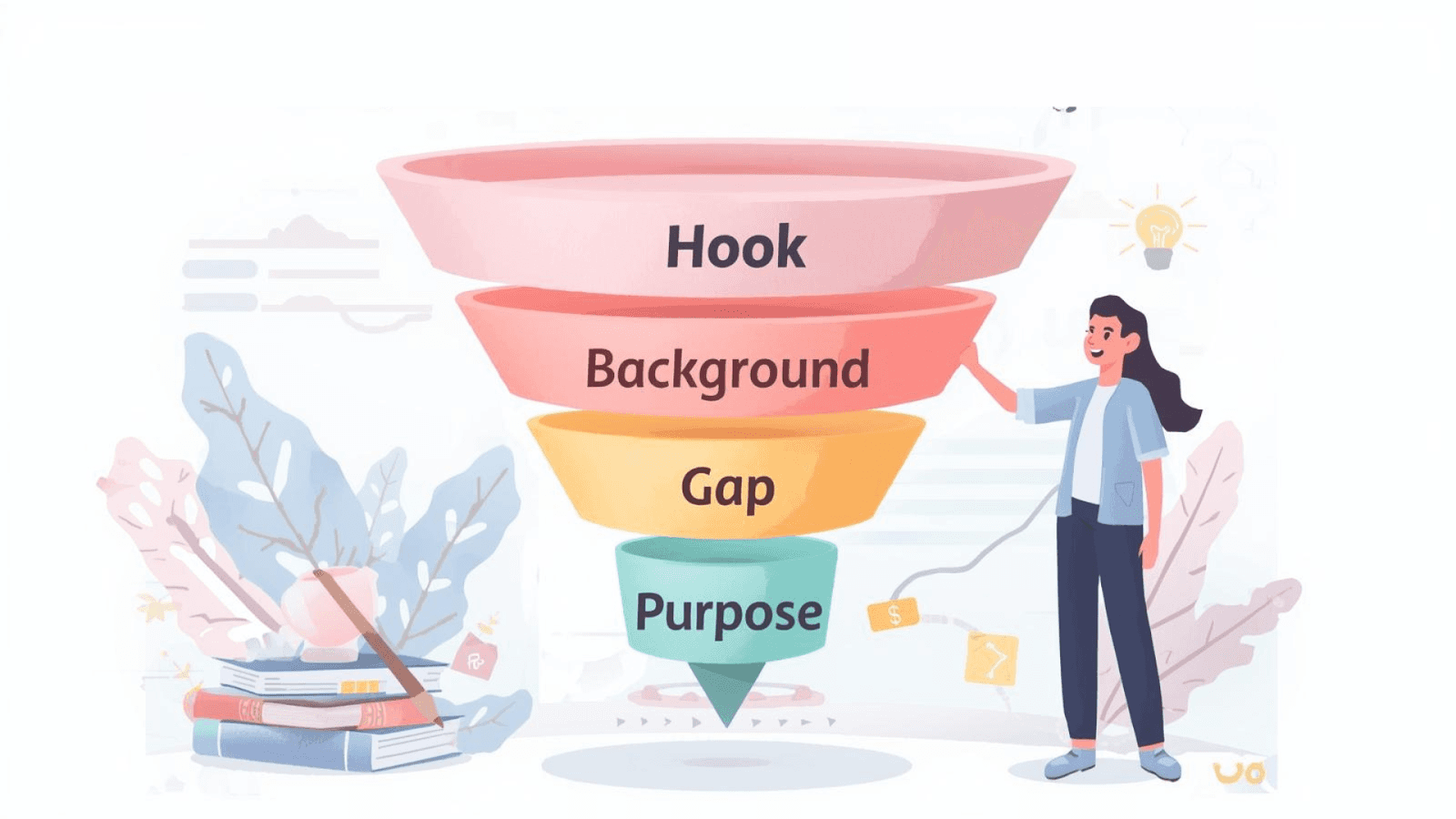
  1. Hook: A statistic, question, fact, or short story that draws attention.

  2. Background: What the field already knows.

  3. Problem or Gap: What is missing or not fully understood.

  4. Purpose/Thesis: What your study will examine or prove.

  5. Roadmap (Optional): A quick outline of what the paper covers.

Your introduction should be around 200–400 words or 1–2 pages, depending on your assignment or journal guidelines.

<ProTip title="💡 Note:" description="Draft the introduction after completing your methods and results so you can write with clarity" />

How to Write the Introduction of a Research Paper: Step-by-Step

Writing an effective research paper introduction follows a structured, step-by-step process that builds clarity, context, and relevance.

1. Start With a Clear and Engaging Hook

The hook is your opening statement. It sets the tone, grabs attention, and guides readers into the topic.

Some effective options include:

  • A strong statistic

  • A surprising fact

  • A short scenario

  • A question

  • A brief, relevant anecdote

Example:
More than 1.5 billion students worldwide shifted to online learning during the COVID-19 pandemic, creating sudden changes in teaching quality and student engagement.

This approach works because it is specific, relevant, and grounded in data.

<ProTip title="💡 Reminder:" description="Use recent sources from the last 5 to 10 years to keep your introduction relevant" />

2. Provide Background and Context

After the hook, explain the broader topic, so readers have the right foundation. This part of your introduction section helps readers understand the general field before you narrow it down to the specific problem.

What to include:

  • Definitions of key concepts

  • A short explanation of the topic

  • A brief mention of what researchers already know

  • Important terms needed to understand your study

Example:
Online learning has been used for many years across universities, often supported by research on motivation, instructional design, and student engagement.

This prepares the reader without overwhelming them.

<ProTip title="💡 Note:" description="Keep background short. Save deeper analysis for the literature review section" />

3. Narrow Down to the Specific Problem or Gap

This is the most important part of the introduction. Every research paper must point to a clear gap, inconsistency, or unanswered question in the field.

Ask yourself:

  • What is missing in the current research?

  • What has not been explored enough?

  • What problem does my study address?

Example:

However, little is known about how sudden transitions to online learning affect students in low-connectivity areas, especially regarding engagement and academic performance.

This shows a precise gap backed by evidence.

4. State the Purpose or Thesis of Your Study

Once the gap is clear, introduce your study. Explain what your research aims to do.

This part is usually one or two sentences.

Example:

This study examines how limited internet access influences student engagement during emergency remote learning.

Make the purpose straightforward to understand.

<ProTip title="💡 Tip:" description="Write your thesis in simple present tense for clarity" />

5. Add a Short Roadmap (Optional)

Some papers include a brief roadmap at the end of the introduction. This tells readers what the next sections will cover.

Example:

The following sections explain the study’s methodology, present the results, and discuss their implications for educational policy.

This step is optional but helpful for long or technical papers.

Writing Techniques That Make Your Introduction Stronger

Understanding the steps is one thing. Applying them well is another. These techniques help improve flow, clarity, and quality.

Use the Funnel Approach

The funnel approach moves from broad to narrow. It helps readers follow your logic.

  1. Start large with a general background.

  2. Narrow down to what is relevant.

  3. Point out the gap.

  4. End with your study’s goal.

This structure helps readers follow your logic without confusion.

Focus on the “So What?” Question

Every introduction must answer this question:

Why does this research matter?

Every introduction must show why the study matters. This is the part of writing the introduction where you make your relevance clear by linking the problem to current conversations, real-world issues, or gaps in the field.

  • a real-world issue

  • a scientific debate

  • a policy needs

  • new technology or trends

If you cannot answer “So what?”, your introduction may feel weak or unclear.

<ProTip title="💡 Note:" description="Use relevance statements to connect your topic to real-world issues" />

Keep Sentences Short and Clear

Academic writing does not need to be complicated. Use short sentences and simple words. Clear writing shows strong thinking.

Good example:

This study investigates how remote learning affects reading comprehension among primary school students.

Avoid unnecessary complexity.

Avoid Overloading the Introduction With Too Many References

Cite only what is needed. The introduction is not a full literature review.

Most introductions use:

  • one to three key references for background

  • one reference for a data point

  • one to two references for the gap

Save deeper analysis for the literature review section.

Define Key Terms Early

If your topic includes specialized terms, define them early. This improves clarity.

Example:
In this paper, digital literacy refers to the ability to use online tools for learning.

This helps readers follow your discussion later.

<ProTip title="💡 Reminder:" description="Avoid abbreviations unless you define them clearly the first time they appear" />

Examples of Strong Research Paper Introductions

Here are three simple models based on different fields.

1. Social Science Example

Social media has become a major communication tool among teenagers, with platforms shaping daily habits and identity. Previous studies show that social media exposure can affect mental health, self-esteem, and peer relationships. 

However, less is known about how curated online content influences body image in early adolescence. This study explores the connection between social media content and body image perceptions among 12 to 15 year-olds.

2. STEM Example

Renewable energy systems are essential for reducing global carbon emissions. Solar power has gained attention due to its accessibility and low long-term cost. Yet, solar panel efficiency still varies widely between climates. 

This study tests how humidity impacts photovoltaic efficiency under controlled conditions. Results may help improve solar adoption in tropical regions.

3. Humanities Example

Storytelling has long shaped cultural identity and memory. Scholars have examined how myths, folklore, and oral traditions reflect shared values. However, modern retellings of traditional stories remain underexplored in Southeast Asian literature. 

This paper analyzes contemporary reinterpretations of ancient myths to understand how authors negotiate tradition and modernity.

Common Mistakes to Avoid When Writing the Introduction

Avoiding these mistakes will help your introduction feel cleaner and more professional.

Mistake 1: Starting Too Broad

Do not begin with a vague phrase like:

“Since the beginning of time…”
“People have always been interested in…”

Start with relevant, research-based background instead.

Mistake 2: Turning the Introduction Into a Literature Review

Your goal is to set up the problem, not summarize every study. Keep the background short.

Mistake 3: Not Showing the Gap

Every introduction needs a gap. Without it, the study seems unnecessary.

Mistake 4: Adding Methods, Results, or Discussion Too Early

Save these for their specific sections.

Mistake 5: Writing the Introduction First

Many researchers struggle because they start the introduction before understanding their own results. Write it later for better flow.

<ProTip title="💡 Pro Tip:" description="Draft a placeholder introduction first, then rewrite it after finishing your results" />

Discipline-Specific Variations

Different fields use the introduction differently. Here is how to adjust your approach.

Humanities Papers

These focus more on:

  • theory

  • interpretation

  • historical context

  • debates among scholars

The introduction may include more conceptual framing than empirical gaps.

Science and Engineering Papers

These focus on:

  • methods

  • hypotheses

  • variables

  • known limitations

  • preliminary data

The introduction tends to be shorter and more direct.

Empirical Studies

These often include:

  • a brief overview of the method

  • a reference to existing data

  • the research question and hypothesis

Keep the structure simple and factual.

Step-by-Step Checklist You Can Follow

Here is a simple checklist you can use before finalizing your introduction.

✔ Start with an engaging hook

✔ Give clear background and context

✔ Mention what researchers already know

✔ Identify the knowledge gap

✔ Explain why the gap matters

✔ State the purpose or thesis

✔ Add a short roadmap (optional)

✔ Keep the tone clear and active

✔ Use updated sources

✔ Revise for clarity and flow

Writing a Perfect Introduction of a Research Paper

Crafting a clear, focused introduction is key to setting up your research paper effectively. By using the funnel method and highlighting the gap. You create a strong foundation that guides readers through your study’s purpose. A well-structured introduction not only explains your topic but also shows why your research matters.

<CTA title="Write a Clear, Publish-Ready Introduction" description="Use Jenni to generate structured, accurate introductions that follow academic standards" buttonLabel="Try Jenni Free" link="https://app.jenni.ai/register" />

Ready to write a strong introduction of a research paper? Try Jenni for easy, step-by-step help to create clear, publish-ready introductions fast.

目录

今天就开启你的非凡写作之旅

从今天起,用 Jenni 写下你的 第一篇论文,开启全新篇章

免费开始

无需信用卡

随时取消

500万+

遍布全球的学者

5.2小时

每篇论文平均节省

超过1500万篇

在鉴研上完成的论文

今天就开启你的非凡写作之旅

从今天起,用 Jenni 写下你的 第一篇论文,开启全新篇章

免费开始

无需信用卡

随时取消

500万+

遍布全球的学者

5.2小时

每篇论文平均节省

超过1500万篇

在鉴研上完成的论文

今天就开启你的非凡写作之旅

从今天起,用 Jenni 写下你的 第一篇论文,开启全新篇章

免费开始

无需信用卡

随时取消

500万+

遍布全球的学者

5.2小时

每篇论文平均节省

超过1500万篇

在鉴研上完成的论文