{{HeadCode}} How to Organize Sources for a Literature Review: Clear Methods That Work

通过

贾斯汀·王

How to Organize Sources for a Literature Review: Clear Methods That Work

贾斯汀·王

增长负责人

获得全球商业与数字艺术学士学位,辅修创业

A disorganized lit review is frustrating. You have all the pieces, but they just don't fit together. The real problem isn't how hard you're working, it's the method.

This guide offers a practical system to sort your sources, define your focus, and build connections between studies. Want to turn that pile of PDFs into a coherent story? Keep reading to see how.

<CTA title="Organize Your Literature Without Overwhelm" description="Turn scattered research into structured insights with guided workflows and smart prompts." buttonLabel="Try Jenni Free" link="https://app.jenni.ai/register" />

What Organized Sources Actually Look Like

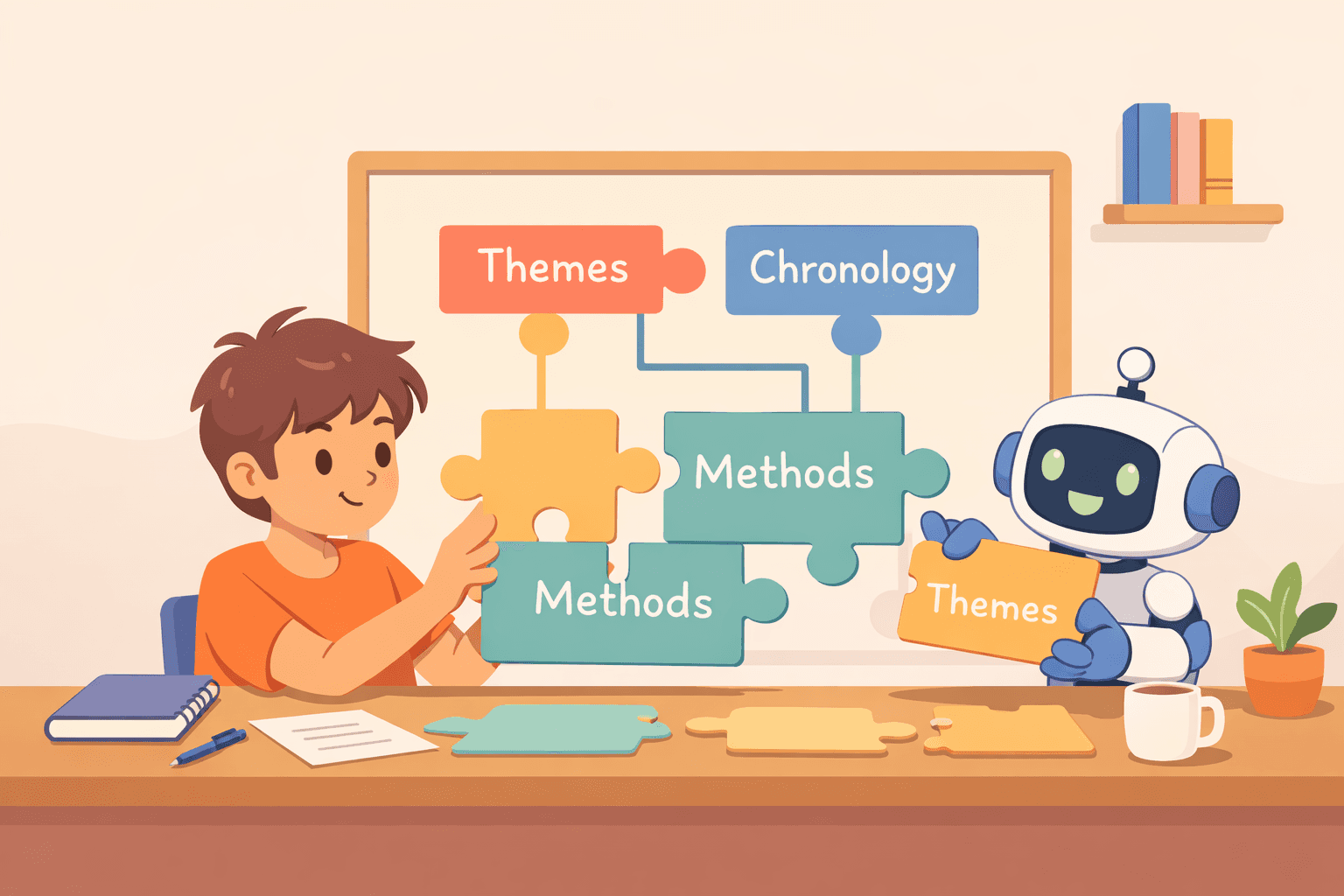
Think of organized sources not as tidy folders, but as a working system. It's the difference between a jumbled box of puzzle pieces and seeing the edges of the picture start to form.

A good system lets you do the real work: spotting trends across different studies, noticing where findings contradict each other, comparing how research was done, and building your argument without endless backtracking.

The point is to move from just collecting information to actually understanding it.

Step 1: Define Your Scope Before You Collect Sources

The most common mistake is diving into research without a clear boundary. You end up with a mountain of vaguely related papers and no direction.

Start by locking down three things:

  • Your central research question.

  • The main themes or variables you're tracking.

  • Concrete inclusion criteria, like publication date range or study methodology.

For instance, instead of the sprawling topic "social media and mental health," a defined scope would be: "the impact of short-form video content on anxiety levels in university students, 2020-2025."

This immediately filters out studies on other platforms, age groups, or time periods.

A quick filtering habit: Before you save any PDF, ask yourself: Does this directly address my question? Is it from a credible source and recent enough? Does it add a new perspective?

If the answer is no to any of these, move on. This one step prevents most of the overload. If you're unsure how to properly frame this stage, reviewing how to write a literature review can help you sharpen your scope and avoid unnecessary sources early on.

<ProTip title="💡 Pro Tip:" description="Focus on quality over quantity. A strong review often uses 40 to 80 well chosen sources." />

Step 2: Choose an Organization Method That Fits Your Topic

You can't analyze fifty papers at once. You need a method to group them, and this choice will directly shape how you write your review later.

Here are the most common approaches:

Method

Best For

Example

Thematic

Finding patterns and topics

Grouping social media studies by anxiety, addiction, or body image.

Chronological

Showing how ideas changed over time

Looking at research before and after a major event or policy change.

Methodological

Comparing how studies were done

Separating survey-based research from experimental lab studies.

Conceptual

Building an argument around theories

Organizing papers by foundational ideas, like cognitive load theory.

Thematic grouping is the most common. If your topic is online learning, you'd sort papers into buckets like "student engagement," "academic performance," and "technology access." Each bucket becomes a section in your writing.

Chronological order makes sense when the timeline itself is important, showing how understanding of a virus evolved, for instance, or how teaching methods shifted with new technology.

Methodological sorting is useful for critiquing research quality. Putting all the qualitative case studies in one group and the large-scale data analyses in another lets you compare their different strengths and blind spots.

Conceptual organization is for theory-driven work. You'd cluster studies based on the core model or framework they use, which helps trace how a theoretical debate has played out in the literature.

If your review leans more interpretive or discussion-based, understanding the structure of a narrative literature review can also help you choose a more suitable way to group sources.

The key is to choose one primary method that fits your question, and stick with it for consistency.

<ProTip title="📌 Reminder:" description="Start with one main method. You can layer additional methods later." />

Step 3: Build a Synthesis Matrix (Your Central System)

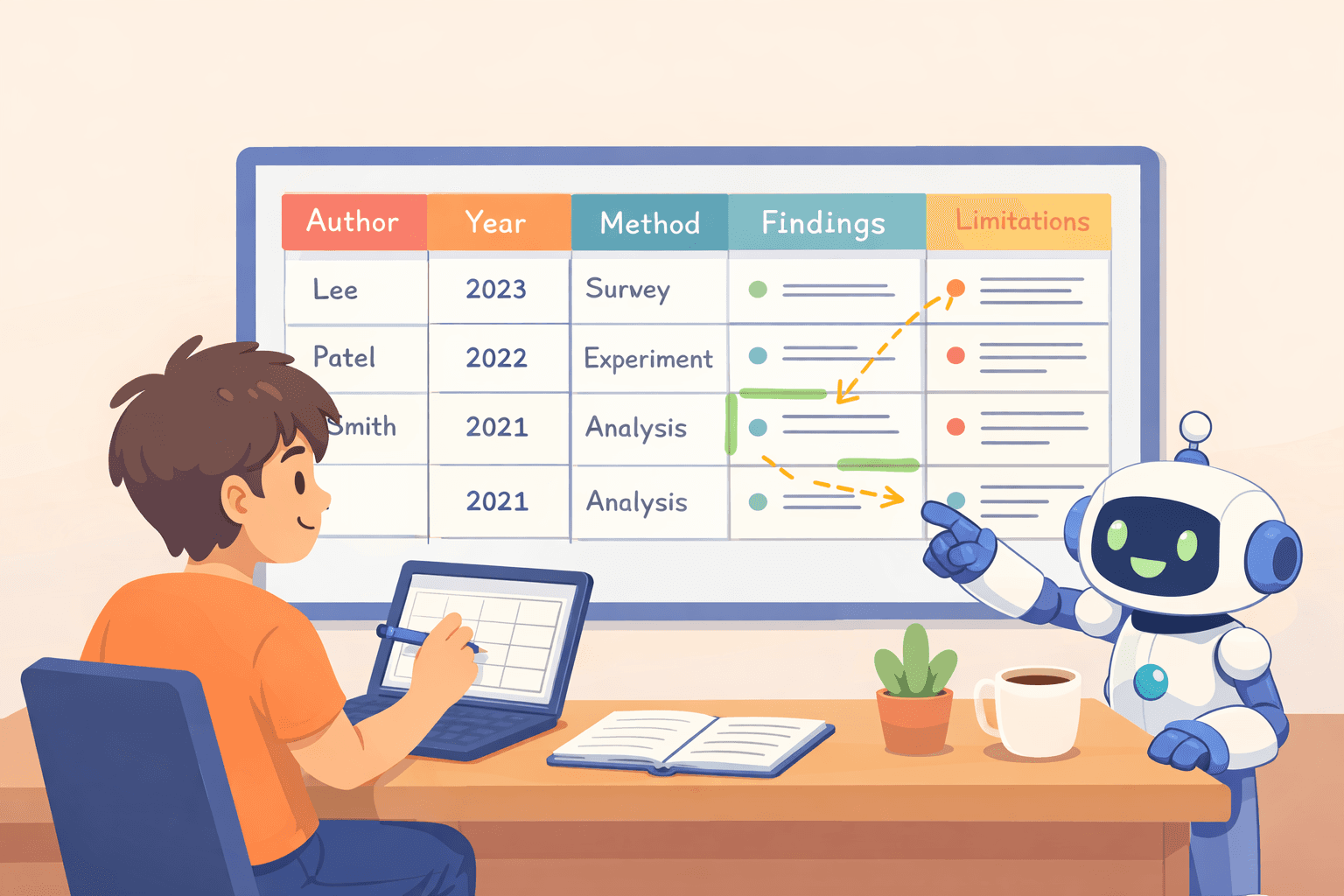
This is your central command system. A synthesis matrix is a simple table that forces you to condense each paper into its key parts, turning a library of PDFs into a single, comparable overview.

Start with a basic table format (or use a literature review matrix template):

Author

Year

Theme

Method

Key Findings

Limitations

Lee

2023

Online learning

Survey

Students reported higher flexibility.

Study only covered one semester.

...

...

...

...

...

...

Each row is one source. The goal isn't to copy the abstract, but to extract what you need. A good entry has a brief summary in your own words, the core results, why it's relevant to your question, and a note on its weaknesses.

This table lets you see the entire landscape at once. You can scan down a column to compare all the methods used, or all the findings on a specific theme, instantly spotting where studies agree, contradict, or leave research gaps.

It stops you from constantly re-reading full papers and lets you build your argument from the evidence laid out in front of you. Following a structured literature reviews guide can also reinforce how to turn these comparisons into a clear, well-supported argument.

<ProTip title="🧠 Pro Tip:" description="Keep summaries short and focused. Two to three sentences are enough." />

Step 4: Annotate Sources With Purpose

Don't just highlight. Read with a purpose: to capture the specific ideas you'll need for your review.

As you read each paper, focus on pulling out four things:

  • The author's central argument.

  • The key evidence they use to support it.

  • How they conducted the research (the method).

  • The main limitations of their approach.

Your notes should be brief and in your own words. Instead of copying a long paragraph, write something like:

"Argues that gamification boosts student motivation, but the study only lasted two weeks and used a small sample from one school."

A useful formula is: Main idea + Method + Limitation. This forces you to quickly assess a study's core contribution and its weaknesses, building the critical perspective you need for your synthesis.

Step 5: Use Digital Tools to Stay Organized

Managing dozens of sources by hand is inefficient. A few digital tools can automate the busywork and keep everything in one place.

For storing PDFs and citations, use a reference manager. Zotero and Mendeley and EndNote will save your articles, format your bibliography, and insert citations directly into your document.

If you're still learning how to manage sources correctly, a solid citation management and academic integrity guide will help you understand how to organize references while avoiding common mistakes.

For your notes and synthesis, a spreadsheet is often the best tool. Google Sheets or Excel are perfect for building your synthesis matrix, letting you sort and filter studies with a click.

For more interconnected notes, apps like Notion or Obsidian can help map relationships between ideas.

A straightforward workflow looks like this:

  • Save the PDF to your reference manager.

  • Read and annotate the key sections.

  • Add a condensed summary to your synthesis matrix.

  • Tag the entry with its relevant themes or methods.

This process creates a clean pipeline from collecting a paper to having its essential information ready for your writing.

<ProTip title="⚡ Pro Tip:" description="Use consistent tags across all tools so you can find sources quickly." />

Step 6: Group Sources Into Clear Sections

Once your sources are sorted in your matrix, you can start building the actual sections of your literature review, which makes drafting a clear literature review outline much easier. This is where your organization pays off.

Your groups, whether thematic, chronological, or methodological, become the main headings. For a review on online learning, your structure might look like:

  • Academic Performance: Discuss studies measuring grades, test scores, and learning outcomes.

  • Student Engagement & Motivation: Cover research on participation, persistence, and psychological investment.

  • Methodological Gaps: Compare the strengths and weaknesses of the research designs used across studies.

This grouping stops you from just listing summaries one after another. Instead, you build a logical argument.

You can discuss how several studies together support a point, then introduce another set of studies that offer a contrasting finding or highlight a limitation.

This kind of comparison is also where researchers often begin to see how to identify research gaps more clearly across the literature.

For example, you could write:

Several survey-based studies report that online learning increases student flexibility and satisfaction. However, this consensus relies heavily on self-reported data, which can be biased.

There is a notable shortage of longitudinal or experimental research that tracks actual long-term performance, indicating a key gap in the current evidence.

By pre-sorting sources into distinct, comparable categories, this paragraph successfully merges various references into a unified argument, transitioning from a specific finding to a critical evaluation and finally identifying a research gap.

Step 7: Maintain and Update Your System

Your literature review is a living document. New research comes out, and your focus might shift slightly as you write. Your organization system has to adapt with it.

Set aside a short, regular time, say, 30 minutes each week, for maintenance. Use this time to:

  • Add any new, relevant papers you've found to your reference manager and synthesis matrix.

  • Read and summarize them using your annotation formula.

  • See if the new findings fit your existing categories or if you need to create a new theme.

  • Archive or remove sources that have become less relevant.

A simple habit is to process two or three new sources each week. This prevents a backlog from building up and ensures the evidence you're writing from is always up-to-date. It turns a potentially overwhelming task into a routine one.

Common Mistakes That Disrupt Organization

A good system can still fail if you make these common errors.

Hoarding sources. Downloading every vaguely related paper creates noise. Be ruthless about relevance from the start.

Putting off the sorting. If you wait until you have eighty PDFs to begin organizing, you'll drown. Start your matrix with your first five papers.

Mistaking a topic for a structure. "Social media" is a topic. "Effects on self-esteem," "addiction behaviors," and "privacy concerns" are a structure. You need the latter.

Skipping the summary. If you don't write a concise note in your matrix, you'll be re-reading entire articles next week to remember the point.

Using inconsistent tags. Tagging one paper with "method-survey" and another with "research design-questionnaire" for the same concept will make your system useless for comparison. Pick a standard set of terms and stick to them.

<ProTip title="🚫 Pro Tip:" description="Keep your system simple. Complexity often leads to inconsistency." />

Bringing It All Together: A Simple Workflow Example

Here's how the entire process looks for a real topic.

Step 1: Define the scope. You start with a broad interest: "remote work." You refine it to a specific question: "What is the impact of remote work on employee productivity in tech companies, based on studies from 2020 onward?"

Step 2 & 3: Collect and categorize. You find 40-50 relevant studies. As you collect them, you sort them into three primary themes: measured productivity outcomes, work-life balance effects, and the role of technology & tools.

Step 4: Build the matrix. Every paper gets a row in your spreadsheet. For each, you jot down the author, year, which theme it fits, the method (e.g., survey, company data analysis), the core finding, and a major limitation.

Step 5: Spot the patterns. With the matrix complete, you can scan it. You quickly see that most evidence comes from employee self-reports, there are very few long-term studies, and findings differ sharply between creative roles and routine task work.

Step 6: Write from the structure. Your review's sections are now clear. You don't list papers one-by-one. Instead, you write a section on productivity findings, synthesizing the survey data while noting its limitations.

You then discuss the conflicting evidence between industries, and conclude with the identified gap for longitudinal research. At that point, having a clear plan for section flow becomes even more useful, and this guide on how to write literature review outline can help you turn your organized notes into a coherent draft.

The organization didn't just tidy your PDFs, it built the outline for your argument.

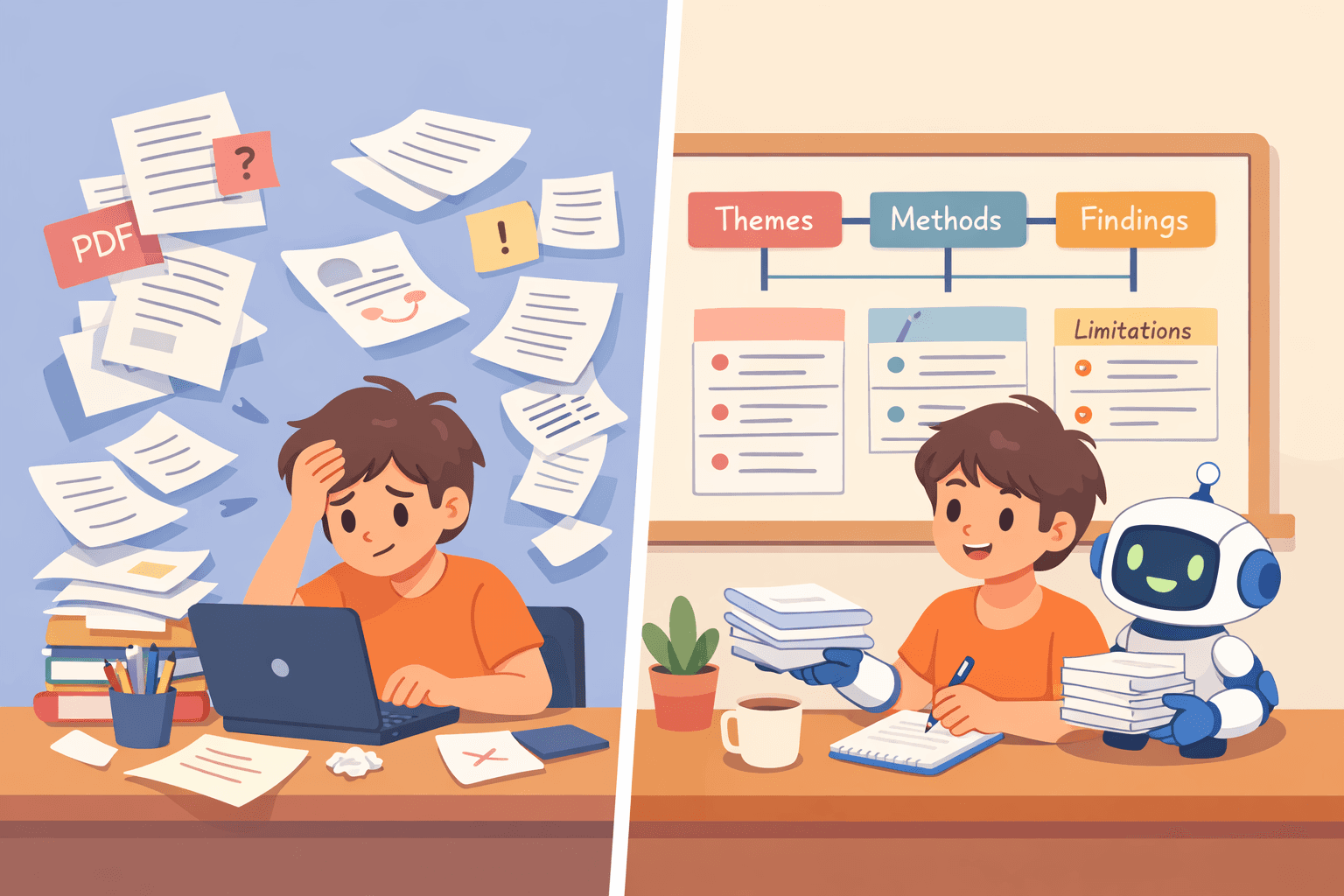
From Messy Notes to Clear Thinking

You sit with scattered papers and half-formed ideas, trying to make sense of everything without losing track of what matters. It feels slow and frustrating. It shows.

<CTA title="Turn Sources Into Structured Insights" description="Organize research, uncover patterns, and write faster with guided academic workflows." buttonLabel="Try Jenni Free" link="https://app.jenni.ai/register" />

You don’t need a perfect system, you need one that works fast and keeps your thinking clear. With Jenni, our AI literature review & RRL generator, you can organize sources into simple structures and move straight into writing with confidence. It helps you connect ideas without overcomplicating the process. Start there, keep it simple, and your literature review will come together in a way that actually makes sense.

目录

今天就开启你的非凡写作之旅

从今天起,用 Jenni 写下你的 第一篇论文,开启全新篇章

免费开始

无需信用卡

随时取消

500万+

遍布全球的学者

5.2小时

每篇论文平均节省

超过1500万篇

在鉴研上完成的论文

今天就开启你的非凡写作之旅

从今天起,用 Jenni 写下你的 第一篇论文,开启全新篇章

免费开始

无需信用卡

随时取消

500万+

遍布全球的学者

5.2小时

每篇论文平均节省

超过1500万篇

在鉴研上完成的论文

今天就开启你的非凡写作之旅

从今天起,用 Jenni 写下你的 第一篇论文,开启全新篇章

免费开始

无需信用卡

随时取消

500万+

遍布全球的学者

5.2小时

每篇论文平均节省

超过1500万篇

在鉴研上完成的论文