"Et al." is a quick way to say "and others" in your paper's citations. If you're listing three or more authors, you'll probably use it. The rules change a bit between APA, MLA, and Chicago style, which trips a lot of people up.
We've got clear breakdowns and real-world examples to show you exactly how it works. Stop guessing and write your references with confidence. Keep reading for the full guide.
<CTA title="Write Clean Academic Citations Faster" description="Generate accurate citations and structured references without formatting confusion" buttonLabel="Try Jenni Free" link="https://app.jenni.ai/register" />
What Does “Et al.” Mean in Academic Writing?
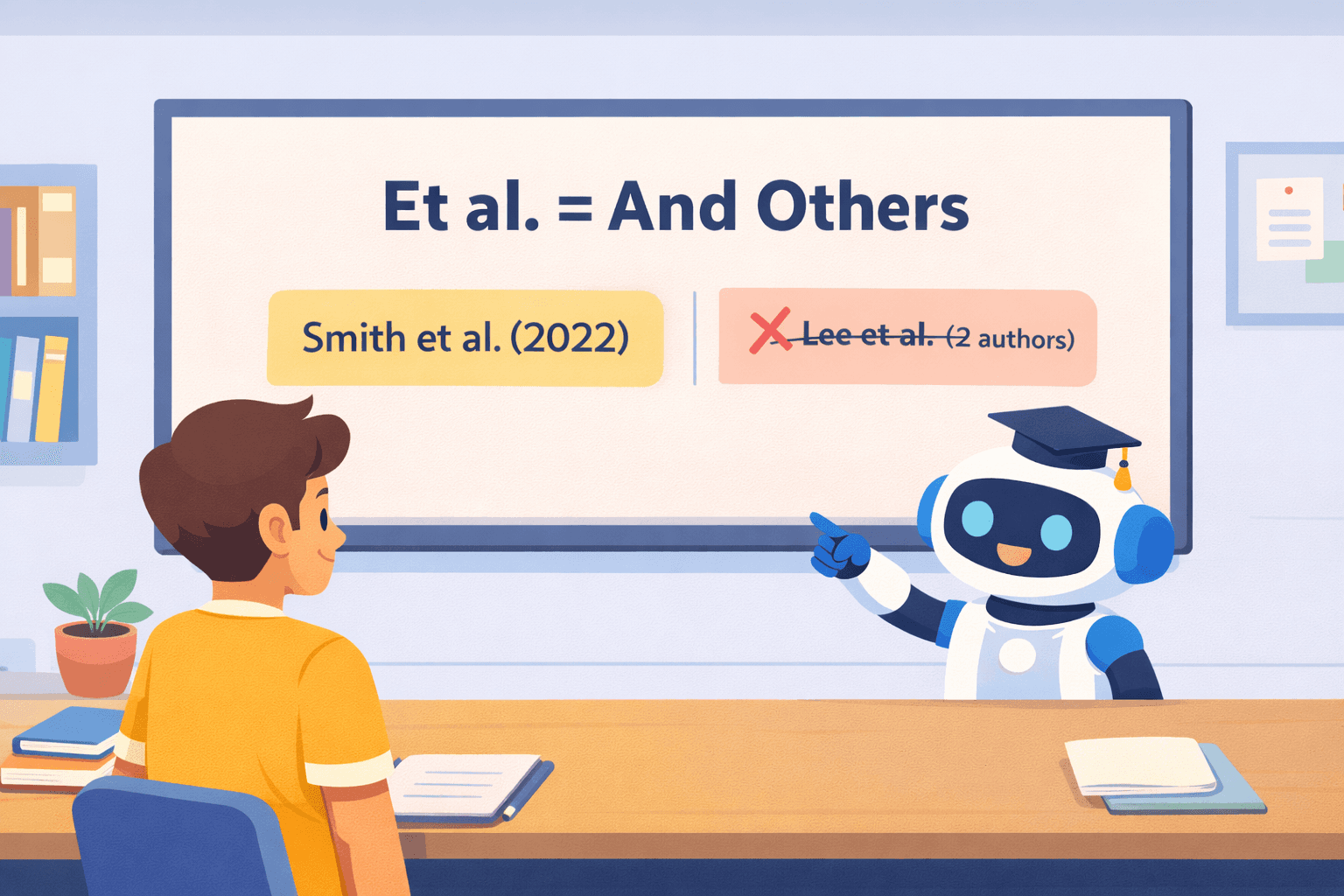
The term "et al." comes from the Latin phrase et alia, which means "and others." It's not just a piece of academic jargon. It's a standard, formal tool used in citations across the globe.
Where It Comes From The abbreviation is a direct lift from Latin. While you might see older versions like et alii, the academic world has settled on "et al." for consistency. This use of Latin shorthand is a holdover from scholarly traditions that helped shape the citation systems we use now. The Oxford English Dictionary notes these abbreviations stuck around because they save space and make text easier to scan.
What It Refers To (And What It Doesn't) "Et al." is only for people. Specifically, it stands in for the additional co-authors of a cited work. You don't use it for things, concepts, or general categories.
Right: The methodology was based on prior work by Chen et al. (2019).
Wrong: The study reviewed policy changes, economic shifts, et al.
Getting this wrong can confuse your reader and make your writing seem less precise.
Why Researchers Use It Simple: teamwork. A single paper in fields like biomedicine or physics can have dozens of authors. Writing out all those names every time you cite the study would clutter the page.
Using "et al." does three practical things:
It keeps your citations and references short.
It prevents your sentences from becoming unreadable lists of names.
It lets you follow the strict formatting rules of styles like APA or MLA.
Guidelines from sources like the Purdue OWL citation resources point out that this clarity helps readers follow complex arguments without getting bogged down.
<ProTip title="💡 Pro Tip:" description="Use et al only for referencing people not concepts or objects in academic writing" />
How to Use Et al. in Citations (With Clear Examples)
Using "et al." in your citations isn't complicated, but you have to follow the rules for your specific style guide. Here’s how it works in practice.
The Basic Format You'll usually see it like this in the text of a paper: the first author's last name, then et al., then the year in parentheses.
Smith et al. (2022) argued the model was flawed.
Later studies confirmed the finding (Smith et al., 2022).
Remember the punctuation: there's no comma before it, and you always need the period after "al." because it's an abbreviation.
When You Should Use It The core rule is the same for most major styles: use et al. for a source that has three or more authors.
For a fuller set of APA rules for multi-author sources (including when you should not shorten to et al.), see How to Cite Multiple Authors in APA Style: Rules and Examples.
This often comes up when you're citing multiple supporting studies while developing a focused research direction, such as when learning how to write research question effectively and backing it with existing literature.
But the details change depending on whether you're using APA, MLA, or Chicago. Getting this wrong is a very common mistake, according to editors at Scribbr.
Style | Use "Et al." For... | In-Text Rule | Reference List |
APA 7th Ed. | 3 or more authors | Use et al. every time after the first citation. | List all authors up to 20. |
MLA 9th Ed. | 3 or more authors | Use et al. for all in-text citations. | Usually list the first author only, followed by et al. |
Chicago | 4 or more authors (for both Author-Date and Notes-Bibliography systems). | Use et al. for all in-text citations. | In the Bibliography, list up to 10 authors; for 11 or more, list the first 7 followed by 'et al. |
When You Shouldn't Use It Don't reach for et al. in a few specific cases:
If a work only has two authors. Always use "and" or an ampersand (&).
Correct: (Lee & Kim, 2021)
Incorrect: (Lee et al., 2021)
In informal writing like emails or personal blog posts.
If your professor or a specific journal's instructions tell you to list every author.
<ProTip title="📌 Note:" description="Always confirm the author count before applying et al in citations" />
Et al. vs. Etc.: What People Get Wrong
It's easy to confuse "et al." and "etc.", they look similar, but they do completely different jobs in your writing.
The Core Difference The mix-up happens because both are Latin abbreviations, but that's where the similarity ends.
Et al. is for people. It stands in for additional authors or contributors.
Etc. is for things. It means "and so on" and finishes an incomplete list of items.
Understanding distinctions like this is similar to how academic concepts are clearly separated in frameworks such as research paradigms, where each term has a specific role and meaning.
Look at how they're used:
"The framework was validated by Miller et al."
"Participants brought pencils, notebooks, etc."
Using one in place of the other doesn't just look wrong. It makes your meaning unclear and can seem sloppy to a reader who knows the difference.
Why People Get Them Wrong Students usually encounter both terms around the same time, often when learning citation rules. The result is that many just copy the format they see without really learning what the abbreviation means. You'll sometimes see the mistake combined, like writing "Davis et al., etc." which is redundant and incorrect.
A Quick Trick to Remember Here's a simple way to keep them straight: think of "et al." as a team name tag. It labels a group of people. Think of "etc." as a list shortcut. It replaces the rest of a series of similar things.
That little distinction will help you avoid the error in your next paper.
<ProTip title="💡 Pro Tip:" description="Remember et al is for authors while etc is for items in a list" />
Et al. in APA, MLA, and Chicago Styles

Major citation styles all use "et al." to shorten author lists, but their specific rules aren't identical. Using the wrong one is a fast way to lose points for formatting.
APA Style (7th Edition) APA is the standard for psychology, education, and the social sciences. Its rule is straightforward: use "et al." for any source with three or more authors, and do it for every single in-text citation after the first one.
In-text: Reyes et al. (2020) conducted a meta-analysis.
In-text (parenthetical): The data was inconclusive (Reyes et al., 2020).
Reference List: You still list every author's name, up to 20 people. The abbreviation is only for the body of your paper.
The APA citation guidelines state this consistency helps readers quickly identify sources.
MLA Format MLA, used for literature and humanities papers, also starts using "et al." for three or more authors.
The main difference is that MLA in-text citations don't include a year. You just use the author name(s) and a page number.
In-text: Reyes et al. suggest the character's motive is ambiguous (204).
In-text (parenthetical): The motive remains ambiguous (Reyes et al. 204).
Works Cited: Here, you'll usually list just the first author, followed by et al.
Chicago Style Chicago style, common in history and publishing, has a higher threshold. You only use "et al." for four or more authors.
It gets trickier because Chicago has two systems: Notes-Bibliography and Author-Date.
In the Notes-Bibliography system (using footnotes), you list all authors in the first note, then use et al. in subsequent notes.
In the Author-Date system, you use et al. in the parenthetical citation just like APA, but only after the fourth author.
Because Chicago allows for this flexibility, you must check your assignment guidelines or journal requirements to know which version to follow.
<ProTip title="⚠️ Reminder:" description="Always follow your departments required citation style not just general rules" />
Why Your Citation Tool Gets Et al. Wrong
You might trust a citation generator to handle the details, but these tools frequently get the rules for "et al." wrong. Relying on them without checking can introduce errors into your paper.
The Default Settings Problem Citation software is built with general defaults that don't always match the exact requirements of APA, MLA, or Chicago. The tool might be programmed to abbreviate author lists after two names, while your specific style guide says to wait until you have three or four. This creates a direct conflict between what the software gives you and what your professor expects.
You'll see the mismatch in places like the built-in citation generator in Microsoft Word, or in popular reference managers like Zotero and Mendeley. The output looks polished, but it's often technically incorrect.
The Extra Work It Creates The result is more work, not less. Students in online academic forums regularly report spending an extra 15 to 30 minutes per paper just fixing automated citations. They generate the reference, then have to go line-by-line through their bibliography to adjust the author lists, punctuation, and formatting that the tool handled improperly.
How to Use Tools Without Getting Burned The fix is to change how you use the tool. Don't treat it as the final step.
Follow this process instead:
Let the software generate your initial citation or bibliography.
Immediately open the official style guide (like the APA Manual or the MLA Handbook) or a trusted university resource (like the Purdue OWL).
Compare the tool's output to the guide's rules, line by line, focusing on author lists.
Manually correct any discrepancies.
Think of citation generators as a rough draft assistant. They give you a structure to start with, but you are still the final editor who must verify everything against the official source.
When “Et al.” Can Lower Your Grade
Your research might be solid, but small mistakes with "et al." can still pull your grade down. Instructors see these errors as a lack of precision.
Frequent Student Errors Certain citation mistakes show up again and again in student work:
Shortening a source with just two authors to "et al." (e.g., writing Jones et al. instead of Jones and Lee).
Applying the rule inconsistently, using it in one sentence but writing out all three authors in the next.
Accidentally blending rules from different style guides in the same paper.
Getting the punctuation wrong, like forgetting the period after "al." or adding an extra comma.
These issues become more noticeable in papers that compare methods or data approaches, such as studies on qualitative vs quantitative research, where multiple citations appear close together.
Data from academic editing services suggests citation formatting issues, including these, appear in well over half of all student submissions. They're that common.
The Problem of Overuse Sometimes, students lean on "et al." too heavily, thinking it makes their writing sound more scholarly. The result is often a cluttered, repetitive sentence.
For example: "Recent studies by Chen et al. (2022), Lopez et al. (2021), and Park et al. (2020) support this theory."
That string of "et al." citations is hard to read. It doesn't sound more academic; it just sounds clunky.
What Actually Impresses Your Instructor Clear, consistent formatting always beats forced complexity. Strong academic writing does three things:
It integrates citations smoothly into the sentence's flow.
It sticks faithfully to one style guide (APA, MLA, or Chicago) from the first page to the references.
It avoids needless repetition, using techniques like synthesizing sources (e.g., "Several recent studies [Chen et al., 2022; Lopez et al., 2021] confirm...") instead of listing them one by one.
Getting "et al." right is less about fancy writing and more about careful, consistent editing.
<ProTip title="💡 Pro Tip:" description="Focus on clarity and consistency instead of using too many citations in one paragraph" />
A Simple Workflow for Using Et al. Correctly

You can avoid most errors by using a consistent, step-by-step process for each source you cite.
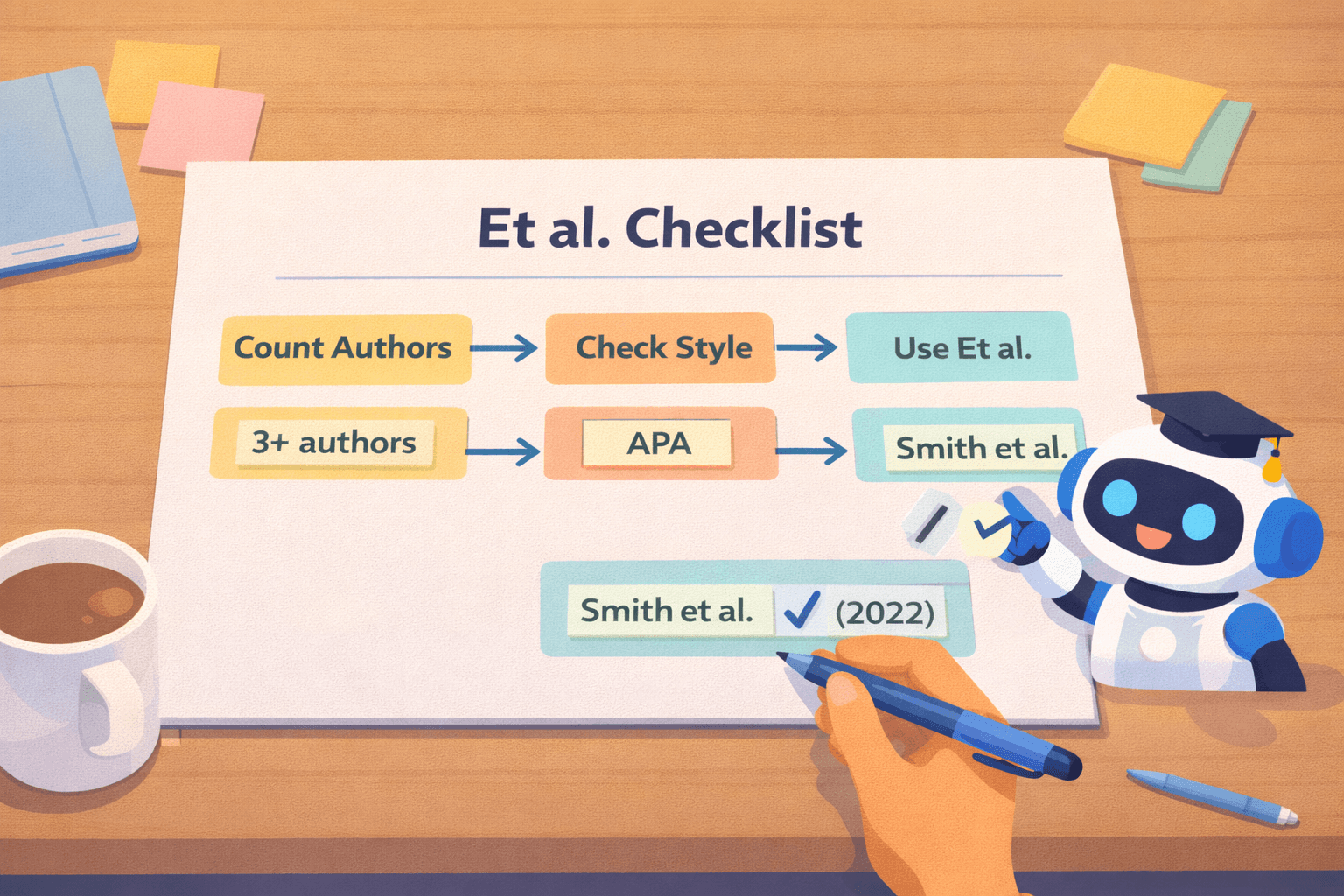
Follow These Steps For every single citation in your paper, run through this list:
Count the authors. Is it one, two, three, or more?
Confirm your style. Are you using APA, MLA, or Chicago? Double-check your assignment sheet.
Apply the rule. Based on steps 1 and 2, do you use "et al." or write out the names?
Format the in-text citation. Write it correctly in the body of your paper.
Check the reference list. Make sure the full citation in your bibliography matches the style's requirements for author lists.
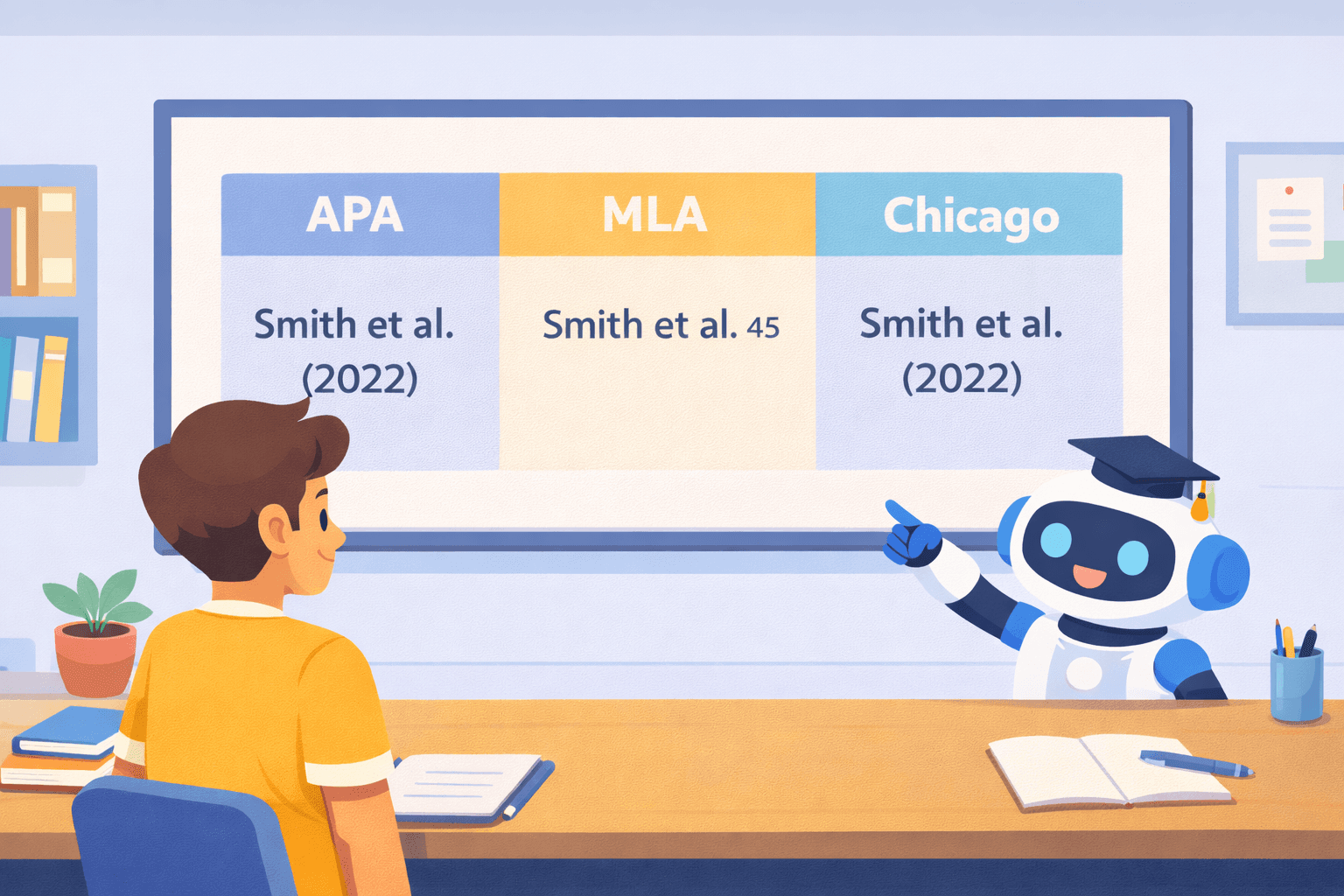
Seeing It in Action Take a source by four authors: Smith, Jones, Lee, and Garcia.
In APA, you'd write: Smith et al. (2022)
In MLA, you'd write: Smith et al.
In Chicago (Author-Date), you'd write: Smith et al. (2022)
The output looks almost the same, but the logic behind it, the threshold for when to abbreviate, is different. That's why step 2 is non-negotiable.
Final Submission Checklist Right before you turn in your paper, scan your citations with these questions:
Did I only use "et al." for sources with three (or four, for Chicago) or more authors?
Is every citation following the same style guide, without mixing rules?
Is the punctuation correct, a period after "al." and no comma before it?
Did I keep "et al." out of any informal writing or prose where it doesn't belong?
Running this quick check catches the majority of common formatting slips.
Et al. in Real Academic Writing Scenarios
Understanding theory is useful, but applying et al in research papers requires context.
Example in a Literature Review
A literature review often includes multiple sources:
Example:
Johnson et al. (2020) highlight trends in digital learning
Patel et al. (2021) expand on these findings
Here, “et al.” keeps citations readable without overwhelming the paragraph.
Example in Scientific Papers
Scientific writing often involves large author groups.
A study in medicine may include 10+ researchers, making “et al.” essential for readability.
Example in Thesis Writing
In theses, consistent citation is critical.
Using “et al.” correctly:
Saves space
Maintains formal tone
Aligns with institutional guidelines
Use “Et al.” the Right Way Without Overthinking It
You’ve probably seen “et al.” in papers and felt unsure about when to use it or if you’re doing it right. That hesitation slows you down and breaks your focus while writing. It’s a small detail, but it matters.
<CTA title="Improve Your Academic Writing Workflow" description="Create structured essays and accurate citations without formatting confusion" buttonLabel="Try Jenni Free" link="https://app.jenni.ai/register" />
Keep it simple and follow the basic rules, then let tools like Jenni handle the formatting so you don’t get stuck. It helps you stay consistent and move faster, so you can focus on your ideas instead of fixing citations.