Writing a critique means you have to judge a piece of work, not just describe it. That's the part most students find difficult.
This guide uses specific examples to show you how it's done. You'll see how a proper critique is structured, how to move from summary to real analysis, and how to use that approach yourself. Read on for the details.
<CTA title="Write Better Critiques Faster" description="Turn rough ideas into structured, evidence-based critique papers with clear arguments and balanced analysis." buttonLabel="Try Jenni Free" link="https://app.jenni.ai/register" />
What Makes a Strong Critique Paper?
A strong critique paper isn't about your personal opinion. It's about forming a judgment based on evidence — and if you want more models of criteria-based assessment, see our evaluation essay examples.
If you're working with multiple academic sources before evaluating one in depth, understanding a narrative literature review can help you identify patterns, themes, and recurring arguments more clearly. If you're unsure how this differs from a critique, our critical review vs literature review guide breaks down the differences.
Imagine you're inspecting a bridge. You wouldn't just say it seems fine or shaky. You'd check the materials used, how it's built, and its overall design.
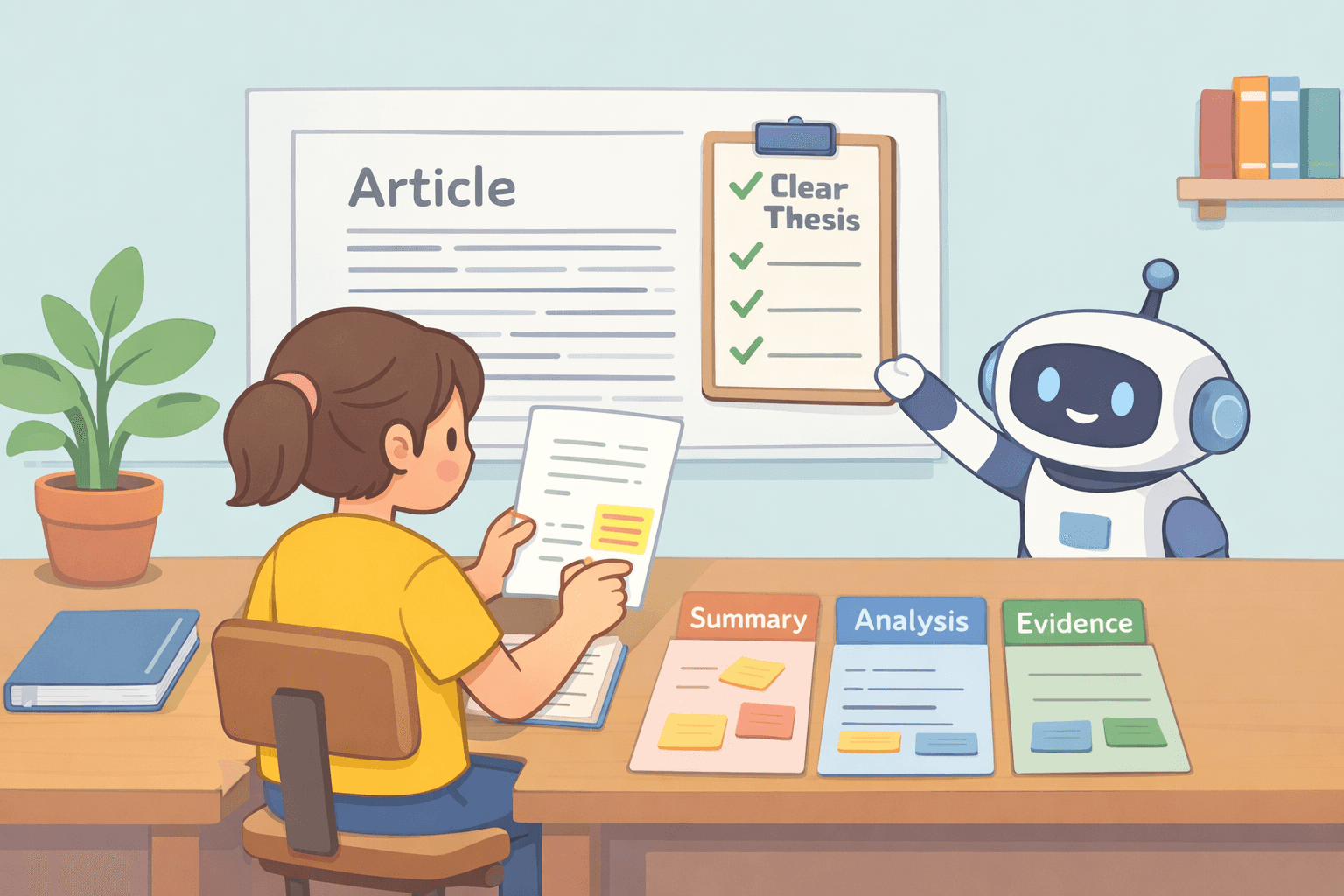
For a paper, that means you need:
A clear thesis: Your main judgment.
A concise summary: The work's main points.
A focused analysis: Its strengths and flaws.
Evidence: Quotes, data, or examples to back up your points.
A balanced conclusion: It shouldn't be purely praise or criticism.
Element | Purpose | Key Question It Answers | Example |
Thesis | States your main judgment | What is your overall evaluation? | The argument is strong but lacks balance |
Summary | Presents the main ideas | What does the work say? | The article examines online learning outcomes |
Analysis | Evaluates strengths and weaknesses | What works and what doesn’t? | The data is clear, but the sample size is small |
Evidence | Supports your evaluation | How do you prove your claims? | Based on the study’s limited participants |
Conclusion | Wraps up your judgment | What is your final assessment? | The study is useful but not fully reliable |
<ProTip title="💡 Pro Tip:" description="Always separate summary from analysis. Mixing them is the most common critique mistake." />
Critique Paper Structure (With Example Breakdown)

Before looking at a full example, it's helpful to know the basic structure. A critique typically follows four parts.
1. Introduction: Your Lens This paragraph introduces the work and your judgment of it. You should mention the author and title, give a bit of context, and then state your thesis, which is your overall evaluation.
Example: In "Dead Man Walking," Sister Helen Prejean argues against capital punishment using personal stories and data. While the book is powerful in its moral appeal, its arguments sometimes miss opposing viewpoints, which reduces their effectiveness.
The key here is that your thesis isn't just a topic; it's a clear judgment.
2. Summary: Just the Facts This section is short. You objectively explain the work's main points, without adding your opinion. If you need to tighten your recap first, our AI summarizer can help you produce a concise, neutral summary to evaluate.
Example: The book details Prejean's experiences with death row inmates, outlines the legal procedures involved, and discusses the ethics of the death penalty.
It's neutral and concise. For additional tips on how to write an effective critique summary, you can follow a structured guide on writing critiques using well-defined frameworks.
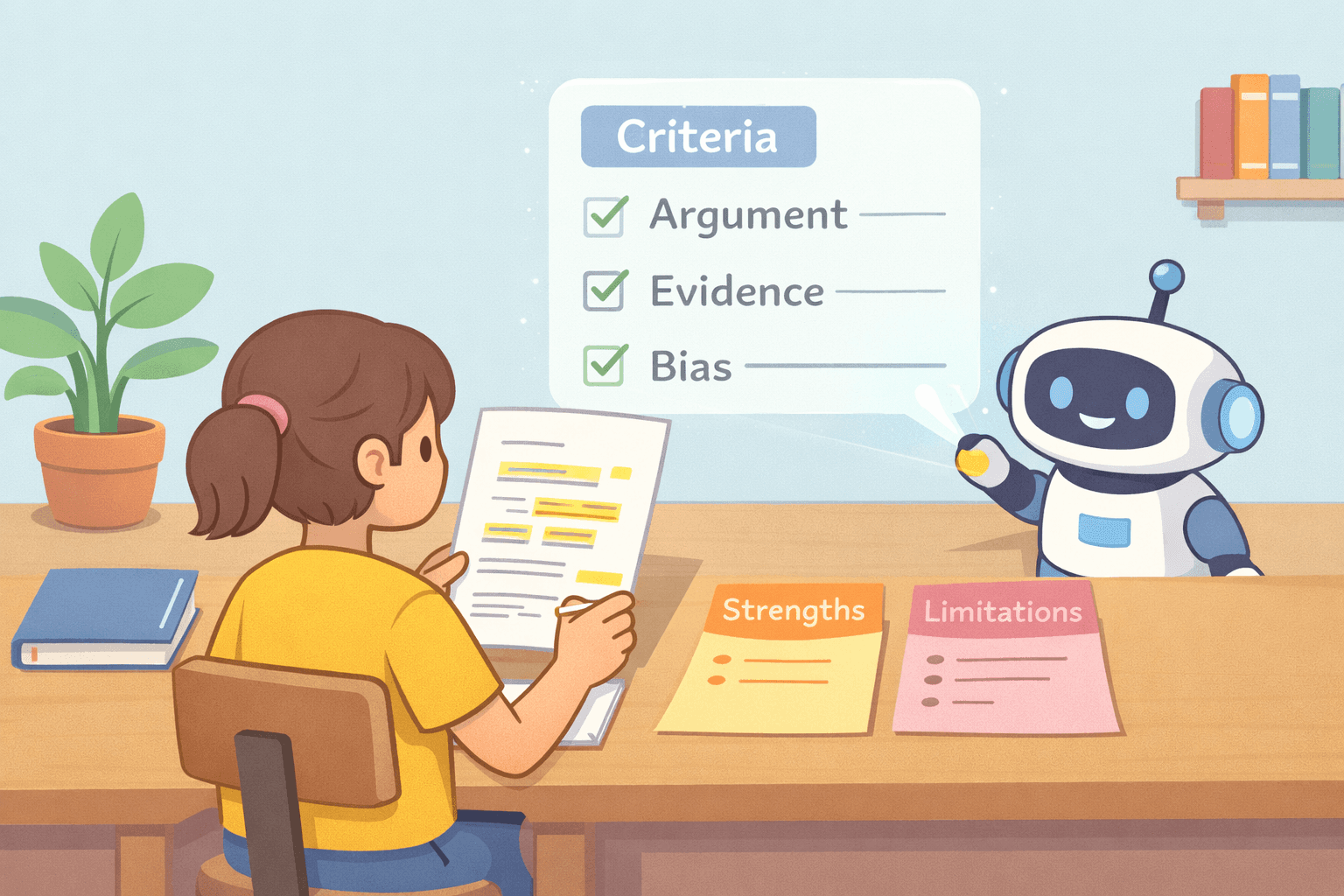
3. Analysis: The Main Section This is where you do the actual critique. You break down the work based on specific criteria, like the strength of its arguments, the quality of its evidence, any potential bias, or its writing style.
Mini Example: Prejean's use of emotional narratives makes the book engaging. But her heavy reliance on these personal stories, without enough statistical backing, makes the logical case less solid.
You support each point with evidence from the work itself.
4. Conclusion: The Final Take Wrap up by restating your main evaluation in a new way, and consider the work's broader significance.
Example: Ultimately, the book is successful in making readers question the ethics of execution, but it doesn't fully deliver a balanced, comprehensive argument.
Critique Paper Example (Article)
Here's a simplified look at how you critique a journal article.
The Work: A research article titled "Online Learning Outcomes in Higher Education" claiming digital courses boost student performance.
Sample Critique:
Introduction (Condensed): The article makes a case for better student outcomes through online learning. Its findings are interesting, but the conclusions aren't very reliable because the study used too few participants.
Summary: The researchers compared final exam scores between online and traditional classroom students at three different schools.
Analysis:
Strength: The research question itself is clear and focused.
Strength: The data is presented in a logical, easy-to-follow way.
Weakness: The sample size is small, only 60 total students were involved.
Weakness: The study only looked at immediate test scores, not long-term retention or skill application.
For additional tips on writing a complete critique in a structured essay format, see how to write a critique in five paragraphs.
Conclusion: The article provides a useful starting point for discussion. However, its bold claims need support from a much larger and more thorough study.
What this example demonstrates:
The evaluation is based on clear criteria (like methodology).
Every point is backed by evidence from the article itself.
The tone stays balanced and objective, not overly emotional.
<ProTip title="🧠 Reminder:" description="Avoid vague criticism. Always explain why something is strong or weak." />
Critique Paper Example (Research Paper)
When you critique a formal research paper, you need to dig deeper, especially into how the study was conducted.
Key areas to focus on:
The research design itself.
How the data was gathered.
The validity and reliability of the results.
Any potential bias in the methods.
Sample Critique of a Research Article
Thesis: The paper outlines a clear, organized methodology. Its biggest flaw is a lack of proper control variables, which casts doubt on how valid the final results really are.
Analysis Example: Using surveys let the researchers collect data quickly from many people. The problem is, they didn't use random sampling to choose those people. This means the participant group might not represent the wider population, introducing a likely bias into the findings.
That focus on the methodology, not just the conclusions, is what turns this from a summary into a proper research critique. For more detailed guidance on undergraduate research writing and critique instructions, see this resource on academic writing practices.
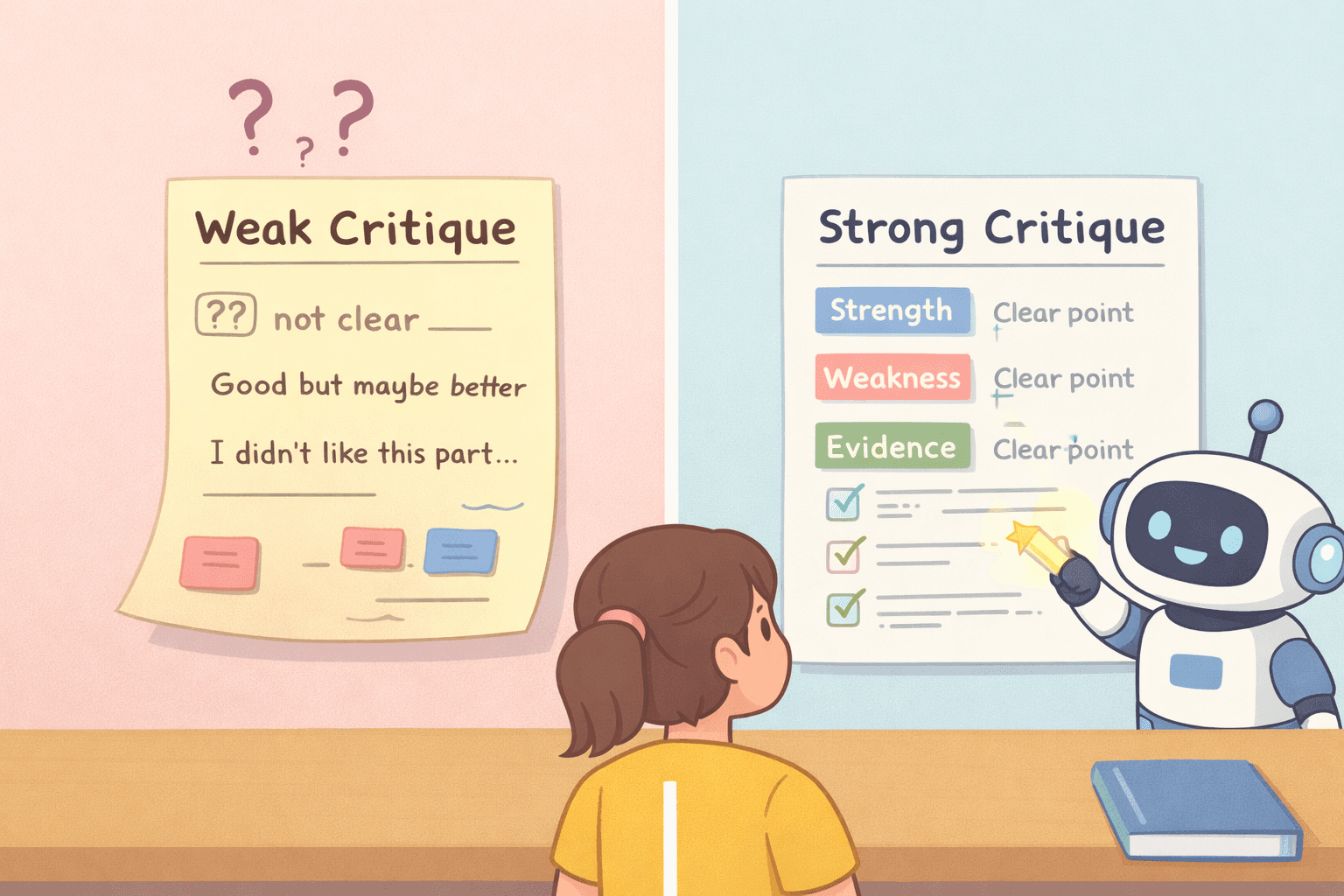
Learning from Examples: Strong vs. Weak
Sometimes, seeing the difference between a good and bad critique is more helpful than just reading the rules.
A Weak Critique "The article is interesting and well-written, but it could be better."
Why it fails:
It uses no clear criteria for judgment.
It provides zero evidence from the text.
The feedback is vague and has no depth.
A Strong Critique "The article's argument is clear and uses recent data effectively. Its main weakness is that it doesn't address any counter-arguments, which makes the analysis feel shallow."
Why it works:
It's specific, pointing to the use of data and the absence of opposing views.
It's balanced, noting both a strength and a weakness.
It's evidence-based; you can see exactly what the critic is referring to in the article.
Criteria | Weak Critique | Strong Critique |
Clarity | Vague and general | Specific and precise |
Use of Evidence | No supporting evidence | Uses clear examples or references |
Depth of Analysis | Surface-level comments | Explains reasoning in detail |
Balance | One-sided or unclear | Includes both strengths and weaknesses |
Example | The article is interesting but could be better | The article uses strong data but ignores counterarguments |
<ProTip title="⚡ Quick Tip:" description="Every critique sentence should answer: what works, what does not, and why." />
Critique Paper Example (Short Essay Format)
Here’s how a critique might look written as a standard essay paragraph.
Sample Paragraph: The essay builds its case logically, starting with the problem and then laying out solutions. A significant issue is its use of old sources, which hurts the overall credibility. For instance, many of the supporting statistics are from studies published more than ten years ago, making them potentially irrelevant to today's situation.
Why this works:
It points out a structural strength and a sourcing weakness.
It uses a concrete example (the decade-old statistics) as evidence.
It explains the impact of that weakness, the claims may not be credible for current discussions.
Common Mistakes in Critique Papers

These are common errors, even for experienced writers.
1. Writing a Summary Instead of a Critique If your paper just repeats what the work says, you haven't critiqued it. Your job is to evaluate its success or failure.
In many academic critiques, that also means recognizing what the author leaves out, which is why knowing how to identify research gaps can strengthen your analysis.
2. Using Personal Opinion as Judgment Avoid statements based purely on feeling, like "I didn't like this part" or "I think this is good." Instead, base your judgment on the work's own merits: "This section fails because it provides no data to support its claim."
3. Skipping the Basic Structure A critique isn't a free-form reaction. It still requires the standard framework: an introduction with your thesis, a brief summary, a detailed analysis, and a concluding judgment.
4. Turning the Critique into an Attack The goal is balanced evaluation, not demolition. An overly harsh or one-sided tone undermines your credibility. Point out flaws, but also acknowledge what the work does well.
<ProTip title="📌 Note:" description="A strong critique always includes at least one strength and one limitation." />
Quick Checklist for Writing Your Own Critique
A Quick Checklist Before You Submit
Run through these points to polish your critique paper. If you're struggling to organize your ideas before drafting, learning how to write a literature review outline can also help you build a clearer structure for academic analysis. You can also map your sections quickly with our AI essay outline generator.
Structure
Does your introduction have a clear thesis statement?
Is there a separate, neutral summary section?
Are your analysis paragraphs focused on specific criteria?
Does your conclusion restate your final judgment?
Content
Is every claim backed up by evidence from the work?
Is your evaluation balanced, noting both strengths and weaknesses?
Have you included specific quotes, data, or examples?
Style
Is the tone formal and objective?
Have you avoided language like "I feel" or "I believe"?
Are your sentences straightforward and easy to follow?
What This Means in Practice
Ultimately, writing a critique means you stop thinking like a passive reader and start thinking like an active evaluator.
You're not just absorbing information. You're asking specific questions:
Did the work actually accomplish what it set out to do?
Is the evidence provided solid and convincing?
What's missing? Are there any hidden biases or logical gaps?
When you make that mental shift, your writing naturally becomes more precise and analytical. You move from describing what something is to judging how well it works.
Writing a Critique That Actually Holds Up
You might feel unsure when your critique sounds too harsh or too vague, and that makes it hard to trust what you’re writing. It’s frustrating. A strong critique isn’t about tearing something down, it’s about judging it fairly with clear reasoning and solid support.
<CTA title="Structure Your Critique with Confidence" description="Turn your ideas into clear structured critique papers with guided outlines and stronger arguments." buttonLabel="Try Jenni Free" link="https://app.jenni.ai/register" />
That’s where Jenni can help, giving you a simple way to organize your points so your analysis stays focused and easy to follow. It keeps your ideas in order and lets you spend more time on the actual critique. When your structure is clear, your argument feels more reliable.