{{HeadCode}} Correlational Research Explained: Types, Examples, and Key Concepts Meta Description: Learn correlational research with clear explanations, real examples, and key concepts. Understand types, interpretation, and how it differs from experimental research.

通过

贾斯汀·王

Correlational Research Explained: Types, Examples, and Key Concepts

贾斯汀·王

增长负责人

获得全球商业与数字艺术学士学位,辅修创业

Correlational studies are everywhere in research, but people often get them wrong. Just because two things are connected doesn't mean one makes the other happen. That's the biggest trap to avoid.

This straightforward guide walks you through the basics: what this method is, how it works, the different types you'll see, and the right way to understand the findings so you don't jump to the wrong conclusion.

<CTA title="Understand Research Methods Faster" description="Turn complex research concepts into clear structured notes and frameworks for better academic writing." buttonLabel="Try Jenni Free" link="https://app.jenni.ai/register" />

What Is Correlational Research?

It's a non-experimental method. Researchers use it to study the relationship between two or more variables, but they don't change or control any of them. The core question isn't about cause and effect. Instead, it asks: do these things change together in some predictable way? For a deeper breakdown, see this guide on correlational research methodology explained.

Take a straightforward example. More study time often goes along with higher grades. More screen time frequently links to worse sleep quality. These show a relationship, a correlation. They do not, however, prove that studying caused the better grade or that screens caused the poor sleep.

Why researchers use this method

This approach is valuable in situations where running a controlled experiment isn't possible or ethical. You can't randomly assign people to experience high stress for a study. But you can measure the stress levels in a group of students and see how those levels correspond with their academic performance. It's also practical for observing how variables interact in real-world settings, outside of a lab.

<ProTip title="💡 Pro Tip:" description="Correlation shows patterns, not causes. Always separate relationship from explanation." />

The Three Types of Correlation

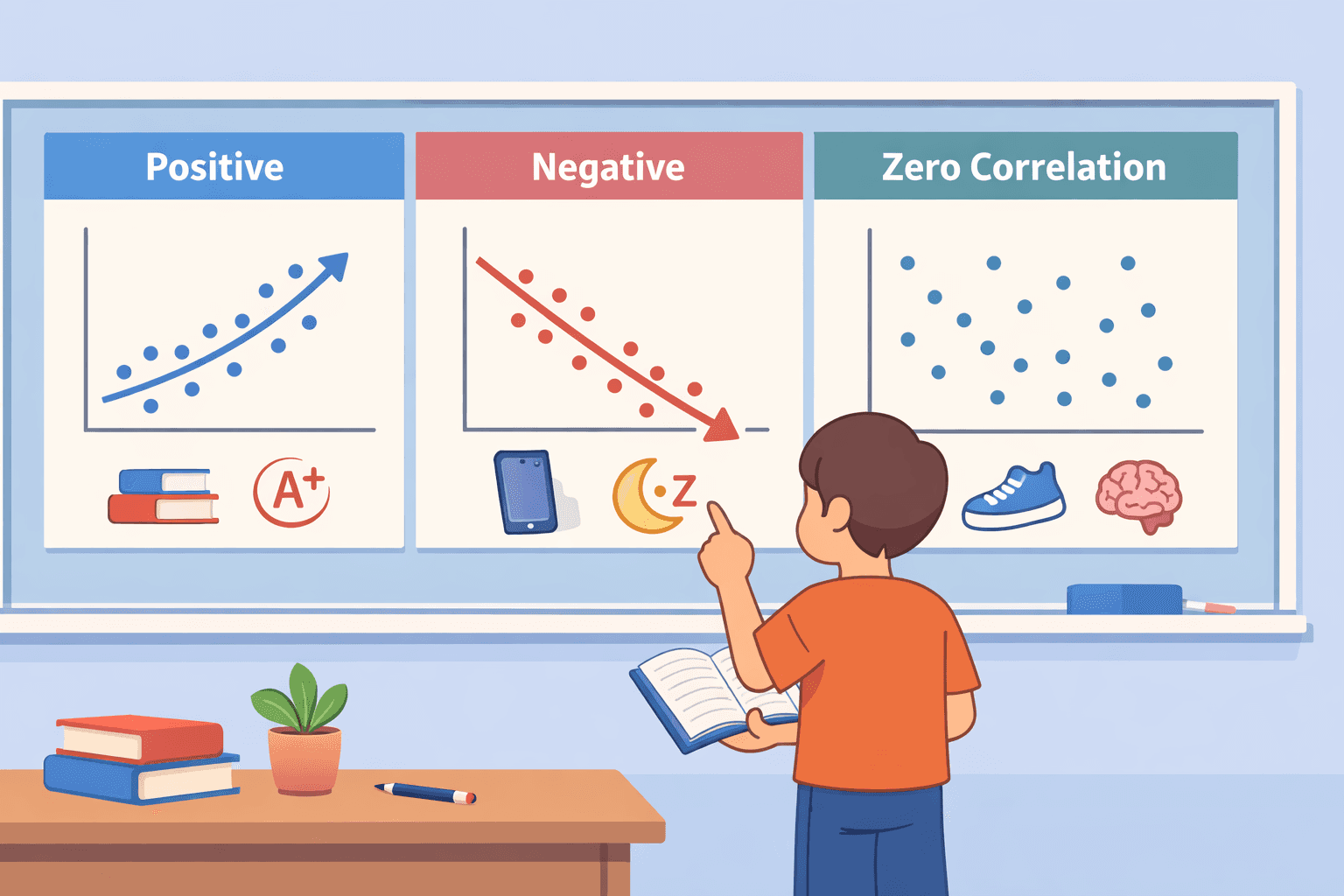
Correlation comes in three flavors: positive, negative, and zero. Knowing which you're looking at keeps you from drawing the wrong conclusions.

A positive correlation means two things move together. More of one usually means more of the other. Think about study time and grades: putting in more hours tends to lead to better results, and the data points on a graph slope upwards.

A negative correlation is the opposite. When one thing goes up, the other goes down. Take screen time before bed and sleep quality. More screen time is linked to worse sleep, fewer hours, and more tiredness the next day. The graph line slopes downward.

Finally, a zero correlation means there's no real link at all. One variable tells you nothing about the other. For instance, your shoe size has no bearing on your intelligence. The data would just be a random scatter on the plot, with no pattern to see.

Type

Direction

Real-World Example

What the Graph Shows

Positive

Same direction

Study hours and exam scores

An upward trend (points rise left to right)

Negative

Opposite direction

Screen time before bed and sleep duration

A downward trend (points fall left to right)

Zero

No pattern

Shoe size and IQ score

A random scatter with no trend

<ProTip title="🧠 Reminder:" description="Always describe both direction and strength when explaining correlation results." />

Correlation vs Causation: The Critical Difference

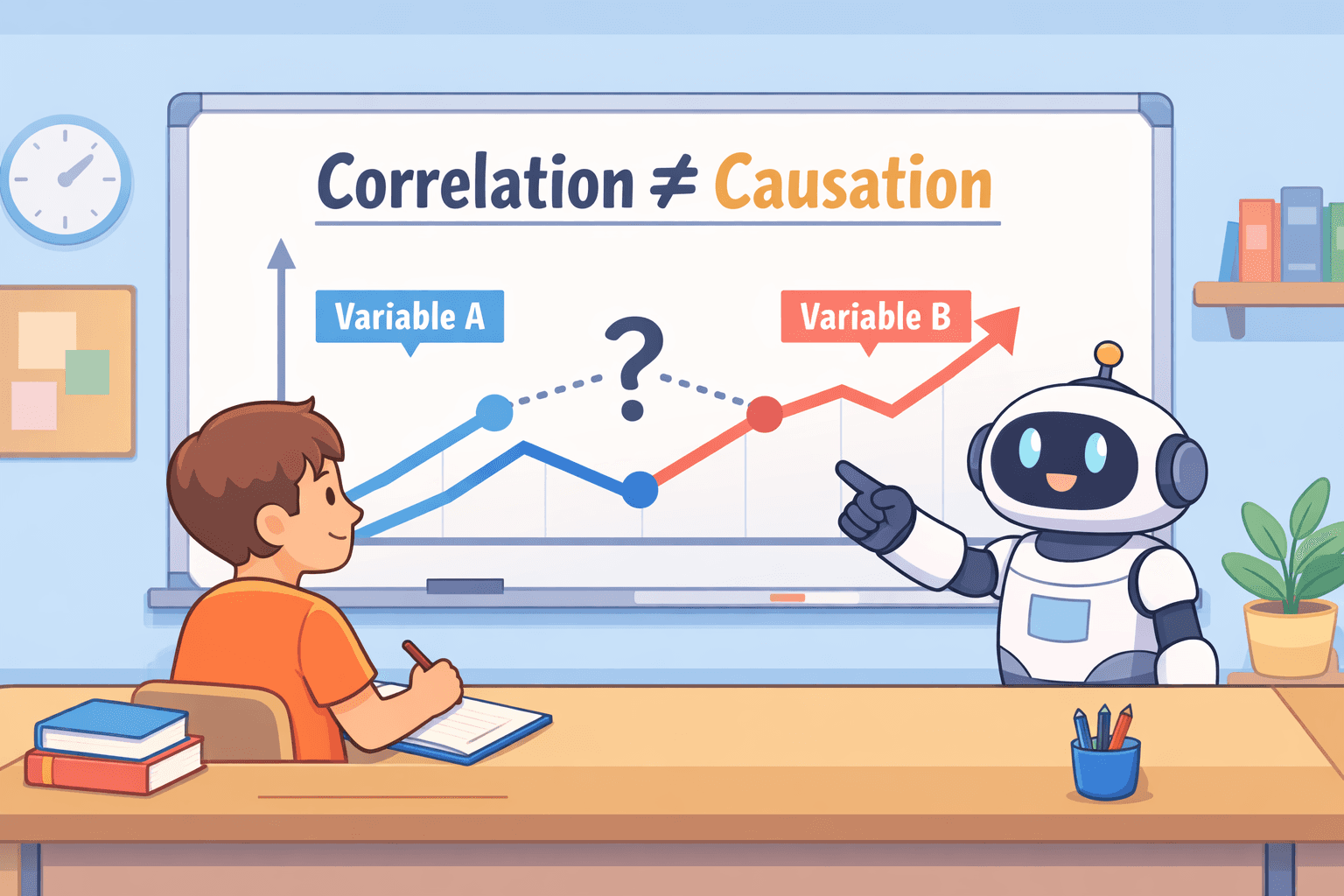
This is the single most important idea in this entire guide. Correlational research, by its very design, cannot prove that one thing causes another. It can only show that two things are related in some way. If you want a clearer conceptual breakdown, this explanation of correlation vs causation differences is worth reviewing.

A classic example that trips people up is the well-documented relationship between ice cream sales and drowning deaths. Both tend to rise sharply during the summer months. The correlation is strong and real. But does eating ice cream cause people to drown? Obviously not.

The hidden factor here is a third variable: hot weather. High temperatures cause both more people to buy ice cream and more people to swim, which unfortunately leads to more drowning incidents. The ice cream and the drownings are both effects of a common cause.

What a correlation might actually mean

When you see two variables linked, you need to consider other explanations beyond a simple cause-and-effect chain. The real connection could be one of three things:

  • A third variable (a confounder): An unseen factor influences both of the things you're measuring, like temperature in the ice cream example.

  • Reverse causation: It's possible the relationship works in the opposite direction. Does anxiety cause poor sleep, or does chronic poor sleep lead to higher anxiety? A correlation alone can't tell you.

  • Pure coincidence: Sometimes, patterns emerge randomly by chance, with no true underlying link at all.

Think of it this way: noticing a correlation is like seeing two people walking down the street together every day. You've correctly observed a connection. But you have no idea why they're together. Are they coworkers? Friends? Is one following the other? The correlation gives you a question, not an answer.

<ProTip title="⚠️ Common Mistake:" description="Never write causes when your study only shows correlation. Use words like associated or related." />

Correlational vs Experimental Research

Grasping this distinction is fundamental to designing a good study or evaluating someone else's work. The two methods ask different questions and provide different kinds of answers.

Understanding different research paradigms can also help explain why some studies focus on measuring relationships while others aim to test causal effects.

If you're still deciding between numerical measurement and non-numerical interpretation, understanding qualitative vs quantitative research can also help place correlational studies in the right broader method category.

The core difference: observation versus intervention

Correlational research is about observation. It measures variables as they naturally occur, looking for patterns and connections between them. The researcher is a passive recorder.

Experimental research is about active testing. It involves deliberately manipulating one variable (the independent variable) to see if it causes a change in another (the dependent variable). The researcher creates the conditions to test a specific hypothesis.

Key differences at a glance

Aspect

Correlational Research

Experimental Research

Control

No manipulation of variables.

Tight control and manipulation of key variables.

Primary Goal

To identify and describe relationships.

To test for cause-and-effect.

Typical Setting

Real-world, natural environments.

Controlled laboratory or field settings.

Example

Measuring the relationship between average nightly sleep and students' semester GPA.

Randomly assigning students to a sleep extension program or a control group, then comparing their GPAs.

Choosing the right method

You should lean on correlational research in a few specific situations:

  • When it's impossible or unethical to manipulate the variables you're interested in (like studying the link between childhood trauma and adult health).

  • When you need data from a real-world, uncontrolled setting to see how variables naturally associate.

  • In the early, exploratory stages of research, where you're looking for patterns and generating hypotheses to test later.

An experiment is the necessary choice when:

  • Your central question demands proof of cause and effect.

  • You have the practical ability to control the environment and randomly assign participants to different conditions.

How Correlational Research Works

While the exact steps can vary, every correlational study follows a basic conceptual flow. Understanding this process shows you how researchers move from a question to a result.

The core stages of a study

  • Identify your variables. The researcher starts by deciding which two or more factors to measure. These must be quantifiable. For a study on academic performance, the variables could be 'weekly study hours' and 'final exam score'.

  • Collect the data. This involves gathering measurements for each variable from every participant in the sample. Data can come from surveys, existing records, direct observations, or tests.

  • Measure the relationship. Here, statistical analysis is applied to the collected data to calculate the strength and direction of the link between the variables.

  • Interpret the results. The researcher examines the statistical output, considers its strength, and, most critically, avoids claiming causation. This stage is where potential third variables and other limitations are discussed.

The key metric: the correlation coefficient (r)

The relationship is quantified using a statistic called the Pearson correlation coefficient, symbolized by r. This number has a specific meaning:

  • +1.0 signifies a perfect positive correlation.

  • 0.0 means absolutely no linear relationship.

  • -1.0 indicates a perfect negative correlation.

In practice, you'll almost never see perfect scores. Researchers use guidelines to interpret the strength:

  • r = 0.70: This is generally considered a strong positive relationship.

  • r = -0.40: This represents a moderate negative relationship.

  • r = 0.05: This is a negligible or very weak correlation, essentially no meaningful relationship.

Seeing the pattern: scatter plots

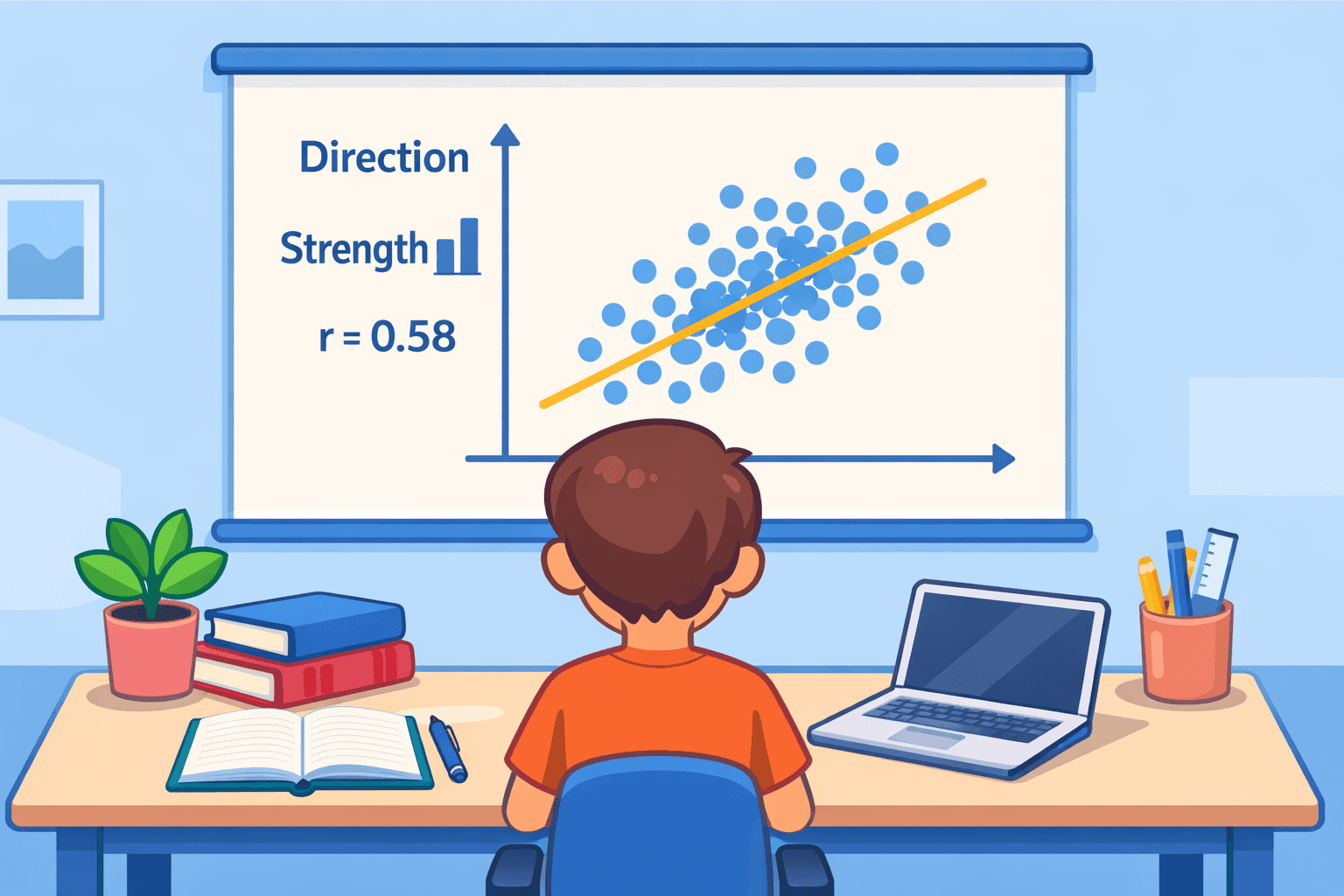
The correlation coefficient gives you a number, but a scatter plot gives you a picture. It's a graph where one variable is on the x-axis and the other on the y-axis, with each data point representing one participant.

  • A tight cluster of points forming an upward-sloping line suggests a strong positive correlation.

  • A tight cluster forming a downward-sloping line suggests a strong negative correlation.

  • A scattered, cloud-like spread of points with no discernible slope indicates a weak or zero correlation. The visual often makes the strength of the relationship immediately apparent.

<ProTip title="📊 Data Tip:" description="Always check scatter plots before trusting correlation values. Outliers can distort results." />

Real-World Examples of Correlational Research

Looking at actual studies shows how this method is used across different fields to uncover connections.

Education: study habits and grades Researchers often measure weekly study hours and student GPA. A typical finding is a positive correlation (e.g., r = 0.65), suggesting that more study time is associated with higher grades. This doesn't prove causation, motivation or prior knowledge could influence both, but it identifies a meaningful pattern.

Public health: exercise and stress Studies linking physical activity to perceived stress levels consistently show a negative correlation. People who exercise more usually report lower stress. The relationship could mean exercise reduces stress, that less-stressed people exercise more, or that another factor like general health affects both.

Business: satisfaction and loyalty Companies track customer satisfaction scores and repeat purchase behavior. The data consistently shows a strong positive correlation: higher satisfaction is strongly associated with customer loyalty and repeat business. This identifies a vital trend for strategy, though it doesn't pinpoint every cause behind a customer's return.

These examples from education, health, and business demonstrate how correlational research is a fundamental tool for spotting trends and generating insights, even when it can't provide definitive causal answers.

Strengths of Correlational Research

This method is widely used because it provides practical advantages experiments often cannot. Many of these benefits are also discussed in this overview of correlation research strengths and limitations, which expands on how researchers apply this method in real contexts.

Key advantages

  • Real-world applicability. It examines variables as they naturally occur, making findings more relevant to everyday situations.

  • Ethical feasibility. It allows the study of sensitive topics, like trauma or poverty, where manipulating variables in an experiment would be unethical.

  • Practical efficiency. These studies are typically faster and less costly to run than controlled experiments, often relying on surveys or existing data.

  • Hypothesis generation. It is a powerful exploratory tool that identifies real-world connections and generates specific hypotheses for future experimental testing.

Why researchers rely on it For complex questions, correlational research is often the necessary starting point. It maps out existing patterns and relationships in natural settings. These observed links then become the defined targets for more rigorous, and more expensive, experimental studies aimed at establishing causation.

Limitations You Should Not Ignore

Correlational research has inherent and significant constraints that shape how its findings should be interpreted.

No proof of causation This is the fundamental limitation. A correlation, no matter how strong, cannot demonstrate that one variable caused a change in another. It only establishes that a relationship exists.

The problem of confounding variables An observed link might be entirely driven by a third, unmeasured factor that influences both variables. This unseen "confounder" creates a misleading association.

The directionality problem Even if a causal link exists, the design cannot determine its direction. You can't tell which variable is influencing the other.

Example of the core problem Take the relationship between stress and poor sleep. The correlation is clear: higher stress associates with worse sleep. But the data cannot confirm the nature of the link. Does stress reduce sleep quality, or does poor sleep increase stress? A correlational study cannot untangle this.

<ProTip title="🔍 Research Insight:" description="Always include limitations in your analysis to show strong critical thinking." />

Common Mistakes in Correlational Research

These are the typical errors that can undermine a study's credibility or lead to incorrect conclusions.

1. Assuming causation from correlation This is the most frequent and serious error. Observing that A and B are related is not evidence that A causes B. Jumping to that conclusion invalidates the interpretation of the findings.

2. Ignoring third variables Failing to consider and discuss possible confounding factors is a major oversight. An observed relationship might be spurious, entirely explained by a hidden variable that affects both of the ones you measured. Good research acknowledges and debates these alternative explanations.

3. Overinterpreting weak correlations A small correlation coefficient, like r = 0.15, is often statistically meaningless in practical terms. It might be a trivial finding or a product of random chance. Treating a weak correlation as an important discovery misrepresents the strength of the evidence.

4. Using poorly defined variables If the variables are vague, subjective, or measured inconsistently, the entire analysis is compromised. For instance, measuring "happiness" without a clear, validated scale, or defining "study time" in a way participants interpret differently, produces unreliable data and weak, uninterpretable results.

How to Interpret Correlational Findings

This is the stage where many analyses go wrong. Proper interpretation requires discipline and a clear framework.

Focus on three core elements

A complete interpretation must address these points:

  • Direction. Is the relationship positive or negative? Do the variables move together or in opposite directions?

  • Strength. How strong is the association? Use the correlation coefficient (r) and standard guidelines (e.g., weak, moderate, strong) to describe it. Don't inflate a weak finding.

  • Context. What does this relationship mean within the real-world setting of the study? Avoid speculative leaps. Stick to what the data actually shows about how these variables relate.

Example of a correct interpretation

"Analysis revealed a moderate positive correlation (r = 0.58) between self-reported weekly study hours and semester GPA among the sample of university students. This suggests that, within this group, a greater amount of study time is associated with higher academic performance."

Notice what this statement does:

  • It uses the precise term "associated with," never "caused" or "led to."

  • It explicitly states the direction (positive) and strength (moderate, based on r = 0.58).

  • It connects the statistics to a real-world meaning, linking study behavior to a performance outcome, without overstepping.

  • It properly limits the conclusion to the specific sample and context ("among this group").

A flawed interpretation would claim, "This proves that studying more causes students to get better grades." That's a causal claim the design cannot support.

A Simple Framework to Understand Correlational Research

A simple framework for understanding any correlational study: if you're reviewing a study or designing your own and feel stuck, work through this basic mental checklist.

Building how to create a research framework can also make it easier to organize your variables and interpret their relationships more clearly.

  • What are the variables? Identify the two or more factors being measured. Be specific. Are they clearly defined and quantifiable? For example, don't just note "health"; specify "weekly minutes of moderate exercise" and "score on a depression inventory."

  • How are they related? Determine the direction of the relationship. Is it positive (both increase together) or negative (one goes up as the other goes down)? This tells you the nature of the link.

  • How strong is the relationship? Look at the correlation coefficient (r). A number close to +1 or -1 indicates a strong linear relationship. A number near 0 suggests a weak or nonexistent one. Don't mistake a statistically significant result for a strong one; a tiny correlation can be significant with a large sample.

  • What might explain it? This is the critical, often missed, step. Generate alternative explanations for the observed link. Could a third variable be responsible? Is the direction of influence unclear? Could it be coincidence? This step forces you to separate observation from assumption and stops you from incorrectly inferring causation.

Wrapping Up Correlational Research the Right Way

You can feel the confusion when patterns look convincing but don’t actually explain why things happen, and that gap can mess with your confidence when writing or analyzing. It’s frustrating. Correlation helps you see connections, but if you forget its limits, your conclusions can fall apart fast.

<CTA title="Simplify Complex Research Concepts" description="Turn difficult research topics into clear structured explanations and study notes with ease." buttonLabel="Try Jenni Free" link="https://app.jenni.ai/register" />

That’s where tools like Jenni come in, helping you turn rough thoughts into clear points so your ideas stay sharp and easy to follow. It’s a simple step that makes your work stronger and more believable. When your explanation is clear, people trust what you’re saying.

目录

今天就开启你的非凡写作之旅

从今天起,用 Jenni 写下你的 第一篇论文,开启全新篇章

免费开始

无需信用卡

随时取消

500万+

遍布全球的学者

5.2小时

每篇论文平均节省

超过1500万篇

在鉴研上完成的论文

今天就开启你的非凡写作之旅

从今天起,用 Jenni 写下你的 第一篇论文,开启全新篇章

免费开始

无需信用卡

随时取消

500万+

遍布全球的学者

5.2小时

每篇论文平均节省

超过1500万篇

在鉴研上完成的论文

今天就开启你的非凡写作之旅

从今天起,用 Jenni 写下你的 第一篇论文,开启全新篇章

免费开始

无需信用卡

随时取消

500万+

遍布全球的学者

5.2小时

每篇论文平均节省

超过1500万篇

在鉴研上完成的论文