由
歐陽威信
—
How to Write a Clinical Study Report (ICH E3 Structure)


Search for guidance on writing a clinical study report and you mostly get the primary sources: the ICH E3 guideline itself, the same document mirrored on the FDA and EMA sites, and a handful of vendor pages that say "follow ICH E3" without telling you what that means in practice.
So this covers the practical layer. The full sixteen section structure with what belongs in each one, where the report sits inside a submission, the sequence experienced writers actually work in, and the parts of E3 that are widely treated as rules when the guideline itself says otherwise.
<CTA title="Keep Long Technical Documents Consistent" description="Jenni helps you draft and structure complex writing while keeping terminology stable across sections" buttonLabel="Try Jenni Free" link="https://app.jenni.ai/register" />
What a Clinical Study Report Is
A clinical study report, or CSR, is the complete written account of a single clinical trial: what was planned, what was done, what was found, and what it means. Its structure comes from ICH E3, Structure and Content of Clinical Study Reports, which reached step 4 in November 1995 and was adopted by the FDA as guidance in July 1996. There is no addendum. There is a Questions and Answers document from 2012, and it matters more than most people realize, as the later sections here explain.
Where it sits. In a marketing application built on the Common Technical Document, individual clinical study reports live in Module 5. Their synopses are collected in section 2.7.6 of the Clinical Summary, and the higher level argument about the product is made in the Clinical Overview at 2.5 and the Clinical Summary at 2.7. Those summary documents are written separately, under ICH M4E, and they are not the CSR. New regulatory writers conflate the two constantly.
A full CSR for a phase 3 trial commonly runs to a few hundred pages of body text before appendices. The appendices themselves can run to thousands.
<ProTip title="📍 Know your module:" description="Before your first CSR, learn where every clinical document sits in the CTD. Half the confusion new regulatory writers experience is not about writing at all, it is about not knowing which document they are in" />
The Sixteen Sections of a CSR
This is the backbone. Section titles below are the ones ICH E3 uses.
# | Section | What belongs in it |
1 | Title Page | Study title, product, indication, protocol number, phase, sponsor, dates of first and last enrollment, and the responsible medical officer |
2 | Synopsis | A short standalone summary of the whole study, with numerical results rather than description alone |
3 | Table of Contents | Contents for the individual report, including the location of appendices and tables |
4 | List of Abbreviations and Definition of Terms | Every abbreviation and any specialized term used in the report |
5 | Ethics | Ethics committee review, that the study followed the Declaration of Helsinki and GCP, and how consent was obtained |
6 | Investigators and Study Administrative Structure | Who ran the study, at which sites, and the committees, laboratories, and vendors involved |
7 | Introduction | A brief statement of the rationale, placing this trial in the development program |
8 | Study Objectives | The primary and secondary objectives, stated as the protocol stated them |
9 | Investigational Plan | The largest planning section: design, population, treatments, blinding, endpoints, data quality assurance, planned statistics, and any changes made during conduct |
10 | Study Patients | Disposition of patients, and protocol deviations with the important ones identified separately |
11 | Efficacy Evaluation | Analysis sets, baseline characteristics, compliance, and the efficacy results with their statistical treatment |
12 | Safety Evaluation | Extent of exposure, adverse events, deaths and other serious events with narratives, laboratory data, and vital signs |
13 | Discussion and Overall Conclusions | What the results mean, benefit and risk, and the conclusions the data supports |
14 | Tables, Figures and Graphs Referred to but Not Included in the Text | The demographic, efficacy, and safety tables that the narrative points to |
15 | Reference List | Publications cited in the report |
16 | Appendices | Study information, patient data listings, case report forms, and individual patient data listings |
Section 16 has four groups worth knowing by name. 16.1 Study Information holds the protocol and amendments, a sample case report form, ethics committee details and the sample consent form, investigator details and short CVs, randomization codes, and documentation of the statistical methods. 16.2 Patient Data Listings holds discontinuations, deviations, exclusions from analysis, demographics, compliance, efficacy responses, adverse events, and laboratory measurements. 16.3 holds case report forms for deaths, other serious events, and withdrawals for adverse events. 16.4 holds individual patient data listings.
The Sections Where the Work Actually Is

Three sections account for most of the writing time, and all three are deeply subdivided.
Section 9, the Investigational Plan. This is where the trial is described in full: the design and the reasoning behind the choice of control, the inclusion and exclusion criteria, the treatments administered and how patients were assigned to them, blinding, prior and concomitant therapy, treatment compliance, the efficacy and safety variables and whether they were appropriate, data quality assurance, the planned statistical methods, and the sample size determination. It closes with any changes made to the conduct of the study or the planned analyses, which is the subsection reviewers read closely.
Section 11, the Efficacy Evaluation. Analysis sets first, then demographics and baseline characteristics, then compliance, then results. The statistical issues subsection is the demanding part: covariate adjustments, handling of dropouts and missing data, interim analyses, multicenter effects, multiplicity, equivalence testing in active control studies, and subgroup analyses. Each of those has a standard way of being described and a wrong way that invites questions.
Section 12, the Safety Evaluation. Extent of exposure, then adverse events summarized, displayed, analyzed and listed by patient. Then deaths, other serious adverse events, and other significant adverse events, each with listings, narratives, and discussion. Then laboratory evaluations parameter by parameter, then vital signs and physical findings, then the safety conclusions.
<ProTip title="🧷 Cross check:" description="Write the safety narratives before the safety summary rather than after. Narratives surface inconsistencies in the underlying data that a summary written first will paper over" />
The Synopsis
Section 2 is short and disproportionately important, because for many readers it is the only part they will read in full. ICH E3 asks for a brief synopsis usually limited to three pages, and is explicit that it should include numerical data to illustrate the results rather than text and p values alone. The guideline supplies a sample format covering the sponsor and product, title, investigator and center, study period and phase, objectives, methodology, patient numbers, diagnosis and main inclusion criteria, the test and reference products with doses and duration, criteria for evaluation, statistical methods, a summary of results, and conclusions.
The three page figure is where the Questions and Answers document becomes useful. It confirms that ICH M4E extends this limit for more complex and important studies, to as much as ten pages. If you have been told that three pages is an absolute ceiling for a pivotal trial synopsis, that is not what the guidance says.
How to Actually Write One
The sequence below is what experienced writers converge on, and it is not the order of the document.
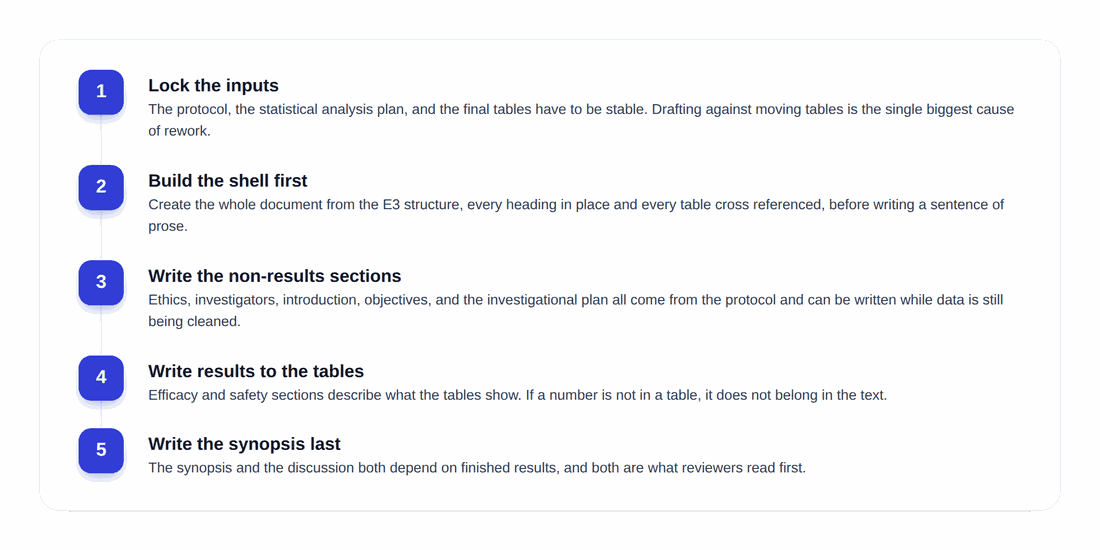
Lock the inputs. The protocol, the statistical analysis plan, and the final tables need to be stable before drafting begins. Writing efficacy text against tables that are still being reissued is the largest single source of wasted effort in this work.
Build the shell first. Create the entire document from the E3 structure with every heading in place, every table cross reference stubbed, and the abbreviation list started. A complete empty shell makes the remaining work visible and stops sections being forgotten.
Write the non-results sections early. Ethics, investigators, introduction, objectives, and most of the investigational plan come from the protocol. All of it can be written while the database is still being cleaned, which is dead time otherwise.
Write results to the tables. Sections 11 and 12 describe what the tables show. They do not introduce analysis, and they do not contain numbers that are not in a table somewhere. If you find yourself calculating something, stop and ask the statistician for a table.
Write the synopsis and discussion last. Both depend on finished results. Both are read first. That inversion is worth remembering when you plan your timeline, because the sections under most time pressure are the ones that get the most attention from readers.
What ICH E3 Permits That People Think It Forbids

This is the most useful thing in the 2012 Questions and Answers document, and it is almost entirely absent from the free guidance available online.
E3 is a guideline, not a template. The Q and A states directly that E3 is not a set of rigid requirements and that flexibility is inherent in its use. Sections may be reordered, sections that are not relevant to a particular study may be omitted, and sections may be added. Teams that treat the numbered structure as immovable produce reports with empty headings and awkward placements for no reason.
The synopsis page limit is not absolute. As above, M4E extends it for complex studies.
The appendices are not a copy of the trial master file. E3 predates current expectations about what the trial master file holds, and duplicating that content into section 16 is a common and expensive habit. Include what a reviewer needs to assess this report.
Data types E3 does not name have a home. Pharmacokinetics, biomarkers, and patient reported outcomes were not contemplated in the same way in 1995. Standalone reports placed alongside the CSR in the submission are acceptable.
The Q and A also settles two recurring arguments: how to distinguish an important protocol deviation from a minor one in section 10.2, and how to avoid double counting a patient who appears in both the deaths listing and the other serious adverse events listing.
<ProTip title="📖 Read the Q and A:" description="The 2012 Questions and Answers document is seven questions long and takes fifteen minutes. It will settle more internal debates than any style guide your company owns" />
Abbreviated Reports and Terminated Studies
Almost nothing written for a general audience covers this, and E3 addresses it explicitly.
An abbreviated report, using summarized data or with some sections removed, may be acceptable for uncontrolled studies, for studies not designed to establish efficacy, for seriously flawed or aborted studies, and for controlled studies examining conditions unrelated to the claim being made. A controlled safety study should still be reported in full.
Two conditions attach. A full description of the safety aspects must be included regardless. And the abbreviated report must contain enough detail of design and results for the regulatory authority to decide whether it wants the full version after all. That second condition is the one people underestimate: an abbreviated report that is too thin simply generates a request for the complete one, several months later.
<ProTip title="📉 Scope it early:" description="If a study was terminated, agree the abbreviated scope with regulatory affairs before drafting rather than after. Rewriting an abbreviated report into a full one is far more expensive than writing the full one first" />
Before You Circulate the Draft
Run these six checks yourself before the document reaches reviewers. Every one of them catches an error that is expensive to find later.
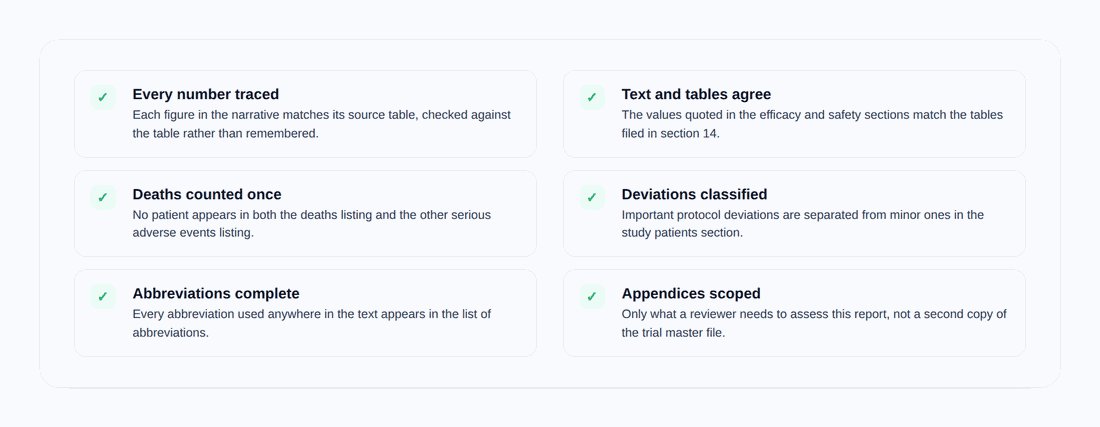
In text: confirm that every number in the narrative matches its source table rather than your memory of it; that the values in sections 11 and 12 agree with the tables filed in section 14; that no patient is counted in both the deaths listing and the other serious adverse events listing; that important protocol deviations are separated from minor ones; that every abbreviation used anywhere appears in section 4; and that the appendices contain only what a reviewer needs for this report.
The habit worth building is tracing rather than trusting. A CSR passes through many hands and the errors that survive to submission are almost always numbers that somebody carried forward without going back to the table.
The Structure Is the Easy Part
Learning the sixteen sections takes an afternoon. What takes years is judgment: knowing how much detail a reviewer needs in the statistical issues subsection, how to describe a protocol deviation without either minimizing it or inflating it, and how to write a discussion that is honest about a mixed result without undermining a program. The structure is public and free. The judgment comes from doing it under supervision.
<CTA title="Draft Complex Documents With Fewer Loose Ends" description="Keep terminology, structure, and sources consistent across a long technical document" buttonLabel="Try Jenni Free" link="https://app.jenni.ai/register" />
If you are starting out, read E3 end to end once, then read the Questions and Answers, then read a published CSR synopsis from a company that posts them. Those three things together will teach you more than any summary of them, including this one. The underlying writing discipline, describing methods precisely and keeping a consistent formal register across a long document, is the same skill that governs any serious technical writing.