Dwara
Justin Wong
—
Research mein Theory Testing: Tarike aur Aam Galtiyan

Justin Wong
Vikas Prabhari
Graduated kiya Bachelor's me Global Business & Digital Arts, Minor me Entrepreneurship
Theory testing woh hai jo aap tab karte hain jab theory data se pehle aati hai. Aap kisi aur ke dwara banaye gaye ek general claim ko lete hain, yeh samajhte hain ki aapke case ke liye iska kya matlab hai, aur phir check karte hain ki kya woh implication sahi hai ya nahi. Yeh research ka deductive hissa hai, aur adhiktar postgraduate work isi hisse mein hota hai.
Iske opposite concept se iski importance aur achhi tarah samajh aati hai. Theory building observations se shuru hoti hai aur ek theory banati hai. Theory testing ek theory se shuru hoti hai aur ek verdict (faisla) deti hai. Aap inmein se kya kar rahe hain, isi se aapka design, aapka analysis, aur ek achha result kya hoga, yeh tay hota hai.
<CTA title="Keep Theory and Evidence Properly Connected" description="Jenni helps you draft with sources attached and claims checked against what you showed" buttonLabel="Try Jenni Free" link="https://app.jenni.ai/register" />
Theory Testing Ka Asli Matlab Kya Hai
Bhattacherjee ki open social science methods textbook is distinction ko bahut hi saaf tarike se samjhati hai: inductive research mein goal observed data se theoretical concepts aur patterns ka andaza lagana hota hai, jabki deductive research mein goal hota hai naye empirical data ka use karke theory se jaane gaye concepts aur patterns ko test karna. Phir woh inhein seedhe naam dete hain: inductive research theory-building research hai, aur deductive research theory-testing research hai.
Dhyan dein iska aapke contribution ke liye kya matlab hai. Theory-building kaam mein, theory aapka output hoti hai aur aapko is baat par judge kiya jata hai ki kya woh ek achhi theory hai. Theory-testing kaam mein, theory aapka input hoti hai, aur aapko is baat par judge kiya jata hai ki kya test fair (sahi) tha.
Theory Building aur Theory Testing Side by Side
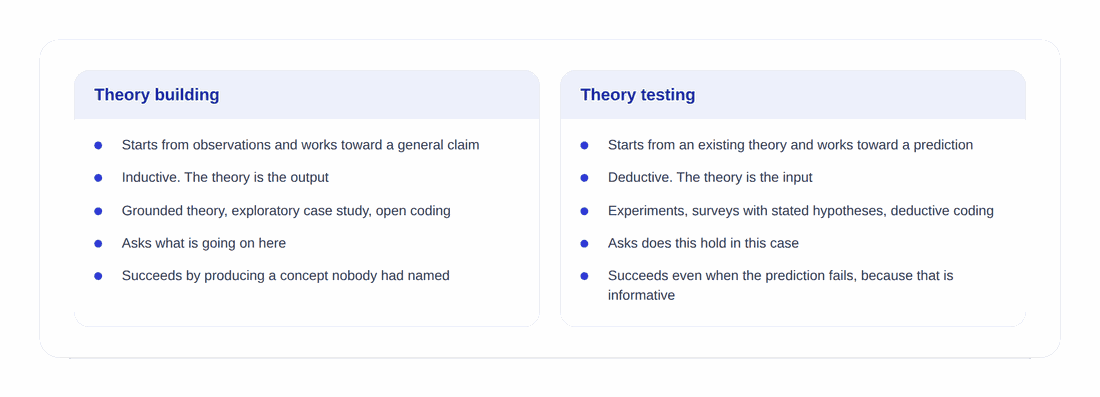
Theory building observations se shuru hoti hai aur ek general claim ki taraf badhti hai. Yeh inductive hoti hai, isme theory output hoti hai, aur yeh grounded theory, exploratory case studies, aur open coding mein use hoti hai. Yeh poochti hai ki "yahan kya ho raha hai?", aur iski kamyabi tab hoti hai jab yeh ek aisa concept banati hai jise pehle kisi ne naam na diya ho.
Theory testing ek existing theory se shuru hoti hai aur ek prediction ki taraf kaam karti hai. Yeh deductive hoti hai, isme theory input hoti hai, aur yeh experiments, stated hypotheses ke sath surveys, aur ek prior framework ke khilaf deductive coding mein hoti hai. Yeh poochti hai ki kya theory is case mein sahi baithti hai, aur yeh tab bhi kamyab hoti hai jab prediction fail ho jaye, kyunki ek failed prediction bhi informative hoti hai, jabki ek inconclusive exploration aisi nahi hoti.
Bhattacherjee saaf taur par kehte hain ki yeh koi hierarchy nahi hai: theory building aur theory testing dono hi science ke advancement ke liye bahut zaroori hain. Fields in dono ke beech cycle karke aage badhte hain.
<ProTip title="🔁 Which mode:" description="If you can name the theory in your title, you are testing. If the theory would have to be written in your discussion because it did not exist before you looked, you are building" />
Ek Testable Theory Se Aapko Kya Milna Chahiye
Har theory ko test nahi kiya ja sakta, aur month eight (aathvein mahine) mein yeh pata chalna bahut mehanga padta hai. Teen cheezein hona zaroori hain.
Ek aisa claim jo itna general ho ki uske implications hon. Agar theory sirf usi case ko describe karti hai jahan se yeh aayi hai, toh aapke case ke liye isme kuch bhi nahi bachega.
Aise constructs jinhe aap operationalize kar sakein. Har concept ko kisi aisi cheez mein badalna hoga jise measure kiya ja sake, jiska matlab hai theek se specify karna ki ise kaise measure kiya jayega, kis instrument ke sath, aur result ko kaise interpret kiya jayega. Ek aisi theory jise koi measure hi nahi kar sakta, woh practice mein untestable hoti hai chahe woh principle mein kitni bhi coherent kyun na ho.
Ek aisi prediction jo galat bhi sabit ho sake. Yeh woh step hai jise log skip kar dete hain. Agar har possible result theory ke sath compatible hai, toh aapne koi test design nahi kiya hai.
<ProTip title="🧪 Design it:" description="Write the sentence that would falsify your theory before you write the one that would support it. If you cannot produce the first sentence, redesign the study rather than the hypothesis" />
Theory Test Kaise Chalta Hai

Yeh sequence chhota hota hai aur har step agle step ko constrain (limit) karta hai.
Theory ko lein aur use ek sentence mein likhein. Is tarah ki ek prediction nikalein ki agar yeh theory sahi hai, toh is population mein humein yeh dekhne ko milna chahiye. Dono sides ko operationalize karein, taaki prediction kisi direction ke bajaye ek specific measured value ki taraf ishara kare. Data collect karne se pehle apne measures fix karein, taaki prediction puri tarah se expose ho sake. Phir collect karein, analyze karein, aur report karein ki kya nateeja nikla.
Yeh aakhri step hai jahan theory testing sabse zyada galat hoti hai, aur yeh error ek logical error hai. Apni prediction ko confirm karne se theory establish nahi ho jati, kyunki dusre mechanisms bhi wahi observation de sakte hain. Iske alawa nateeja nikalna "affirming the consequent" ki fallacy (bhool) hai. Ek failed prediction logically kahin zyada strong hoti hai, isiliye negative results ko usse zyada respect milni chahiye jitni aam taur par milti hai.
Isme ek sachhi complication bhi hai. Jab ek prediction fail hoti hai, toh aap apne measures, apne sample aur apni procedure ko bhi test kar rahe hote hain. Failure aapko batata hai ki us bundle mein kuch galat hai, zaroori nahi ki theory hi galat ho. Aisa saaf kehna hedging ke bajaye rigor dikhata hai.
<ProTip title="🔒 Lock it:" description="Write your prediction and your measures down before you collect anything, and date the document. A prediction specified after the data is not a test, and experienced examiners can spot one" />
Theory Testing Design Ke Hisab Se Kahan Dikhti Hai
Design | Yeh kya test karta hai | Typical output |
Experiment | Kya koi manipulation predicted effect produce karta hai | Ek supported ya unsupported hypothesis |
Survey stated hypotheses ke sath | Kya predicted relationships population mein sahi baithte hain | Predictions ke khilaf model fit aur coefficient signs |
Confirmatory case study | Kya theory us case ko explain karti hai jise isliye chuna gaya kyunki woh ek mushkil test hona chahiye | Support, qualification, ya boundary condition |
Deductive qualitative coding | Kya koi prior framework un baaton ko explain karta hai jo participants describe karte hain | Supported, contradicted, refined, ya expanded constructs |
Replication | Kya koi established finding specified conditions ke under phir se hoti hai | Ek successful ya failed replication, dono publish karne yogya hain |
Qualitative row logo ko hairan karti hai. Deductive qualitative analysis ek real tradition hai, jise Fife aur Gossner ne deductive aur inductive kaam ke combination ke roop mein describe kiya hai taaki examine kiya ja sake supporting, contradicting, refining, aur expanding evidence ko us theory ke liye jise examine kiya ja raha hai. Theory aapko batati hai ki kahan dekhna hai. Yeh aapko yeh nahi batati ki aapne kya paya.
<ProTip title="📉 Negative results:" description="A failed prediction is a finding, not a failure. Report it in the same voice you would have used for a confirmation, and address whether the theory or the measures are the likelier culprit" />
Theory Ko Test Karein, Usse Apne Attachment Ko Nahi
Ek achhe theory-testing kaam ki pehchan yeh hai ki reader dekh sake ki yeh kaise alag tarike se samne aa sakta tha. Theory ko state karein, batayein ki iske khilaf kya jayega, dekhne se pehle use fix karein, aur wahi result report karein jo aapko mila na ki woh jo aap chahte the.
<CTA title="Write Up a Test Your Examiner Can Follow" description="Structure your chapter, cite the theory properly, and check that your claims match your evidence" buttonLabel="Try Jenni Free" link="https://app.jenni.ai/register" />
Agar aap abhi bhi decide kar rahe hain ki aapka project build karta hai ya test karta hai, toh ek-sentence ki prediction likhein aur dekhein ki kya aap aisa kar sakte hain. Iske baad ka sab kuch, methodology section se lekar is tak ki aap un sources ko kaise handle karte hain jin par aapki theory tiki hai, isi jawab se tay hota hai.