Dwara
Nathan Auyeung
—
Null aur Alternative Hypothesis ko aasan shabdon mein samjhein

Nathan Auyeung
Senior Accountant EY mein
Bachelor ka Accounting mein Graduation kiya, aur ek Postgraduate Diploma of Accounting bhi poora kiya
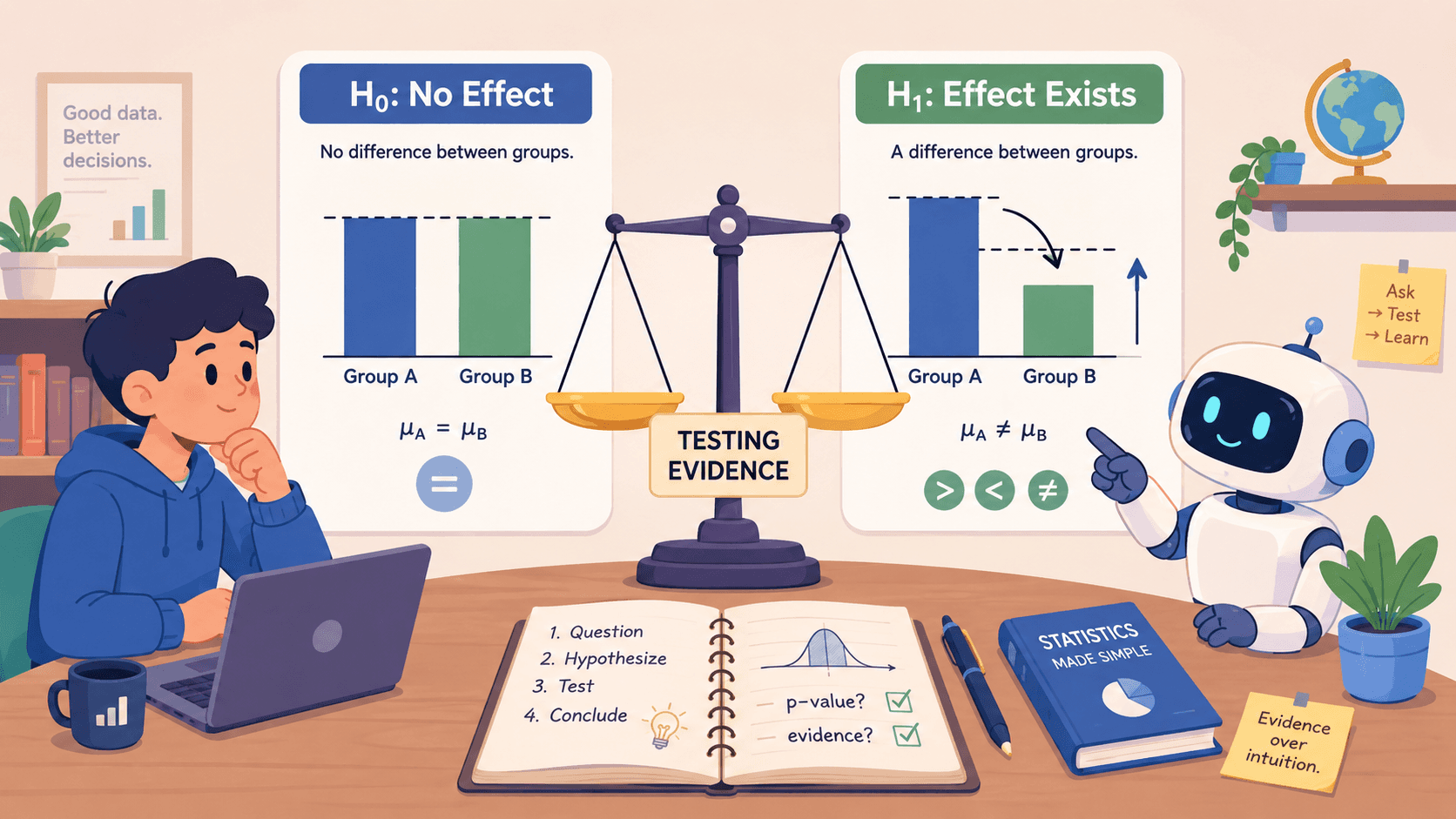
Statistical testing ek simple question se shuru hota hai: kya yeh result real hai, ya sirf kismat hai? Null aur alternative hypothesis isi ke liye hote hain. Yeh ek formal tareeqa hai jisse medicine, business, ya education ke researchers ek test setup karte hain sach pata karne ke liye. Aap inhe har us study mein dekhenge jo decision lene ke liye data ka use karti hai.
Hum isko examples ke sath aasan bhasha mein samjhayenge, un jagaho ko point out karenge jahan log aksar galti karte hain, aur aapko apna khud ka hypothesis likhne ke liye ek seedha-saadha guide denge. Ise padhne ke baad aapko sahi tareeqe se samajh aa jayega ki yeh dono statements har statistical investigation ko kaise frame karte hain.
<CTA title="Clear Research Hypotheses Likhein" description="Structured guidance ke sath apne research questions ko precise testable hypotheses mein badlein." buttonLabel="Jenni Free Try Karein" link="https://app.jenni.ai/register" />
Null aur Alternative Hypotheses Kya Hain?
Yeh aapki study ki ja rahi population ke baare mein do opposite statements hain. Inhe statistics ke liye "innocent until proven guilty" (tab tak begunah jab tak gunah sabit na ho) setup ki tarah samjhein. Ek test run karne ka poora maqsad yeh dekhna hota hai ki data aakhir kis statement ko support karta hai.
National Institute of Standards and Technology (NIST) ise null aur alternative hypotheses process ke roop mein define karta hai, jo yeh check karta hai ki aapka sample data sabhi ke baare mein aapki initial assumption se match karta hai ya nahi.
The Null Hypothesis (H0)
Yeh default aur skeptical position hoti hai. Yeh yeh maan kar chalti hai ki kuch bhi interesting nahi ho raha hai—koi change nahi, koi difference nahi, koi connection nahi. Aap iske khilaf evidence jama karne ki koshish karte hain.
Examples:
Do teaching methods bilkul ek jaise average test scores produce karte hain.
Ek nayi drug ka blood pressure par zero impact hota hai.
Padhai mein bitaya gaya samay final grades ko affect nahi karta.
Notation mein, isme aam taur par ek equals (=) sign hota hai:
H0: μ₁ = μ₂ (Means bilkul same hain)
H0: ρ = 0 (Correlation zero hai)
The Alternative Hypothesis (H1 ya Ha)
Yeh woh cheez hai jise researcher asal mein believe karta hai ya prove karna chahta hai. Yeh state karta hai ki koi effect, difference, ya relationship hai.
Examples:
Teaching method A ke scores method B ke muqable zyada hote hain.
Nayi drug blood pressure ko kam karti hai.
Zyada study time ka connection behtar grades se hai.
Ise ek inequality symbol (≠, >, ya <) ke sath likha jata hai:
H1: μ₁ ≠ μ₂ (Means different hain)
H1: μ₁ > μ₂ (Pehla mean bada hai)
H1: μ₁ < μ₂ (Pehla mean chota hai)
<ProTip title="💡 Pro Tip:" description="Statistical testing logic ke sath match karne ke liye null hypothesis mein hamesha equality include karein." />
Null vs Alternative Hypothesis Se Itne Saare Students Confuse Kyun Hote Hain
Yeh ek common mushkil hai. Aap definitions padh sakte hain, lekin hum is tarah setup kyun karte hain iski logic aksar samajh nahi aati. Confusion aam taur par yahan se shuru hoti hai.
"Main Inhe Aapas Mein Swap Kyun Nahi Kar Sakta?" Wali Problem
Bahut se students yeh poochte hain. Agar aapko lagta hai ki alternative sach hai, toh use hi null kyun nahi bana dete? Iska reason mechanical hai: kisi bhi statistical test ki math null hypothesis ko sahi maan kar shuru hoti hai.
Aap jitne bhi probabilities calculate karte hain, jaise ki famous p-value, woh usi starting point par based hote hain. Inhe swap karne se underlying machinery kharab ho jati hai.
Yeh samajhne ke liye ki yeh bade scientific frameworks mein kaise fit hota hai, different research paradigms ko samajhna madad kar sakta hai ki hum is specific skeptical approach ka use kyun karte hain.
Ek courtroom analogy yahan acche se kaam karti hai:
H0: Defendant innocent hai.
H1: Defendant guilty hai.
Trial innocence prove karne ki koshish nahi karta. Yeh poochta hai ki kya evidence itna strong hai ki presumption of innocence ko reject kiya ja sake.
Frustration Real Hai
Study forums par, aapko baar-baar wahi posts dikhenge:
"Maine chapter teen baar padha hai aur main abhi bhi lost hoon."
"Mujhe class mein toh samajh aa jata hai, lekin main ise apply nahi kar pata."
Yeh aam taur par tab hota hai jab concept ko sirf symbols aur rules ke roop mein padhaya jata hai, bina kisi real-world use ke connect kiye.
Jo Asal Mein Samajh Mein Aata Hai
Aapko ise action mein dekhna hoga. Yeh framework concrete scenarios mein turant samajh aata hai:
Website button ke liye ek A/B test run karna.
Yeh determine karna ki kya ek nayi drug placebo se behtar kaam karti hai.
Do curriculums ke beech student performance ko compare karna.
Kisi specific aur real problem ke liye likhe gaye hypothesis pair ko dekhna, bina kisi formula ke, real understanding build karta hai.
Research Question Se Hypotheses Tak: Ek Simple Process
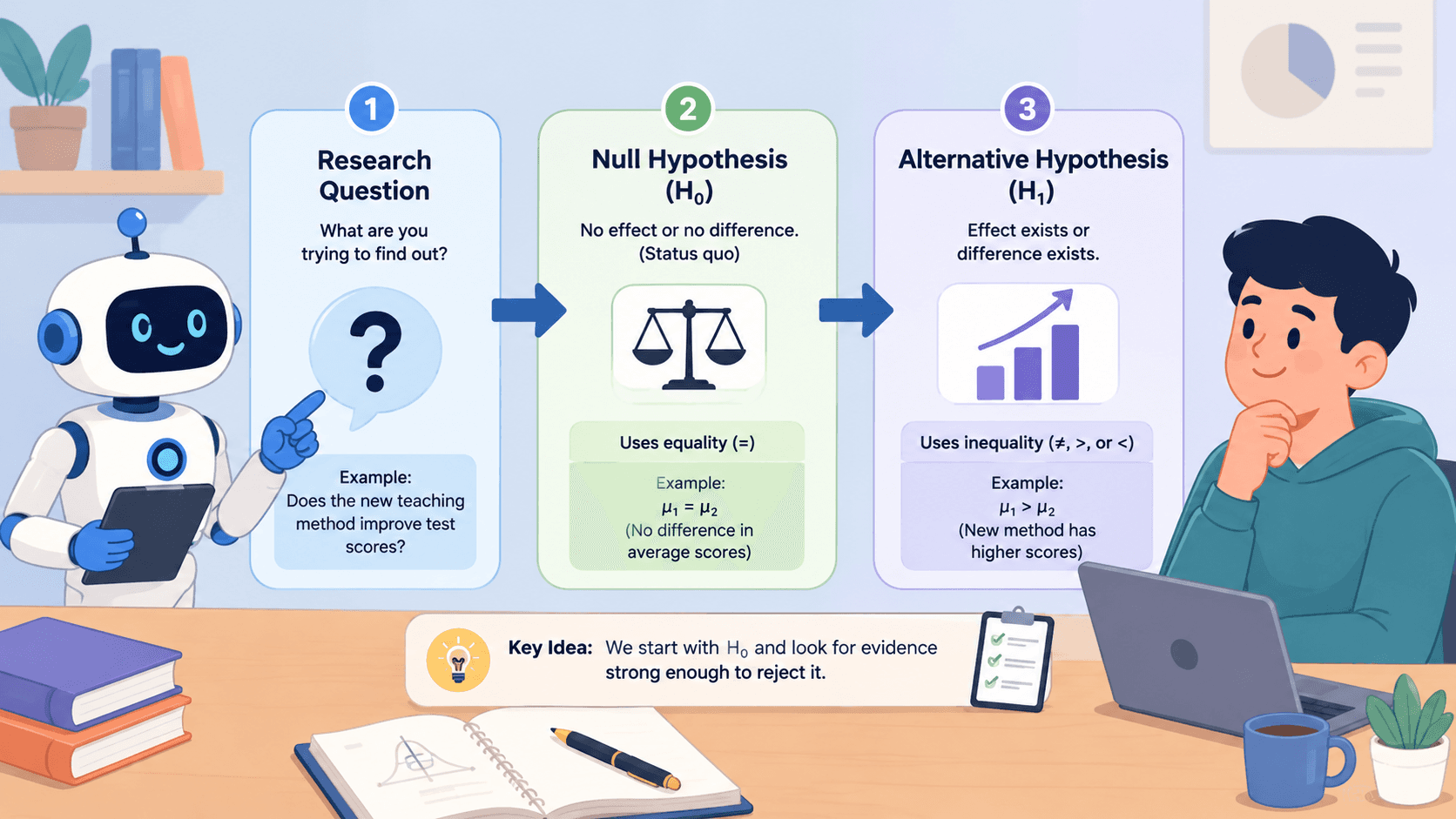
Yeh ek teen steps ka process hai. Goal yeh hai ki ek broad research idea ko lekar use ek specific, testable pair of statements mein badla jaye.
Step 1: Ek Direct Question Poochein
Kuch concrete se shuru karein. Vague ideas se bachein. Ek valid hypothesis ki taraf pehla step yeh janna hai ki research question effectively kaise likha jaye.
Example: Kya ek naya teaching method higher final exam scores ki taraf le jata hai?
Step 2: Identify Karein Ki Aap Kya Measure Kar Rahe Hain
Yaad rakhein, aap poori population (e.g., sabhi students) ke baare mein claim kar rahe hain, na ki sirf apni study ke sample par. Key parameter ko define karein.
Yeh aam taur par ek population mean (μ), do means ke beech ka difference (μ₁ - μ₂), ya ek correlation (ρ) hota hai.
Step 3: Dono Hypotheses Likhein
Ab, apne question ko formal H0 aur H1 mein translate karein. Null hamesha "no effect" state karta hai. Alternative us specific effect ko state karta hai jise aap dhoond rahe hain.
H0: μ_new_method = μ_old_method (Average scores mein koi difference nahi hai)
H1: μ_new_method > μ_old_method (Naya method higher average scores deta hai)
Yeh structured approach tab zaroori hoti hai jab aap qualitative vs quantitative research conduct kar rahe hon, kyunki yeh ensure karta hai ki aapka data collection kisi specific claim ko prove ya disprove karne par focused ho.
Ek Real-World Example: Sleep aur Grades
Ek psychologist yeh janna chahta hai ki kya neend ki kami academic performance ko nuksan pahunchati hai.
H0: Average test scores sleep-deprived aur well-rested dono tarah ke students ke liye same hain. (μ_deprived = μ_rested)
H1: Sleep-deprived students ke liye average test scores kam hote hain. (μ_deprived < μ_rested)
Yahi exact structure psychology, drug trials, aur market testing ki studies ka backbone hai.
<ProTip title="💡 Pro Tip:" description="Interpretation mein bias se bachne ke liye data collect karne se pehle hypotheses likhein." />
One-Tailed vs Two-Tailed Hypotheses
Aapka alternative hypothesis sirf is baare mein nahi hai ki koi effect hai ya nahi, balki is baare mein bhi hai ki aap kis tarah ka effect dhoond rahe hain. Yeh choice null aur alternative hypotheses design ka ek fundamental hissa hai.
One-Tailed Test (Directional)
Yeh ek specific direction mein change ko dekhta hai. Aapke paas yeh manne ka strong reason hota hai ki effect sirf ek hi taraf jayega.
Symbol: H1: μ₁ > μ₂ ya H1: μ₁ < μ₂
Example: Aap ek fertilizer test kar rahe hain. Aapka hypothesis hai ki yeh plant growth ko badhata hai (μ_fertilized > μ_control). Aap yeh test nahi karenge ki kya yeh growth ko kam karta hai.
Kab use karein: Jab pehle ki research ya theory effect ki direction ke baare mein ek clear prediction deti hai.
Two-Tailed Test (Non-Directional)
Yeh kisi bhi difference ko dekhta hai, chahe direction jo bhi ho. Yeh zyada conservative aur open-minded approach hai.
Symbol: H1: μ₁ ≠ μ₂
Example: Aap do pain relievers ko compare kar rahe hain. Aap sirf yeh janna chahte hain ki kya ek dusre se alag kaam karta hai, behtar ya badtar (μ_A ≠ μ_B).
Kab use karein: Jab aap kisi naye area ko explore kar rahe hon ya jab kisi bhi direction mein effect meaningful ho.
Ek Quick Side-by-Side Look
Type | Symbol in H1 | Aap Kya Pooch Rahe Hain |
One-Tailed | > ya < | "Kya Group A specifically Group B se bada (ya chota) hai?" |
Two-Tailed | ≠ | "Kya Group A aur B ek dusre se different hain?" |
Aapko data dekhne se pehle decide karna hoga ki aapke research question par kaun sa fit baithta hai. Galat choose karne se aap ek real finding ko miss kar sakte hain ya apne results ko poori tarah galat interpret kar sakte hain.
Hypothesis Testing Asal Mein Kaise Kaam Karta Hai
Yeh process aapke idea ko sahi prove karne ke baare mein nahi hai. Yeh check karne ke baare mein hai ki kya data aapki initial, skeptical assumption ko unlikely banata hai.
Basic Logic
Aap yeh pretend karke shuru karte hain ki null hypothesis (H0) bilkul sach hai. Phir aap poochte hain: "Agar H0 sach hai, toh jo data maine collect kiya hai woh kitna surprising hai?"
P-value isi question ka answer hai. Agar null hypothesis sahi hai, toh random chance se aapke results ya usse bhi extreme results dekhne ki probability p-value hoti hai.
Ek chota p-value ka matlab hai ki aapka data null assumption ke mutabik unusual hai. Ek bada p-value ka matlab hai ki aapka data waisa hi hai jaisa null sahi hone par expect kiya jata hai.
Halaanki, hume interpretation ke sath careful rehna hoga. Research jo Nature on significance testing mein publish hui hai, highlight karti hai ki p-values ko aksar galat samjha jata hai; yeh aapko yeh nahi batate ki aapke hypothesis ke "sach" hone ki probability kya hai, balki yeh batate hain ki aapka data null ke sath kitna compatible hai.
Decision Rule
Aapko yeh decide karne ke liye ek cutoff point chahiye ki "too surprising" ka kya matlab hai. Yeh significance level hai, alpha (α), jo aam taur par 0.05 (5%) par set hota hai.
Agar p-value ≤ α (e.g., ≤ 0.05): Data ko H0 ke under bahut unlikely mana jata hai. Aap null hypothesis ko reject karte hain.
Agar p-value > α (e.g., > 0.05): Data H0 ko chodne ke liye kaafi surprising nahi hai. Aap null hypothesis ko reject karne mein fail rehte hain.
Jo Aap Nahi Keh Rahe Hain
Yeh ek bada difference hai. H0 ko reject karne ka matlab yeh nahi hai ki aapne alternative hypothesis (H1) ko "prove" kar diya hai. Iska matlab sirf yeh hai ki evidence null par serious doubt karne ke liye kaafi strong hai.
Ise ek verdict ki tarah samjhein. Ek "guilty" verdict absolute guilt prove nahi karta; iska matlab hai ki evidence presumption of innocence ko reject karne ke liye kaafi tha. Similarly, aap kabhi H0 ko accept nahi karte ya H1 ko prove nahi karte. Aapko ya toh H0 ko reject karne ke liye kaafi evidence milta hai, ya nahi milta.
<ProTip title="💡 Pro Tip:" description="Academic writing mein accept the null ke bajaye fail to reject the null kahein." />
Hypothesis Testing Mein Common Mistakes
Hypothesis testing mein kuch classic galtiyan hoti hain. Inhe jaan kar aap apne data se galat conclusion nikalne se bach sakte hain.
Galti 1: Sample Ke Baare Mein Likhna
Aapke hypotheses us poore group ke baare mein claims hote hain jise aap study kar rahe hain, yaani population. Aapka data sirf uska ek sample hai.
Wrong: "Group A ka sample mean Group B se bada hai."
Right: "Group A ka population mean (μ) Group B se bada hai."
Galti 2: Kehna Ki Aapne Null Ko "Accept" Kar Liya Hai
Aap kabhi null hypothesis ko accept nahi karte. Test sirf yeh batata hai ki kya aapke paas ise bahar phenkne ke liye kaafi evidence hai. Sahi phrase hai "we fail to reject the null" (hum null ko reject karne mein fail rahe).
Yeh wording sahi dhang se imply karti hai ki data hume convince karne ke liye kaafi strong nahi tha; yeh prove nahi karta ki null sach hai.
Galti 3: Do Tarah Ki Galtiyon Ko Bhool Jana
Har statistical decision ke sath error ka risk hota hai. Aapko pata hona chahiye ki woh kya hain.
Type I Error (False Positive): Null hypothesis ko reject karna jabki woh asal mein sach ho. (Aapko aisa effect dikhta hai jo wahan hai hi nahi.)
Type II Error (False Negative): Null ko reject karne mein fail hona jabki woh asal mein galat ho. (Aap ek real effect miss kar dete hain.)
Significance level (α, jaise 0.05) directly Type I error karne ki probability hoti hai.
Galti 4: p < 0.05 Ko Magic Samajhna
Ek result "statistically significant" (p < 0.05) ho sakta hai lekin real world mein bilkul mamooli ho sakta hai. Agar aapke paas ek bada sample hai, toh aap chhote aur bina matlab ke differences ko bhi detect kar sakte hain.
Iske opposite, ek important finding p < 0.05 tak nahi pahunch sakti agar aapka sample bahut chota ho. P-value aapko reliability ke baare mein batata hai, effect ke size ya importance ke baare mein nahi.
Hypothesis Testing Ke Real-World Examples
Yeh framework sirf textbooks ke liye nahi hai. Yeh kayi fields mein data-driven decisions lene ka standard tareeqa hai.
Business: Website Ka A/B Testing
Ek e-commerce team sochti hai ki kya ek redesigned "Buy Now" button behtar kaam karega.
H0: Naye button ka click-through rate purane wale ke barabar hi hai.
H1: Naye button ka click-through rate zyada hai. Woh test run karte hain, traffic split karte hain, aur data collect karte hain. Agar results H0 ko strongly contradict karte hain (low p-value), toh woh naya design poori company mein roll out kar dete hain. Agar nahi, toh woh original ke sath hi rehte hain.
Medicine: Clinical Drug Trials
Kisi bhi naye medication ke approve hone se pehle, use controlled trial mein placebo se behtar perform karna hota hai.
H0: Drug sugar pill se zyada effective nahi hai.
H1: Drug placebo se zyada effective hai. Yahan null ko reject karna sirf academic nahi hai, balki regulatory approval paane aur doctors ke treatment ke tareeqe ko badalne ka key step hai.
Education: Naye Curriculum Ka Evaluation
Ek school district math ke naye program ko apne aadhe classrooms mein pilot karta hai.
H0: Naye aur purane programs ke under student proficiency same hai.
H1: Naye program ke under student proficiency higher hai. Is test ka statistical conclusion directly ek bade (aur expensive) decision ko inform karta hai ki agle saal kya padhana hai.
Null Hypothesis Ka Galat Use Dangerous Kyun Ho Sakta Hai
Is statistical tool ka galat use sirf bad science ki taraf nahi le jata, balki iske real-world consequences ho sakte hain, paise waste hone se lekar public health ko harm pahunchne tak.
P-Hacking Ki Problem
Maan lijiye ek researcher 20 different outcomes measure karta hai. Agar woh 0.05 significance level ke sath 20 separate tests run karta hai, toh sirf chance se hi unme se ek "significant" result dikha dega, bhale hi kuch bhi real na ho raha ho.
Is practice ko, jise p-hacking kaha jata hai, false discoveries create karti hai. Yahi wajah hai ki chhote aur exploratory studies ke findings bade aur zyada careful trials mein fail ho jate hain.
Common Misinterpretations
Log aksar results se galat conclusion nikalte hain:
"Hum H0 ko reject karne mein fail rahe, iska matlab koi effect nahi hai." Yeh galat hai. Ek non-significant result ka matlab aksar sirf yeh hota hai ki aapki study effect ko detect karne ke liye kaafi powerful nahi thi. Yeh evidence of absence nahi hai, balki absence of evidence hai.
Sample size ke role ko ignore karna. Ek choti study ek bada effect dhoond sakti hai lekin statistical significance tak pahunchne mein fail ho sakti hai. Ek badi study ek chota sa effect dhoond sakti hai jo statistically significant ho. P-value ko hamesha effect ke actual size ke sath consider kiya jana chahiye.
Jab Null Hypothesis Khud Unrealistic Ho
Kayi fields mein, khaskar social sciences ya biology mein, absolute zero effect ka idea ek statistical fiction hai. Hamesha thoda bahut difference ya correlation hota hi hai.
Ek implausible "no effect" null ko test karna statistical significance ki bekar khoj ki taraf le ja sakta hai, jabki is baat ko ignore kar diya jata hai ki finding meaningful ya useful hai ya nahi. Focus "Kya yeh important hai?" se shift hokar simply "Kya mujhe p < 0.05 mil sakta hai?" par aa jata hai.
<ProTip title="💡 Pro Tip:" description="Behtar decisions ke liye statistical significance ko practical significance ke sath combine karein." />
Hypothesis Testing Ke Liye Ek Clear Path
Hypothesis testing confusing lag sakta hai. Yeh structure aapke analysis ko logical aur consistent rakhne mein madad karta hai.
In Steps Ko Follow Karein
Ek precise research question se shuru karein. Aap asal mein kya pata lagane ki koshish kar rahe hain?
Un population parameters ko identify karein jinme aap interested hain, jaise ki mean ya proportion.
Apna null hypothesis (H0) formulate karein. Isme hamesha equality ya "no effect" ki condition honi chahiye.
Apna alternative hypothesis (H1) formulate karein. Yeh expected direction of change ya difference ko state karta hai.
Apne test type ko decide karein. Kya yeh one-tailed hai (ek specific direction mein change dekhna) ya two-tailed (kisi bhi difference ko dekhna)?
Apna data collect karein aur test statistic nikalne ke liye calculations run karein.
P-value ko care ke sath interpret karein. Samjhein ki yeh asal mein H0 ke khilaf evidence ke baare mein kya batata hai.
Is order ka use karne se aap apne hypotheses ko mix up karne ya test ko galat apply karne se bach jate hain. Yeh ek fuzzy concept ko ek clear procedure mein badal deta hai.
Hypothesis Testing Ko Aakhirkaar Samajhein
Aap baar-baar guess karte rehte hain ki kaun sa hypothesis kya karta hai. Jab aap ise apply karne ki koshish karte hain toh logic dimag mein nahi baithta. Jab terms similar lagte hain aur meaning slip ho jata hai, toh confusion jaldi hoti hai.
<CTA title="Research Questions Ko Clear Hypotheses Mein Badlein" description="Structured writing aur guided hypothesis creation ke sath strong statistical reasoning build karein." buttonLabel="Jenni Free Try Karein" link="https://app.jenni.ai/register" />
Hypothesis testing symbols ko yaad rakhne ke baare mein nahi hai—yeh ek logical framework ko samajhne ke baare mein hai. Ek clear research question se shuru karein, null ko "no effect" ke roop mein likhein, aur data ko batane dein ki kya ise reject karne ke liye kaafi evidence hai. Yeh shift statistical reasoning ko solid banata hai, mushkil nahi.