Dwara
Nathan Auyeung
—
Literature Reviews Mein Source Synthesis ki Galtiyan: Common Errors Ko Kaise Fix Karein

Nathan Auyeung
Senior Accountant EY mein
Bachelor ka Accounting mein Graduation kiya, aur ek Postgraduate Diploma of Accounting bhi poora kiya
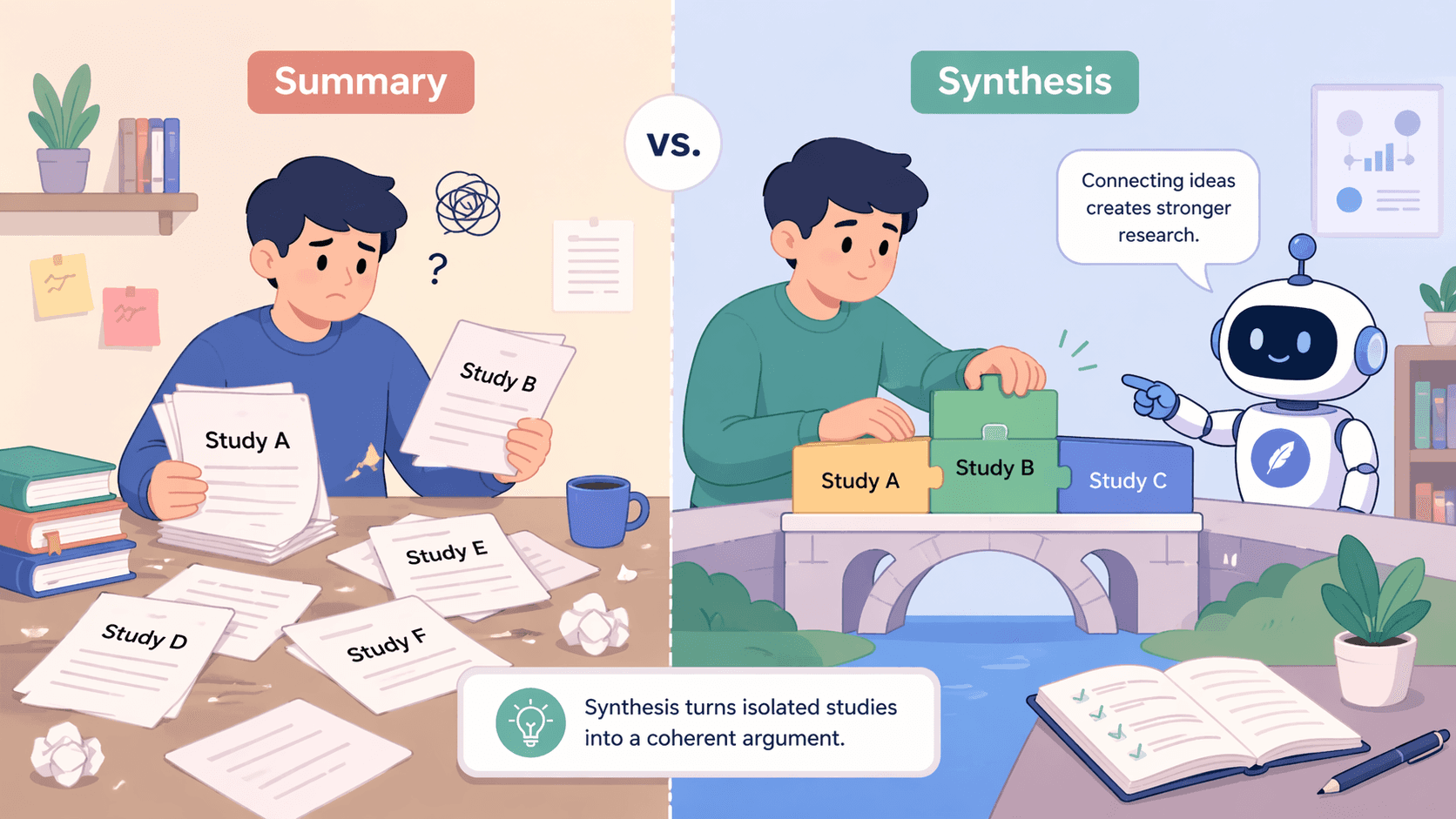
Quotes aur citations ki list ko ek majboot argument mein badalna kaafi mushkil hota hai. Aksar, ek literature review sirf ek ke baad ek sources ko summarize karta hai, jaise koi kirane ki list ho.
Yeh bikhra hua lagta hai. Asli problem har book ya paper ko ek alag aur akela fact manna hai, bajaye iske ki yeh dekha jaye ki woh ek case banane ke liye aapas mein kaise judte hain ya takrate hain.
Yeh approach review ko sirf padhne mein boring hi nahi banata; balki aapki research ke poore maqsad ko nuksaan pahunchata hai, jisse important insights dabi reh jaati hain aur aapki credibility kamzor ho jaati hai. Yeh article aam galtiyo ko batata hai aur unhe theek karne ke aasan, step-by-step tareeqe pesh karta hai.
<CTA title="Write Strong Literature Reviews Faster" description="Organize sources and build clear synthesis with structured prompts and guided writing workflows" buttonLabel="Try Jenni Free" link="https://app.jenni.ai/register" />
Source Synthesis ka Asli Matlab Kya Hai
Iska matlab sirf har study ko alag se summarize karna nahi hai. Synthesis ka matlab hai alag-alag sources ko ek single, solid argument mein pirona.
Harvard Writing Center isey saaf shabdon mein kehta hai: core task aapke sources ke beech ke rishte ko pehchanna hai, ki woh kaise aapas mein agree karte hain, disagree karte hain, ya ek dusre par aage badhte hain. Yahi cheez ek asardaar review ko ek kamzor review se alag karti hai.
Agar aap is process ke basic structure ke saath struggle kar rahe hain, toh literature review outline kaise likhein yeh sikhne se aap drafting shuru karne se pehle in connections ko samajh paenge.
Ek accha literature review ek conversation ya baat-cheet ki tarah lagna chahiye. Ek paper dusre ko respond karta hai. Dusra kisi purani assumption ko challenge karta hai.
Teesra purane kaam ke upar ek naya framework banata hai. Agar aapke review mein yeh aapsi charcha missing hai, toh yeh sirf alag-alag statements ke dher jaisa lagega.
Data bhi is baat ko support karta hai. Academic assessments lagatar yeh dikhate hain ki low-scoring literature reviews ki sabse badi kamzori critical synthesis ki bajaye descriptive summary par zyada depend rehna hai.
Iska result analytical depth ki kami aur ek aisi research direction hoti hai jo unclear lagti hai.
Ek Nazar: Summary vs. Synthesis
Approach | Yeh Kya Karta Hai | Result |
Summary | Har source se findings ko list karta hai | Toota-phoota, list-like writing |
Synthesis | Sources ke beech ideas ko connect karta hai | Ek solid, behtar hota hua argument |
Isey samajhne ka ek aasan tareeqa: synthesis ek bridge banane jaisa hai. Har source ek structural beam hai. Agar aap in beams ko bina jode bas ek ke baad ek rakh denge, toh poora structure gir jayega.
Source Synthesis ki Sabse Common Galtiyan
Literature review ki dher saari problems kuch predictable habits ki wajah se hoti hain. Unhe jaldi spot kar lene se aap ek kamzor aur bikhre hue argument ko likhne se bach sakte hain.
Sources ko Bina Connect Kiye List Karna
Academic writing mein yeh sabse zyada hone wali galti hai. Iski wajah se aksar ek narrative literature review ban jata hai jo kisi critical analysis ke bajaye is baat ki kahani lagta hai ki kisne kya kaha. Yeh kuch aisa dikhta hai: “Smith ne X paaya. Jones ne Y paaya. Lee ne Z paaya.”
Aapne bas ek narrative summary bana di hai, synthesis nahi. Isme studies ke beech koi comparison nahi hai, koi tension nahi hai, aur reader ke liye koi logical flow nahi hai.
Ek mazboot approach ideas ko aapas mein jodti hai: “Jabki Smith ka kaam X ko identify karta hai, Jones is conclusion ko Y dikhakar challenge karta hai, jo yeh suggest karta hai ki methodological differences outcomes ko influence kar rahe ho sakte hain.”
<ProTip title="💡 Pro Tip:" description="After every cited study add one sentence explaining how it connects to another source" />
Woh ek extra sentence ek chhota sa badlav hai, lekin yeh aapki writing ko descriptive se analytical mein poori tarah badal deta hai.
Contradictions aur Research Gaps ko Ignore Karna
Ek strong literature review asani se disagreements aur unanswered questions ko highlight karta hai. Ek kamzor review aisi acting karta hai jaise woh exist hi nahi karte.
Research argument banane ke liye literature reviews ki baarikiyo ko samajhna bahut zaroori hai. Agar aap contradictions ko ignore karte hain, toh aap ek galat impression dete hain ki field mein sab kuch pehle se hi decided hai.
University of North Carolina Writing Center note karta hai ki contradictions ko identify karna research argument banane ke liye bahut zaroori hai. Agar aap unhe ignore karte hain, toh aap yeh galat impression create karte hain ki field mein sab kuch pehle se settled hai.
Example: Weak: “Smith (2020) ne X paaya, aur Jones (2021) ne bhi X paaya.” Strong: “Recent studies ne A par pehle ki findings ko challenge karna shuru kar diya hai, jo yeh ishara karta hai ki underlying mechanism ke baare mein abhi bhi unresolved questions hain.”
Yahi par research gaps ko point out na karna ek badi problem ban jata hai. Agar koi gap hi nahi hoga, toh aapke paas apni nayi research ke liye koi saaf justification nahi hoga.
Low-Quality ya Secondary Sources Par Bahut Zyada Depend Rehna
Textbooks, blogs, ya secondhand summaries ka use aapki credibility ko kam karta hai. PubMed ya Scopus jaise databases ke peer-reviewed sources aapko primary evidence dete hain jiski aapko zaroorat hai. Secondary citations aksar original findings ko bigad dete hain.
Elsevier highlight karta hai ki secondary sources par bahut zyada depend rehne se original data ko galat samajhne ka risk kaafi badh jata hai, jo aapke scholarly work ki integrity ko kharab kar sakta hai.
Apne synthesis ko trustworthy rakhne ke liye:
Primary studies ko priority dein.
Secondary sources ka use sirf bade context ke liye karein.
Cite karne se pehle original claims ko verify karein.
<ProTip title="🔍 Pro Tip:" description="Always trace claims back to the original study instead of citing summaries or textbooks" />
Structural Mistakes jo Coherence ko Todti Hain
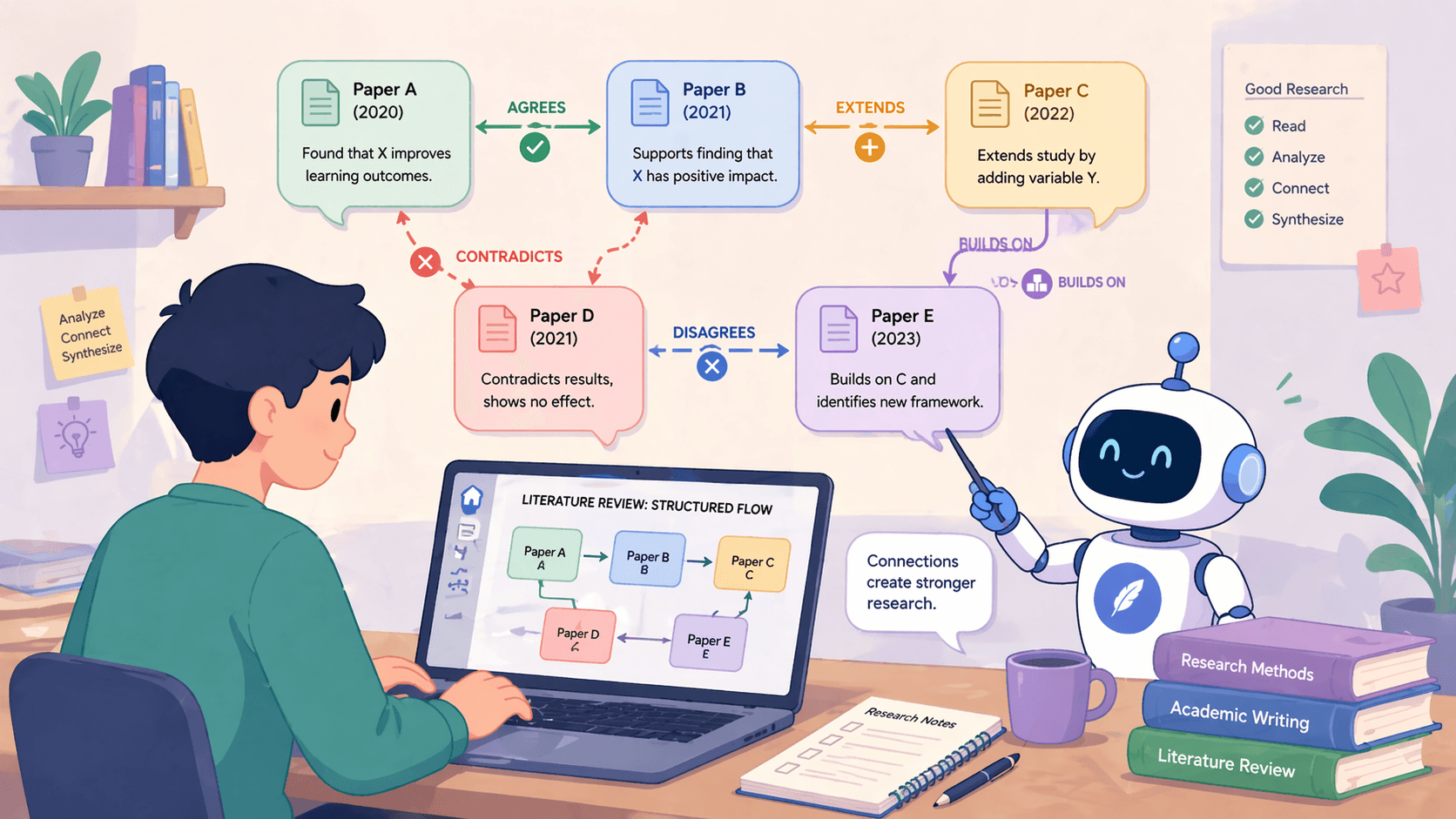
Acche sources hone ke baad bhi, kharab organization aapke argument ko kharab kar sakti hai. Aap apne review ko kaise structure karte hain, iska seedha asar uski quality aur clarity par padta.
Thematic Organization ki Kami
Aapka literature review themes ke hisab se organize hona chahiye, na ki authors ya publication dates ke hisab se. Studies ki ek simple chronological list ideas ke khichdi aur kamzor connections ka result banti hai.
Iske bajaye, aapko studies ko concepts ke hisab se group karna hoga:
Shared methodology
Converging ya conflicting findings
Key debates ya contradictions
Yeh thematic grouping reader ke liye ek logical flow banati hai aur bahut mazboot analytical connections ko support karti hai. Yeh tab aur bhi critical ho jata hai jab aap meta-analysis conduct karte hain, jahan statistical synthesis ko ek logical thematic framework par based hona chahiye.
Studies ke Beech Weak Transitions
Transitions woh signposts hote hain jo aapke reader ko aapke argument ke zariye guide karte hain. Unke bina, review lagatar rukne aur shuru hone jaisa lagta hai.
In do approach ko compare karein:
Weak: "Smith ne X paaya. Jones ne Y paaya."
Strong: "Smith ki X ke baare mein findings par aage badhte hue, Jones Y ko demonstrate karta hai..."
Transitions glue ki tarah kaam karte hain. Woh ideas ko connect karte hain aur aapke poore section ki coherence ko maintain rakhte hain.
<ProTip title="🧠 Pro Tip:" description="Use transition phrases like 'conversely,' 'similarly,' and 'building on this' to connect studies smoothly" />
Research Question se Koi Connection na Hona
Ek literature review ka ek clear purpose hona chahiye: isey aapke research goal ko support karna chahiye. Jab sources ko aapke main question se bina jode pesh kiya jata hai, toh review unfocused aur be-maqsad lagne lagta hai.
Har paragraph ko implicitly is baat ka jawab dena chahiye:
Yeh information research problem ko define ya clarify karne mein kaise madad karti hai?
Agar aap is link ko kho dete hain, toh aapke thesis statements kamzor ho jate hain aur arguments unclear aur aapke khud ke kaam se disconnected lagne lagte hain.
Literature Reviews mein Content-Level Galtiyan
Structural problems ek alag baat hain, lekin content mein hi galtiyan aapke review ki credibility aur depth ko sach mein nuksaan pahuncha sakti hain. Yeh galtiyan chhoti lag sakti hain, lekin inka impact serious hota hai.
Paraphrasing ki Jagah Overquoting Karna
Bahut zyada direct quotes ka use karne se aapki writing ka flow toot jata hai aur aapki apni scholarly voice kamzor hoti hai.
Quotes par depend hone ke bajaye, paraphrasing karne aur apna analysis jodne ki koshish karein. Yeh sirf technical data ko repeat karne ke bajaye evidence-based research synthesis ki ek gehri samajh ko dikhata hai.
Quotes par depend hone ke bajaye, paraphrasing aur apna analysis jodne ki koshish karein.
Weak: “Jaise ki author kehte hain, ‘study se direct quote.’”
Strong: Study ki findings X suggest karti hain, ek aisi baat jo baad mein research mein Y ke sath align hoti hai.
Yeh approach aapki voice ko strong banati hai aur text ko padhne mein kaafi aasan banati hai.
Cherry-Picking Evidence
Yeh selective reporting bias hai. Yeh tab hota hai jab aap sirf un studies ko include karte hain jo aapke argument ko support karti hain, aur unhe ignore kar dete hain jo iske khilaf hain.
Ek strong aur honest synthesis ke liye un sabhi evidences ko dhyan mein rakhna zaroori hai jo aapki position ko support karte hain aur un findings ko bhi jo isey challenge karti hain. Aisa na karne se aapke conclusions ki validity mein ek critical systematic review failure ho sakta hai.
Ek strong aur honest synthesis ke liye dhyan rakhna zaroori hai:
Woh evidence jo aapki position ko support karte hain.
Woh findings jo isey contradict ya challenge karti hain.
Un studies ki limitations jinhe aap use kar rahe hain.
Opposing evidence ko ignore karna ek clear signal hai ki aapne literature ka proper critical evaluation nahi kiya hai.
Findings ko Misinterpret ya Overgeneralize Karna
Misinterpretation tab hoti hai jab aap kisi study ke results ko unke original context se bahar nikal dete hain. Overgeneralization tab hoti hai jab aap un findings ko bahut broad tarike se apply karte hain, us hadd se pare jise data actually support karta hai.
Weak: “Yeh method sabhi cases mein kaam karta hai.”
Strong: “Is method ne specific conditions, jaise A aur B ke andar effectiveness dikhayi hai.”
National Institutes of Health ke mutabik, is tarah ka misinterpretation aage chal kar flawed research conclusions ka ek bada kaaran banta hai. Yeh ek fundamental error hai jo poori field ko distort kar deta hai.
<ProTip title="⚠️ Reminder:" description="Always consider study context before applying findings to broader claims" />
Strong Source Synthesis ke Liye Ek Practical Framework
In galtiyon ko theek karne ke liye aapko ek repeatable system ki zaroorat hai. Yahan ek simple workflow hai jo kaam karta hai.
Synthesis Matrix Method
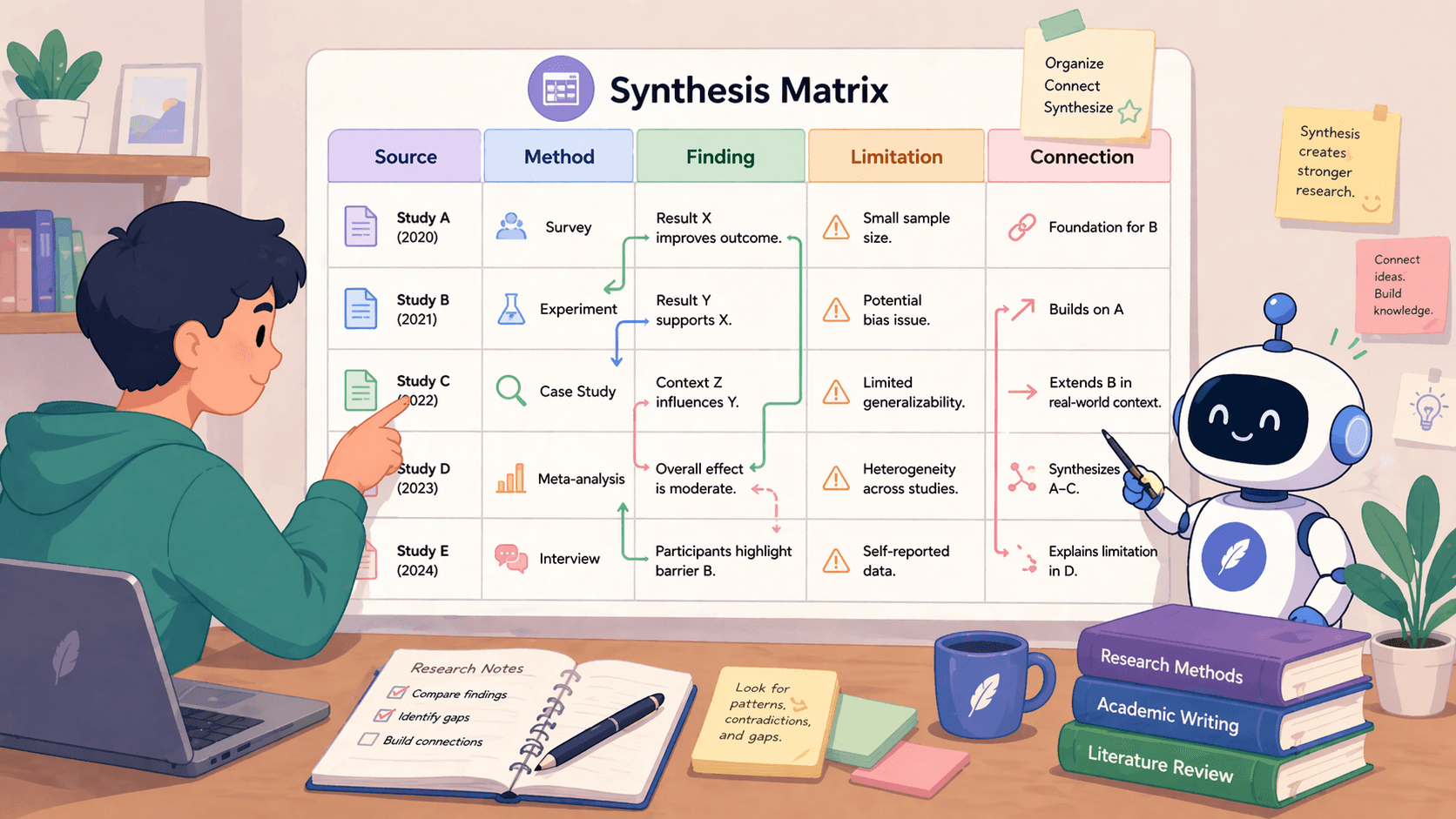
Likhna shuru karne se pehle apne sources ko organize karein. Ek synthesis matrix ek simple table hai jo aapko relationships dekhne par majboor karti hai—ek literature review matrix template ka use karne se alag-alag studies ko themes ke hisab se compare karna aasan ho jata hai.
Source | Method | Key Finding | Limitation | Connection |
Study A | Survey | Result X | Chhota sample | B ko support karta hai |
Study B | Experiment | Result Y | Bias issue | A ko contradict karta hai |
Yeh table create karne se aapko visually identify karne mein madad milti hai:
Studies ke beech patterns.
Clear contradictions.
Existing research mein gaps.
Yeh ek aisa tool hai jo shuruat se hi thematic organization ko behtar banata hai aur aapko bikhre hue tareeqe se likhne se rokta hai.
Thematic Writing Approach
Ek source ke baare mein likh kar phir agle par mat jaiye. Ek theme ke baare mein likhiye, phir agle par.
Example themes ho sakte hain:
Field mein methodological differences.
Woh areas jahan findings conflict karti hain.
Emerging trends ya consensus.
Aapka likha har paragraph us theme ke andar multiple sources se evidence ko combine karna chahiye. Yeh approach aapke review ke coherence ko drastically improve karti hai aur aapke argument ke flow ko majboot banati hai.
“Connection Sentence” Technique
Yeh ek simple, mechanical fix hai. Kisi source se evidence pesh karne ke baad, ek sentence jodein jo explicitly isey dusri study ya aapke main idea se connect kare.
Example: “Yeh findings Smith ki pehle ki research ke sath align hoti hain, lekin unke sample size aur methodology mein kaafi farq hai.”
Yeh technique seedhe sabse common failure ko target karti hai: alag-alag sources ke beech ideas ko connect na karna. Yeh ek summary ko synthesis mein badal deti hai.
<ProTip title="✍️ Pro Tip:" description="Add one linking sentence after every source to build clear relationships across studies" />
Bina Connection Khoye Isey Wrap Up Karein
Aap feel kar sakte hain jab aapka review kaam nahi kar raha hota, ideas bikhre hue lagte hain aur aap bina aage badhe bas points ko repeat karte rehte hain. Yeh jaldi hi frustrating ho jata hai. Yahi problem hai.
<CTA title="Improve Your Literature Review Workflow" description="Use structured prompts and synthesis frameworks to write clearer more analytical reviews" buttonLabel="Try Jenni Free" link="https://app.jenni.ai/register" />
Iska solution summaries par nahi balki connections par focus rakhna hai, aur likhte waqt organize rehne ke liye Jenni jaise tools ka use ek simple tareeqe ke roop mein karna hai. Yeh aapke liye sochne ka kaam nahi karega, lekin yeh aapko sab kuch align rakhne mein madad karta hai taaki aapka argument sach mein build aur land ho sake.