Dwara
Nathan Auyeung
—
Clinical Study Report Kaise Likhein (ICH E3 Structure)

Nathan Auyeung
Senior Accountant EY mein
Bachelor ka Accounting mein Graduation kiya, aur ek Postgraduate Diploma of Accounting bhi poora kiya

Clinical study report likhne ke liye guidance search karenge to aapko mostly primary sources milenge: jaise ICH E3 guideline khud, wahi document jo FDA aur EMA sites par mirrored hai, aur kuch vendor pages jo kahte hain "ICH E3 follow karein" bina ye bataye ki iska practical matlab kya hai.
To ye practical layer ko cover karta hai. Pura sixteen section structure isme kya aana chahiye uske sath, report submission ke andar kaha baithti hai, wo sequence jisme experienced writers sach mein kaam karte hain, aur E3 ke wo parts jise widely rules ki tarah treat kiya jata hai jabki guideline khud kuch aur kahti hai.
<CTA title="Keep Long Technical Documents Consistent" description="Jenni helps you draft and structure complex writing while keeping terminology stable across sections" buttonLabel="Try Jenni Free" link="https://app.jenni.ai/register" />
Clinical Study Report Kya Hai
Ek clinical study report, ya CSR, kisi ek single clinical trial ka pura written account hota hai: kya plan kiya gaya tha, kya kiya gaya, kya mila, aur iska kya matlab hai. Iska structure ICH E3, Structure and Content of Clinical Study Reports se aata hai, jo November 1995 mein step 4 par pahuncha tha aur jise FDA ne July 1996 mein guidance ke roop mein adopt kiya tha. Iska koi addendum nahi hai. 2012 ka ek Questions and Answers document hai, aur ye log jitna samajhte hain usse kahi zyada mayne rakhta hai, jaisa ki aage ke sections mein bataya gaya hai.
Ye kaha baithta hai. Common Technical Document par banaye gaye marketing application mein, individual clinical study reports Module 5 mein hoti hain. Unke synopses Clinical Summary ke section 2.7.6 mein collect kiye jate hain, aur product ke baare mein higher level argument Clinical Overview mein 2.5 par aur Clinical Summary mein 2.7 par kiya jata hai. Wo summary documents alag se likhe jate hain, ICH M4E ke under, aur wo CSR nahi hain. Naye regulatory writers in dono ko aksar confuse kar dete hain.
Phase 3 trial ke liye ek full CSR body text ke appendices se pehle aamtaur par kuch sau pages tak jata hai. Appendices khud hazaro pages tak ja sakte hain.
<ProTip title="📍 Know your module:" description="Before your first CSR, learn where every clinical document sits in the CTD. Half the confusion new regulatory writers experience is not about writing at all, it is about not knowing which document they are in" />
CSR Ke Sixteen Sections
Ye backbone hai. Niche diye gaye section titles wahi hain jo ICH E3 use karta hai.
# | Section | Isme kya aata hai |
1 | Title Page | Study title, product, indication, protocol number, phase, sponsor, dates of first and last enrollment, aur responsible medical officer |
2 | Synopsis | Puri study ki ek choti standalone summary, jisme sirf description ke bajaye numerical results hote hain |
3 | Table of Contents | Individual report ke liye contents, jisme appendices aur tables ki location shamil hai |
4 | List of Abbreviations and Definition of Terms | Report mein use kiya gaya har abbreviation aur koi bhi specialized term |
5 | Ethics | Ethics committee review, ki study ne Declaration of Helsinki aur GCP ko follow kiya, aur consent kaise obtain kiya gaya |
6 | Investigators and Study Administrative Structure | Study kisne chalayi, kin sites par, aur involved committees, laboratories, aur vendors |
7 | Introduction | Rationale ka ek brief statement, jo is trial ko development program mein rakhta hai |
8 | Study Objectives | Primary aur secondary objectives, jaise protocol mein state kiye gaye the |
9 | Investigational Plan | Sabse bada planning section: design, population, treatments, blinding, endpoints, data quality assurance, planned statistics, aur conduct ke dauran kiye gaye koi bhi changes |
10 | Study Patients | Patients ka disposition, aur protocol deviations jisme important wale alag se identify kiye gaye hain |
11 | Efficacy Evaluation | Analysis sets, baseline characteristics, compliance, aur efficacy results unke statistical treatment ke sath |
12 | Safety Evaluation | Extent of exposure, adverse events, deaths aur dusre serious events narratives ke sath, laboratory data, aur vital signs |
13 | Discussion and Overall Conclusions | Results ka kya matlab hai, benefit aur risk, aur data jin conclusions ko support karta hai |
14 | Tables, Figures and Graphs Referred to but Not Included in the Text | Demographic, efficacy, aur safety tables jinki taraf narrative point karta hai |
15 | Reference List | Report mein cite kiye gaye publications |
16 | Appendices | Study information, patient data listings, case report forms, aur individual patient data listings |
Section 16 ke char groups naam se janne layak hain. 16.1 Study Information mein protocol aur amendments, ek sample case report form, ethics committee details aur sample consent form, investigator details aur short CVs, randomization codes, aur statistical methods ka documentation hota hai. 16.2 Patient Data Listings mein discontinuations, deviations, analysis se exclusions, demographics, compliance, efficacy responses, adverse events, aur laboratory measurements hote hain. 16.3 mein deaths, dusre serious events, aur adverse events ke liye withdrawals ke case report forms hote hain. 16.4 mein individual patient data listings hoti hain.
Wo Sections Jaha Sach Mein Kaam Hota Hai

Teen sections likhne ke adhiktar samay ke liye zimmedar hote hain, aur ye teeno deeply subdivided hain.
Section 9, Investigational Plan. Ye wo jagah hai jaha trial ko poore tarike se describe kiya jata hai: design aur control ke choice ke piche ka reasoning, inclusion aur exclusion criteria, administered treatments aur patients ko unhe kaise assign kiya gaya, blinding, prior aur concomitant therapy, treatment compliance, efficacy aur safety variables aur kya wo appropriate the, data quality assurance, planned statistical methods, aur sample size determination. Ye conduct of study ya planned analyses mein kiye gaye kisi bhi badlav ke sath close hota hai, jo ki wo subsection hai jise reviewers dhyan se padhte hain.
Section 11, Efficacy Evaluation. Pehle analysis sets, phir demographics aur baseline characteristics, phir compliance, phir results. Statistical issues subsection demanding part hai: covariate adjustments, dropouts aur missing data ki handling, interim analyses, multicenter effects, multiplicity, active control studies mein equivalence testing, aur subgroup analyses. Inme se har ek ko describe karne ka ek standard tarika hota hai aur ek galat tarika jo sawalo ko bulata hai.
Section 12, Safety Evaluation. Extent of exposure, phir adverse events summarized, displayed, analyzed aur patient ke dwara list kiye gaye. Phir deaths, dusre serious adverse events, aur dusre significant adverse events, har ek listings, narratives, aur discussion ke sath. Phir laboratory evaluations parameter by parameter, phir vital signs aur physical findings, phir safety conclusions.
<ProTip title="🧷 Cross check:" description="Write the safety narratives before the safety summary rather than after. Narratives surface inconsistencies in the underlying data that a summary written first will paper over" />
Synopsis
Section 2 chota hai aur disproportionately important hai, kyunki bahut se readers ke liye ye akela part hai jise wo pura padhenge. ICH E3 ek brief synopsis mangta hai jo aamtaur par teen pages tak limited ho, aur explicit hai ki isme results ko illustrate karne ke liye numerical data hona chahiye na ki sirf text aur p values. Guideline ek sample format supply karti hai jo sponsor aur product, title, investigator aur center, study period aur phase, objectives, methodology, patient numbers, diagnosis aur main inclusion criteria, doses aur duration ke sath test aur reference products, evaluation ke criteria, statistical methods, results ka summary, aur conclusions ko cover karta hai.
Teen page ka figure wo jagah hai jaha Questions and Answers document useful ho jata hai. Ye confirm karta hai ki ICH M4E is limit ko aur complex aur important studies ke liye, das pages tak badhata hai. Agar aapko bataya gaya hai ki pivotal trial synopsis ke liye teen pages ek absolute ceiling hai, to guidance aisa nahi kehti.
Ise Sach Mein Kaise Likhein
Niche diya gaya sequence wo hai jis par experienced writers agree karte hain, aur ye document ka order nahi hai.
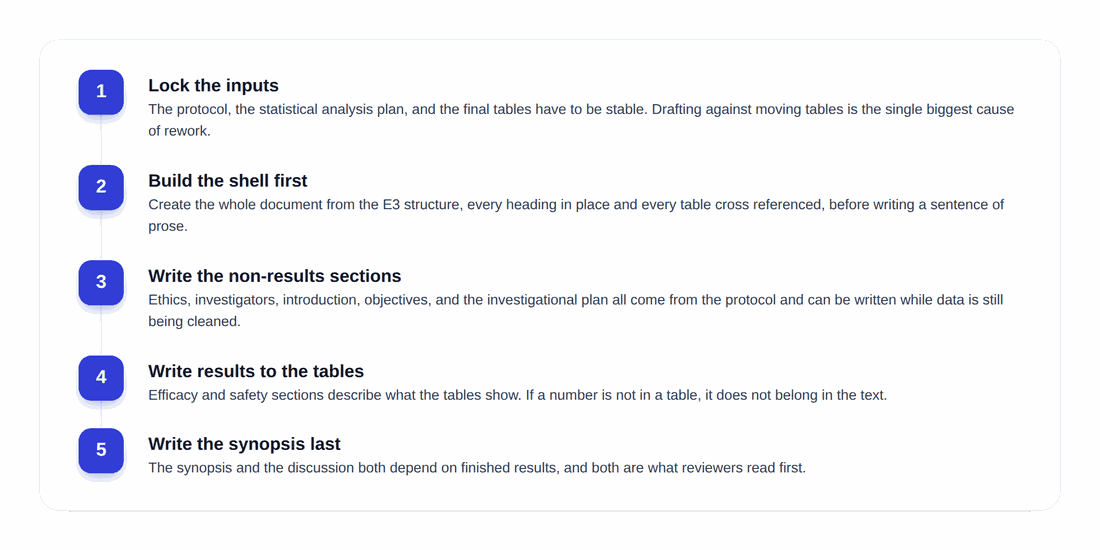
Inputs ko lock karein. Drafting shuru hone se pehle protocol, statistical analysis plan, aur final tables ka stable hona zaroori hai. Un tables ke against efficacy text likhna jo abhi bhi re-issue ho rahi hain, is kaam mein wasted effort ka sabse bada single source hai.
Pehle shell banayein. E3 structure se pura document banayein jisme har heading apni jagah par ho, har table cross reference stubbed ho, aur abbreviation list started ho. Ek complete empty shell bache hue kaam ko visible banata hai aur sections ko bhulne se rokta.
Non-results sections jaldi likhein. Ethics, investigators, introduction, objectives, aur investigational plan ka adhiktar hissa protocol se aata hai. Ye sab tabhi likha ja sakta hai jab database abhi bhi clean ho raha ho, jo ki naye to dead time hota.
Tables ke hisab se results likhein. Sections 11 aur 12 describe karte hain ki tables kya dikhati hain. Wo analysis ko introduce nahi karte, aur unme aise numbers nahi hote jo kahi table mein na ho. Agar aap khud ko kuch calculate karte hue paayein, to rukein aur statistician se table mangein.
Synopsis aur discussion sabse aakhir mein likhein. Dono finished results par depend karte hain. Dono sabse pehle padhe jate hain. Timeline plan karte samay is inversion ko yaad rakhna zaroori hai, kyunki sabse zyada time pressure wale sections wahi hote hain jin par readers ka sabse zyada dhyan jata hai.
ICH E3 Kya Permit Karta Hai Jo Log Sochte Hain Ki Ye Mana Karta Hai

Ye 2012 ke Questions and Answers document mein sabse useful cheez hai, aur ye online available free guidance se lagbhag gayab hai.
E3 ek guideline hai, template nahi. Q and A directly state karta hai ki E3 rigid requirements ka set nahi hai aur flexibility iske use mein inherent hai. Sections ko reorder kiya ja sakta hai, wo sections jo kisi particular study ke liye relevant nahi hain unhe omit kiya ja sakta hai, aur sections ko add kiya ja sakta hai. Jo teams numbered structure ko immovable treat karti hain, wo bina kisi wajah ke empty headings aur awkward placements ke sath reports produce karti hain.
Synopsis page limit absolute nahi hai. Jaise upar bataya gaya hai, M4E isko complex studies ke liye extend karta hai.
Appendices trial master file ki copy nahi hain. E3 trial master file ke paas kya hota hai iski current expectations se pehle ka hai, aur us content ko section 16 mein duplicate karna ek common aur expensive habit hai. Wahi shamil karein jo ek reviewer ko is report ko assess karne ke liye chahiye.
Jin data types ka E3 naam nahi leta unka bhi ek ghar hai. Pharmacokinetics, biomarkers, aur patient reported outcomes ko 1995 mein is tarah se contemplate nahi kiya gaya tha. Submission mein CSR ke sath rakhi gayi standalone reports acceptable hain.
Q and A do recurring arguments ko bhi settle karta hai: section 10.2 mein ek important protocol deviation ko minor se kaise distinguish karein, aur us patient ke double counting se kaise bachein jo deaths listing aur dusre serious adverse events listing dono mein aata hai.
<ProTip title="📖 Read the Q and A:" description="The 2012 Questions and Answers document is seven questions long and takes fifteen minutes. It will settle more internal debates than any style guide your company owns" />
Abbreviated Reports aur Terminated Studies
General audience ke liye likha gaya lagbhag kuch bhi isko cover nahi karta, aur E3 ise explicitly address karta hai.
Ek abbreviated report, summarized data ka use karke ya kuch sections ko remove karke, uncontrolled studies ke liye, efficacy establish karne ke liye design nahi ki gayi studies ke liye, seriously flawed ya aborted studies ke liye, aur controlled studies jo claim se unrelated conditions ko examine karti hain, ke liye acceptable ho sakti hai. Ek controlled safety study ko phir bhi poore tarike se report kiya jana chahiye.
Do conditions attach hoti hain. Safety aspects ka ek full description regardless shamil kiya jana chahiye. Aur abbreviated report mein design aur results ka itna detail hona chahiye ki regulatory authority decide kar sake ki kya use aakhirkaar full version chahiye. Ye dusri condition wo hai jise log underestimate karte hain: ek abbreviated report jo bahut thin hoti hai, wo kuch mahino baad complete report ke liye request generate karti hai.
<ProTip title="📉 Scope it early:" description="If a study was terminated, agree the abbreviated scope with regulatory affairs before drafting rather than after. Rewriting an abbreviated report into a full one is far more expensive than writing the full one first" />
Draft Ko Circulate Karne Se Pehle
Document reviewers tak pahunchne se pehle khud ye che check karein. Har ek check aisi error ko catch karta hai jise baad mein find karna expensive hota hai.
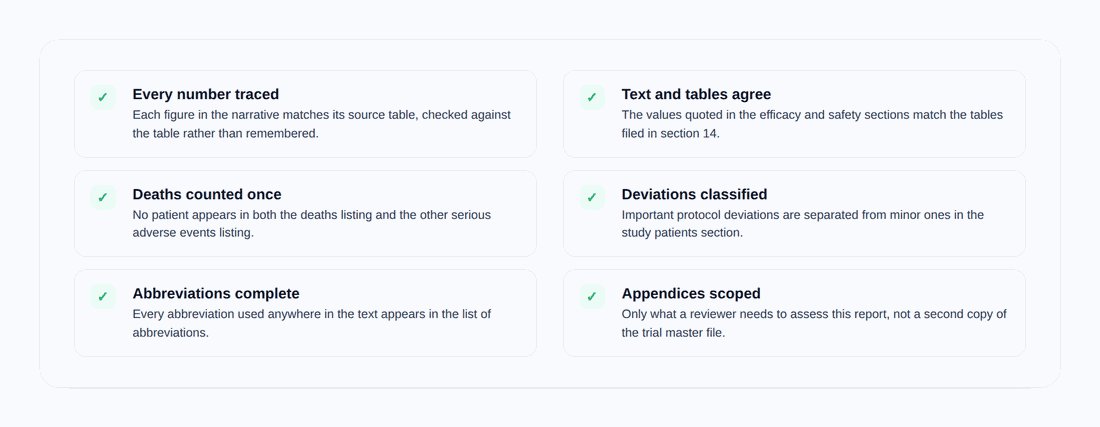
Text mein: confirm karein ki narrative mein har number apne source table se match karta ho na ki aapki memory se; ki sections 11 aur 12 ke values section 14 mein file kiye gaye tables se agree karte ho; ki koi bhi patient deaths listing aur dusre serious adverse events listing dono mein count na ho; ki important protocol deviations minor wale se alag ho; ki kahi bhi use kiya gaya har abbreviation section 4 mein dikhe; aur ki appendices mein sirf wahi ho jo ek reviewer ko is report ke liye chahiye.
Jo habit build karne layak hai wo hai trust karne ke bajaye trace karna. Ek CSR kai hatho se guzarta hai aur jo errors submission tak survive karti hain wo aamtaur par wahi numbers hote hain jise koi bina table par wapas gaye aage le gaya.
Structure Sabse Aasan Part Hai
Sixteen sections ko sikhne mein ek afternoon lagti hai. Jisme saal lagte hain wo hai judgment: ye janna ki reviewer ko statistical issues subsection mein kitni detail chahiye, protocol deviation ko bina minimize ya inflate kiye kaise describe karein, aur ek aisi discussion kaise likhein jo mixed result ke baare mein honest ho bina kisi program ko undermine kiye. Structure public aur free hai. Judgment supervision ke under kaam karne se aata hai.
<CTA title="Draft Complex Documents With Fewer Loose Ends" description="Keep terminology, structure, and sources consistent across a long technical document" buttonLabel="Try Jenni Free" link="https://app.jenni.ai/register" />
Agar aap start kar rahe hain, to E3 ko ek baar end to end padhein, phir Questions and Answers padhein, phir us company ki published CSR synopsis padhein jo unhe post karti hai. Ye teen cheezein sath milkar aapko unke kisi bhi summary se zyada sikhayengi, is summary ke samet. Underlying writing discipline, methods precisely describe karna aur ek lambe document mein consistent formal register rakhna, wahi skill hai jo kisi bhi serious technical writing ko govern karti hai.