Por
Nathan Auyeung
—
Revisión de alcance vs. revisión sistemática: en qué se diferencian realmente

Nathan Auyeung
Contador Senior en EY
Graduado con una Licenciatura en Contabilidad, completó un Diploma de Postgrado en Contabilidad.
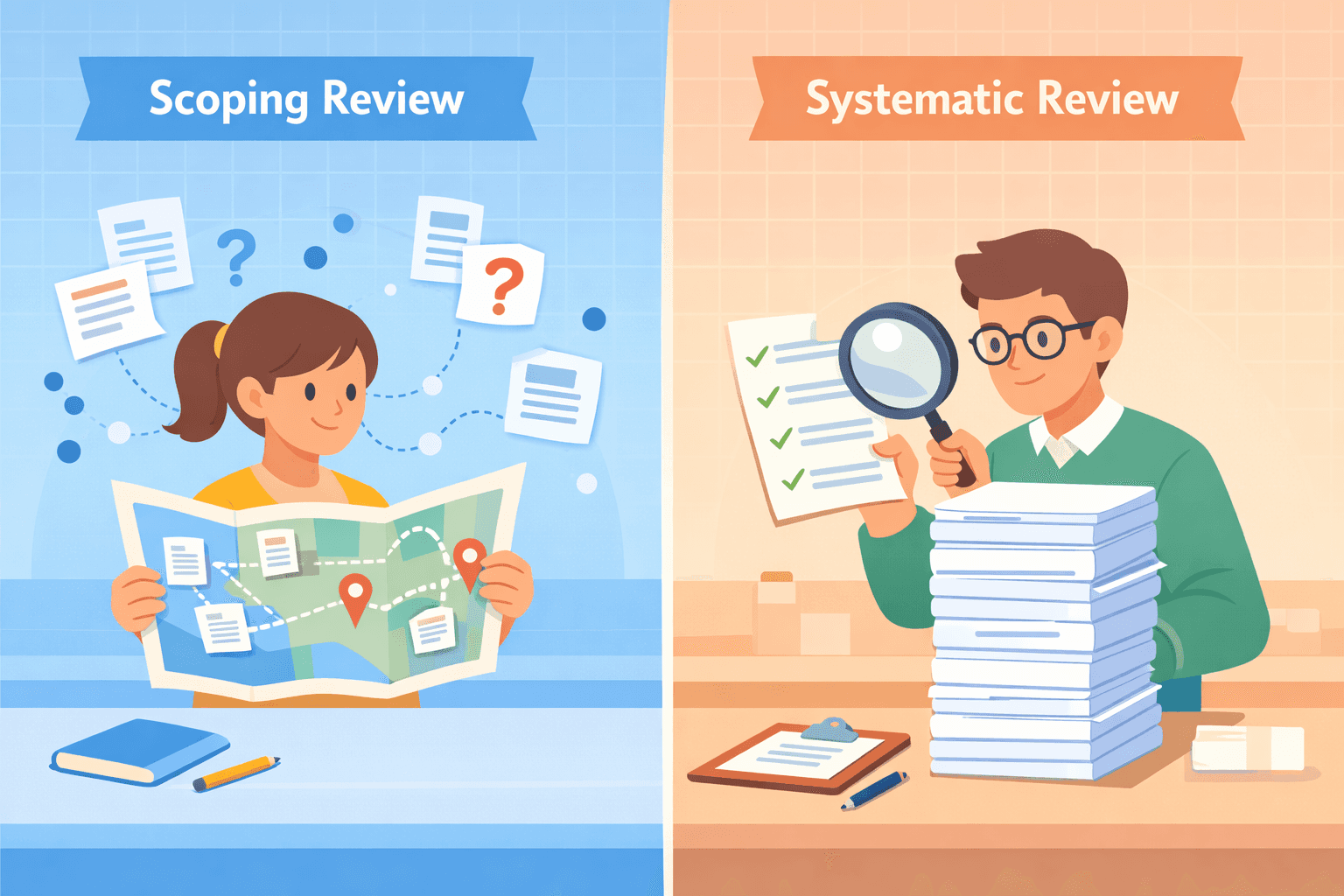
Todo proyecto de investigación comienza con una pregunta básica, pero crucial: ¿qué sabemos ya? Una revisión de la literatura responde a eso al trazar el mapa del conocimiento existente, lo que ya está establecido, lo que se debate y dónde siguen existiendo vacíos. Marca la dirección y evita que reinventes la rueda.
Dos formas comunes de hacerlo son las revisiones de alcance y las revisiones sistemáticas. A menudo se confunden porque sus flujos de trabajo parecen similares, pero cumplen propósitos muy distintos. Elegir la incorrecta puede costarte meses de trabajo o incluso provocar un rechazo. Esta guía se centra en las diferencias prácticas, para qué sirve realmente cada tipo de revisión, cómo influyen en tu carga de trabajo y cómo elegir la que mejor se adapte a tu objetivo de investigación. Para un contexto más amplio, consulta nuestra guía sobre los distintos tipos de revisiones de literatura.
<CTA title="Elige más rápido el método de revisión adecuado"description="Aclara tu objetivo de investigación y decide si encaja mejor una revisión de alcance o una revisión sistemática antes de comprometer meses de trabajo." buttonLabel="Prueba Jenni gratis"link="https://app.jenni.ai/register"/>
¿Qué es una revisión de alcance?
Hablemos de la revisión de alcance. Piensa en ella menos como un veredicto final y más como el mapa de un topógrafo. Su trabajo consiste en cartografiar el terreno.
Una revisión de alcance es tu mejor opción cuando tu tema es amplio, confuso o completamente nuevo. Se utiliza para averiguar qué investigación ya existe, quién está trabajando en ella y las distintas formas en que la están estudiando. Se trata de explorar, no de concluir.
Según las guías de síntesis de evidencia, las revisiones de alcance mapean el cuerpo de literatura sobre un tema para identificar conceptos, vacíos y tipos de evidencia, en lugar de producir conclusiones definitivas como lo hace una revisión sistemática, lo que te ayuda a decidir si conviene realizar una síntesis más enfocada.
La usarías en algunas situaciones clave. Tal vez el campo sea muy reciente y caótico, sin definiciones consensuadas.
Quizá la investigación esté repartida entre distintas disciplinas académicas, cada una con sus propios métodos. La pregunta central no es "¿funciona esto?" sino "¿qué es esto, en realidad?"
Por eso, las preguntas que aborda son naturalmente amplias:
¿Qué enfoques distintos han probado los investigadores para un problema específico?
¿Cómo definen distintas disciplinas la misma idea central?
¿Qué métodos están usando realmente las personas para estudiar este fenómeno?
La estrategia se centra en la cobertura. Lanzarás una red amplia para capturar tanto de la literatura como puedas, priorizando la amplitud e identificando las ideas principales, los tipos de estudios y los grupos implicados, en lugar de profundizar en una sola pieza.
Un punto clave es que, por lo general, no se evalúa la calidad de los estudios que encuentras. Estás catalogando lo que hay en la estantería, no comprobando cuán resistente es cada elemento. El resultado final es un mapa del panorama, con sus límites y sus espacios vacíos.
<ProTip title="🧭 Consejo profesional:" description="Si tu tema se siente vago o fragmentado entre distintas disciplinas, empieza con una revisión de alcance antes de acotar el enfoque." />
¿Qué es una revisión sistemática?
Ahora veamos la revisión sistemática. Si una revisión de alcance dibuja un mapa, una revisión sistemática es el informe del ingeniero que te dice exactamente dónde y cómo construir.
Su propósito es definitivo y práctico. Existe para responder a una única pregunta, estrechamente enfocada, reuniendo toda la evidencia relevante, evaluando su calidad y sintetizándola en una respuesta clara. Esta es la herramienta que usas cuando necesitas tomar una decisión.
Las revisiones sistemáticas siguen procedimientos estructurados para identificar, evaluar y sintetizar la evidencia, y se informan según marcos estandarizados como la declaración Preferred Reporting Items for Systematic Reviews and Meta-Analyses (PRISMA), lo que ayuda a garantizar la transparencia y la reproducibilidad.
Verás que las revisiones sistemáticas constituyen la base de las guías de práctica clínica, respaldan nuevas políticas de salud o resuelven debates de larga data en campos consolidados. La pregunta que abordan es precisa, a menudo formulada con una estructura como PICO (Paciente/Problema, Intervención, Comparación, Resultado).
Las preguntas típicas son directas:
¿Este medicamento específico mejora las tasas de supervivencia de pacientes con esta afección?
¿Es la terapia cognitivo-conductual más eficaz que la medicación para tratar la ansiedad en adolescentes?
El proceso se define por el rigor y el juicio. No basta con encontrar los estudios. Cada estudio que entra en la síntesis final se evalúa críticamente, se examinan sus métodos, se valora su posible sesgo y se analiza su validez interna.
A veces, si los datos lo permiten, la revisión da un paso más con un metaanálisis, usando estadística para combinar resultados de varios estudios en un único hallazgo más sólido.
Todo el esfuerzo apunta a una sola cosa: producir una conclusión fiable, basada en evidencia, que pueda orientar directamente lo que hacemos, ya sea en una clínica, un laboratorio o una sesión legislativa.
<ProTip title="📌 Recordatorio:" description="Elige una revisión sistemática solo cuando tu pregunta de investigación y los resultados estén claramente definidos desde el principio." />
Propósito central: exploración vs evaluación
La diferencia fundamental se reduce a la intención. ¿Estás explorando una frontera o estás construyendo sobre terreno ya consolidado?
Una revisión de alcance es tu herramienta para la exploración. Es la que usas cuando el territorio no te resulta familiar.
Su objetivo es delimitar el panorama, averiguar el volumen y la naturaleza de la literatura, ver cómo se ha abordado la investigación e identificar dónde están los núcleos densos de evidencia, así como los grandes vacíos.
Se trata de preguntar: “¿Qué hay aquí?” En cambio, una revisión sistemática es para evaluar. Su objetivo es llegar a una respuesta específica y accionable.
Pone a prueba una hipótesis definida, mide la eficacia de una intervención o examina la solidez de una asociación. El resultado final está pensado para respaldar directamente una recomendación o una decisión.
La elección depende de tu propio objetivo. Para aclarar los contornos de un tema amplio o desordenado, empiezas con una revisión de alcance. Para obtener una respuesta definitiva a una pregunta precisa, realizas una revisión sistemática.
Aspecto | Revisión de alcance | Revisión sistemática |
Propósito principal | Explorar y mapear la literatura existente | Responder a una pregunta de investigación enfocada y predefinida |
Pregunta de investigación típica | Amplia, abierta y exploratoria | Delimitada, específica y estructurada |
Etapa de la investigación | Fase inicial o exploratoria | Etapa posterior, orientada a la toma de decisiones |
Flexibilidad durante la revisión | Alta; el alcance puede evolucionar | Baja; el protocolo se fija con antelación |
Resultado | Resumen de conceptos, tipos de evidencia y vacíos | Conclusión o recomendación basada en evidencia |
Preguntas de investigación: amplias vs delimitadas
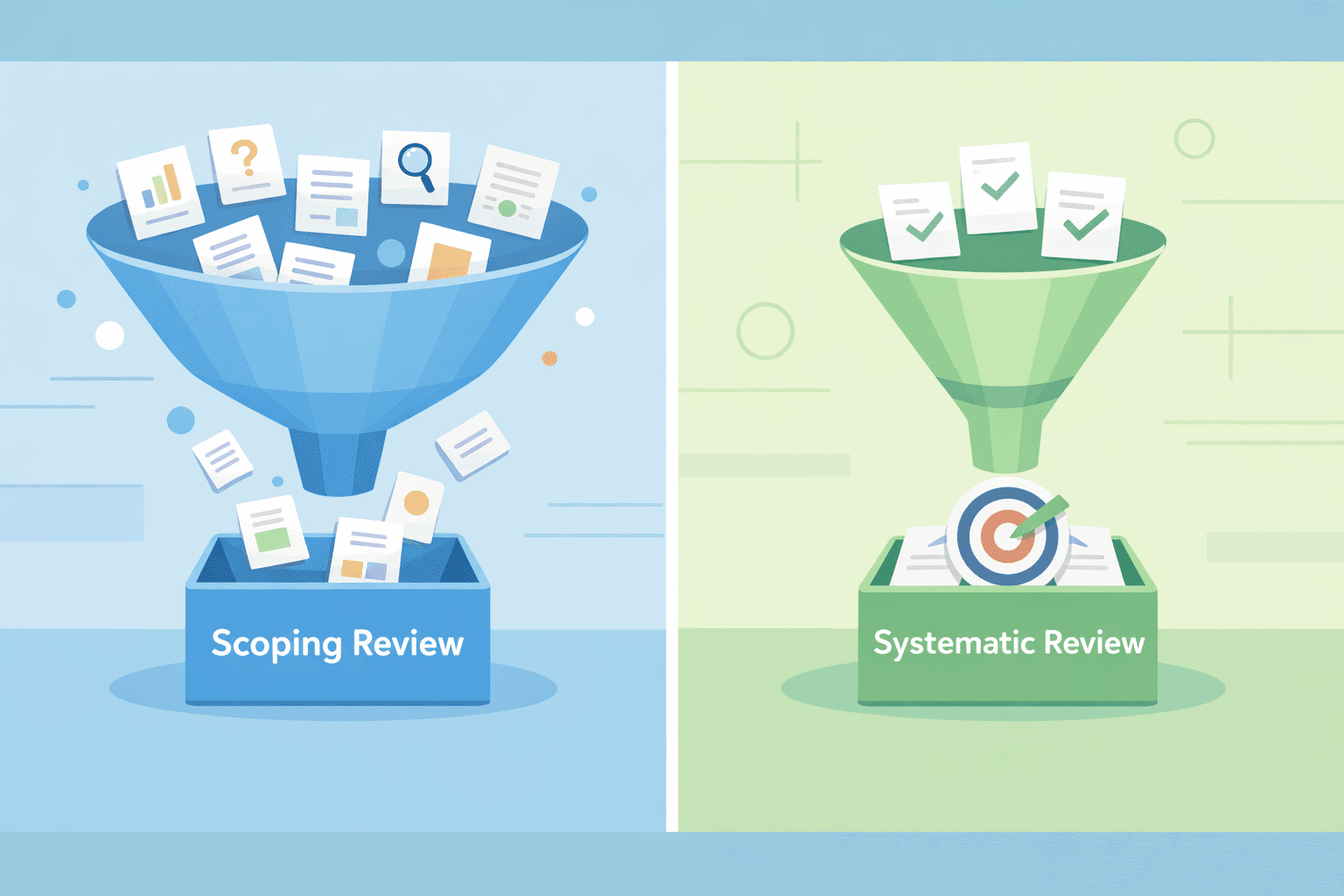
Las preguntas que planteas marcan todo el rumbo del proyecto. No son solo un punto de partida; dictan la metodología.
En una revisión de alcance, la pregunta es inherentemente amplia y abierta. Es una sonda inicial, como "¿Qué tipos de investigación existen sobre este fenómeno?" Este tipo de pregunta es flexible por diseño.
A medida que profundizas en la literatura, tu comprensión del tema se amplía y los límites de tu revisión pueden cambiar para adaptarse a lo que encuentras. El proceso es iterativo y exploratorio.
En una revisión sistemática, la pregunta es el ancla. Debe estar estrechamente definida, meticulosamente estructurada (a menudo con un marco como PICO) y fijada antes de que comience la búsqueda.
Esta rigidez no es una limitación, es la base de la credibilidad de la revisión. Una pregunta fija y precisa minimiza el sesgo del revisor y hace que todo el proceso sea reproducible, algo imprescindible cuando los resultados deben guiar la práctica clínica o la política pública.
<ProTip title="🧠 Recuerda:"description="Si tu pregunta de investigación sigue cambiando, es una señal de que una revisión de alcance sería más apropiada." />
Rigor metodológico y flexibilidad
El proceso de cada revisión está estructurado, pero las reglas son diferentes. Una permite ajustes, mientras que la otra se basa en un protocolo estricto.
Las revisiones de alcance priorizan una visión amplia. La estrategia de búsqueda es extensa y busca captar la mayor cantidad posible de literatura, incluidas fuentes no tradicionales como informes o tesis.
Los criterios de inclusión de estudios pueden ser más flexibles y, a veces, evolucionan a medida que el revisor comprende mejor el campo. El análisis es principalmente descriptivo, y cartografía qué existe y cómo se categoriza.
Las revisiones sistemáticas se definen por su rigidez. La búsqueda es exhaustiva, pero se centra estrechamente en una pregunta predefinida. Los criterios para incluir o excluir un estudio se fijan antes de iniciar la búsqueda y no son negociables.
Cada estudio incluido pasa por una evaluación formal de calidad. Todo el plan suele registrarse previamente en un protocolo público. La extracción de datos es altamente estructurada, todo para respaldar una síntesis que conduzca a una conclusión definitiva.
Este mayor nivel de rigor en una revisión sistemática es obligatorio. Sus hallazgos están destinados a influir directamente en las decisiones, por lo que los métodos no deben dejar margen para la ambigüedad ni el sesgo.
Evaluación de la calidad: opcional vs esencial
El enfoque para juzgar la calidad de la evidencia es una diferencia clave. Cambia de forma fundamental lo que la revisión puede decirte.
En una revisión de alcance, por lo general no se realiza una evaluación formal de la calidad. Los estudios se incluyen para mostrar el rango de lo publicado, no para avalar su credibilidad.
Un estudio metodológicamente débil aún puede ser útil para ilustrar cómo se ha discutido un concepto. La revisión busca una muestra representativa de la literatura, con sus fallos y todo.
En una revisión sistemática, la evaluación de la calidad no es solo un paso, es el núcleo de la síntesis. Se aplican herramientas para evaluar el riesgo de sesgo a cada estudio incluido.
Los hallazgos de estudios con fallos metodológicos graves pueden excluirse del análisis final o señalarse claramente como poco fiables. A menudo, la solidez general de la evidencia se califica formalmente (por ejemplo, con alta, moderada o baja certeza).
Este proceso riguroso de selección es una de las principales razones por las que las revisiones sistemáticas exigen más tiempo, habilidades especializadas y recursos. No solo estás recopilando respuestas; estás construyendo un caso.
<ProTip title="🔍 Consejo profesional:" description="No añadas una evaluación de calidad a una revisión de alcance a menos que tu revista lo exija explícitamente." />
Síntesis de datos: mapear vs responder

La síntesis final es el momento en que el propósito de cada revisión queda completamente claro. En una revisión de alcance, la síntesis consiste en organizar y describir. Estás ordenando la literatura para formar una imagen coherente.
El resultado suele ser un conjunto de tablas o gráficos que clasifican los tipos de estudios, las poblaciones analizadas o los métodos utilizados, normalmente organizados con una plantilla de matriz para revisión de literatura.
Podrías crear un mapa visual que muestre dónde se concentra la investigación y dónde no hay presencia. El resultado es una visión estructurada que identifica patrones, temas y, lo más importante, vacíos en la evidencia.
En una revisión sistemática, la síntesis se centra en el análisis y la interpretación. No solo ordenas los estudios; analizas conjuntamente sus hallazgos.
Esto puede implicar una comparación cualitativa de resultados entre estudios o, cuando los datos lo permiten, un metaanálisis cuantitativo que combina estadísticamente los resultados para producir una estimación única y más precisa.
A menudo, los analistas realizan análisis de subgrupos o pruebas de sensibilidad para ver cuán robustos son los hallazgos. El objetivo es pasar de una colección de datos a una conclusión respaldada.
Consideraciones de tiempo y recursos
El compromiso de tiempo y esfuerzo es marcadamente distinto, y es un factor clave en la planificación. Una revisión de alcance suele ser el proyecto más factible para un equipo pequeño o un plazo ajustado. Puede llevar varios meses completarla.
Aunque requiere una búsqueda sistemática, evita las etapas más laboriosas, como la evaluación crítica formal y la síntesis estadística compleja.
Una revisión sistemática es una empresa importante. Lo habitual es que tarde un año o más desde el protocolo hasta la publicación.
Suele requerir un equipo con experiencia diversa, expertos en la materia, un bibliotecario dedicado para la búsqueda y un metodólogo para la evaluación y el análisis, además de una cuidadosa gestión de referencias para una revisión sistemática, especialmente al importar bibliotecas desde Zotero y Mendeley.
La profundidad del trabajo justifica el plazo; estás construyendo algo pensado para resistir un escrutinio intenso y orientar decisiones del mundo real.
Para la tesis de un estudiante de posgrado o para una primera mirada a un campo nuevo, una revisión de alcance suele ser la opción más pragmática. Para informar una guía clínica o un documento de política pública, las mayores exigencias de una revisión sistemática son una inversión necesaria.
<ProTip title="⏱️ Consejo de planificación:" description="Adapta el tipo de revisión a tu cronograma y al tamaño de tu equipo, no solo a lo que suena más riguroso." />
Estándares y marcos de reporte
Ambas revisiones operan dentro de marcos establecidos, pero siguen conjuntos de reglas distintos. Seguir el adecuado no solo es una buena práctica, sino que a menudo es un requisito para publicar.
Para una revisión de alcance, por lo general sigues un plan específico. El más común fue creado por investigadores llamados Arksey y O'Malley, y otros, como Levac, lo han actualizado.
Cuando redactas tu revisión, existe una lista de verificación que ayuda a asegurarse de que informes todo con claridad. Esa lista se llama la Extensión PRISMA para revisiones de alcance, o PRISMA-ScR para abreviar.
Para una revisión sistemática, existe una lista de verificación muy utilizada para redactar los resultados llamada declaración PRISMA. Asegura que informes todos los detalles importantes.
Para garantizar que la revisión en sí se realice con rigor, muchos investigadores siguen manuales detallados de grupos como la Colaboración Cochrane o el Joanna Briggs Institute.
Además, antes de empezar siquiera a buscar estudios, es muy recomendable, y a menudo obligatorio, publicar tu plan completo de revisión en un registro llamado PROSPERO. Esto fija tus métodos desde el principio y ayuda a evitar sesgos.
Seguir el marco adecuado te da un plan paso a paso para realizar la revisión. También asegura que tu informe final sea claro, completo y que otra persona pueda seguir exactamente tus pasos para comprobar tu trabajo o reproducirlo.
Cuándo las revisiones de alcance van primero
Es útil pensar en estas dos revisiones no como rivales, sino como fases de una cadena de investigación. En muchos casos, una revisión de alcance va primero.
Antes de comprometerse con la enorme tarea que supone una revisión sistemática, un equipo puede realizar una revisión de alcance. Su naturaleza exploratoria es perfecta para responder a las preguntas prácticas que preceden a la definitiva.
¿Existe siquiera suficiente investigación primaria como para justificar una revisión sistemática completa? ¿Cómo han definido otros investigadores los conceptos clave o medido los resultados? ¿Cómo se ve el panorama general?
En algunos proyectos en etapas tempranas, los investigadores incluso pueden comenzar con una revisión narrativa de la literatura para desarrollar una comprensión conceptual antes de pasar a un enfoque de alcance más estructurado.
La revisión de alcance proporciona el mapa y el glosario. Aclara la terminología, identifica los resultados más relevantes que conviene medir y ayuda a convertir un interés amplio en una pregunta estrecha y respondible.
Con esa base establecida, una revisión sistemática posterior puede diseñarse con mucha mayor precisión y confianza.
Este enfoque por etapas es especialmente valioso en campos de estudio nuevos o en áreas donde la investigación está dispersa entre distintas disciplinas académicas, y donde los contornos básicos de la evidencia aún no están claros.
Conceptos erróneos comunes
Hay que aclarar un par de mitos persistentes.
El primero es la idea de que una revisión de alcance es simplemente una versión "rápida y básica" de una revisión sistemática. Eso no es exacto.
Realizar una buena revisión de alcance exige su propia forma de rigor: planificación meticulosa, un proceso de búsqueda sistemático y documentado, y una síntesis de hallazgos reflexiva y transparente.
La diferencia no está en el nivel de cuidado, sino en el tipo de pregunta que se plantea. Es una herramienta distinta para una tarea distinta, no una versión inferior.
El segundo es suponer que una revisión sistemática es automáticamente el "estándar de oro" para todas las situaciones.
Esto puede salir mal. Lanzar una revisión sistemática en un campo que aún está emergiendo, donde las definiciones son difusas y los métodos están desigualmente distribuidos, suele ser un error.
Podrías acabar con una búsqueda vacía, o combinar peras con manzanas de una forma que produzca una conclusión sin sentido o engañosa. A veces, la revisión sistemática no es el primer paso correcto.
Cómo elegir el tipo de revisión adecuado: una lista práctica
Para decidir qué revisión necesitas, responde a estas preguntas prácticas, idealmente después de esbozar tu enfoque con un claro cómo escribir un esquema de revisión de literatura:
¿Cuál es el objetivo principal? ¿Explorar y mapear un área amplia o obtener una respuesta definitiva a una pregunta específica?
¿En qué estado está el campo? ¿Es nuevo, caótico y repartido entre disciplinas, o está maduro y con métodos consolidados?
¿Es esencial juzgar la calidad de la evidencia? ¿Necesitas calificar la solidez de los hallazgos o basta con describir el rango de lo que existe?
¿Qué tan claros son tus resultados? ¿Sabes exactamente qué estás midiendo o todavía estás definiéndolo?
¿Cuáles son tus limitaciones prácticas? Considera tu plazo, el tamaño del equipo y la experiencia metodológica disponible.
Si tus respuestas apuntan a la exploración, a clarificar conceptos y a identificar vacíos, la revisión de alcance es tu camino.
Si apuntan a una pregunta precisa y predefinida, a la necesidad de evaluar la calidad y a una conclusión que deba respaldar una decisión, entonces estás ante una revisión sistemática.
Una vez que hayas elegido tu enfoque, usar un generador de revisiones de literatura y RRL con IA puede ayudarte a agilizar la redacción inicial mientras mantienes organizadas las fuentes y las citas.
Decidir entre revisiones de alcance y sistemáticas
Las revisiones de alcance y las revisiones sistemáticas son más eficaces cuando se usan para el propósito adecuado. Una revisión de alcance te ayuda a entender el panorama, qué se ha estudiado, cómo se utilizan los conceptos y dónde siguen existiendo vacíos. Es ideal cuando un tema es amplio, emergente o está poco definido. Una revisión sistemática, en cambio, está diseñada para evaluar la evidencia, probar preguntas concretas y respaldar decisiones sobre la práctica o la política pública.
<CTA title="Convierte tu elección de revisión en un plan de investigación claro" description="Usa Jenni para refinar tu pregunta de investigación, estructurar tu revisión y mantenerte alineado con los estándares de publicación." buttonLabel="Prueba Jenni gratis"link="https://app.jenni.ai/register" />
Comprender esta diferencia define todo lo que viene después: la pregunta que planteas, el tiempo y los recursos que necesitarás, y la solidez de las conclusiones que podrás extraer. Elegir la revisión adecuada desde el principio mantiene tu investigación enfocada, defendible y alineada con lo que realmente necesitas averiguar.