에 의해
네이선 아우영
—
학생을 위한 인용 스타일 설명 (APA, MLA, 시카고, 하버드 및 밴쿠버 가이드)

논문을 작성할 때마다 여러분은 다른 사람들의 아이디어를 바탕으로 연구를 발전시키게 됩니다. 공정하고 정직한 연구 태도를 유지하려면 그러한 아이디어가 어디서 왔는지 반드시 밝혀야 합니다. 이는 원저자에게 공로를 돌리는 짧은 기록인 '인용'을 통해 이루어집니다. 인용 스타일은 이러한 기록을 작성하는 방법을 알려주는 일련의 규칙입니다. 인용 스타일을 사용하면 이름, 날짜, 제목, 페이지를 일관된 형식으로 표기할 수 있어 글이 깔끔하고 신뢰성 있으며 전문적으로 보입니다.
이 가이드에서는 다섯 가지 주요 인용 스타일(APA, MLA, 시카고, 하버드, 밴쿠버)을 배우게 됩니다. 각 스타일의 목적과 사용 방법, 그리고 여러분의 전공 분야에 가장 적합한 스타일이 무엇인지 알아보세요. 장기 연구 프로젝트의 경우, 일관된 참고문헌 작성이 문헌 검토에서 특히 중요합니다. 구조화된 방식으로 초안을 작성하고 출처를 추적하려면 AI Literature Review & RRL Generator — Jenni AI를 살펴보세요.
<CTA title="완벽한 참고문헌 목록 생성하기" description="형식 맞추기로 고민할 필요 없이 몇 분 만에 올바른 형식의 참고문헌을 손쉽게 만들어 보세요." buttonLabel="Jenni 무료로 시작하기" link="https://app.jenni.ai/register" />
인용 스타일이 중요한 이유
인용은 단순히 규칙을 따르는 것 이상의 의미가 있습니다. 인용은 여러분의 연구를 보호하고 다른 사람들이 신뢰할 수 있도록 돕습니다.
공로를 인정합니다
다른 사람의 글을 인용하거나 의역할 때마다 인용을 통해 독자에게 그 아이디어가 어디서 왔는지 알려줄 수 있습니다. 이는 마치 발자국을 남기는 것과 같습니다.
정직함을 나타냅니다
올바른 인용은 타인의 저작물을 자신의 것인 양 가로채지 않는다는 것을 증명하며, 심각한 학문적 부정행위인 표절로부터 여러분을 보호해 줍니다.
독자를 안내합니다
독자들은 여러분이 남긴 인용 표시를 보고 더 자세히 공부하기 위해 해당 출처를 쉽게 찾아볼 수 있습니다. 이로써 여러분의 논문은 더욱 유용하고 신뢰할 수 있게 됩니다.
일관성을 유지합니다
특정 분야의 모든 사람들이 동일한 스타일을 따를 때, 연구 논문을 읽고 검토하기가 훨씬 더 쉬워집니다. 학문 분야마다 선호하는 인용 스타일이 다른 이유가 바로 여기에 있습니다.
<ProTip title="💡 간단한 알림:" description="인용, 의역, 요약을 할 때는 항상 출처를 밝혀야 합니다. 단어를 바꾸어 표현하더라도 저작자의 공로를 반드시 인정해야 합니다." />
다섯 가지 주요 인용 스타일
인용 체계는 다양하지만, 학생들이 가장 자주 사용하는 다섯 가지는 APA, MLA, 시카고(Chicago), 하버드(Harvard), 밴쿠버(Vancouver)입니다. 각 스타일은 저마다의 규칙, 장점, 주로 쓰이는 학문 분야가 있습니다. 하나씩 자세히 살펴보겠습니다.
APA 스타일 (미국심리학회)
주로 사용되는 분야: 사회과학, 심리학, 교육학, 경영학.
중요한 이유: 이러한 학문 분야에서는 최신 연구가 가장 중요하기 때문에 APA는 발행 연도에 중점을 둡니다.
본문 내 인용 형식:
(저자, 연도, 페이지)
예시: (Smith, 2023, p. 45)
참고문헌 목록 형식:
논문 끝부분에 References(또는 참고문헌)라는 제목 아래에 배치합니다.
각 항목에는 저자, 연도, 제목, 출처가 기재됩니다.
참고문헌 작성 예시:
Smith, J. (2023). Exploring student engagement online. Education Press.
추가 APA 유의사항:
항상 저자 이름 바로 뒤에 발행 연도를 기재해야 합니다.
제목은 첫 단어만 대문자로 시작합니다(고유명사 제외).
도서 명과 저널 명은 이탤릭체로 표기합니다.
온라인 출처의 경우 가능한 한 DOI나 URL을 포함해야 합니다.
APA는 여러분의 아이디어가 최신 연구에 기반하고 있음을 보여주는 데 유용합니다.
<ProTip title="💡 유용한 팁:" description="Jenni AI를 사용하면 올바른 문장 부호와 대소문자를 적용하여 APA 스타일 참고문헌을 즉시 생성할 수 있습니다." />
MLA 스타일 (현대어문학협회)
주로 사용되는 분야: 인문학 (문학, 언어학, 역사, 예술).
중요한 이유: 텍스트의 정독과 세밀한 분석을 중시하는 인문학 분야 특성상 MLA는 저자와 페이지 번호에 중점을 둡니다.
본문 내 인용 형식:
(저자 페이지)
예시: (Smith 45)
참고문헌(Works Cited) 형식:
출처의 전체 목록 상단에는 'References'가 아닌 Works Cited라는 제목을 붙입니다.
참고문헌 작성 예시:
Smith, John. Exploring Student Engagement in Literature Classes. Oxford UP, 2023.
추가 MLA 유의사항:
저자와 페이지 번호 사이에 쉼표(,)를 쓰지 않습니다.
직접 인용할 때는 항상 페이지 번호를 기재해야 합니다.
단행본 및 대규모 저작물의 제목은 이탤릭체로 표기합니다.
논문이나 시 등의 제목은 큰따옴표("") 안에 넣어야 합니다.
MLA 방식은 독자가 인용구를 문학 작품의 정확한 페이지와 쉽게 대조해 볼 수 있게 도와줍니다. 자세한 예시는 MLA 스타일 센터에서 확인해 볼 수 있습니다.
<ProTip title="💬 유용한 팁:" description="MLA 스타일을 쓸 때는 본문에 사용된 저자 이름이 'Works Cited' 목록과 완벽히 일치하는지 꼭 다시 확인하세요." />
시카고 스타일 (The Chicago Manual of Style)
주로 사용되는 분야: 역사학, 미술사, 일부 사회과학.
중요한 이유: 시카고 스타일은 두 가지 시스템을 제공하여 모든 주제에 유연하게 대응할 수 있도록 해줍니다. 각주, 미주, 저자-연도 표기법에 대한 단계별 설명은 시카고 스타일 인용 가이드를 참고하세요.
1. 각주-참고문헌 시스템 (Notes and Bibliography System)
이 시스템은 본문에 위첨자 숫자를 붙이고 페이지 하단(각주)이나 장 끝부분(미주)에 상세한 출처를 기록하는 방식입니다.
본문 내 예시:
제국에 대한 현대 연구는 새로운 관점들을 탐색한다.^1
각주:
존 도(John Doe), Empire and Memory (New York: History Press, 2019), 102.
참고문헌(Bibliography) 항목:
Doe, John. Empire and Memory. New York: History Press, 2019.
2. 저자-연도 시스템 (Author–Date System)
APA 스타일과 유사하지만 조금 더 단순합니다.
본문 내 표기: (Smith 2020, 45)
참고문헌 목록 제목: “References”
예시:
Smith, John. 2020. Learning Across Cultures. New York: University Press.
<ProTip title="📘 프로 팁:" description="사용하는 1차 사료나 역사 관련 문헌이 많다면 '각주-참고문헌' 시스템을 사용하는 것이 더 좋습니다." />
시카고 스타일은 유연성이 뛰어나기 때문에 인용구 제시와 정밀한 분석이 모두 중요한 분야에서 애용됩니다.
하버드 스타일 (저자-연도 시스템)
주로 사용되는 분야: 영미권(특히 영국, 호주) 및 글로벌 대학의 다양한 학문 분야.
중요한 이유: 단순하고 명확하며 APA와 유사하지만 세부 레이아웃에서 약간의 차이가 있습니다.
본문 내 인용 형식:
(저자, 연도, p. 페이지)
예시: (Taylor, 2021, p. 89)
참고문헌 목록 형식:
문서 마지막에 References라는 제목으로 목록을 작성합니다.
참고문헌 작성 예시:
Taylor, S. (2021) Effective Study Skills. Cambridge University Press.
추가 하버드 스타일 유의사항:
연도는 항상 저자 이름 바로 뒤에 표시됩니다.
본문 내 인용 시 소괄호를 사용합니다.
전체 저작물(책 등)의 제목은 이탤릭체로 표기합니다.
참고문헌 목록은 저자 이름을 기준으로 알파벳순으로 정렬합니다.
다양한 표기법을 쉽고 빠르게 형식에 맞추고 싶다면, 자동 도구와 정확한 사용법을 설명한 하버드 인용법 가이드: 제너레이터 활용법을 읽어보시기 바랍니다.
<ProTip title="📚 알림:" description="하버드 스타일은 범용성이 높습니다. 대학마다 세부 적용 양식이 다를 수 있으니 소속 기관의 공식 가이드를 꼭 확인하세요." />
밴쿠버 스타일 (숫자 표기 시스템)
주로 사용되는 분야: 의학, 보건학, 자연과학.
중요한 이유: 지면을 절약할 수 있고 다수의 참고문헌을 인용하는 논문을 깔끔하게 정리해 줍니다.
본문 내 인용 형식:
대괄호 [ ] 또는 위첨자로 숫자를 표기합니다.
예시: 연구 결과에 따르면 뚜렷한 개선 효과가 확인되었다 [3].
참고문헌 목록 형식:
알파벳순이 아니며 본문에 인용된 순서대로 번호를 매겨 나열합니다.
참고문헌 작성 예시:
Smith J, Jones B. Treatment Outcomes in Oncology. Medical Journal. 2023; 11(2): 45–52.
추가 밴쿠버 스타일 유의사항:
각 출처는 고유한 번호를 부여받습니다.
동일한 출처를 다시 인용할 때는 기존에 부여된 번호를 그대로 사용합니다.
저자 이름은 성 뒤에 머리글자(이니셜)만 표기하고 마침표를 찍지 않습니다.
저널의 권호 및 페이지 번호를 필히 기재해야 합니다.
<ProTip title="💡 프로 팁:" description="의학 보고서나 과학 실험 논문처럼 간결하고 빠른 번호 지정 방식의 인용이 필요한 경우 밴쿠버 방식을 사용하세요." />
적절한 인용 스타일을 선택하는 방법

알맞은 스타일을 선택하는 것은 전공 분야, 교육자, 과제물의 유형에 따라 달라집니다.
글을 쓰기 전에 다음 체크리스트를 확인해보세요. 만약 가장 흔히 쓰이는 두 스타일 사이에서 고민 중이라면, APA 대 MLA: 본인 논문에 맞는 인용 스타일 선택 가이드에서 언제 각각을 써야 하는지 알아보세요.
과제 안내 사항 확인하기:
대부분의 교수님은 사용할 인용 법을 미리 고지해 줍니다. 별다른 안내가 없다면 집필을 시작하기 전에 한 번 더 여쭤보세요.
전공 분야 파악하기:
사회과학 → APA
인문학 → MLA
역사학 및 예술 → 시카고 (Chicago)
의학 및 이공계 → 밴쿠버 (Vancouver)
일반 학술 분야 → 하버드 (Harvard)
자료의 출처 유형 고려하기:
서적, 에세이 → MLA 또는 Chicago
학술 연구 논문 → APA 또는 Harvard
실험 보고서 → Vancouver
일관성 유지하기:
한 편의 논문에서 여러 종류의 스타일을 혼용해서는 안 됩니다. 한 가지 스타일을 선택해 처음부터 끝까지 유지해야 합니다.
<ProTip title="📋 팁:" description="글을 쓰기 전에 먼저 해당 인용 양식에 맞춰 제목 수준, 여백, 페이지 설정을 완료해 두세요." />
자주 논의되는 세부 설정 비교
특징/구분 | APA | MLA | Chicago (각주형) | Harvard | Vancouver |
본문 내 표시 양식 | (저자, 연도) | (저자 페이지) | 위첨자 주석 번호 | (저자, 연도, p.) | [ 번호 ] |
최종 목록 명칭 | References | Works Cited | Bibliography | References | References |
각주 사용 유무 | 매우 드묾 | 매우 드묾 | 있음 | 없음 | 없음 |
핵심 강조 영역 | 연구 수행 연도 | 정확한 페이지 | 유연한 서술 방식 | 저자-연도의 명확성 | 간결하고 밀도 높은 인용 |
대표 전공 분야 | 심리학, 교육학 | 문학, 어문학, 예술 | 역사학, 인문학 일반 | 종합 학술 | 의학, 제약, 자연과학 |
<ProTip title="🔎 빠른 점검:" description="본문 안의 내어쓰기나 괄호 인용이 너무 길어 가독성을 해친다면 밴쿠버 스타일 같은 숫자 시스템 전환을 검토해 보세요." />
예시 비교: 하나의 동일 출처를 다섯 가지 스타일로 표기하기
하나의 도서가 각 인용 스타일에 따라 어떻게 바뀌는지 확인해 보세요.
사용한 도서: Smith, John. Global Learning in Higher Education. New York: University Press, 2020.
APA 예시
본문 내: (Smith, 2020, p. 45)
참고문헌: Smith, J. (2020). Global learning in higher education. University Press.
MLA 예시
본문 내: (Smith 45)
참고문헌(Works Cited): Smith, John. Global Learning in Higher Education. University Press, 2020.
Chicago (Notes-Bibliography) 예시
본문 내: …혁신적인 교육 방법론이다.^1
각주: 1. John Smith, Global Learning in Higher Education (New York: University Press, 2020), 45.
참고문헌(Bibliography): Smith, John. Global Learning in Higher Education. New York: University Press, 2020.
Harvard 예시
본문 내: (Smith, 2020, p. 45)
참고문헌: Smith, J. (2020) Global Learning in Higher Education. University Press.
Vancouver 예시
본문 내: …학습 결과가 크게 향상되었다 [1].
참고문헌: 1. Smith J. Global Learning in Higher Education. New York: University Press; 2020.
가장 흔히 저지르는 인용 실수와 해결 방법
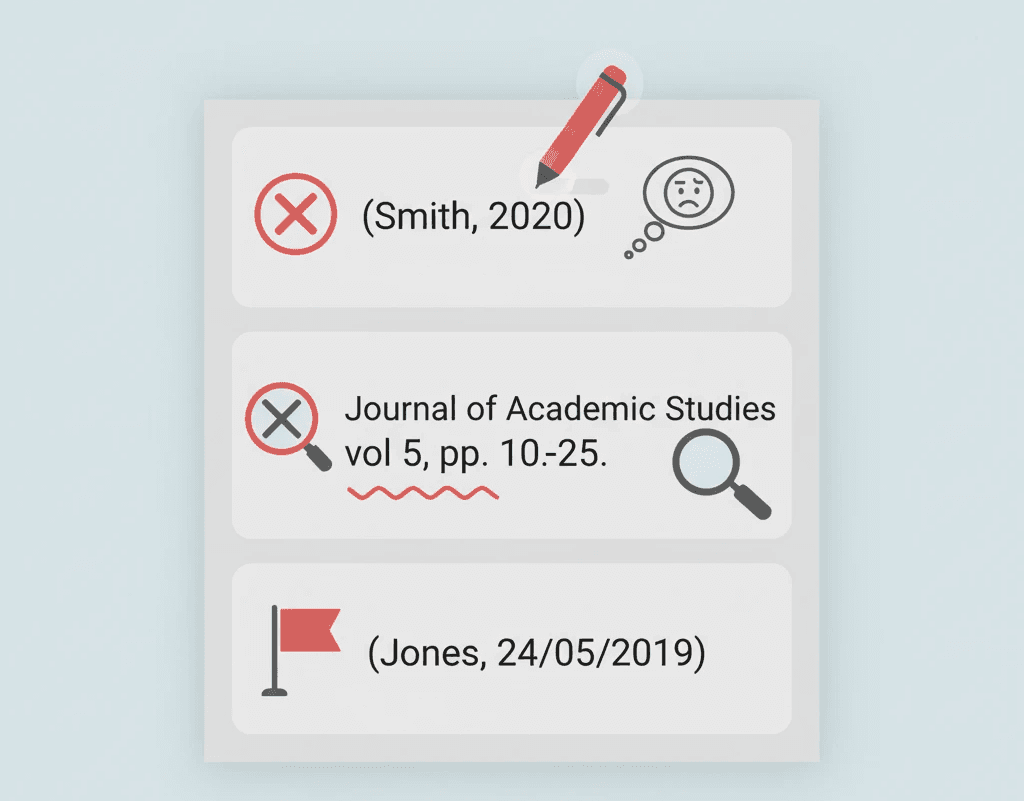
꼼꼼하게 글을 쓰는 학생들도 간혹 실수를 하곤 합니다. 가장 대표적인 오기 사례와 예방법을 알려드립니다.
1. 여러 양식의 혼용
서로 다른 스타일이 뒤섞여 있으면 격이 떨어져 보입니다. 반드시 한 가지만 선택해 끝까지 사용하세요.
2. 페이지 누락
원글을 그대로 따올 때는 꼭 페이지 번호를 기록해야 합니다. 의역 시에는 간혹 생략하기도 하지만, 직접 인용에는 필수적입니다.
3. 필수 세부 사항 누락
모든 참고 항목은 저자, 날짜, 제목, 출판사 정보를 포함해야 합니다. 이 중 하나라도 빠지면 불완전한 출처가 됩니다.
4. 지나간 옛 규칙의 적용
최신 규정을 적용하고 있는지 확인하세요. 현재는 APA 7판 및 MLA 9판이 표준입니다. 잘못하여 예전 규정을 따르고 있지는 않은지 대조해 보세요.
5. 자동 생성기에만 과도하게 의존
자동 생성 기구들은 편리하지만 기호나 띄어쓰기 한 자씩 빼먹는 경우가 잦습니다. 끝마친 뒤 손수 검수하는 요령이 필요합니다.
<ProTip title="⚠️ 주의 사항:" description="자동 인용구 생성기에서 복사해 붙여넣을 때는 각별히 유의하세요. 쉼표 한 개, 대소문자, 이탤릭체가 올바르게 적용되었는지 꼼꼼히 훑어야 합니다." />
제출 전 최종 자가 진단 리스트
과제를 교수님께 제출하기 전, 아래 체크리스트를 한 줄 한 줄 점검해 보세요.
추천 도구 및 리소스
✔ 모든 본문 내 인용구가 마지막 참고문헌 리스트의 내용과 완벽히 상응하는가
✔ 서식 스타일이 처음부터 끝까지 통일되었는가
✔ 직접 가져다 쓴 문장이나 타인의 핵심 구상은 예외 없이 다 적절히 기재되었는가
✔ 수록된 페이지 숫자가 빠짐없이 기입되었는가
✔ 책·정기간행물 등의 타이틀 표기 및 문장 부호가 약속된 규칙을 지켰는가
✔ 인터넷 참고 항목에 유효한 링크 주소나 식별용 DOI 값이 표기되었는가
✔ 각 스타일 정식 지침서의 가장 최신 버전을 참고해 마쳤는가
소프트웨어 도구들을 알맞게 쓰면 시간을 크게 줄이고 실수를 방지할 수 있습니다.
Purdue OWL: 전 세계적으로 애용되는 신뢰도 높은 학문의 장이자 규정 가이드라인.
Citation Machine: 유수 인용 포맷 작성을 민첩하게 도와주는 솔루션.
Zotero 및 Mendeley: 참고 정보를 가볍게 축적하고 빌드 파일 내 출처 서식 자동 작성을 해결해 줍니다.
Jenni AI: 인용 틀을 맞추고 흐름 틀을 잡는 번거로운 준비 시간을 대폭 절약하도록 도울 수 있습니다.
<ProTip title="🧠 마음에 새길 말:" description="아무리 뛰어난 소프트웨어를 빌렸더라도, 마감 직전 완성된 목록 결과물은 꼭 본인의 눈으로 오리지널 서적 가이드 원칙과 교차 대조해보아야 탈이 없습니다." />
글쓰기에 능숙한 스마트한 대학생 되기
올바른 인용 스타일을 정확하게 아는 행동은 지엽적인 교정을 준수하는 수동적인 작업 이상의 가치를 전합니다. 이는 선배 연구자들의 사유와 깊이에 담긴 정당한 권익에 경의를 보내는 표현이며 본인의 생각을 선명하고 투명하게 부각하는 전문가의 소양입니다.
<CTA title="완벽한 인용으로 논문의 품격을 높이세요" description="Jenni AI를 사용하면 몇 초 만에 APA, MLA, Chicago, Harvard, Vancouver 형식에 맞춰 인용을 완성하고 논문의 퀄리티를 한 단계 끌어올릴 수 있습니다." buttonLabel="Jenni 무료 체험 시작" link="https://app.jenni.ai/register" />
체계적이고 올바른 참고문헌 작성은 표절 방지를 너머, 여러분이 신뢰할 수 있는 학술 필자임을 보여주는 증거입니다.