{{HeadCode}} How to Build a Clear, Effective Literature Review Outline

によって

ネイサン・オユエン

How to Build a Clear, Effective Literature Review Outline

ネイサン・アウユンのプロフィール写真

ネイサン・オユエン

EYのシニアアカウンタント

会計学の学士号を取得し、会計の大学院ディプロマを修了しました

A literature review is tough. The hard part isn't the writing; it's the work that comes before. You're staring down a pile of books and articles, trying to figure out how they all connect, where the arguments fall short, and how to explain it clearly. It's a lot.

That's where an outline comes in. It's not just a list of topics. A good outline is your plan of attack. It forces you to sort your sources into a logical order, which keeps you from just describing each study one after another. Instead, it helps you build a real argument. This guide will walk you through creating that kind of outline, so you can start writing with confidence.

<CTA title="Start Your Literature Review with a Clear Outline"description="Create a structured outline that helps you organize sources and identify research gaps before you start writing." buttonLabel="Try Jenni Free" link="https://app.jenni.ai/register"/>

Understand What a Literature Review Outline Is

First, you need to be clear on what a literature review is for. It's not a simple summary.

A literature review isn't a bibliography. It doesn't just list studies in order, or give you a series of disconnected summaries. It also shouldn't just describe sources without judging them.

What it should do is bring different pieces of research together. It compares results, points out where experts disagree, shows how thinking in the field has changed, and finds the holes that still need filling. 

Ultimately, it explains where your own work fits into that bigger picture, an approach commonly emphasized in classic research writing guides.

Your outline is the plan for that entire process. It's the document you create before you start writing to figure out the structure. It helps you answer key questions: 

What belongs in the introduction versus the conclusion? How will you group your sources, by theme, by the methods used, or in chronological order? Where exactly will you put your critical analysis?

Consider the outline of the skeleton of your review. Get that structure right, and the writing will follow much more smoothly.

<ProTip title="🧠 Remember:"description="A literature review outline should organize ideas and debates rather than list studies one by one."/>

Clarify Your Topic, Scope, and Research Question

Start with a clear focus. If your topic is vague or your scope is too wide, your outline won't hold together. Before you plan anything else, nail down three things:

  1. Your main topic. Be specific. "Automation in urban hydroponics" is a good start.

  2. Your research question. What are you trying to find out or argue?

  3. Your scope. Set clear boundaries.

    • What time period are you covering? (e.g., studies from 2010 onward)

    • What types of sources will you include? (e.g., empirical studies, theoretical papers)

    • Are there specific variables or populations you're focusing on?

Here’s what that clarity looks like in practice:

"This review will look at research on automated nutrient delivery systems in urban hydroponic farming. It focuses on their efficiency, sustainability, and the practical challenges of putting them to use, using studies published from 2010 to the present."

This sentence does more than just define your work, it becomes the core of your introduction. Once you have this, you know exactly what your outline needs to support.

<ProTip title="📌 Tip:" description="If you can explain your topic scope in one clear sentence your outline is already on the right track."/>

Select and Evaluate Your Sources First

Don't try to build a detailed outline before you've actually read your sources. It won't work. You need to know what the literature says before you can organize it.

A good rule of thumb is to gather a solid base of material first. For a standard research paper, that might be 20 to 30 key sources. For a thesis or dissertation, you're likely looking at 40 to 60.

As you read, take notes in a structured way, following best practices outlined in writing a literature review guide for academic research. Don't just highlight; capture the essentials for each source:

  • What was the study trying to find out?

  • What methodology did it use?

  • What were the main results?

  • What were its strengths and major weaknesses?

  • How does it connect to or contradict other studies you've read?

A lot of people use tools for this, annotated bibliographies, a simple spreadsheet, or the note-taking features in a reference manager like Zotero or Mendeley. Right now, you're not writing paragraphs. 

You're hunting for patterns. Look for ideas that keep coming up, points where researchers clearly disagree, and questions that no one seems to have answered yet. These patterns will become the main sections of your outline.

<ProTip title="🗂️ Pro Tip:" description="Write notes that compare studies as you read to make outlining faster and more analytical later."/>

Choose the Right Organizational Structure

The structure you choose for your outline is the most critical part, particularly when aligning with expectations described in established evidence synthesis guidelines. There's no one-size-fits-all answer. 

The right structure depends entirely on what you're writing about and what you want to achieve, especially when deciding between approaches such as narrative, scoping, or systematic reviews as discussed in scoping review vs systematic review comparisons. 

Most reviews use one main approach, sometimes mixing in a secondary one.

Structure Type

How It Organizes Literature

Best Used When

Typical Disciplines

Main Strength

Thematic

Groups studies by key concepts or recurring ideas

The topic is broad and involves ongoing debates

Social sciences, education, health, technology

Highlights patterns and contradictions

Chronological

Orders studies by publication date

Tracking the evolution of ideas or policies

History, policy studies, emerging fields

Shows development over time

Methodological

Groups studies by research methods used

Methods strongly influence findings

Psychology, health sciences, education

Enables method comparison and critique

Theoretical

Organizes literature by theories or models

Field is driven by competing frameworks

Philosophy, sociology, theoretical research

Clarifies conceptual differences

1. Thematic (Most Common)
This is about grouping your sources by ideas, not by author. You organize studies around key concepts, recurring debates, or specific variables.

  • Use this when: Your topic is broad, or your field has clear, ongoing arguments.

  • Common in: Social sciences, education, health, technology.

  • Example themes: Studies on cost efficiency, papers discussing technical barriers, research on environmental benefits.

2. Chronological
Here, you arrange research in the order it was published. This structure shows how thinking on a topic has changed over time.

  • Use this when: You're looking at a new or fast-changing field, tracking the development of a policy, or providing a historical view.

  • What it shows: It highlights progress, major shifts in opinion, or turning points in the research.

3. Methodological
This structure groups studies based on how the research was done, the methods used.

  • Use this when: The research methods themselves are a central part of the discussion, or when the chosen methodology heavily influences the findings.

  • What it does: It lets you compare the strengths and weaknesses of different approaches.

  • Example groups: All the quantitative experiments in one section, the qualitative interview studies in another, and mixed-methods papers in a third.

4. Theoretical
You organize the literature around different schools of thought, models, or theoretical frameworks.

  • Use this when: Your field is built on competing theories, or your research is highly conceptual.

  • What it's for: It's useful for comparing and contrasting different theoretical lenses applied to the same problem.

<ProTip title="🔍 Note:" description="Most literature reviews use one main structure such as thematic and avoid mixing too many approaches."/>

Build the Core Literature Review Outline Structure

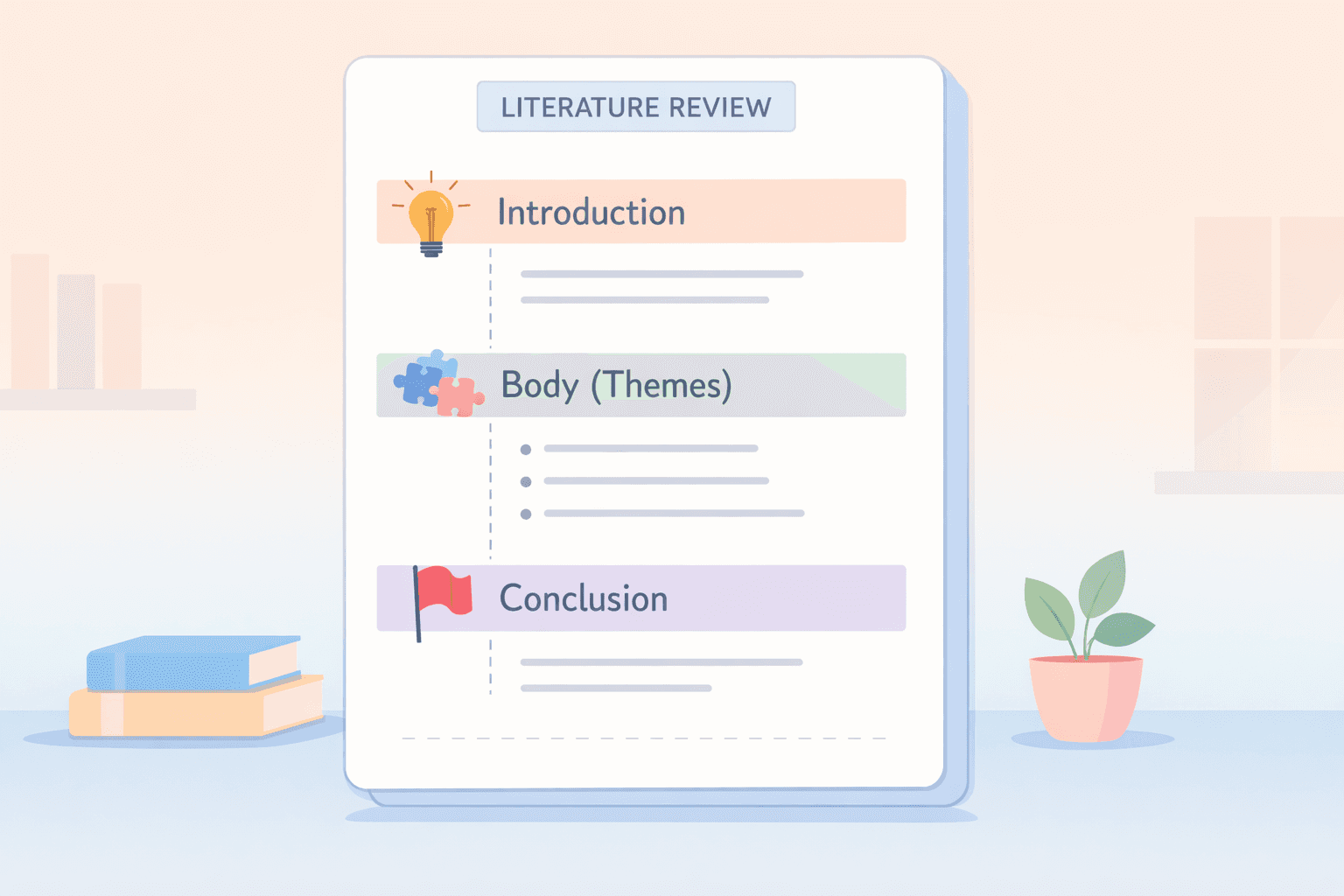
Now you need to build the actual outline. Most academic reviews follow a three-part structure.

I. Introduction (About 10-15% of the review)
Your outline for this section needs to cover a few key points. First, explain why your topic matters and give some background. Then, state your specific research question or objective. 

Be clear about your scope, what you're including and, just as importantly, what you're leaving out. Finally, give the reader a quick roadmap of how the rest of the review is organized.

Example outline for the introduction:
I. Introduction
A. The role of automation in addressing urban food security.
B. Main research question: How effective are current automated nutrient systems in urban hydroponics?
C. Scope: Peer-reviewed empirical studies from 2010-2024.
D. Brief overview of the review's thematic structure.

II. Body (About 70-80% of the review)
This is the core. Each main section here should represent one major category from the structure you chose, a theme, a time period, a method, or a theory. The goal in each section isn't to summarize one study after another. It's to synthesize. 

You're putting studies in conversation with each other, pointing out where they agree, where they clash, and what they collectively miss. Build in critique and direct comparison.

Example of a thematic body section in an outline:
II. Body
A. Theme: Efficiency and Yield Outcomes
1. Synthesis of findings on increased production rates.
2. Analysis of contradictory data on long-term efficiency.
3. Identified gap: Lack of standardized efficiency metrics across studies.

B. Theme: Implementation and Cost Barriers
1. Synthesis of common technical failure points.
2. Comparison of economic analyses from different regional contexts.
3. Critique of the short-term focus in most cost-benefit studies.

III. Conclusion (About 10-15% of the review)
Don't introduce new sources here. Your outline for the conclusion should recap the most important points that emerged from the body. 

State the major gaps or ongoing debates that your review uncovered. Explain what this all means for your own research project. Finally, suggest where future research should focus.

Example outline for the conclusion:
III. Conclusion
A. Summary of consensus on benefits and persistent technical challenges.
B. Primary research gap: Real-world, multi-year performance data.
C. How these findings inform the methodology of the current study.
D. Proposed directions for future research on system durability and cost reduction.

Write Notes That Emphasize Synthesis

A common mistake is to take notes that just describe each source in isolation, rather than using synthesis techniques commonly applied in a narrative literature review. Your outline will end up as a disconnected list.

Instead, write your outline notes to show the relationships between sources from the very beginning. Use language that connects ideas.

Instead of notes that say:

  • "Zhang (2020) examined system efficiency."

  • "Lee (2022) found a 15% yield increase."

Try writing notes like this:

  • "Multiple studies from 2020-2023 confirm a baseline efficiency improvement (Zhang, Lee, Patel)."

  • "However, these findings contrast with earlier skepticism from pre-2015 research (e.g., Miller, 2014)."

  • "While most research focuses on commercial setups, only two studies consider small-scale urban applications (Garcia, Ito)."

Writing this way forces you to synthesize as you plan. You're not just cataloging sources; you're already building the argument for each section of your review. 

When you go to write the full draft, your outline will already contain the critical connections you need to make.

<ProTip title="✍️ Writing Tip:" description="Using connecting language in your outline makes the final draft easier to write and revise."/>

Ensure Logical Flow and Coherence

Think of your outline as the blueprint for an argument, not just a list. It should have a logical flow from start to finish.

Ask yourself a few questions as you review your outline:

  • Does each main section lead naturally to the next? The conclusion of one idea should set up the introduction of the next.

  • Are you moving from general, established concepts toward more specific, debated, or novel points?

  • Can you see the implied transition between sections? The connection should be clear even at the outline stage.

Consistency in formatting is also key for clarity. Stick to a standard hierarchy:

  • Use Roman numerals (I, II, III) for your main sections (Introduction, Body, Conclusion).

  • Use letters (A, B, C) and then numbers (1, 2, 3) for your sub-points.

  • Keep your heading phrasing parallel. If one sub-section starts with a noun phrase ("Nutrient delivery efficiency"), the others in that section should too ("System reliability challenges," not "Discussing cost barriers").

Getting this flow and structure right in your outline means the actual writing process will be far less tangled. You'll spend less time figuring out what comes next and more time crafting clear sentences.

Use an Outline Template and Adapt It

Here is a straightforward template you can use as a starting point, similar to how researchers use tools like a literature review matrix template to organize and compare sources. It's designed to be adapted, not copied exactly.

I. Introduction
A. Context and significance of the topic.
B. The specific research question or central argument.
C. Definition of scope (timeframe, source types, key boundaries).
D. Brief description of the review's organization.

II. Body
A. First Major Theme or Category
1. Synthesis of relevant findings from multiple sources.
2. Critical discussion comparing and contrasting these studies.
3. Identification of limitations or unresolved questions within this theme.
B. Second Major Theme or Category
1. Synthesis of relevant findings.
2. Analysis of different methodological or theoretical approaches used.
3. Summary of the main points of contention or debate here.

III. Conclusion
A. Concise restatement of the most important conclusions from the body.
B. Clear statement of the primary research gap your review has identified.
C. Explanation of the implications for your own project and suggested directions for future research.

This template is a skeleton. You should rename the themes in Section II to fit your specific topics, and add or remove sub-points as needed. 

A short paper might have just two main themes; a dissertation chapter might have five or six. The goal is to provide a clear, logical container for your synthesis.

Common Mistakes to Avoid

Here are a few common pitfalls that can weaken your outline, and your final review.

  • Outlining before you've read. This is the biggest one. You can't organize ideas you haven't encountered yet.

  • Listing sources by author. Your outline should be built around concepts and arguments, not a roster of names. Group studies by what they say, not who wrote them.

  • Smoothing over disagreement. If studies contradict each other, that's important. Your outline needs a place for that debate; don't ignore it to create a false sense of consensus.

  • Letting the introduction balloon. The intro sets the stage, but the body is the main event. Keep your outline's introduction section focused and proportional.

  • Treating the outline as a chore. If you see it as just a bureaucratic step, it won't help you. A good outline is a thinking tool. It's where you work out your argument's logic.

Ultimately, a useful outline shows your critical analysis taking shape. It's a map of your thinking, not just a table of contents.

Writing a Strong Literature Review Starts with the Outline

Building your literature review outline first helps you tackle the hardest part of the process early on: figuring out how sources relate to one another. Instead of trying to organize ideas while drafting paragraphs, you begin with a clear structure that defines your main themes, comparisons, and research gaps.

<CTA title="Turn Your Outline into a Strong Literature Review" description="Use Jenni to expand your outline into clear analytical sections while keeping structure and flow intact." buttonLabel="Try Jenni Free" link="https://app.jenni.ai/register"/>

With this outline in place, writing becomes more focused and intentional. Each section has a clear purpose, reducing the risk of simple summaries or constant restructuring. A well-designed literature review outline lets you concentrate on analysis and coherence, making it far easier to produce a review that is critical, well-organized, and academically sound from start to finish.

目次

今日、あなたの最も素晴らしい作品に向けて進展を遂げましょう

今日、Jenniと一緒に最初の論文を書き、決して振り返ることはありません

無料で始めましょう

クレジットカードは不要です

いつでもキャンセルできます

5メートル以上

世界中の学術

5.2時間の節約

1件あたりの平均

1500万以上

ジェニに関する論文

今日、あなたの最も素晴らしい作品に向けて進展を遂げましょう

今日、Jenniと一緒に最初の論文を書き、決して振り返ることはありません

無料で始めましょう

クレジットカードは不要です

いつでもキャンセルできます

5メートル以上

世界中の学術

5.2時間の節約

1件あたりの平均

1500万以上

ジェニに関する論文

今日、あなたの最も素晴らしい作品に向けて進展を遂げましょう

今日、Jenniと一緒に最初の論文を書き、決して振り返ることはありません

無料で始めましょう

クレジットカードは不要です

いつでもキャンセルできます

5メートル以上

世界中の学術

5.2時間の節約

1件あたりの平均

1500万以上

ジェニに関する論文