Dwara
Nathan Auyeung
—
Scoping Review vs Systematic Review: Inme Asli Farak Kya Hai

Nathan Auyeung
Senior Accountant EY mein
Bachelor ka Accounting mein Graduation kiya, aur ek Postgraduate Diploma of Accounting bhi poora kiya
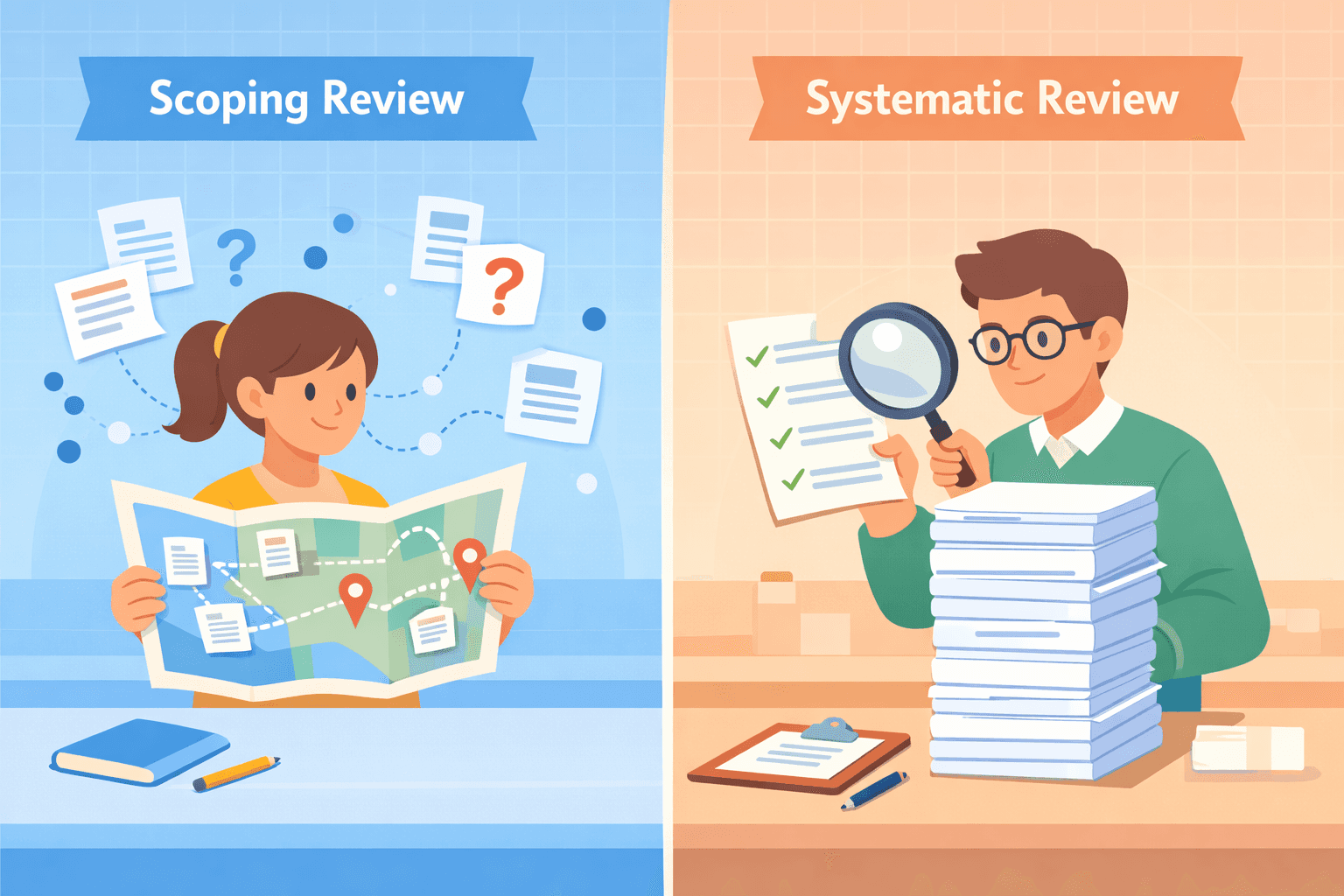
Har research project ek basic lekin crucial question se shuru hota hai: what do we already know? Ek literature review existing knowledge ko map karke, kya establish ho chuka hai, kis baat par debate hai, aur gaps kahan hain, iska jawab deta hai. Yeh aapko direction deta hai aur dubara naye sire se mehnat karne se bachata hai.
Aisa karne ke do aam tareeqe hain scoping reviews aur systematic reviews. Yeh aksar aapas me mix up ho jate hain kyunki inka workflow ek jaisa dikhta hai, lekin inka purpose bilkul alag hota hai. Galat tareeqa chunne se aapke mahino ki mehnat barbad ho sakti hai ya aapka paper reject ho sakta hai. Yeh guide practical differences par focus karti hai, har review asal me kis liye hai, yeh aapke workload ko kaise shape karte hain, aur aap apne research goal ke mutabiq sahi review kaise chunein. Ek broader context ke liye, hamara guide to the different types of literature reviews dekhein.
<CTA title="Choose the Right Review Method Faster"description="Clarify your research goal and decide whether a scoping or systematic review fits before you commit months of work." buttonLabel="Try Jenni Free"link="https://app.jenni.ai/register"/>
Scoping Review Kya Hai?
Chaliye scoping review ke baare me baat karte hain. Ise ek final verdict ke taur par nahi, balki ek surveyor ke map ki tarah samjhein. Iska kaam us area ko chart karna hai.
Ek scoping review tab aapka best choice hota hai jab aapka topic broad, confusing, ya bilkul naya ho. Aap ise yeh pata lagane ke liye use karte hain ki pehle se kya research exist karti hai, isme kaun kaam kar raha hai, aur is par study karne ke alag tareeqe kya hain. Yeh exploration ke bare me hai, conclusion ke bare me nahi.
Evidence synthesis guidance ke mutabiq, scoping reviews kisi topic par literature ki wide range ko map karte hain taaki concepts, gaps, aur evidence ke types ko identify kiya ja sake, bajay ek systematic review ki tarah definitive conclusions dene ke, jo aapko yeh decide karne me help karta hai ki kya aur zyada focused synthesis ki zaroorat hai.
Aap ise kuch khaas situations me use karenge. Shayad woh field bilkul nayi aur chaotic ho, jisme koi agreed-upon definitions na hon.
Shayad research alag-alag academic disciplines me spread ho, aur har koi apna tareeqa use kar raha ho. Central question yeh nahi hai ki "kya yeh kaam karta hai?" balki yeh hai ki "aakhir yeh kya hai?"
Toh, jo questions yeh tackle karta hai woh naturally broad hote hain:
Ek specific problem ke liye researchers ne kaunse alag-alag approaches try kiye hain?
Alag-alag fields ek hi core idea ko kaise define karte hain?
Is phenomenon ko study karne ke liye log aakhir kaunse methods use kar rahe hain?
Strategy poori tarah se coverage ke baare me hai. Aap jitna ho sake utne literature ko capture karne ke liye ek bada net phenkte hain, jisme breadth par focus hota hai, main ideas, studies ke types, aur involved groups ko identify kiya jata hai, na ki kisi ek piece me deep dive kiya jaye.
Ek key point yeh hai ki aap aam taur par un studies ki quality ko grade nahi karte jo aapko milti hain. Aap sirf wahi catalog kar rahe hain jo shelf par hai, yeh test nahi kar rahe ki har item kitna mazboot hai. Iska final output us landscape ka map hota hai, uski boundaries aur khali spaces ke sath.
<ProTip title="🧭 Pro Tip:" description="If your topic feels vague or fragmented across fields start with a scoping review before narrowing your focus." />
Systematic Review Kya Hai?
Ab chaliye systematic review par nazar dalte hain. Agar scoping review ek map banta hai, toh systematic review ek engineer ki report hai jo aapko batati hai ki building kahan aur kaise banani hai.
Iska purpose definitive aur practical hota hai. Yeh har ek relevant evidence ko gather karke, uski quality judge karke, aur sabko ek clear answer me combine karke ek single, tightly focused question ka answer dene ke liye hota hai. Yeh woh tool hai jise aap tab use karte hain jab aapko koi decision lena ho.
Systematic reviews evidence ko identify, appraise aur synthesize karne ke liye structured procedures follow karte hain aur inki reporting standardized frameworks jaise ki Preferred Reporting Items for Systematic Reviews and Meta-Analyses (PRISMA) statement ke mutabiq ki jati hai, jo transparency aur reproducibility ensure karne me help karta hai.
Aap clinical practice guidelines ka backbone systematic reviews ko bante hue dekhenge, jo nayi health policies ko support karte hain ya established fields me chal rahi debates ko settle karte hain. Iska question precise hota hai, jo aksar PICO (Patient/Problem, Intervention, Comparison, Outcome) jaise structure par framed hota hai.
Typical questions direct hote hain:
Kya yeh specific drug is condition wale patients ka survival rate behtar karta hai?
Kya teenagers me anxiety ke treatment ke liye cognitive behavioral therapy medication se zyada effective hai?
Iska process rigor aur judgment se defined hota hai. Sirf studies dhoondh lena hi kafi nahi hota. Har study jo final synthesis me jati hai, uska critically appraisal kiya jata hai, uske methods ko scrutinize kiya jata hai, usme bias ka potential evaluate kiya jata hai, aur uski internal validity assess ki jati hai.
Kabhi-kabhi, agar data allow kare, toh review ek step aage badhkar meta-analysis karta hai, jisme kai studies ke results ko statistically combine karke ek single, zyada powerful finding banayi jati hai.
Is poori mehnat ka aim sirf ek cheez hai: ek reliable, evidence-based conclusion produce karna jo direct bataye ki hume kya karna chahiye, chahe clinic me ho, laboratory me ho, ya kisi legislative session me.
<ProTip title="📌 Reminder:" description="Only choose a systematic review when your research question and outcomes are clearly defined from the start." />
Core Purpose: Exploration vs Evaluation
Core difference intention par aakar rukta hai. Kya aap kisi naye border ko explore kar rahe hain, ya aap bani banayi zameen par building bana rahe hain?
Ek scoping review aapka exploration ka tool hai. Ise tab use kiya jata hai jab territory unfamiliar ho.
Iska goal cheezon ka scope lagana hota hai, literature ke volume aur nature ko samajhna, yeh dekhna ki research ko kaise approach kiya gaya hai, aur yeh pata lagana ki evidence ke ghane clusters kahan hain aur bilkul khali gaps kahan hain.
Yeh sawal puchne ke bare me hai, “Yahan kya hai?” Iske contrast me, systematic review evaluation ke liye hai. Iska goal ek specific, actionable answer tak pahunchana hai.
Yeh ek defined hypothesis ko test karta hai, kisi intervention ki effectiveness ko measure karta hai, ya kisi association ki strength ko examine karta hai. Iska end result direct ek recommendation ya decision ko support karne ke liye hota hai.
Yeh choice aapke apne aim se aati hai. Kisi broad ya messy topic ke contours ko clarify karne ke liye, aap scoping review se shuru karte hain. Kisi precise question ka definitive answer paane ke liye, aap systematic review conduct karte hain.
Aspect | Scoping Review | Systematic Review |
Primary purpose | Existing literature ko explore aur map karna | Ek focused, predefined research question ka answer dena |
Typical research question | Broad, open-ended, exploratory | Narrow, specific, aur structured |
Stage of research | Early ya exploratory phase | Later stage, decision-oriented |
Flexibility during review | High; scope change ho sakta hai | Low; protocol advance me fixed hota hai |
Outcome | Concepts, evidence types, aur gaps ka overview | Evidence-based conclusion ya recommendation |
Research Questions: Broad vs Narrow
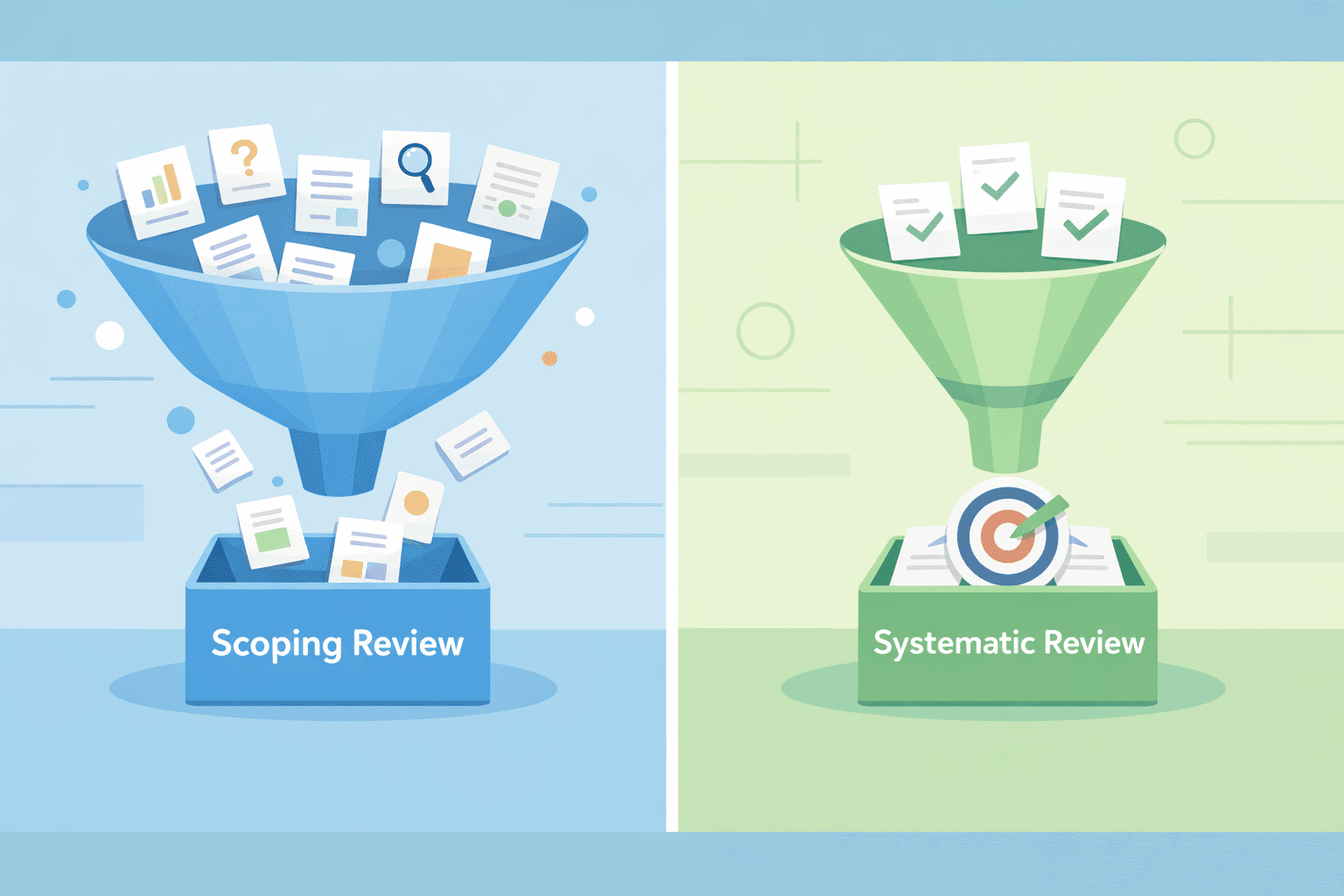
Jo questions aap puchte hain wahi poore project ka course decide karte hain. Woh sirf ek starting point nahi hain; woh methodology ko dictate karte hain.
Ek scoping review ke liye, question inherently broad aur open hota hai. Yeh ek starting probe hota hai, jaise "Is phenomenon par kis tarah ki research exist karti hai?" Is tarah ka question design ke hisab se flexible hota hai.
Jaise-jaise aap literature me dive karte hain, topic par aapki understanding deep hoti hai, aur aapke review ki boundaries shift ho sakti hain taaki jo aapko mila hai use adjust kiya ja sake. Yeh process iterative aur exploratory hota.
Systematic review ke liye, question ek anchor hota hai. Ise search shuru hone se pehle narrowly define, meticulously structure (aksar PICO jaise framework ka use karke) aur lock karna zaroori hai.
Yeh rigidity koi limitation nahi hai, balki review ki credibility ka foundation hai. Ek fixed, precise question reviewer ke bias ko kam karta hai aur poore process ko reproducible banata hai, jo tab non-negotiable hota hai jab results clinical practice ya policy ko guide karne ke liye banaye ja rahe hon.
<ProTip title="🧠 Remember:"description="If your research question keeps changing that is a sign a scoping review is more appropriate." />
Methodological Rigor aur Flexibility
Dono review ka process structured hai, lekin rules alag hain. Ek me adjustment ki gunjaish hoti hai, jabki doosra strict protocol par bana hota hai.
Scoping reviews comprehensive view ko prioritize karte hain. Search strategy broad hoti hai, jiska aim jitna ho sake utna literature capture karne ka hota hai, jisme non-traditional sources jaise reports ya theses bhi shaamil hain.
Studies ke liye inclusion criteria zyada flexible ho sakta hai, aur kabhi-kabhi jaise-jaise reviewer ko field ki behtar samajh milti hai, yeh change bhi hota hai. Analysis primarily descriptive hota hai, jo yeh chart karta hai ki kya exist karta hai aur use kaise categorize kiya gaya hai.
Systematic reviews apni rigidity se define hote hain. Search exhaustive hoti hai lekin pre-defined question par tightly focused hoti hai. Kisi study ko include ya exclude karne ke criteria search shru hone se pehle hi fixed hote hain aur non-negotiable hote aur hain.
Har included study ka formal quality appraisal hota hai. Poora plan aam taur par ek public protocol me pre-registered hota hai. Data extraction highly structured hota hai, sab kuch ek aise synthesis ko support karne ke liye jo definitive conclusion tak pahunchata hai.
Systematic review me rigor ka yeh higher level mandatory hai. Iske findings decisions ko directly influence karne ke liye hote hain, isliye methods me ambiguity ya bias ke liye koi jagah nahi honi chahiye.
Quality Appraisal: Optional vs Essential
Evidence ki quality ko judge karne ka approach ek bada dividing line hai. Yeh fundamentally change kar deta hai ki review aapko kya bata sakta hai.
Scoping review ke liye, formal quality assessment aam taur par nahi kiya jata. Studies ko isliye include kiya jata hai taaki dikhaya ja sake ki kya publish ho chuka hai, na ki unki credibility ki guarantee dene ke liye.
Ek methodologically weak study bhi kisi concept ke discussion ko illustrate karne ke liye useful ho sakti hai. Review ka aim literature ka ek representative sample dikhana hota hai, flaws ke sath.
Systematic review ke liye, quality appraisal sirf ek step nahi hai, balki synthesis ka core hai. Risk of bias ko assess karne ke tools har included study par apply kiye jate hain.
Serious methodological flaws wali studies ke findings ko final analysis se exclude kiya ja sakta hai ya unhe clearly unreliable flag kiya ja sakta hai. Aksar, overall strength of evidence ko formally grade kiya jata hai (jaise, high, moderate, low certainty).
Yeh rigorous vetting process ek bada reason hai kyunki systematic reviews zyada time, specialized skills, aur resources demand karte hain. Aap sirf answers collect nahi kar rahe; aap ek case build kar rahe hain.
<ProTip title="🔍 Pro Tip:" description="Do not add quality appraisal to a scoping review unless your journal explicitly requires it." />
Data Synthesis: Mapping vs Answering

Final synthesis woh jagah hai jahan har review ka purpose bilkul clear ho jata hai. Scoping review me, synthesis organization aur description ke bare me hai. Aap literature ko ek coherent picture me sort kar rahe hote hain.
Output aksar tables ya charts ke roop me hota hai jo studies ke types, studied populations, ya used methods ko categorize karte hain, jo aam taur par ek literature review matrix template ke sath organize hote hain.
Aap ek visual map create kar sakte hain jo dikhata hai ki research kahan concentrated hai aur kahan absent hai. Result ek structured overview hota hai jo patterns, themes, aur sabse important, evidence me gaps ko identify karta hai.
Systematic review me, synthesis analysis aur interpretation ke bare me hai. Aap sirf studies ko arrange nahi kar rahe; aap unke combined findings ko interrogate kar rahe hain.
Isme studies ke results ka qualitative comparison shaamil ho sakta hai, ya, jab data allow kare, ek quantitative meta-analysis jo results ko statistically pool karke ek single, zyada precise estimate deta hai.
Analysts aksar subgroup analyses ya sensitivity tests karte hain yeh dekhne ke liye ki findings kitni robust hain. Goal data points ke collection se ek supported conclusion tak pahunchana hota hai.
Time aur Resource Considerations
Time aur effort ka commitment bilkul alag hai, aur yeh planning me ek bada factor hai. Ek scoping review aam taur par ek choti team ya tight timeline ke liye zyada feasible project hota hai. Ise complete hone me kuch mahine lag sakte hain.
Halan ki isme systematic search ki zaroorat hoti hai, lekin yeh sabse labor-intensive steps jaise formal critical appraisal aur complex statistical synthesis se bachta hai.
Systematic review ek bada undertaking hai. Protocol se lekar publication tak ek saal ya usse zyada lagna aam baat hai.
Isme aam taur par diverse expertise wali team, subject matter experts, search ke liye ek dedicated librarian, aur appraisal aur analysis ke liye ek methodologist ki zaroorat hoti hai, sath hi systematic review ke liye careful reference management ki zaroorat hoti hai—khaaskar jab Zotero aur Mendeley se libraries import ki ja rahi hon.
Kaam ki depth is timeline ko justify karti hai; aap kuch aisa build kar rahe hain jo intense scrutiny ko withstand kar sake aur real-world decisions ko guide kar sake.
Graduate student ke thesis ya kisi naye field par initial look ke liye, scoping review aksar ek pragmatic choice hota hai. Clinical guideline ya policy white paper banane ke liye, systematic review ki badi demands ek zaroori investment hain.
<ProTip title="⏱️ Planning Tip:" description="Match your review type to your timeline and team size not just to what sounds more rigorous." />
Reporting Standards aur Frameworks
Dono reviews established frameworks ke under chalte hain, lekin unke rules alag hote hain. Sahi framework ko follow karna sirf ek achhi practice nahi hai, balki aksar publish hone ke liye ek pre-requisite hota hai.
Scoping review ke liye, aap aam taur par ek specific plan follow karte hain. Sabse common plan Arksey aur O'Malley naam ke researchers ne banaya tha, aur ise dusre researchers jaise Levac ne update kiya hai.
Jab aap apna review likhte hain, toh ek checklist hoti hai jo yeh confirm karne me help karti hai ki aapne sab kuch clearly report kiya hai. Us checklist ko PRISMA Extension for Scoping Reviews, ya short me PRISMA-ScR kaha jata hai.
Systematic review ke liye, results likhne ke liye ek widely-used checklist hoti hai jise PRISMA statement kaha jata hai. Yeh ensure karta hai ki aapne saari important details report ki hain.
Yeh ensure karne ke liye ki review rigorous tarike se kiya gaya hai, kai researchers Cochrane Collaboration ya Joanna Briggs Institute jaise groups ke detailed handbooks follow karte hain.
Sath hi, studies search karna shuru karne se pehle, yeh ek bahut achha idea hai, aur aksar required hota hai, ki aap apna poora review plan PROSPERO naam ke registry me publicly post karein. Yeh aapke methods ko pehle hi lock kar deta hai, jo bias ko prevent karne me help karta hai.
Sahi framework ko follow karna aapko review karne ke liye ek step-by-step plan deta hai. Yeh yeh bhi ensure karta hai ki aapki final report clear aur complete ho, taaki koi aur aapke exact steps ko follow karke aapke kaam ko check ya repeat kar sake.
Jab Scoping Reviews Pehle Aate Hain
In dono reviews ko rivals ke roop me nahi, balki ek research pipeline ke phases ke roop me dekhna behtar hai. Kai cases me, scoping review pehle aata hai.
Systematic review ke massive undertaking me commit karne se pehle, ek team scoping review conduct kar sakti hai. Iska exploratory nature un practical questions ka answer dene ke liye perfect hai jo definitive question se pehle aate hain.
Kya bahar itni primary research hai bhi jo ek full systematic review ko justify kare? Dusre researchers ne key concepts ko kaise define kiya hai ya outcomes ko kaise measure kiya hai? Broader landscape kaisa dikhta hai?
Kuch early-stage projects me, researchers structured scoping approach ki taraf badhne se pehle conceptual understanding develop karne ke liye ek narrative literature review se bhi shuru kar sakte hain.
Scoping review map aur glossary provide karta hai. Yeh terminology ko clarify karta hai, measure karne ke liye sabse relevant outcomes ko identify karta hai, aur ek broad interest ko ek narrow, answerable question me refine karne me help karta hai.
Is groundwork ke tayaar hone ke bad, ek subsequent systematic review ko bahut zyada precision aur confidence ke sath design kiya ja sakta hai.
Yeh stepwise approach naye fields of study me ya un areas me khaaskar valuable hai jahan research alag-alag academic disciplines me scattered hai, jahan evidence ke basic contours abhi clear nahi hain.
Common Misconceptions
Kuch persistent myths ko door karna zaroori hai.
Pehla myth yeh hai ki scoping review systematic review ka sirf ek "quick aur dirty" version hai. Yeh bilkul sach nahi hai.
Ek proper scoping review conduct karne ke liye iski apni rigor ki zaroorat hoti hai: meticulous planning, ek systematic aur documented search process, aur findings ka ek thoughtful, transparent synthesis.
Difference care ke level me nahi hai, balki pooche ja rahe question ke type me hai. Yeh ek alag kaam ke liye ek alag tool hai, koi chota ya kamtar tool nahi.
Doosra myth yeh assumption hai ki har situation ke liye systematic review automatic ek "gold standard" hota hai.
Yeh backfire kar sakta hai. Ek aise field me systematic review shuru karna jo abhi abhi emerge ho raha hai, jahan definitions fuzzy hain aur methods har jagah scattered hain, aksar ek galti hoti hai.
Aapke hath ek empty search lag sakti hai, ya aap alag-alag cheezon ko is tarah combine kar sakte hain jisse ek meaningless ya misleading conclusion nikle. Kabhi-kabhi, systematic review galat pehla step hota hai.
Sahi Review Type Chunna: Ek Practical Checklist
Yeh decide karne ke liye ki aapko kaunse review ki zaroorat hai, in practical questions par kaam karein, ideally apna approach ek clear how to write literature review outline ke sath sketch karne ke baad:
Primary goal kya hai? Ek bade area ko explore aur map karna, ya kisi specific question ka definitive answer paana?
Field ki state kya hai? Kya yeh naya, messy aur disciplines me spread hai, ya yeh established methods ke sath mature ho chuka hai?
Kya evidence ki quality ko judge karna zaroori hai? Kya aapko findings ki strength ko grade karne ki zaroorat hai, ya jo bahar hai uski range ko describe karna hi kafi hai?
Aapke outcomes kitne clear hain? Kya aap jaante hain ki aap exactly kya measure kar rahe hain, ya aap abhi bhi use figure out kar rahe hain?
Aapke practical constraints kya hain? Apne timeline, team size, aur available methodological expertise par evaluate karein.
Agar aapke answers exploration, concepts ko clarify karne aur gaps identify karne ki taraf point karte hain, toh scoping review aapka rasta hai.
Agar woh ek precise, pre-defined question, quality appraisal ki zaroorat, aur ek aise conclusion ki taraf point karte hain jo decision ko support kare, toh aap ek systematic review ko dekh rahe hain.
Ek baar jab aap apna approach chun lete hain, toh ek AI literature review & RRL generator ka use karna early drafting ko streamline karne me help kar sakta hai jabki sources aur citations organize rehte hain.
Scoping aur Systematic Reviews Ke Beech Decide Karna
Scoping reviews aur systematic reviews tabhi sabse effective hote hain jab unhe sahi purpose ke liye use kiya jaye. Ek scoping review aapko landscape, kya study kiya gaya hai, concepts ko kaise use kiya gaya hai, aur gaps kahan hain, yeh samajhne me help karta hai. Yeh tab ideal hota hai jab koi topic broad, emerging, ya poorly defined ho. Iske contrast me, systematic review evidence ko evaluate karne, focused questions ko test karne, aur practice ya policy ke mutabiq decisions ko support karne ke liye bana hota hai.
<CTA title="Turn Your Review Choice Into a Clear Research Plan" description="Use Jenni to refine your research question outline your review and stay aligned with publication standards." buttonLabel="Try Jenni Free"link="https://app.jenni.ai/register" />
Is difference ko samajhna aage ki har cheez ko shape karta hai: jo sawal aap puchte hain, jo time aur resources required hote hain, aur jo conclusions aap draw kar sakte hain. Shuruat se hi sahi review chunna aapki research ko focused, defensible, aur aligned rakhta hai jo aapko aakhir me dhoondhna hai.