Dwara
Nathan Auyeung
—
Rationale vs Significance of the Study: Key Differences Explained

Nathan Auyeung
Senior Accountant EY mein
Bachelor ka Accounting mein Graduation kiya, aur ek Postgraduate Diploma of Accounting bhi poora kiya

Ye dono sections aksar isliye confuse ho jaate hain kyunki ye un sawalon ke jawab dete hain jo bilkul ek jaise sunne mein lagte hain. Is study ki kya ahemeyat hai? Kisi ko iski parwah kyun karni chahiye? Agar is tarah se dekhein toh ye dono ek hi sawal hain. Lekin agar bariki se dekhein, toh ye bilkul alag hain.
The rationale piche dekhta hai, ki is field mein pehle kya kaam ho chuka hai, aur ye argument deta hai ki kya reh gaya hai. Significance aage dekhta hai, ki aapke results se kya sambhav ho payega, aur un logon ke naam batata hai jinko isse fayda hoga. Ek gap ke baare mein hai. Dusra uske asar (consequence) ke baare mein hai.
<CTA title="Make the Case Before You Make the Argument" description="Jenni helps you draft an introduction where every claim is tied to a source" buttonLabel="Try Jenni Free" link="https://app.jenni.ai/register" />
The Difference, Precisely
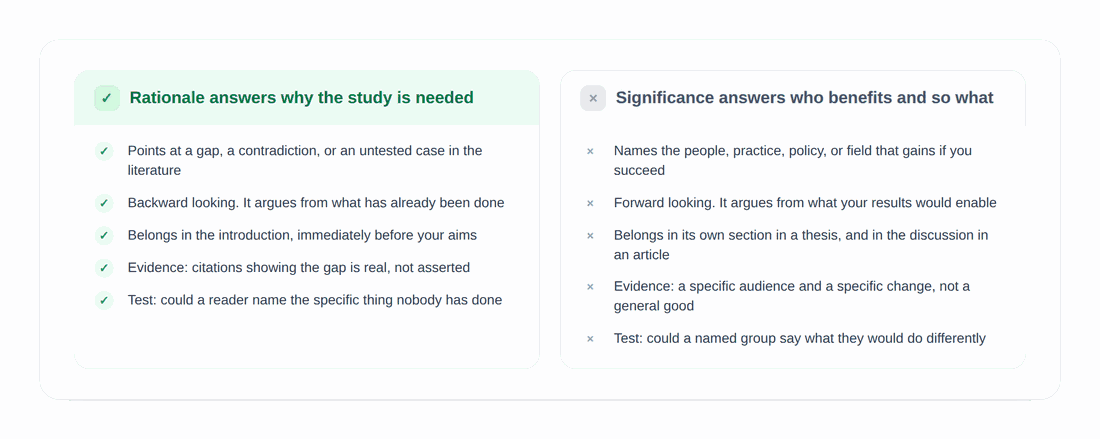
Rationale maujuda literature mein kisi gap, contradiction, ya kisi untested case ki taraf ishara karta hai. Ye piche dekhne wala (backward looking) hota hai, jo is baat par argument karta hai ki pehle se kya kiya ja chuka hai. Ye introduction mein aata hai, bilkul aapke aims se pehle, aur iska saboot wo citations hote hain jo ye dikhate hain ki gap real hai na ki sirf claim kiya gaya hai. Test ye hai: kya reader us specific cheez ka naam bata sakta hai jo abhi tak kisi ne nahi ki?
Significance un logon, practice, policy, ya field ke naam batata hai jise aapki kamyabi se fayda hoga. Ye aage dekhne wala (forward looking) hota hai, jo is baat par argument karta hai ki aapke results se kya sambhav hoga. Ek thesis mein aam taur par iska apna alag section hota hai; ek journal article mein ye discussion mein shamil ho jata hai. Iska saboot ek specific audience aur ek specific badlaav hota hai, na ki ahemeyat ki koi aam appeal. Test ye hai: kya koi named group ye keh sakta hai ki wo kya alag karenge?
Rationale wahi kaam kar raha hai jise Swales ne establishing a niche kaha tha, jo ki CARS model mein counter-claiming, indicating a gap in previous research, sawal uthane, ya kisi tradition ko aage badhane ke zariye kiya jata hai. Aapke aims phir us niche ko occupy karte hain. Significance bilkul ek alag move hai, jo ki us cheez ke zyada kareeb hai jo NIH reviewers se score karne ko kehta hai jab wo puchta hai ki kya koi project addresses an important problem or critical barrier to progress in the field, aur agar aims achieve ho gaye toh scientific knowledge, technical capability, ya clinical practice mein kaise sudhaar aayega.
The Same Study, Written Both Ways
Rural schools mein teacher retention ki ek study ka example lijiye.
Rationale. Teacher attrition par research zyadatar urban districts par concentrate rahi hai, jahan se national datasets ka bada hissa collect kiya jata hai. Rural retention ko examine karne wali teen studies sirf ek hi state tak limited hain aur 2020 ke hybrid instruction ke shift se pehle ki hain. Kisi bhi study ne abhi tak ye examine nahi kiya hai ki kya urban settings mein identify kiye gaye factors un districts mein bhi us tarah se kaam karte hain jo 2,000 se kam students ko serve karte hain.
Significance. Rural districts nationally lagbhag paanch mein se ek teacher ko employ karte hain aur sabse zyada vacancy rates report karte hain. Findings se district administrators ko retention spending ko target karne ka ek basis milega, aur state education agencies ko ye saboot milega ki kya urban-derived incentive schemes rural contexts ke liye appropriate hain.
Dhyan dijiye ki kaun si cheez kisko work karwati hai. Rationale batata hai ki kya exist karta hai aur kya nahi, itni specificity ke sath ki reader check kar sake. Significance actors ke naam batata hai aur ye ki wo kya alag karenge. Dono mein se koi bhi ye nahi kehta ki topic important hai, kyunki topic important hai kehna log tab likhte hain jab unke paas dono mein se kuch nahi hota.
<ProTip title="🪤 The tell:" description="If your significance section could be pasted into any thesis in your discipline with three words changed, it is not a significance section yet. Name a group and name the decision they would make differently" />
<ProTip title="🔗 Chain them:" description="Your rationale should make your aims feel inevitable. If a reader could finish the rationale and predict a different set of aims, the two are not connected tightly enough" />
Where Each One Goes
Yahan par bahut saara confusion shuru hota hai, kyunki answer is baat par depend karta hai ki aap kya likh rahe hain.
In a thesis | In a journal article | |
Rationale | Introduction ya background mein, jo problem statement par end hota hai | Introduction ka aakhri third part, bilkul aims se pehle |
Significance | Aksar chapter one mein iska apna numbered section hota hai | Koi heading nahi hoti. Discussion, implications, aur kabhi-kabhi ek dedicated significance statement mein dissolve ho jata hai |
Length | Rationale kuch paragraphs ka, significance aadhe page se ek page tak | Rationale do ya teen paragraphs ka, significance discussion mein ek paragraph |
Audience | Examiners jo ye check karte hain ki aapko apni field ki samajh hai ya nahi | Reviewers jo ye decide karte hain ki kya aapka contribution space ko justify karta hai |
Disappearing significance heading tab logon ko confuse karti hai jab wo ek thesis chapter ko article mein convert karte hain. Journals mein shayad hi kabhi 'Significance of the Study' naam ka section hota hai. Iska matlab ye nahi hai ki content ki zaroorat nahi hai; iska matlab hai ki ye move ho jata hai. Kuch journals aur aage badhkar ek chota standalone significance statement mangte hain jo general readership ke liye likha gaya ho, jise submission ke samay discover karne ke bajay author guidelines mein pehle hi check kar lena chahiye.
A Note on Regional Convention
Ye saaf taur par kehna zaroori hai, kyunki ye explain karta hai ki kyun kuch readers ne is section ko kabhi nahi dekha aur dusre iske bina kisi thesis ki kalpana nahi kar sakte. Ek dedicated Significance of the Study section kuch national traditions mein ek majboot convention hai aur dusron mein lagbhag absent hota hai.
Example ke liye, University of the Philippines Manila ka thesis manual chapter one ko background of the study, statement of the problem, objectives, significance of the study, aur scope and limitations ke roop mein prescribe karta hai, jisme alag se koi rationale section nahi hota. Kai UK aur North American programs ise invert kar dete hain, jahan introduction mein hi rationale ka tana-bana hota hai aur koi significance heading nahi hoti.
Practical instruction: kisi bhi generic advice ke upar apne institution ke manual ko follow karein, is page ke upar bhi. Agar aapka manual dono sections prescribe karta hai, toh dono likhein aur unka kaam alag-alag rakhein. Agar ye dono mein se koi prescribe nahi karta, toh bhi content ko introduction mein kahin na kahin hona chahiye.
<ProTip title="📘 Check the manual:" description="Read your own program thesis format manual before drafting chapter one. Section names and their order are usually prescribed, and rewriting a chapter to match them afterwards is entirely avoidable work" />
How to Write Each One
Rationale ke liye, teen steps mein kaam karein. Batayein ki kya established hai, ek ya do sentences mein citations ke sath. Batayein ki kya missing hai, specifically population, setting, method, ya period ka naam lekar jise kisi ne cover nahi kiya hai. Phir batayein ki wo absence is sawal ke liye kyun matter karti hai. Agar aapka gap sirf ye hai ki kisi ne aapke exact topic ko study nahi kiya hai, toh wo sirf ek description hai na ki rationale; aisi bahut si cheezein hain jo unstudied hain kyunki wo study karne ke layak nahi hain.
Significance ke liye, kam se kam do distinct beneficiaries ke naam batayein aur har ek ke baare mein concrete rahein. Practitioners jo kuch change karenge. Policymakers jinke paas wo saboot hoga jo unke paas abhi nahi hai. Researchers jinko ek measure, ek dataset, ya ek resolved contradiction milega. Phir state karein ki har ek ke liye kya badalta hai. "will contribute to the body of knowledge" jaise phrase se bachein, jo bahut saari theses mein dikhta hai aur iska koi matlab nahi hota.
<ProTip title="✍️ Two beneficiaries:" description="Write your significance section as a list of who benefits and how before you turn it into prose. If the list has one entry and it is other researchers, keep going" />
One Looks Back, One Looks Forward
Is baat ko pakad kar rakhein aur sections blur hona band ho jayenge. Rationale literature ke baare mein ek argument hai, jise citations se sabit kiya jata hai. Significance consequences ke baare mein ek argument hai, jise ye batakar sabit kiya jata hai ki kaun alag tarike se act karta hai. Ek reader ko aapka introduction khatam karte hi ye pata chal jana chahiye ki exactly kya nahi kiya gaya hai aur exactly kaun iske hone ka intezar kar raha hai.
<CTA title="Write an Introduction That Earns Its Aims" description="Draft the gap and the contribution with sources attached and claims checked" buttonLabel="Try Jenni Free" link="https://app.jenni.ai/register" />
Dono sections ek hi foundation par tike hain, jo ki a literature review hai jisne gap ko announce karne ke bajay actually demonstrate kiya hai. Document ke parts ko sahi order mein rakhna, aur ye sure karna ki har claim ek source par tika ho jo use carry kar sake, wahi cheez hai jo pehle sthan par in dono paragraphs ko likhne layak banati hai.