Dwara
Justin Wong
—
Oxford Referencing Style Overview: Footnotes, Bibliography & Citation Guide ka jaiza

Justin Wong
Vikas Prabhari
Graduated kiya Bachelor's me Global Business & Digital Arts, Minor me Entrepreneurship

Academic writing needs honesty, structure, and trust. Isko achieve karne ka ek tareeqa Oxford referencing style ka use karna hai. Yeh method writers ko dusron ke kaam ko credit dene me help karta hai aur unke khud ke text ko clean aur readable banaye rakhta hai.
Is guide me, aap seekhenge ki Oxford referencing kya hai, yeh kaise kaam karti hai, aur iska sahi tareeqe se use kaise kiya jaye. Hum footnotes, bibliographies, aur aam galtiyon ke baare me baat karenge. Aap Oxford style ka use karke books, articles, aur websites ko cite karne ke simple examples bhi dekhenge.
<CTA title="Master Academic Referencing Fast" description="Jenni AI ka use karke seconds me accurate Oxford citations generate karein, koi formatting headaches nahi, koi missed footnotes nahi." buttonLabel="Try Jenni Free" link="https://app.jenni.ai/register" />
Oxford Referencing Style Kya Hai?
Oxford referencing style (jise documentary-note system bhi kaha jata hai) footnotes aur bibliography ka use karta hai yeh dikhane ke liye ki information kaha se aayi hai. Yeh humanities, law, aur social sciences me kaafi popular hai.
Jab aap is style ka use karte hain, toh aap quoted ya paraphrased sentence ke theek baad apne text me chote superscript numbers lagate hain. Har number page ke bottom me ek footnote se match karta hai. Pehla footnote source ke baare me poori details deta hai. Baad me usi source ke references ko chota kiya ja sakta hai. Paper ke end me, aap ek bibliography include karte hain jo sabhi sources ko author ke last name ke hisab se alphabetically list karti hai.
Oxford style ki shuruat University of Oxford me hui thi, jahan clarity aur accuracy sabse zaroori thi. Harvard ya APA ke opposite, Oxford referencing aapke text ko lambe in-text brackets se free rakhta hai, jisse isse padhna asan ho jata hai.
<ProTip title="💡 Pro Tip:" description="Oxford referencing ka use karein jab aap chahte hain ki aapka paper clean aur padhne me asan dikhe." />
Oxford Style Kyun Important Hai
Achi referencing sirf rules follow karne se zyada hoti hai. Yeh dusre writers ke ideas ke liye honesty aur respect show karti hai. Oxford system aapko clear aur consistent rehne me help karta hai.
Yahan bataya gaya hai ki yeh kyun important hai:
Writing ko clean rakhta hai: Readers aapke ideas par focus karte hain, na ki lambe citations par.
Depth dikhata hai: Footnotes me helpful notes ya short comments include kiye ja sakte hain.
Trust banaye rakhta hai: Har idea ko uske source tak trace kiya ja sakta hai.
Learning ko support karta hai: Readers aur zyada details ke liye sources check kar sakte hain.
For example, ek history student kisi theory ko explain karne ke liye Oxford referencing ka use kar sakta hai, bina story ko interrupt kiye bottom me sources add karke.
Oxford Referencing System Ke Key Parts
1. Superscript Numbers
Jab bhi aap kuch cite karein, sentence ya quotation ke theek baad ek superscript number add karein. Yeh numbers aapke poore document me order me badhte jate hain.
Example:
Many scholars believe that education changes social mobility.¹
2. Footnotes
Footnotes page ke bottom me dikhte hain. Pehli baar jab aap kisi source ka mention karein, toh poori details dein. Agar aap ise baad me phir se use karte hain, toh ise short kar dein.
Example (pehla citation):
¹ Peter Burke, History and Social Theory, 3rd edn (Cambridge: Polity Press, 2019), p. 45.
Example (baad ka citation):
² Burke, History and Social Theory, p. 112.
<ProTip title="📘 Reminder:" description="Ek baar source cite karne ke baad, next time notes ko neat rakhne ke liye shortened version ka use karein." />
3. Bibliography
Apne essay ya report ke end me, sabhi sources ko alphabetically list karein.
Example:
Burke, Peter. History and Social Theory, 3rd edn. Cambridge: Polity Press, 2019.
Footnotes page numbers dete hain; bibliography page numbers nahi deti, jab tak ki aap koi edited volume list na kar rahe hon.
Formatting Rules Aur Variations
Different institutions ke thode alag rules ho sakte hain, lekin zyada tar in basics ko follow karte hain.
General Formatting
Element | Rule |
Font & Size | Times New Roman 12 pt ya similar use karein. |
Line Spacing | Double-space text, single-space footnotes. |
Footnote Numbers | Numbering ko continuous rakhein. |
Quotation Marks | Short quotes ke liye single (‘ ’); double (“ ”) sirf quotes ke andar. |
Block Quotes | Lambe quotes (40 + words) ko indent karein, quotation marks nahi. |
Page Numbers | Specific pages ko quote ya paraphrase karte waqt hamesha include karein. |
<ProTip title="✍️ Note:" description="Oxford style me, punctuation quotation marks ke andar jata hai, unke baad nahi." />
“Ibid.” Aur Short Titles
Agar aap previous note ke theek baad phir se wahi source cite karte hain, toh aap poora likhne ke bajaye Ibid. ka use kar sakte hain.
Example:
¹ John Tosh, The Pursuit of History, 6th edn (London: Routledge, 2015), p. 78.
² Ibid., p. 79.
Kuch teachers digital versions padhte waqt clarity ke liye “Ibid.” ke bajaye short titles ko prefer karte hain.
Different Source Types Co Kaise Cite Karein
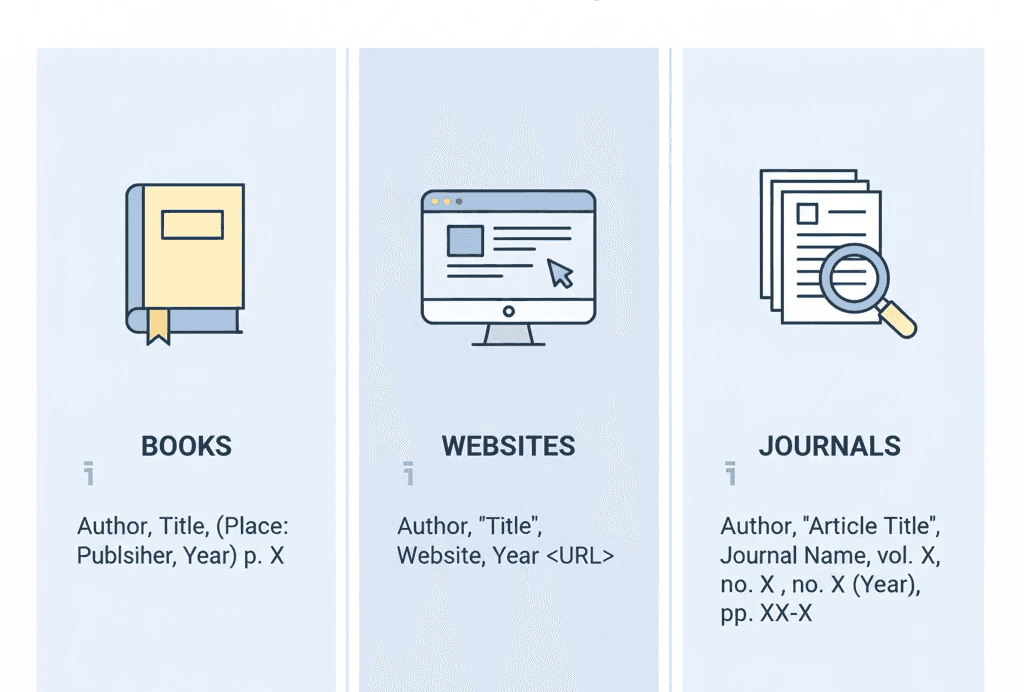
Har tarah ke source ka apna structure hota hai. Yahan sabse common examples diye gaye hain.
1. Books
Footnote:
¹ Eric Hobsbawm, The Age of Revolution: Europe 1789–1848 (London: Weidenfeld & Nicolson, 1962), p. 33.
Bibliography:
Hobsbawm, Eric. The Age of Revolution: Europe 1789–1848. London: Weidenfeld & Nicolson, 1962.
2. Edited Books
Footnote:
² Roger Scruton (ed.), The Oxford Companion to Philosophy (Oxford: Oxford University Press, 2005), p. 215.
Bibliography:
Scruton, Roger, ed. The Oxford Companion to Philosophy. Oxford: Oxford University Press, 2005.
3. Book Chapters
Footnote:
³ Mary Beard, ‘Roman Laughter and Power’, in Laughter and the Ancient World, ed. by J. Hall (Cambridge: Cambridge University Press, 2014), pp. 45–58 (p. 47).
Bibliography:
Beard, Mary. ‘Roman Laughter and Power’. In Laughter and the Ancient World, edited by J. Hall, 45–58. Cambridge: Cambridge University Press, 2014.
4. Journal Articles
Footnote:
⁴ Linda Woodbridge, ‘The Shadow of Hamlet’s Father’, Studies in English Literature, 48.2 (2008), pp. 265–290 (p. 270).
Bibliography:
Woodbridge, Linda. ‘The Shadow of Hamlet’s Father’. Studies in English Literature, 48 no. 2 (2008): 265–290.
<ProTip title="🗞️ Pro Tip:" description="Jab bhi aap journal article cite karein, hamesha volume aur issue number add karein." />
5. Websites
Footnote:
⁵ National Archives, ‘World War II Documents’, UK Government Archives, https://www.nationalarchives.gov.uk/ww2/ [accessed 25 October 2025].
Bibliography:
National Archives. ‘World War II Documents’. UK Government Archives. https://www.nationalarchives.gov.uk/ww2/ [accessed 25 October 2025].
6. Online Journals
Footnote:
⁶ Maria Lopez, ‘Digital Humanities and Archival Research’, Journal of Modern Studies [Online], 7 (2022), https://jms.edu/lopez2022.
Bibliography:
Lopez, Maria. ‘Digital Humanities and Archival Research’. Journal of Modern Studies [Online], 7 (2022). https://jms.edu/lopez2022.
7. Newspaper Articles
Footnote:
⁷ Jane Bennett, ‘Ethics in Contemporary Politics’, The Guardian, 15 July 2024, p. 12.
Bibliography:
Bennett, Jane. ‘Ethics in Contemporary Politics’. The Guardian, 15 July 2024.
Direct aur Indirect Quotations
Direct Quotes
Short quotes ke liye single quotation marks ka use karein. Lambe quotes ke liye, indented block ka use karein aur quotation marks hata dein.
Example:
As Foucault wrote, ‘power is everywhere, not because it embraces everything, but because it comes from everywhere’.⁸
Indirect Quotes
Agar aap kisi idea ko apne shabdon me bhi likhte hain, toh bhi aapko source cite karna hoga.
Example:
Scholars agree that social norms help shape power in daily life.⁹
<ProTip title="🧠 Pro Tip:" description="Plagiarism se bachne ke liye hamesha paraphrased ideas ko cite karein." />
Common Mistakes Jinse Bachna Hai
Yahan tak ki careful writers bhi citation mistakes kar sakte hain. Yeh sabse common mistakes hain.
1. Different Styles Ko Mix Karna
Ek hi paper me Oxford aur Harvard ya APA ke beech switch na karein. Koi ek choose karein aur usse har jagah use karein.
2. Page Numbers Missing Hona
Jab bhi aap kisi source se kisi specific point ka use ya discuss karein, hamesha page numbers add karein.
3. Galat Punctuation
Oxford referencing me citation ke parts ke beech commas aur end me full stop ka use hota hai.