Dwara
Justin Wong
—
Nibandho mein Transition Sentences ka maharat hasil karna: Smooth Writing Flow ke liye Tips

Justin Wong
Vikas Prabhari
Graduated kiya Bachelor's me Global Business & Digital Arts, Minor me Entrepreneurship
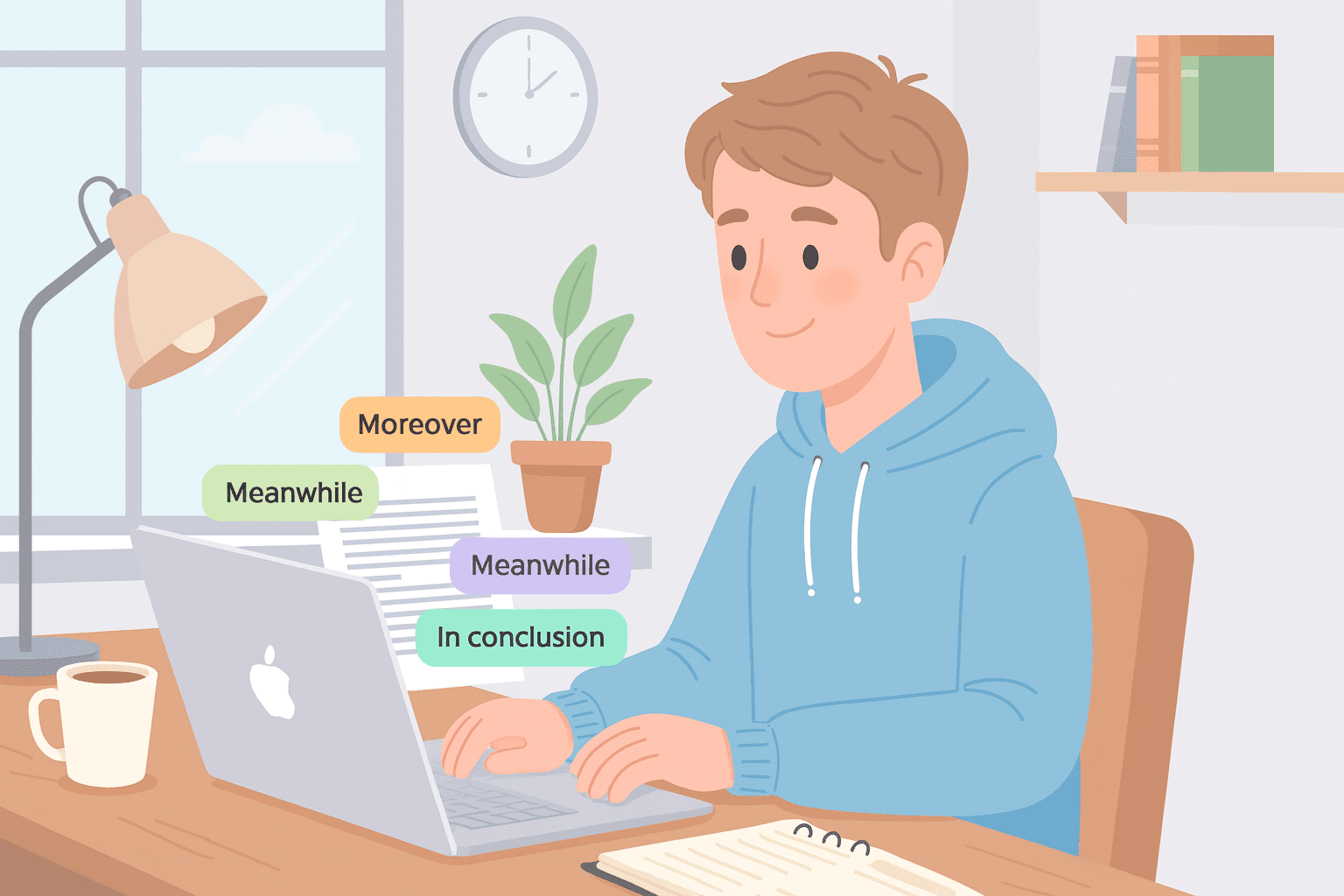
Lagbhag har student ne is dasha ka samna kiya hai, ek khaali page ko ghurte hue, yeh jaante hue ki kya kehna hai par yeh nahi ki use kaise kehna hai. Ideas toh sab hain, jo puzzle ke tukdon ki tarah idhar-udhar ghum rahe hain par ek sath thik se fit nahi ho rahe. Beshak, har paragraph apne aap mein solid ho sakta hai, par unhe ek flow mein lana? Wahin par sabse zyada log atak jaate hain.
Ache transitions sirf sundar shabd nahi hote. Yeh readers ko bina kisi rukawat ke ek idea se dusre idea par jaane mein madad karte hain, pichle paragraph ko aane wale paragraph se jodte hain. Yeh guide aapko dikhayegi ki effective transition sentences kaise likhe jayein. Isme aapko real examples, simple patterns, and practical tips milenge jineh aap turant use karna shuru kar sakte hain. Apne essays ko zyada clear aur asaan banana chahte hain? Padhte rahiye.
<CTA title="Build a Strong Problem Statement" description="Generate a precise, publication-ready statement in minutes, no stress, no fluff." buttonLabel="Try Jenni Free" link="https://app.jenni.ai/register" />
Transition Sentences Kyun Matter Karte Hain
Har writer chahta hai ki unka essay samajhne mein asaan ho. Transitions readers ko bhatakne nahi dete. Ho sakta hai ki aapko apne logic ka rasta pata ho, par aapke reader ko nahi pata hai. Ek acha transition sentence ek signboard ki tarah kaam karta hai, jo dikhata hai ki pichla paragraph aane wale paragraph se kaise juda hai.
Bina ache transitions ke, essays alag-alag points ki ek series jaise lagte hain. Yeh bina road signs ke driving karne jaisa hai, jo confusing aur frustrating hota hai. Transition sentences coherence ensure karte hain, jo readability ki backbone hai.

Yeh contrasts, causes, ya examples ko signal karke critical thinking ko bhi demonstrate karte hain. Yeh Gerald Graff jaise experts ki salah se match karta hai, jo writing mein clear logical connections ki importance ko highlight karte hain.
For example, 'however' ya 'consequently' jaise words ka use karna yeh dikhata hai ki aap samajhte hain ki ideas aapas mein kaise relate karte hain.
Yeh ideas ko link karke readers ko bhatakne se bachate hain.
Yeh paragraphs ke beech coherence ensure karte hain.
Yeh aapki analytical thinking ko dikhate hain.
<ProTip title="💡 Pro Tip:" description="Aek transition koi decoration nahi hai, balki is baat ka saboot hai ki aapne dhyan se socha hai ki aapke ideas aapas mein kaise connect hote hain." />
Step 1: Relationships Ko Samajhein
Is baare mein sochein, aap apne paragraphs ke beech kis tarah ka link chahte hain? Ek baar jab aap yeh jaan lete hain, toh transition sentences likhna bahut asaan aur thoda fun ban jata hai. Yeh step tab aur bhi asaan ho jata hai jab aapne apna structure pehle se plan kiya ho—dekhein how to organize academic essay for maximum impact.
Yahan common types of relationships ke examples diye gaye hain, showing relationship categories:
Addition / Continuation: jab agla paragraph pichle paragraph ko support ya extend karta hai.
For example, “Additionally, the results align with previous studies.”Contrast / Opposition: jab agla paragraph ek counterpoint pesh karta hai.
For instance, “Nevertheless, the data reveals several contradictions.”Cause and Effect: jab ek idea sidhe dusre idea ki taraf le jata hai.
Such as, “As a result, the project gained widespread attention.”Sequence / Order: jab essay step-by-step aage badhta hai.
For example, “First, we’ll examine the data. Then, we’ll evaluate implications.”Example / Illustration: jab aap claim ko clear karne ke liye evidence de rahe hon.
Like, “For instance, Japan’s policy offers a clear case study.”Emphasis: jab significance ko highlight karna ho.
For instance, “Indeed, this marks the turning point in the debate.”Concession: jab kisi limitation ya opposing view ko acknowledge karna ho.
Such as, “Although progress has been made, challenges remain.”Summary / Conclusion: jab wrap up karna ho.
For example, “In conclusion, the findings support a unified approach.”
<ProTip title="📝 Reminder:" description="Pahele relationship ko plain language mein likhein (jaise, yeh paragraph opposite dikhata hai) aur fir use polished transition ka roop dein." />
Step 2: Apni Transition Vocabulary Build Karein
Yahan ek aisi cheez hai jispar shayad aapne dhyan na diya ho: sahi words transitions mein bada difference create karte hain. Unhe dhyan se chunna aapke essay ko natural aur easy-to-follow banata hai.
✨ Addition
Related ideas ko add karte waqt ya kisi point ko expand karte waqt use karein: also, and, in addition, additionally, furthermore, moreover, coupled with, along with, equally important
⚖️ Contrast
Differences ya opposing views ko dikhane ke liye perfect hai: but, however, yet, nevertheless, in contrast, alternatively, although, whereas, on the other hand
🔗 Cause & Effect
Relationships ya results ko dikhane ke liye inka use karein: so, because, since, as a result, therefore, thus, accordingly, hence, due to, in order to
⏳ Sequence
Steps ya ideas ko order mein organize karein: first, next, then, after, following this, thereafter, meanwhile, before, finally, lastly
💬 Examples & Emphasis
Key points ko clarify ya underscore karte waqt inka use karein: for example, for instance, in fact, notably, especially, indeed, significantly, particularly
🎯 Conclusions
Apne points ko ache se wrap up karein: in conclusion, to summarize, overall, accordingly, in short, finally, to close, to end with
<ProTip title="🔑 Key Tip:" description="Khud ko sirf however aur therefore tak limit na karein. Vocabulary ko rotate karne se essays zyada engaging bante hain aur repetition se bacha ja sakta hai." />
Step 3: Placement Strategies
Aap apne transition sentence ko kahan place karte hain, yeh utna hi important hai jitna ki aapke chune hue words.
Paragraph ke start mein: Yeh ek clear shift ya continuation ka ishara deta hai.
“Having discussed the historical context, we now explore its economic effects.”Paragraph ke end mein: Yeh ek idea ko close karta hai aur sath hi agle idea ka hint deta hai.
“This reform reduced inequality. At the same time, enforcement costs rose, the next section explains how we controlled them.”Paragraph ke andar: Yeh lambe sections mein complex sentences ko jodta hai.
“The results were promising. Nevertheless, replication remains essential.”
Case study: Weak vs strong
Weak example: “The study was detailed. The next paragraph explains more.”
Stronger: “The study was detailed. Consequently, policymakers relied on its findings.”
<ProTip title="📍 Placement Tip:" description="Body paragraphs ke start mein transitions ka use karein taaki readers ko aapke main structure ke zariye guide kiya ja sake, fir naye shades ke liye internal transitions daalein." />
Step 4: “Known–New” Contract
Yahan ek simple trick hai: apne sentence ki shuruat aisi cheez se karein jo aapka reader pehle se jaanta ho. Fir, naya idea add karein. Is tarah, readers ke liye bina bhatke aage badhna asaan ho jata hai.
Weak: “Economic instability grew because new policies lacked proper implementation.”
Stronger: “The policies lacked proper implementation. As a result, local prices swung more from month to month.”
Pehle se known idea ko echo karke, aap apne readers ko aasani se naye territory mein jaane mein madad karte hain.
Step 5: Variety aur Clarity Ke Liye Revision
Drafts mein aksar repetitive ya unclear transitions dekhne ko milte hain. Revision aapko flow ko behtar banane ka mauka deta hai.
Transitions ko revise karne ki checklist:
Har transition sentence ko highlight karein.
Repeated words ko furthermore, moreover, ya likewise jaise synonyms se replace karein.
Ensure karein ki har transition apne logical role (contrast, addition, cause) se match kare.
Rhythm aur clarity test karne ke liye zoor se padhein.
Before: “The new law was strict. Also, it had supporters.”
After: “The new law was strict. Moreover, it earned strong support from industry leaders.”
<ProTip title="✍️ Editing Tip:" description="Agar multiple paragraphs ek hi transition se shuru hote hain, toh behtar rhythm ke liye unme se aadhe ko alternatives ke sath rewrite karein." />
Essay Types Ke Hisab Se Expanded Examples
Argumentative essay:
“The tax policy boosted short-term revenue. However, it threatens long-term sustainability.”
“Critics argue the reform hurts small businesses. In contrast, supporters believe it spurs innovation.”
Expository essay:
“The ecosystem involves plants and animals. Similarly, human activity forms part of the web.”
“Urban growth continues rapidly. At the same time, rural populations are shrinking.”
Narrative essay:
“The family moved often during his childhood. Consequently, he developed remarkable adaptability.”
“She hesitated at the doorway. Meanwhile, the crowd waited in silence.”
Research paper:
“Earlier studies show a link between diet and cognition. Likewise, exercise appears to improve memory.”
“The experiment failed to replicate. Nevertheless, its data remains valuable.”
Creative writing:
“The storm passed, leaving silence. Thereafter, the city began to rebuild.”
“The hero stumbled but rose again. In spite of exhaustion, he pressed forward.”
Common Mistakes Jinse Bachna Hai
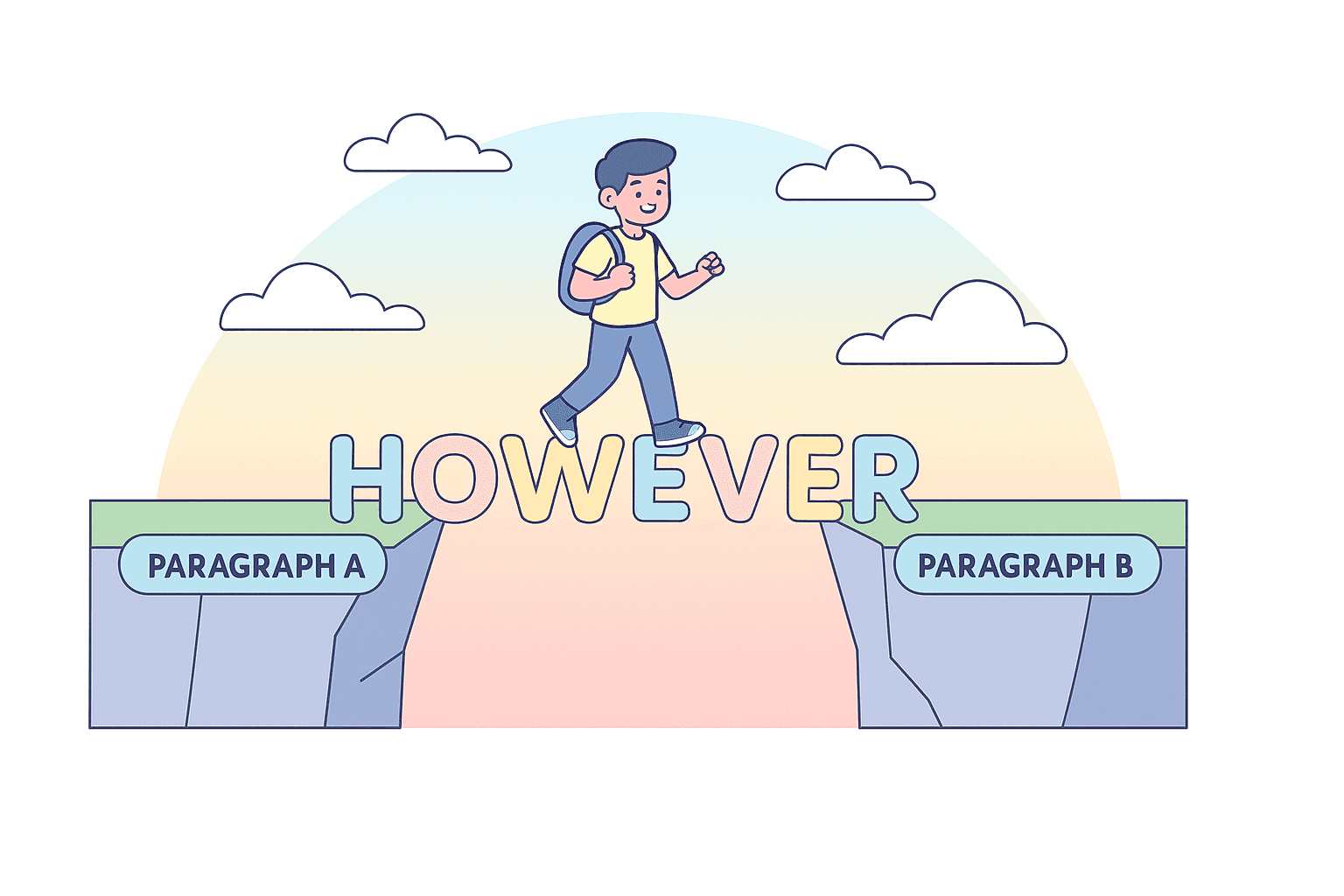
Ek hi word ka baar-baar use karna, jaise har paragraph ko “however” se shuru karna.
Zabardasti transitions thopna jahan pehle se natural flow maujood hai.
Transitions ko ek sath stack karna jaise “however, but” jo ki redundant hai.
Bina clear purpose ke “also” jaise vague connectors ka use karna.
Transitions ko bahut der se place karna jisse reader lost feel kare.
<ProTip title="🚫 Mistake Alert:" description="Transitions ko clarify karna chahiye, clutter nahi. Agar koi transition clunky lag raha hai, toh use simple karein ya hata dein." />
Practice Exercises
Transitions ki practice karne ke liye yahan simple exercises hain: Blanks fill karein, sentences ko different transitions ke sath rewrite karein, aur dost ka essay review karke transition words ko identify karein.
Exercise 1: Blanks fill karein
“The experiment failed. ___, the hypothesis remained strong.”
“She worked long hours. ___, she achieved her promotion.”
“The new rule was unpopular. ___, it improved safety standards.”
Exercise 2: Variety ke sath rewrite karein
Yahan har transition ko replace karein:
“First, the study measured health outcomes. Second, it compared age groups. Finally, it reported recommendations.”
Exercise 3: Peer review
Apne partner ke draft mein transitions ko highlight karein. Poochein: Kya yeh sahi relationship dikhate hain? Kya yeh repetitive hain? Kya inki jagah strong options use kiye ja sakte hain?
Mastery Ke Liye Advanced Tips
Subtle aur explicit transitions ko blend karein. Har sentence ko signal ki zaroorat nahi hoti; kabhi-kabhi flow implicit hota hai.
Tone ko formality se match karein. Academic writing ke liye “nevertheless” sahi ho sakta hai jabki blogs ke liye “still” behtar ho sakta hai.
Read karke practice karein. Published essays mein transitions ko highlight karein aur analyze karein ki authors unhe kaise use karte hain.
Transition chains build karein. Lambe essays ke liye, order ko badlein: addition → example → contrast → cause.
<ProTip title="📚 Advanced Tip:" description="Top journals ya newspapers mein transitions ko study karein. Professional writers bina monotony ke flow maintain karne ke liye unhe creatively vary karte hain." />
Apne Ideas Ko Smooth Transitions Se Connect Karein
Transition sentences invisible glue ki tarah kaam karte hain, jo bina dhyan bhatkaye paragraphs ko jodte hain. Yeh woh subtle connectors hain jo readers ko ek thought se dusre thought tak guide karte hain, thik waise hi jaise kisi sunsaan sadak par signs hote hain. Koi unhe khade hokar admire nahi karta, bas unka kaam chal jata hai.
<CTA title="Build a Strong Problem Statement" description="Generate a precise, publication-ready statement in minutes, no stress, no fluff." buttonLabel="Try Jenni Free" link="https://app.jenni.ai/register" />
"Still" jaise basics ke sath shuru karne se kaam ban jata hai. Practice ke sath, yeh connections natural lagne lagte hain. Readers smoothly aage badhte rehte hain, mechanics par nahi balki message par focus karte hue.