Dwara
Nathan Auyeung
—
Deductive Reasoning Samjhaya Gaya: Logic aur Aam Galtiyan

Nathan Auyeung
Senior Accountant EY mein
Bachelor ka Accounting mein Graduation kiya, aur ek Postgraduate Diploma of Accounting bhi poora kiya

Deductive reasoning ekmaatra aisi reasoning hai jo guarantee ke saath aati hai. Agar premises sahi hain aur structure thik hai, toh conclusion galat nahi ho sakta. Yeh kisi bhi dusre form ke argument se zyada mazboot vaada hai, aur yahi wajah hai ki deduction mathematics, formal logic, aur science mein hypotheses test karne ke tareeqe ke neeche baitha hai.
Yeh wahi jagah bhi hai jahan ek specific aur bohot hi common research error rehta hai. Neeche: deduction asal mein kya hai, ek valid argument aur ek true argument ke beech ka farq, jaan ne layak paanch forms, do invalid forms jo lagbhag sabhi ko dhokha dete hain, aur yeh sab tab kaise samne aata hai jab aap ek results section likhte hain.
<CTA title="Build Arguments That Hold Up" description="Jenni helps you structure reasoning, check claims against sources, and write with precision" buttonLabel="Try Jenni Free" link="https://app.jenni.ai/register" />
Deductive Reasoning Kya Hai?
Deductive reasoning general statements se ek specific conclusion ki taraf badhti hai jo zaroori roop se unse nikalta hai. Isi wajah se ise aksar top-down reasoning kaha jata hai. Aap kisi aisi cheez se shuru karte hain jise sach mana gaya hai, ise ek particular case par apply karte hain, aur conclusion majboor ho jata hai.
Textbook ka example teen lines lamba hai:
Sabhi mammals vertebrates hain. Sabhi whales mammals hain. Isliye sabhi whales vertebrates hain.
Conclusion par kuch bhi naya enter nahi hota. Jo kuch bhi yeh kehta hai woh pehle se hi premises mein shaamil tha, jo ki bilkul wahi wajah hai jisse guarantee bani rehti hai aur yahi wajah hai ki deduction kabhi bhi, apne aap mein, aapko duniya ke baare mein kuch sach mein naya nahi bata sakta. Iski tulna inductive reasoning se karein, jo specific observations se ek general claim ki taraf badhti hai aur certainty ki keemat par naya content haasil karti hai. Ek hazar safed saaras (swans) ko dekhna is claim ko support karta hai ki sabhi saaras safed hain; yeh ise establish nahi karta.

Validity aur Soundness Ek Hi Cheez Nahi Hain
Yeh distinction is page par kisi bhi dusre idea se zyada kaam karta hai, aur zyadatar log jo "valid" shabd ka casually istemaal karte hain, woh ise sahi tarike se nahi kar rahe hain.
Ek deductive argument tab valid hota hai jab iska structure conclusion ki guarantee deta hai: jise Internet Encyclopedia of Philosophy is tarah kehti hai, ek valid argument woh hai jiska form aisa hota hai ki agar premises sach hain, toh conclusion ko sach hona hi hoga. Validity is baare mein kuch nahi kehti ki premises sach mein sach hain ya nahi.
Ek argument tab sound hota hai jab yeh valid hota hai aur iske sabhi premises sach mein sach hote hain. Soundness wahi property hai jo aapko asal mein chahiye.
Yahan ek perfectly valid argument hai jo poori tarah se unsound hai:
Sabhi birds udd sakti hain. Penguins birds hain. Isliye penguins udd sakti hain.
Logic bilkul flawless hai. Pehla premise galat hai, isliye conclusion bekar hai. Yeh academic writing mein bohot zyada maayne rakhta hai, kyunki ek literature review premises par bani arguments ki ek chain hoti hai jise aapne khud verify nahi kiya hota. Aapki reasoning behtareen ho sakti hai aur aapka conclusion fir bhi galat ho sakta hai, kyunki ek cited finding replicate hone mein fail ho gayi. Apne premises ka audit karna aapke logic ko check karne se ek alag kaam hai, aur yeh jaan na ki kya cheez ek source ko credible banati hai, isi tarah se aap ise karte hain.
<ProTip title="🗝️ Key idea:" description="Validity is about structure and soundness is about truth. When somebody calls an argument valid, ask whether they mean the reasoning holds or the conclusion is correct, because those are different claims" />
Deductive Reasoning Ke Everyday Examples
Deduction sirf logic classes tak mahdood nahi hai. Zyadatar log bina naam liye iska lagatar istemaal karte hain, aur ise ordinary settings mein dekhna formal versions ko yaad rakhna aasan banata hai.
Medicine. Is infection wale har patient ka test is assay par positive aata hai. Is patient ka test negative aaya. Isliye is patient ko infection nahi hai.
Law. Yeh kanoon January 2024 ke baad sign kiye gaye contracts par apply hota hai. Yeh contract 2022 mein sign kiya gaya tha. Isliye yeh kanoon apply nahi hota.
Software. Agar config file missing hai, toh startup par service fail ho jati hai. Service start ho gayi. Isliye config file maujood hai.
Mathematics. Har proof construction ke hisab se deductive hota hai. Axioms premises hote hain aur theorem forced conclusion hota hai.
Aptitude tests. Deductive reasoning ke sawaal aapko rules ka ek set dete hain aur puchte hain ki kaun sa conclusion zaroori roop se nikalta hai, jo ki bilkul validity test hai jo time pressure ke andar apply kiya jata hai.
Dhyan dein ki yeh us reasoning se kitna alag mehsus hota hai jiska istemaal aap tab karte hain jab aap yeh conclude karte hain ki ek restaurant shayad accha hai kyunki teen doston ko yeh pasand aaya tha. Woh dusra wala induction hai, aur yeh poori tarah se reasonable ho sakta hai jabki fir bhi galat ho sakta hai.
Jaan ne Layak Paanch Forms
Deductive arguments recognized shapes mein aate hain. Naamo ko seekhna koi fizool ki baat nahi hai: ek baar jab aap form ko dekh lete hain, toh aap ek argument ko ek ghante tak argue karne ke bajaye seconds mein check kar sakte hain.
Modus ponens
Agar P toh Q. P sach hai. Isliye Q. Agar baarish hui, toh pitch geeli hai. Baarish hui. Toh pitch geeli hai. Yeh hypothesis testing ka sabse bada sahara hai, aur lagbhag har research prediction isi form mein hoti hai.
Modus tollens
Agar P toh Q. Q galat hai. Isliye P galat hai. Agar dawa kaam karti hai, toh symptoms kam hote hain. Symptoms kam nahi hue. Toh dawa kaam nahi karti. Yeh falsification ka logical shape hai, aur yeh wahi form hai jo negative results ko unka force deta hai.
Hypothetical syllogism
Agar P toh Q. Agar Q toh R. Isliye agar P toh R. Agar funding badhti hai, toh staffing badhti hai. Agar staffing badhti hai, toh waiting times kam hote hain. Toh agar funding badhti hai, toh waiting times kam hote hain. Conditionals ki aisi chains se hi theoretical arguments ek literature review ke dauran bante hain.
Disjunctive syllogism
Ya toh P ya Q. P nahi hai. Isliye Q. Ya toh sample contaminated tha ya reagent expire ho chuka tha. Yeh contaminated nahi tha. Toh reagent expire ho chuka tha. Explanations ko eliminate karne ke liye useful hai, aur tab khatarnak jab alternatives ki list adhuri ho.
Categorical syllogism
Sabhi M, P hain. Sabhi S, M hain. Isliye sabhi S, P hain. Teen propositions aur bilkul teen classes ke saath classical form: ek major term jo conclusion ka predicate hai, ek minor term jo iska subject hai, aur ek middle term jo dono premises mein dikhta hai lekin conclusion mein nahi.
Do Invalid Forms Jo Valid Lagte Hain
In dono par baaki paanch valid forms ke mukable zyada dhyan dene ki zaroorat hai, kyunki yeh convincing hote hain, behad common hain, aur confident-sounding conclusions produce karte hain jo follow nahi hote.
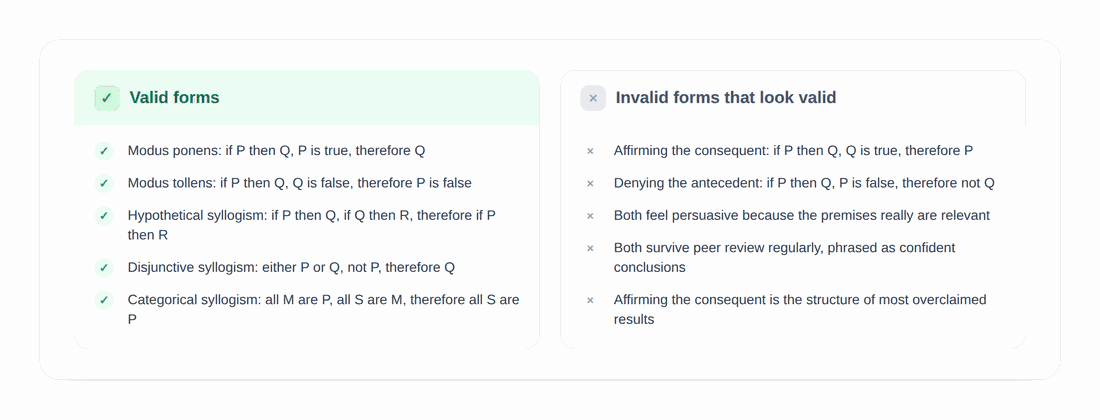
Affirming the consequent. Agar P toh Q. Q sach hai. Isliye P. Agar theory sahi hai, toh scores badhte hain. Scores badhe. Toh theory sahi hai. Invalid hai, kyunki kisi aur cheez ne bhi scores ko badhaya ho sakta hai. Empirical research mein yeh sabse badi single fallacy hai, un reasons ke liye jise agla section batayega.
Denying the antecedent. Agar P toh Q. P galat hai. Isliye Q nahi. Agar theory sahi hai, toh scores badhte hain. Theory sahi nahi hai. Toh scores nahi badhenge. Invalid hai, kyunki dusre causes bhi exist karte hain.
Dono compelling lagte hain kyunki premises sach mein conclusion ke liye relevant hote hain. Relevance entailment nahi hai, aur unke beech ka gap wahi hai jahan bohot saara overclaiming rehta hai.
<ProTip title="🧩 Form check:" description="Strip an argument down to P and Q before you evaluate it. Once the content is gone, an invalid form is obvious in a way it never is while the sentences still sound authoritative" />
Deductive vs Inductive Reasoning
Zyadatar research dono ka istemaal ek cycle mein karti hai. Farq direction ka hai aur is baare mein hai ki har ek aapse kya vaada kar sakta hai.
Deductive | Inductive | |
Direction | General se specific, top down | Specific se general, bottom up |
Promise | Agar premises sach hain, toh conclusion ko sach hona hi hoga | Conclusion probable hai, kabhi guaranteed nahi |
Judged by | Valid ya invalid, sound ya unsound | Strong ya weak, cogent ya nahi |
New content | Kuch nahi, conclusion pehle se hi premises mein tha | Haan, isi wajah se certainty kho jati hai |
Research role | Theory testing, hypothesis testing | Theory building, pattern finding |
Typical design | Experiments, ek stated hypothesis ko test karne wale surveys | Grounded theory, exploratory qualitative work |
Theory ke saath pairing hi yaad rakhne layak hissa hai. Jaisa ki Bhattacherjee ne apne open methods textbook mein likha hai, inductive research theory-building research hai aur deductive research theory-testing research hai, aur kisi field ko aage badhne ke liye dono ki zaroorat hoti hai.
Research Mein Deductive Reasoning Kaise Kaam Karti Hai
Research application ke liye formal naam hypothetico-deductive method hai: aap test ke andar hypothesis se observable consequences deduce karte hain, fir jaakar dekhte hain. Stanford Encyclopedia of Philosophy note karta hai ki iska koi single founder nahi hai, ise nineteenth century mein Whewell dwara aage badhaya gaya tha aur iska standard modern formulation Hempel dwara 1966 mein diya gaya tha.
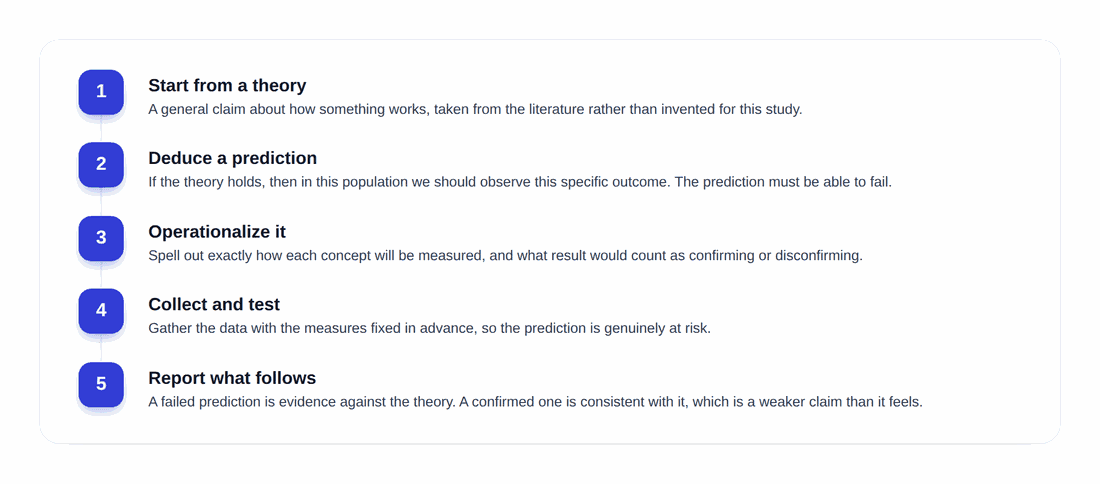
Practice mein sequence is tarah chalta hai. Ek theory se shuru karein, jise study ke liye invent karne ke bajaye literature se liya gaya ho. Ek prediction deduce karein jo isse nikalti ho: agar theory sahi hai, toh is population mein hume yeh specific outcome observe karna chahiye. Ise operationalize karein, jiska matlab hai poori tarah se batana ki har ek concept ko kaise measure kiya jayega, jisme variable, measure, aur result ko kaise interpret kiya jayega, shaamil hai. Pehle se fixed measures ke saath data collect karein, taaki prediction sach mein fail hone ke kabil ho. Fir report karein jo sach mein nikalta hai, jo ki wahi step hai jo galat ho jata hai.
Ek aisi prediction jise har haal mein sach hona hi hai chahe kuch bhi ho jaye, woh kisi theory se deduction nahi hai. Woh theory ka ek description hai. Agar aap pehle se nahi bata sakte ki kaun sa result aapke khilaf jayega, toh study kisi cheez ko test nahi kar rahi hai.
<ProTip title="📐 Structure:" description="Write your prediction as a single sentence in the form: if [theory] holds, then in [population] we should observe [measured outcome]. If you cannot fill all three slots, the hypothesis is not ready to test" />
Zyadatar Overclaimed Results Ke Peeche Ki Reasoning Error

Yahan woh connection hai jo lagbhag koi bhi explicitly nahi banata, aur yeh is page par sabse useful cheez hai.
Aapki prediction ka form hai agar meri theory sach hai, toh main yeh result observe karunga. Aap study chalate hain aur result observe karte hain. Iske baad kya hota hai? Formally: kuch nahi. Yeh conclude karna ki theory isliye sach hai, affirming the consequent hai, jo do sections pehle wala invalid form hai. Koi dusra mechanism bhi wahi same observation produce kar sakta hai.
Yahi wajah hai ki negative direction mein logic bohot behtar chalta hai. Agar aapne result ko predict kiya tha aur woh nahi mila, toh woh modus tollens hai, aur modus tollens valid hai. Karl Popper ne is asymmetry par science ki ek poori philosophy banayi, The Logic of Scientific Discovery mein argue karte hue ki experience ke reference se kisi universal proposition ko verify karna logically impossible hai, jabki ek single genuine counter-instance corresponding universal law ko falsify kar deta hai.
Practical consequence sentence-level par hota hai. Confirmed predictions consistent with, supports, aur as predicted by ko license dete hain. Woh proves, demonstrates that the theory is correct, ya confirms the theory ko license nahi dete. Examiners aur reviewers is farq ko notice karte hain, aur yahan sahi tarike se hedge karna kamzori ke bajaye competence ke roop mein padha jata.
Ek honest complication. Real falsification bhi shayad hi kabhi clean hota hai, kyunki jab ek prediction fail hoti hai toh aap apne measures, apne sample, aur apne manipulation ko bhi test kar rahe hote hain. Ek negative result aapko batata hai ki us bundle mein kuch galat hai, zaroori nahi ki theory. Discussion section mein aisa explicitly kehna ek careful writer ki pehchan hai.
<ProTip title="🚫 Not so fast:" description="Search your results and discussion for the words prove, proves, and proven. In a deductive design a confirmed prediction never proves the theory, and that one word choice is what most often marks a draft as inexperienced" />
Qualitative Research Mein Deductive Reasoning
Deduction ko aamtaur par quantitative kaam ke andar rakha jata hai, jo ki ek galti hai. Iska ek direct qualitative counterpart deductive coding mein hai, jahan aap data ko touch karne se pehle ek existing theory ya framework se apni codebook banate hain, bajaye iske ki codes ko isse emerge hone dein.
Rigorous version sirf framework ko impose nahi karta. International Journal of Qualitative Methods mein likhte hue, Fife aur Gossner deductive qualitative analysis ko deductive aur inductive kaam ko milane ke roop mein describe karte hain taaki examine kiya ja sake supporting, contradicting, refining, aur expanding evidence ko us theory ke liye jise examine kiya ja raha hai, guiding theory se sensitizing constructs ka istemaal karte hue jinhe fir bhi results mein apni jagah banani hogi aur data mein grounded rehna hoga.
Saaf shabdo mein: theory aapko batati hai ki kahan dekhna hai. Yeh aapko yeh nahi batati ki aapne kya paya.
Yaad Rakhne Layak Aadat
Deduction koi aisi abstraction nahi hai jise aap ek baar seekhein aur file kar dein. Yeh ek checking procedure hai. Jab kisi paper mein koi argument persuasive lagta hai, toh ise iske form mein reduce karein aur dekhein ki kya conclusion sach mein forced hai ya sirf suggested hai. Jab aap apna khud ka ek conclusion likhte hain, toh puchen ki kya yeh usse entailed hai jo aapne dikhaya ya fir yeh kai plausible explanations mein se ek hai.
<CTA title="Write Claims Your Examiner Cannot Puncture" description="Draft with sources attached and check every claim against what the evidence actually supports" buttonLabel="Try Jenni Free" link="https://app.jenni.ai/register" />
Woh aadat academic writing mein har jagah dikhayi deti hai: isme ki kaise ek research argument banta hai, isme ki kaise methods describe kiye jate hain, aur sabse badhkar us gap mein jo ek study ne observe kiya aur jo iske author ne claim kiya ki isne establish kiya hai. Ek competent paper aur ek strong paper ke beech ki zyadatar doori usi gap mein beetti hai.