Durch
Nathan Auyeung
—
Ein einfacher Leitfaden zu den verschiedenen Arten von Forschungsarbeiten

Nathan Auyeung
Senior Accountant bei EY
Abschluss mit einem Bachelor in Rechnungswesen, abgeschlossenes Postgraduate-Diplom in Rechnungswesen

Forschungsarbeiten gibt es in vielen Formen, und jede erfüllt einen anderen Zweck. Manche Arbeiten zerlegen Ideen in kleinere Teile, um sie besser zu verstehen. Andere vertreten eine These, testen eine Hypothese oder fassen zusammen, was Wissenschaftler bereits wissen. Bei so vielen Formaten ist es für Studierende leicht, unsicher zu sein, welche Art zu ihrer Aufgabe passt.
Dieser Leitfaden schafft Klarheit. Du erfährst, was jeder Typ von Forschungsarbeit leistet, wie er funktioniert und wo er üblicherweise verwendet wird. Einfache Beispiele zeigen, wie diese Arbeiten in echten Kursarbeiten aussehen, damit du mit Sicherheit die richtige Struktur wählen kannst. Wenn du den breiteren Kontext dafür möchtest, wie eine akademische Arbeit typischerweise aufgebaut ist, siehe unseren Erklärer zur akademischen Arbeit.
<CTA title="Eine starke Problemstellung erstellen" description="Erstelle in Minuten eine präzise, publikationsreife Aussage ohne Stress" buttonLabel="Jenni kostenlos testen" link="https://app.jenni.ai/register" />
Was Forschungsarbeitstypen sind und warum sie wichtig sind
Forschungsarbeitstypen erklären den Zweck deines Schreibens und die Art und Weise, wie du ein Thema untersuchst. Diese Typen leiten dich, wenn du lernst, wie man eine wissenschaftliche Arbeit schreibt, oder wenn du an fortgeschritteneren Projekten arbeitest. Klare Kategorien helfen dir auch, Argumente, Zusammenfassungen oder Daten nicht an der falschen Stelle zu vermischen.
Verschiedene Fachgebiete nutzen verschiedene Arbeitstypen. Die Geisteswissenschaften verwenden oft analytische oder argumentative Arbeiten. MINT-Fächer setzen auf empirische Arbeiten. Sozialwissenschaften nutzen Fallstudien oder vergleichende Designs. Wenn du den Zweck jedes Typs kennst, kannst du deine Forschung planen, deine Ideen ordnen und klar schreiben
1. Analytische Forschungsarbeiten
Analytische Arbeiten untersuchen ein Thema, indem sie es in kleinere Teile zerlegen. Statt eine persönliche Position zu stützen, betrachten diese Arbeiten Muster, Beziehungen oder Themen genau.
Wie dieser Typ funktioniert
Bevor man seine Merkmale auflistet, hilft es, die Kernidee hinter dem analytischen Schreiben zu verstehen. Das Ziel ist zu erkunden statt zu überzeugen. Du prüfst mehrere Sichtweisen, interpretierst Quellen und zeigst, welche Einsichten entstehen, wenn Informationen sorgfältig untersucht werden.
Wichtige Merkmale
Hier ist, was Dozenten von dieser Art Arbeit erwarten:
Ein sachlicher Ton ohne persönliche Meinungen
Mehrere Quellen, die genutzt werden, um ein Thema aus verschiedenen Blickwinkeln zu untersuchen
Fokus auf Interpretation statt Zusammenfassung
Klare Erklärungen von Mustern oder Zusammenhängen
Beispielszenario
Stell dir vor, ein Student untersucht wie narrative Rahmung die Wahrnehmung des Publikums in den Nachrichtenmedien beeinflusst. Statt zu argumentieren, dass eine Methode besser ist, analysiert der Student Techniken, vergleicht Beispiele und interpretiert Muster über mehrere Artikel hinweg.
<ProTip title="💡 Pro Tip:" description="Verwende eine Gliederung in zwei Spalten, um Belege auf der einen Seite und deine Interpretation auf der anderen zu trennen. So bleibt die Analyse fokussiert und klar." />
Wann du diesen Typ verwenden wirst
Analytische Arbeiten kommen häufig in Literatur-, Psychologie-, Geschichts-, Kulturwissenschafts- und Kommunikationskursen vor. Sie helfen Studierenden, Ideen kritisch zu hinterfragen, statt eine bestimmte These zu verteidigen.
2. Argumentative Forschungsarbeiten
Argumentative Arbeiten stellen eine These auf und stützen sie mit Belegen. Das Hauptziel ist Überzeugung durch Logik, Forschung und klare Argumentation.
Warum argumentative Texte wichtig sind
Bevor man sich die Struktur ansieht, hilft es sich zu erinnern, warum Lehrende diese Art zuweisen. Argumentative Arbeiten lehren Studierende, Fragen zu untersuchen, Positionen einzunehmen und Ideen mit Belegen statt mit Annahmen zu vermitteln.
Was diese Arbeit enthält
Hier sind die typischen Bestandteile einer argumentativen Arbeit:
Logische Behauptungen, die durch glaubwürdige Quellen gestützt werden
Gegenargumente, die die gegensätzliche Sicht anerkennen
Widerlegungen, die erklären, warum deine Position stärker ist
Beispielszenario
Ein Student, der darüber schreibt, ob Regierungen KI-Tools in Schulen regulieren sollten, sammelt Belege, vergleicht Vor- und Nachteile, stellt Gegenargumente vor und verteidigt eine ausgewogene Position.
Wo sie vorkommen
Politikwissenschaft, Wirtschaftswissenschaften, Philosophie, Bildungswissenschaften und Kommunikationskurse vergeben häufig argumentative Arbeiten, weil sie Überzeugungskraft im Schreiben aufbauen.
<ProTip title="Reminder:" description="Führe Gegenargumente früh ein. Das zeigt den Lesenden, dass deine Position informiert und nicht einseitig ist." />
3. Empirische und experimentelle Forschungsarbeiten
Empirische Arbeiten berichten über Originaldaten, die durch Experimente, Umfragen, Beobachtungen oder fallbasierte Messungen erhoben wurden. Sie sind in den Naturwissenschaften üblich, weil sie Hypothesen mithilfe messbarer Belege testen.
Was diesen Typ auszeichnet
Empirische Arbeiten folgen einer wissenschaftlichen Struktur. Sie beantworten spezifische Fragen durch kontrollierte Methoden. Diese Klarheit hilft anderen Forschern, die Studie zu wiederholen und Ergebnisse zu überprüfen.
Hauptbestandteile
Bevor die üblichen Elemente aufgelistet werden, denke daran, dass jede empirische Arbeit zeigen muss, wie Daten erhoben wurden. Dann muss sie zeigen, was die Daten bedeuten. Vor diesem Hintergrund sind hier die üblichen Abschnitte (für einen Überblick über verschiedene Typen siehe unsere Aufschlüsselung der wesentlichen Bestandteile einer Forschungsarbeit):
Zusammenfassung
Einleitung und Hypothese
Methodik
Ergebnisse
Diskussion
Einschränkungen
Schlussfolgerung
Beispiel
Ein Psychologiestudent, der testet, wie sich unterschiedliche Schlafmengen auf das Erinnern auswirken, erhebt Daten von Teilnehmenden, analysiert Leistungswerte und berichtet die Ergebnisse mit Tabellen und Grafiken.
Wo sie verwendet werden
Biologie, Psychologie, Physik, Ingenieurwissenschaften, Umweltwissenschaften und Medizin sind stark von empirischer Forschung abhängig.
<ProTip title="💡 Pro Tip:" description="Verwende einfache, wiederholbare Methoden. Klare Abläufe helfen den Lesenden, deinen Ergebnissen zu vertrauen und ihre Grenzen zu verstehen." />
4. Review-Arbeiten
Review-Arbeiten fassen frühere Studien zusammen und vergleichen sie. Sie erheben keine neuen Daten. Viele von ihnen nutzen eine kritische Analyse, um zu untersuchen, wie Ideen über Forschungsarbeiten hinweg zusammenhängen. Einige Reviews verwenden die Argumentationstheorie, um zu prüfen, wie Behauptungen gestützt werden. Andere betrachten die Validität der Bewertung, um zu sehen, wie stark die Belege sind.
Warum Review-Arbeiten wichtig sind
Studierende verwechseln Review-Arbeiten oft mit Zusammenfassungen. Eine Review-Arbeit tut mehr, als Studien zu beschreiben. Sie ordnet sie ein, vergleicht Ideen, hebt Trends hervor und erklärt, wo Forschung widersprüchlich ist.
Arten von Review-Arbeiten
Bevor die Arten beschrieben werden, beachte, dass jede einen anderen Zweck hat. Manche sind breit angelegt. Andere folgen strengen Regeln. Hier sind die Hauptkategorien:
Literaturübersichten
Ein breiter Überblick über vorhandene Studien. Diese erscheinen in Essays, Dissertationen und Abschlussarbeitskapiteln. Wenn du ein RRL zusammenstellst und Quellen ordnest, kann der KI-Generator für Literaturübersichten und RRL dir beim Entwurf und der Strukturierung der Übersicht helfen.
Systematische Reviews
Eine strukturierte Untersuchung, die strengen Kriterien zur Auswahl und Bewertung von Studien folgt. Häufig in der Medizin und im öffentlichen Gesundheitswesen.
Meta-Analysen
Eine statistische Methode, die Daten aus mehreren Studien kombiniert, um allgemeine Trends zu erkennen.
Beispielszenario
Ein Student, der die Forschung zum Zusammenhang zwischen Social-Media-Nutzung und Angstzuständen überprüft, vergleicht Studienergebnisse, hebt konsistente Muster hervor und erklärt, wo sich die Resultate unterscheiden.
5. Weitere Forschungspapier-Typen
Manche Arbeiten passen nicht in die vier Hauptkategorien, erscheinen aber dennoch häufig im akademischen Schreiben. Diese Typen haben spezifischere Ziele und eignen sich am besten für bestimmte Fachgebiete.
5.1 Fallstudienarbeiten
Fallstudien untersuchen ein einzelnes Thema, Ereignis oder eine Situation im Detail. Sie konzentrieren sich auf reiche Details statt auf breite Verallgemeinerung.
Was Fallstudien nützlich macht
Bevor typische Verwendungen aufgelistet werden, erinnere dich daran, dass Fallstudien Forschern helfen, komplexe Systeme in realen Umgebungen zu verstehen. Sie zeigen Nuancen, die große Datensätze oft übersehen.
Häufige Verwendungen
Fallstudien erscheinen in:
Geschäftsanalysen
Medizin und Patientenversorgung
Rechts- und Politikstudien
Sozial- und Gemeinschaftsforschung
Beispiel
Ein Student untersucht wie eine Schule ein neues Leseprogramm umgesetzt hat und analysiert die Ergebnisse.
5.2 Theoretische Arbeiten
Theoretische Arbeiten entwickeln neue Modelle, Konzepte oder Rahmenwerke. Sie erheben keine neuen Daten, sondern schlagen Erklärungen dafür vor, wie etwas funktioniert.
Wann dieser Typ am besten funktioniert
Diese Arbeiten helfen dabei, Forschungsfelder zu prägen. Sie führen neue Ideen ein oder verfeinern bestehende Theorien, damit zukünftige Studien auf einer stärkeren Grundlage stehen.
Beispiel
Ein Philosophiestudent schlägt ein neues ethisches Rahmenwerk zur Bewertung von Technologierisiken vor.
5.3 Ursache-Wirkungs-Arbeiten
Diese Arbeiten untersuchen, warum etwas geschieht und welche Folgen daraus entstehen. Sie ordnen Ideen nach Auslösern, Ergebnissen oder einer Kombination aus beidem.
Wie diese Struktur Schreibenden hilft
Bevor Beispiele betrachtet werden, denke daran, dass Ursache-Wirkungs-Schreiben Studierenden hilft, Beziehungen zwischen Ereignissen zu zeigen, statt nur Details aufzulisten.
Beispiel
Eine Arbeit, die erforscht, wie steigende globale Temperaturen Migrationsmuster beeinflussen.
5.4 Definitionsarbeiten
Definitionsarbeiten erklären einen Begriff mithilfe mehrerer wissenschaftlicher Quellen. Das Ziel ist Klarheit, nicht Meinung.
Was dieser Typ erfordert
Bevor Beispiele genannt werden, beachte, dass starke Definitionsarbeiten auf präziser Sprache beruhen. Jeder Teil der Erklärung muss durch Forschung gestützt sein, nicht durch persönliche Interpretation.
Beispiel
Ein Student definiert kulturelle Identität, indem er Definitionen aus Anthropologie, Soziologie und Psychologie vergleicht.
5.5 Vergleichende Arbeiten
Vergleichende Arbeiten analysieren Gemeinsamkeiten und Unterschiede zwischen zwei oder mehr Themen.
Warum dieser Typ Lesenden hilft
Der Vergleich von Themen zeigt, wie Ideen zusammenhängen und wo sie auseinandergehen. Diese Struktur hilft Lesenden, Muster über Fälle, Theorien oder Systeme hinweg zu verstehen.
Beispiel
Ein Student vergleicht Lernergebnisse aus Online-Klassenzimmern und traditionellem Präsenzunterricht.
6. Wie du den richtigen Typ einer Forschungsarbeit auswählst
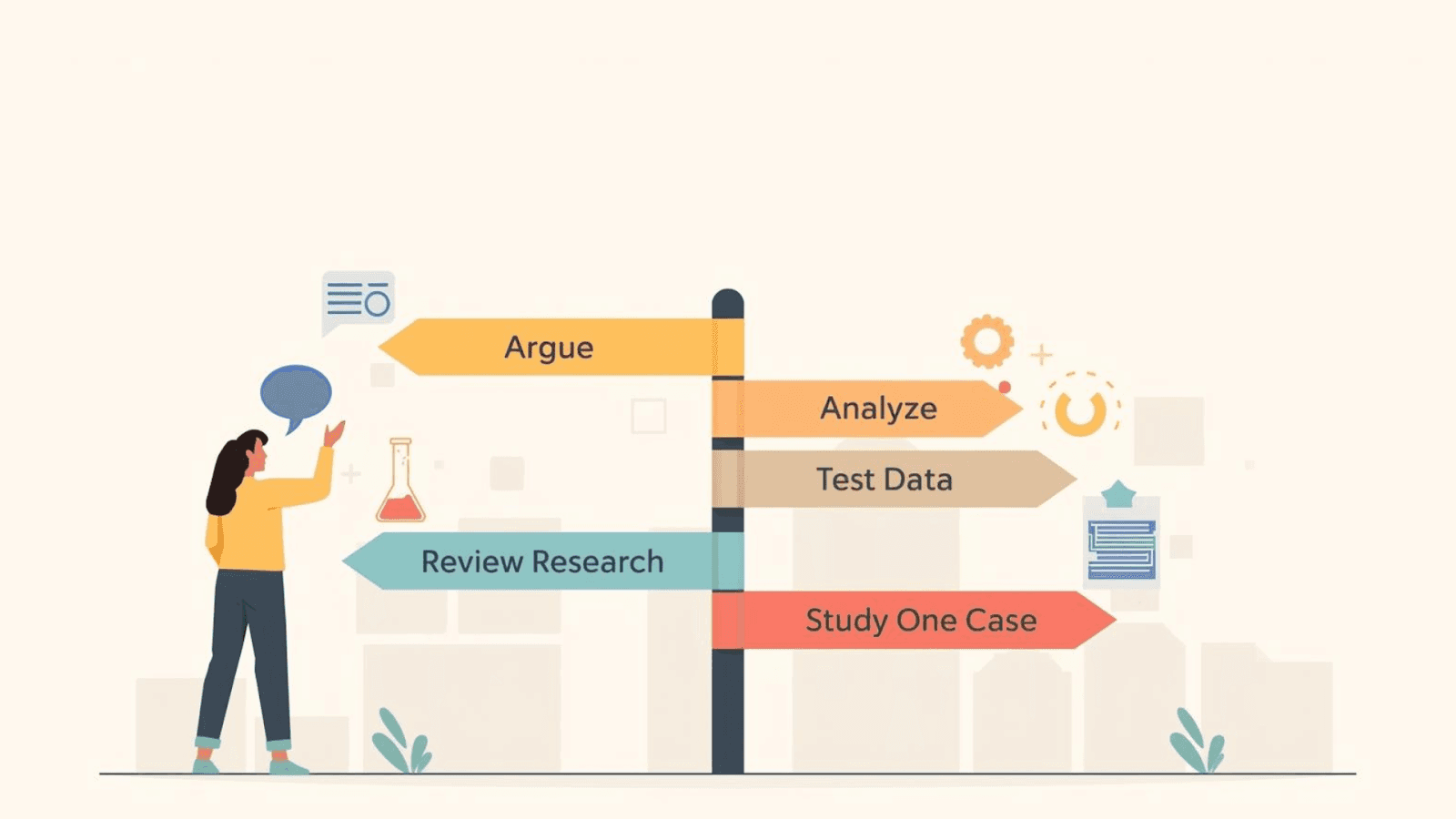
Die Wahl des richtigen Typs einer Forschungsarbeit hängt von deiner Forschungsfrage, deinem Fachgebiet und den Aufgabenanweisungen ab.
Verstehe deinen Zweck
Bevor du einen Arbeitstyp auswählst, beginne damit, dein Hauptziel zu identifizieren. Schreibende überspringen diesen Schritt oft und vermischen am Ende Formate. Klare Ziele geben die Struktur vor.
Wichtige Fragen
Hier sind hilfreiche Fragen, die deinen Zweck klären:
Muss ich etwas erklären oder definieren?
Muss ich die Lesenden überzeugen?
Muss ich eine Hypothese testen?
Muss ich vorhandene Studien zusammenfassen?
Muss ich einen einzelnen Fall im Detail untersuchen?
Ordne den Typ deinem Fachgebiet zu
Unterschiedliche akademische Fächer setzen auf unterschiedliche Forschungsdesigns. Diese Vorlieben zu erkennen hilft dir, unpassende Formate zu vermeiden.
Häufige Zuordnungen nach Fachgebiet
Hier ist, wie Fächer typischerweise mit Arbeitstypen zusammenhängen:
MINT-Fächer → empirische, experimentelle, theoretische
Geisteswissenschaften → analytische, argumentative, Definitionsarbeiten
Sozialwissenschaften → vergleichende, empirische Arbeiten, Fallstudien
Wirtschaft → Fallstudien, argumentative Arbeiten, Review-Arbeiten
Lies deine Aufgabenstellung sorgfältig
Die Sprache der Aufgabe gibt starke Hinweise auf den Arbeitstyp.
Typische Signalwörter in Aufgaben
Hier ist ein Leitfaden zu häufigen Verben und ihrer üblichen Bedeutung:
„Analysieren“ → analytische Arbeit
„Argumentieren“ → argumentative Arbeit
„Untersuchen“ → empirische Arbeit
„Forschung zu ... überprüfen“ → Review-Arbeit
„Definieren“ → Definitionsarbeit
<ProTip title="💡 Pro Tip:" description="Formuliere die Aufgabenstellung in deinen eigenen Worten um. So wird sichtbar, was der Dozent von dir erwartet." />
7. Wie jeder Arbeitstyp dasselbe Thema angeht

Um die Unterschiede klarer zu sehen, stell dir vor, dass fünf Studierende dasselbe Thema untersuchen: Remote-Arbeit und Produktivität. Jeder Arbeitstyp behandelt das Thema anders.
Analytischer Ansatz
Eine analytische Arbeit zerlegt das Thema in Bestandteile. Der Student untersucht Kommunikationswerkzeuge, Motivation, Teamstruktur und Arbeitsumfeld, um zu erklären, wie jeder Faktor die Produktivität beeinflusst.
Argumentativer Ansatz
Eine argumentative Arbeit bezieht Position. Der Student vertritt die These, dass Remote-Arbeit die Produktivität insgesamt verbessert, und nutzt Belege, um diese Behauptung zu stützen, während Gegenargumente berücksichtigt werden.
Empirischer Ansatz
Eine empirische Arbeit erhebt Originaldaten. Der Student befragt Mitarbeitende, verfolgt Produktivitätswerte und analysiert die Ergebnisse statistisch.
Review-Ansatz
Eine Review-Arbeit fasst vorhandene Studien zusammen. Der Student betrachtet wissenschaftliche Befunde aus Psychologie, Management und Kommunikation, um Trends und Lücken hervorzuheben.
Fallstudienansatz
Eine Fallstudie untersucht eine Organisation. Der Student beschreibt, wie ein Unternehmen Remote-Arbeit eingeführt hat, und bewertet die Auswirkungen auf Mitarbeitende.
8. Begriffe der Forschungsmethodik, die Studierende kennen sollten
Gutes wissenschaftliches Schreiben beginnt damit, die Methoden hinter jedem Arbeitstyp zu kennen. Diese Methoden prägen deine Forschungsfragen und helfen dir, Ansätze zu wählen, wenn du jede Art von Forschungsarbeit schreibst.
Quantitative Methoden
Quantitative Methoden verwenden Zahlen und Statistiken, um Forschungsfragen zu beantworten.
Häufige Techniken
Hier sind Beispiele für quantitative Ansätze:
Experimente
Groß angelegte Umfragen
Statistische Modellierung
Qualitative Methoden
Qualitative Methoden untersuchen Ideen oder Erfahrungen mithilfe beschreibender Daten.
Häufige Techniken
Diese Ansätze helfen Forschern, Kontext und Bedeutung zu verstehen:
Interviews
Beobachtungen
Textanalyse
Gemischte Methoden
Gemischte Methoden kombinieren numerische und beschreibende Daten. Dieser Ansatz eignet sich gut für komplexe Themen, weil er sowohl Breite als auch Tiefe bietet.
9. Kurze Checkliste zur Identifizierung deines Forschungsarbeitstyps
Eine Checkliste hilft dir, beim Planen deines Schreibens fokussiert zu bleiben.
Lies jede Frage und beantworte sie ehrlich
Bevor du jeden Punkt durchgehst, erinnere dich daran, dass Klarheit dein bestes Werkzeug ist. Je spezifischer deine Antworten sind, desto einfacher wird es, die richtige Methode zu wählen.
Was ist mein Hauptzweck?
Erfordert mein Thema ein Argument oder eine Erklärung?
Brauche ich eigene Daten?
Gibt es genug vorhandene Forschung, die ich überprüfen kann?
Welche Form bevorzugt mein Fachgebiet?
<ProTip title="Note:" description="Wenn du zwischen zwei Typen feststeckst, skizziere beide. Die stärkere Gliederung zeigt meist die richtige Richtung." />
Dein Verständnis von Forschungsarbeitstypen abrunden
Verschiedene Forschungsarbeitstypen helfen dir, Ideen zu erkunden, eine Position zu vertreten, Daten zu testen oder vorhandene Studien zu überprüfen. Zu wissen, wie jeder funktioniert, macht es leichter, deinen Ansatz zu planen und Formate nicht zu vermischen. Mit einem klaren Zweck wird dein Schreiben fokussierter und wirksamer.
<CTA title="Stärkere Forschungsarbeiten schneller schreiben" description="Nutze Jenni, um jede Forschungsarbeit klar und selbstbewusst zu gliedern und zu verfeinern" buttonLabel="Jenni kostenlos testen" link="https://app.jenni.ai/register" />
Wenn du übst, wird die Wahl des richtigen Typs natürlicher. Und wenn du Unterstützung brauchst, um deine Ideen zu formen oder deine Struktur zu ordnen, kann Jenni dir helfen, eine Gliederung zu erstellen, sie zu verfeinern und von Anfang an eine stärkere Arbeit aufzubauen.