由
賈斯汀·黃
—
AMA Style Guide: Formatting and Citation Rules for Medical Writing


AMA style is what medicine writes in, and most of the free guides explaining it are incomplete in the same place. The single most searched question about AMA style is how the in-text citations work, and several of the highest ranking pages do not have a section on it at all. Others still show 10th edition formats that were retired in 2020.
This is the complete version: how the superscript numbering works down to where it sits against a comma, the reference format for twelve source types, what actually changed in the 11th edition, and the manuscript rules that make up most of the manual.
<CTA title="Write in AMA Style Without Formatting Every Reference by Hand" description="Jenni builds your reference list as you write and keeps the numbering in order" buttonLabel="Try Jenni Free" link="https://app.jenni.ai/register" />
What Is AMA Style?
AMA style is the editorial standard set out in the AMA Manual of Style, now in its 11th edition, written by an editorial committee from the JAMA Network and published by Oxford University Press in February 2020. It is used across medicine, nursing, pharmacy, public health, and biomedical research.
It is worth understanding how much larger it is than a citation format. The manual runs to 23 chapters, and only one of them is about references. The rest covers grammar, punctuation, capitalization, preferred usage, abbreviations, nomenclature, units of measure, numbers, study design and statistics, and inclusive language. When a journal says it follows AMA style, it is committing to all of that, not just the reference list.
How it relates to Vancouver. The two are related and not identical. AMA is built on the Vancouver system, so both number citations in the order they appear rather than alphabetizing them. The difference is scope and detail: Vancouver and the ICMJE recommendations govern citation format, while AMA is a complete style guide. There are formatting differences too, the most visible being that AMA italicizes journal titles and Vancouver does not.
One point of confusion worth clearing up. The online edition of the manual is updated continuously, so you will see a recent copyright year on the Oxford page. That does not mean a 12th edition exists. The current edition is still the 11th.
How AMA In-Text Citations Work
Citations are superscript arabic numerals. No brackets, no parentheses, no space before the number. Sources are numbered in the order they first appear in the text, and once a source has a number it keeps that number for the rest of the document, however many times you cite it.
The part that trips people up is punctuation. AMA has a specific rule and it is not the same as other numbered styles.
Situation | Rule | Example |
End of a sentence | The number goes after the period | Statin therapy reduced major vascular events.1 |
Mid sentence, at a comma | The number goes after the comma | Two trials reported no benefit,2,3 whereas a later meta-analysis did.4 |
At a colon or semicolon | The number goes before it | To err is human1; to forgive, divine.2 |
Two sources at once | Comma between them, no space | The association is well documented.1,2 |
Three or more in sequence | A hyphenated range | Several cohort studies agree.3-8 |
A mixed set | Combine commas and ranges | The evidence is consistent.1,3-8,19 |
A specific page | Number, then the page in parentheses, no space | As Smith et al5(p179) noted, the effect was durable. |
Several sources with pages | Use pp for a page range | Both reviews concur.4,6(pp23,30),11 |
When you name authors in the sentence itself, use surnames only. For two or more authors, write "Smith et al" or "Smith and colleagues". Note that AMA does not put a period after et al, and the same applies to eg and ie.
<ProTip title="🔢 Numbering:" description="Never renumber references by hand after you insert a new citation in the middle of a draft. Renumber from the reference manager or the citation tool, because manual renumbering is the most common source of mismatched references in a submitted manuscript" />
How the Reference List Is Formatted
The list is headed References and appears in numerical order of first citation. Do not alphabetize it. There is no hanging indent in AMA, which surprises people arriving from APA, and a runover line simply returns to the left margin.
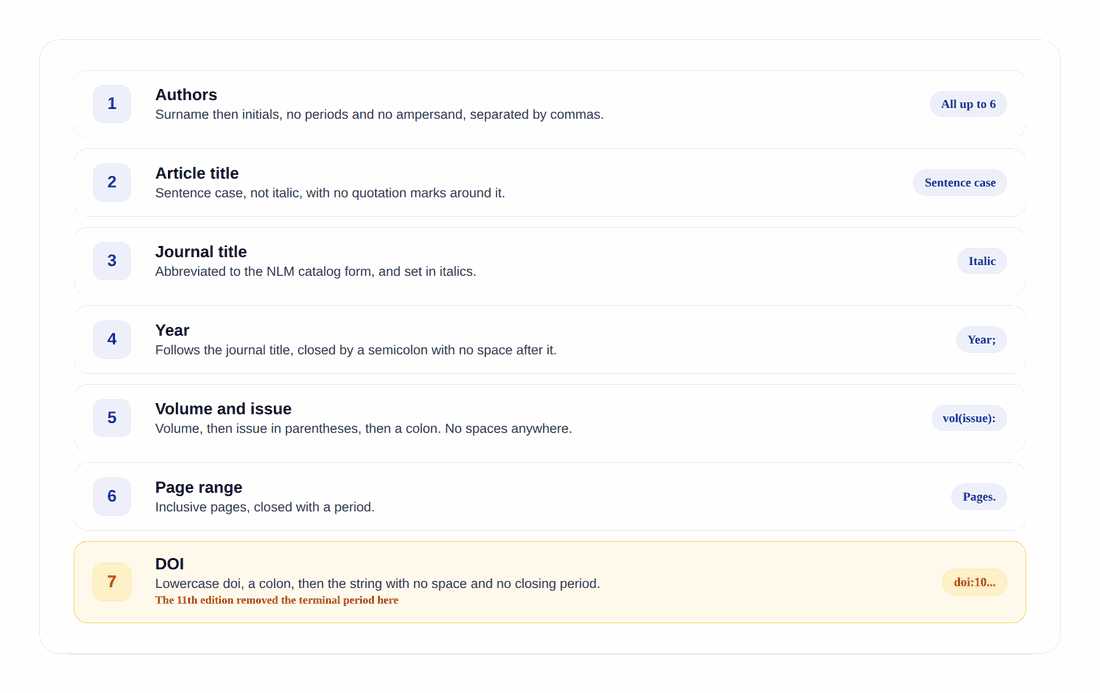
Reading a reference from left to right, these are the parts and the rules attached to each.
Article title. Sentence case, not italic, and no quotation marks.
Journal title. Italicized and abbreviated to the form used in the NLM Catalog. Single word titles such as Pediatrics are not abbreviated.
Year, volume, issue, pages. Run together with no spaces, in the pattern Year;volume(issue):pages.
DOI. Lowercase doi, a colon, then the string, with no space after the colon and no period at the end. The 11th edition removed that terminal period so URLs and DOIs do not break when copied.
Book and journal titles are title case and italic. Article and chapter titles are sentence case and roman. That split holds throughout the style.
AMA Reference Examples by Source Type
These are the formats you will use most. Every example follows the 11th edition.
Source type | AMA 11th edition example |
Journal article, one to six authors | Beran RG, Braley TJ, Segal BM, Chervin RD. Sleep-disordered breathing in multiple sclerosis. Neurology. 2013;80(14):1354-1355. |
Journal article, seven or more authors | Magee T, Peters C, Jacobsen SM, et al. Inequities in the treatment of opioid use disorder: a scoping review. J Subst Use Addict Treat. 2023;152:209082. doi:10.1016/j.josat.2023.209082 |
Journal article with a DOI | Chamberlain Mitchell SAF, Garrod R, Clark L, et al. Physiotherapy, and speech and language therapy intervention for patients with refractory chronic cough. Thorax. 2017;72(2):129-136. doi:10.1136/thoraxjnl-2016-208843 |
Entire book | Shepard TH. Catalog of Teratogenic Agents. 7th ed. Johns Hopkins University Press; 1992. |
Chapter in an edited book | Boushey CJ. Application of research paradigms to nutrition practice. In: Coulston AM, Boushey CJ, Ferruzzi MG, eds. Nutrition in the Prevention and Treatment of Disease. 3rd ed. Academic Press; 2013:99-105. |
Website or web page | Suicide prevention. Centers for Disease Control and Prevention. Published October 19, 2022. Accessed November 22, 2022. https://www.cdc.gov/suicide/ |
Government or organization report | US Government Accountability Office. Reported Status of Department of Defense Enterprise Resource Planning Systems. 2012. GAO-12-565R. Accessed April 2, 2012. http://www.gao.gov/products/GAO-12-565R |
Online article with no DOI | Kapur VK. Obstructive sleep apnea: diagnosis, epidemiology, and economics. Respir Care. 2010;55(9):1155-1167. Accessed November 8, 2011. http://www.rcjournal.com/contents/09.10/09.10.1155.pdf |
Preprint | Morozova O, Li ZR, Crawford FW. A model for COVID-19 transmission in Connecticut. medRxiv. Preprint posted online June 16, 2020. doi:10.1101/2020.06.12.20126391 |
Package insert | Byetta. Package insert. Amylin Pharmaceuticals; 2008. |
Conference presentation or poster | Nevidomskyte D, Meissner MH, Tran N, Murray S, Farrokhi E. Influence of gender on abdominal aortic aneurysm repair in the community. Poster presented at: Vascular Annual Meeting; June 5-7, 2014; Boston, MA. |
Dataset in a repository | Cutter AD, Gray JC. Data from: Ephemeral ecological speciation and the latitudinal biodiversity gradient. Dryad Digital Repository. Deposited August 17, 2016. doi:10.5061/dryad.734v9 |
Two notes on the awkward cases. For repository data, AMA also asks you to cite the original source alongside the deposit. For statistical software, the manual allows an in-text mention instead of a reference, in the form "All analyses were conducted using SAS version 9.4 (SAS Institute Inc)".
<ProTip title="🏷️ Abbreviations:" description="Look up every journal abbreviation in the NLM Catalog rather than guessing from the full title. Guessed abbreviations are the second most common reference error after wrong author counts" />
What Changed From the 10th Edition to the 11th
This matters more than it sounds, because a large number of university style pages were written for the 10th edition and never updated. If you copy a format from one of them, you are producing references that were correct in 2019.
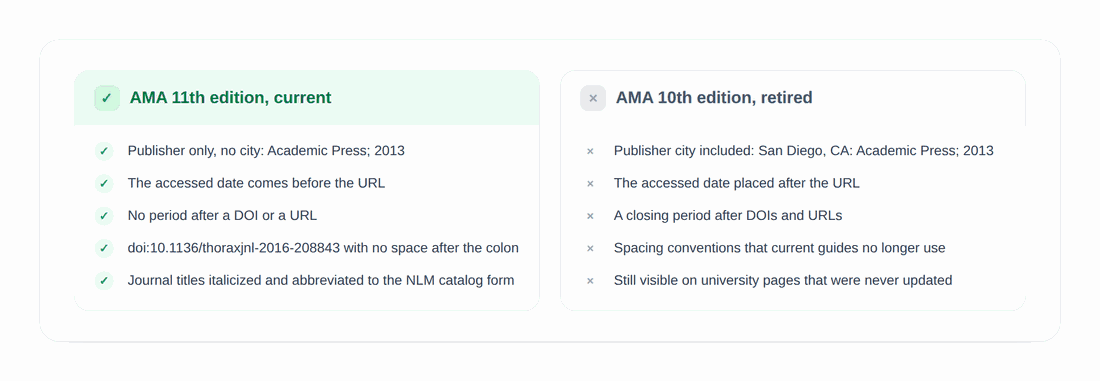
Five changes account for almost all the difference you will notice.
Publisher location is gone. The 11th edition drops the city. It is now "Academic Press; 2013", not "San Diego, CA: Academic Press; 2013".
The accessed date moved. It now comes before the URL, not after it.
No terminal period after a DOI or URL. This was changed so links do not break when the trailing period is copied along with them.
DOI formatting tightened. Lowercase, no space after the colon, no "https://doi.org/" wrapper needed.
Inclusive language guidance was substantially expanded, which is covered further down.
<ProTip title="🕰️ Edition check:" description="If a style guide you are reading shows a publisher city in a book reference, it is written for the 10th edition. Close it and find another one" />
Manuscript Formatting Rules

First, an honest caveat that most guides skip. AMA does not prescribe a student paper format. The manual is written for authors submitting to journals, so it says very little about title pages, fonts, margins, or running heads. Every instruction you will find on a university page about 12 point Times New Roman and a title page with your student ID is that institution's own convention, not an AMA rule. Follow whatever your instructor or target journal specifies, and do not assume the two agree.
What the manual does govern, and what you should apply consistently:
Numbers. Use numerals throughout, including for numbers under ten. The exceptions are a number that begins a sentence or title, common fractions, and ordinals from first through ninth.
Abbreviations. Expand at first use even when the term is well known, then use the abbreviation. No periods inside acronyms. Spell out state names in running text.
Units. SI units, with a space between the numeral and the unit. Large numbers take no comma, so it is 1600 km rather than 1,600 km.
Quotations. A quotation running longer than four lines is set as a block quote without quotation marks. Use square brackets for anything you insert into a quotation yourself.
If you are moving between styles regularly, it is worth noting how differently these conventions run. The author rules in APA and the differences between MLA and Chicago do not transfer here, and neither does the Nature reference style, despite Nature also using numbered citations.
Inclusive Language in AMA Style

Chapter 11 of the manual covers correct and preferred usage, and its guidance on describing people is one of the most practically useful parts of the whole style, as well as one of the least covered by free citation guides.
The core principles, as the manual and the library guides that track it set them out:
Person-first language by default, so "a person with paraplegia" rather than a label. Use identity-first language where the community concerned prefers it, as with "autistic person".
Do not use "males" and "females" as nouns when writing about people. They are adjectives.
Prefer "older adults" to "the elderly" or "seniors".
Distinguish sex from gender, and report which one you actually measured.
Singular "they" is accepted.
Capitalize Black and White when used as racial descriptors, and avoid "Caucasian".
Prefer "low income" to "poor" when describing populations.
The general rule underneath all of these is to describe what was measured rather than to assign an identity. It is the same discipline that keeps a claim inside its evidence, applied to people instead of to data.
<ProTip title="💬 Word choice:" description="Search your finished draft for the words elderly, males, females, and Caucasian before you submit. Those four turn up in almost every first draft written by somebody new to AMA" />
Five Mistakes That Give You Away
Editors spot these instantly, and all five are avoidable in a final pass.
1. Leftover 10th edition formats. A publisher city, an accessed date after the URL, or a period after a DOI. Any one of them dates your reference list.
2. Superscripts on the wrong side of the punctuation. After periods and commas, before colons and semicolons. It is a small thing that signals whether you actually read the style.
3. Importing the APA author threshold. APA and AMA cut off at different author counts. AMA lists all authors up to six, then switches to the first three plus et al.
4. Alphabetizing the reference list, or adding a hanging indent. Neither belongs in AMA. The list is in citation order and the runover lines are flush left.
5. Guessed journal abbreviations. Abbreviations come from the NLM Catalog, and a plausible looking invention is still wrong. Titles that are a single word stay whole.
How to Apply AMA Style in Jenni
Formatting references by hand is where most of the time goes, and it is the part worth automating.
Step 1. Set up the document. Describe the piece you are writing, including the fact that it needs AMA style, so the draft comes back with numbered citations rather than author-date ones.

Step 2. Choose the citation style. The style selector searches the Zotero CSL Style Repository, which carries over ten thousand styles including AMA Manual of Style 11th edition. Search for it there rather than looking for it among the defaults, and set how many sources you want drawn in.
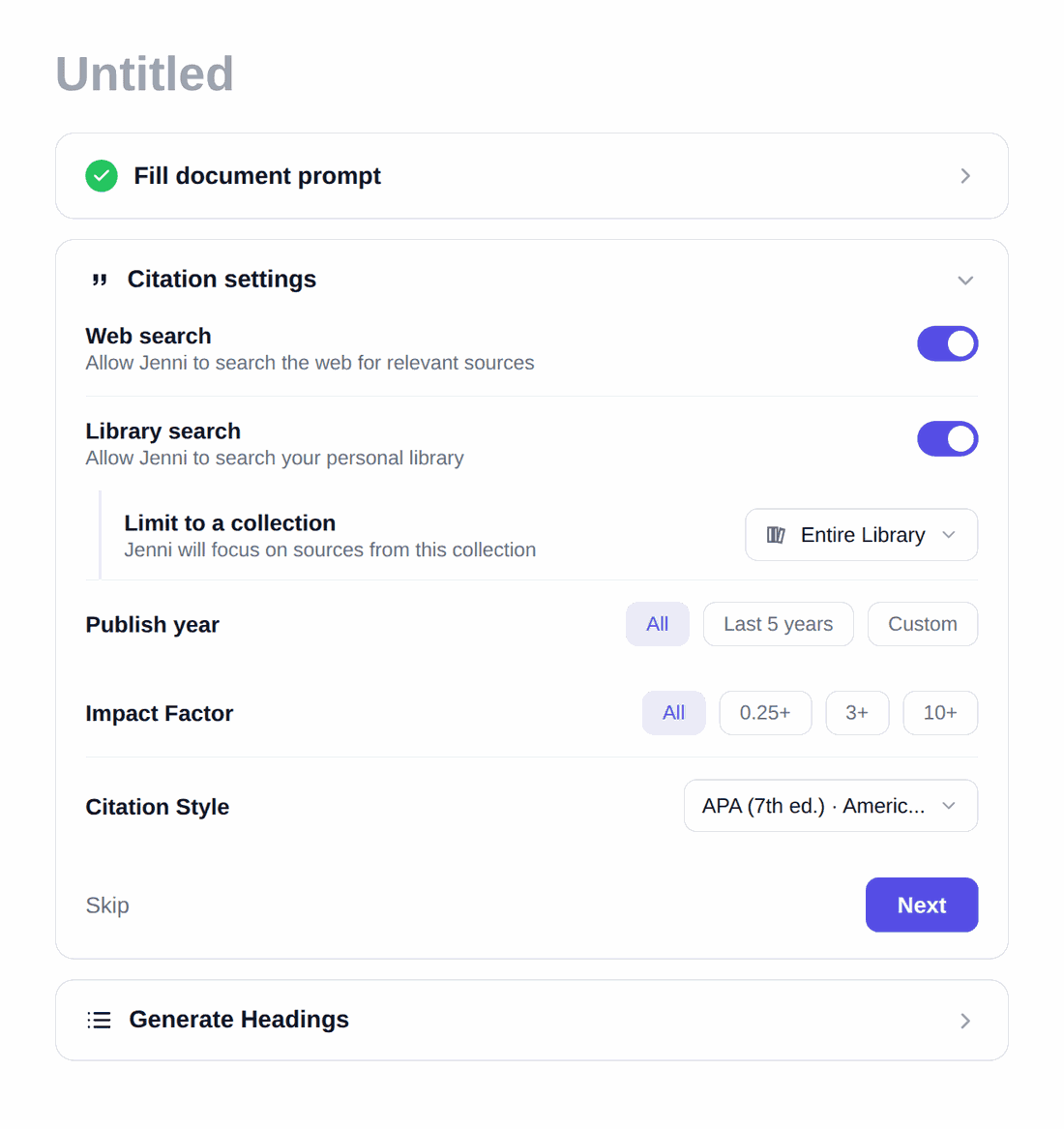
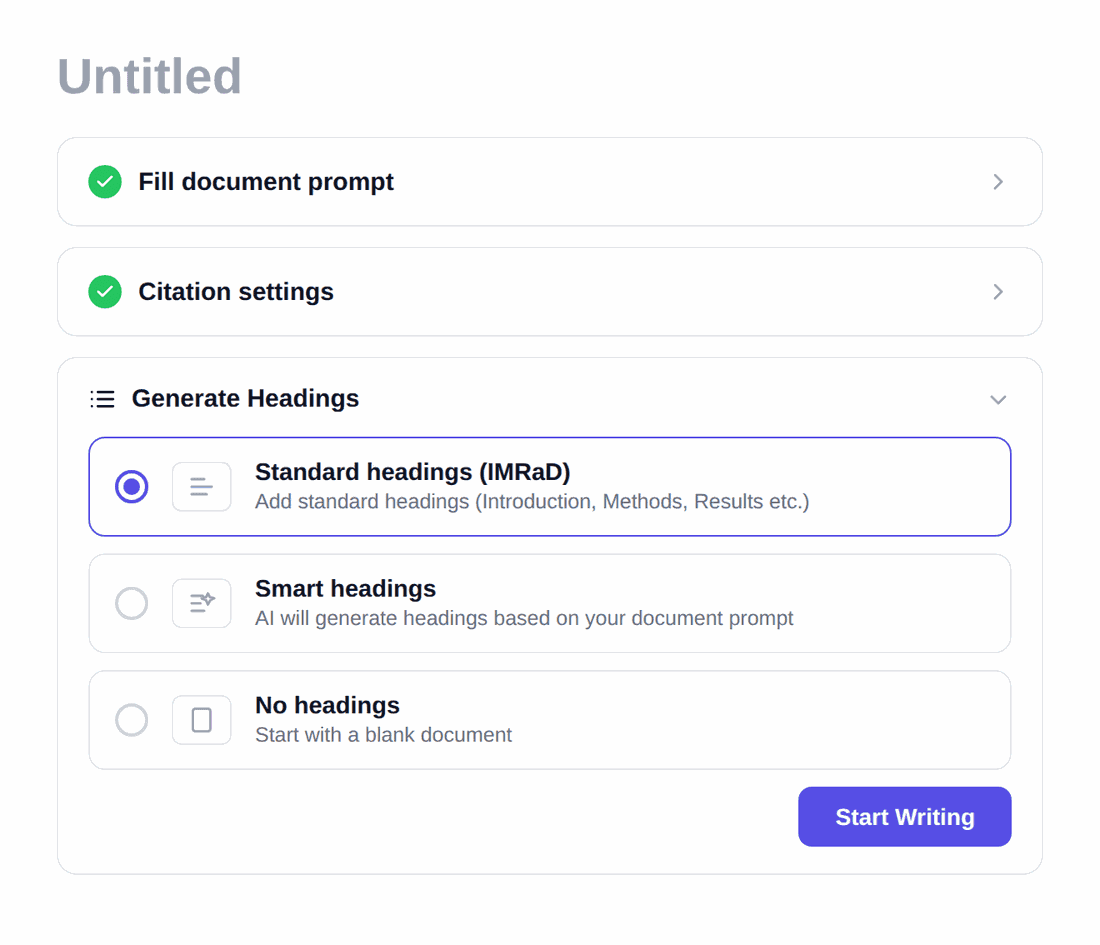
Step 3. Generate the headings. Build the outline before any prose exists, so citations attach to sections that are already in their final order. That matters more in a numbered style than in an author-date one, because moving a section later renumbers everything after it.
Step 4. Bring in your sources by identifier. Add each paper by its PMID, DOI, or ISBN, or import an existing library from Zotero, Mendeley, BibTeX, or RIS. Pulling by identifier means the author list and page range come in correct, which removes the two fields people most often mistype.
Step 5. Check the output against this page. No tool is a substitute for knowing the style. Spot check three references against the examples above, particularly the author count and the journal abbreviation, and confirm that every source is one you would defend if an editor asked.
Get the Style Right, Then Stop Thinking About It
The purpose of a house style is to make formatting invisible so a reader spends their attention on the argument. AMA achieves that better than most, because the numbered system keeps the running text clean, and the manual settles almost every question you might otherwise stop to consider. The cost is that the rules are specific and there are a lot of them.
<CTA title="Let the References Format Themselves" description="Write in AMA style with citations numbered and built as you go, then check them against the source" buttonLabel="Try Jenni Free" link="https://app.jenni.ai/register" />
Bookmark the reference table above, look up journal abbreviations rather than guessing them, and check any guide you rely on for the tell of a publisher city. Do those three things and your reference list will already be cleaner than most of what reaches editors.