Por
Justin Wong
—
Ensaio sobre Brutalidade Policial: Exemplos, Análise e Como Escrever o Seu Próprio

Justin Wong
Chefe de Crescimento
Formado com um Bacharelado em Negócios Globais e Artes Digitais, com Menor em Empreendedorismo

A brutalidade policial é um problema sério em muitos países. Isso acontece quando os agentes policiais usam força excessiva ou agem de forma injusta com os civis. Essas ações podem prejudicar as pessoas física e emocionalmente. Também podem abalar a confiança entre a polícia e as comunidades. Escrever um ensaio sobre brutalidade policial pode parecer difícil porque o tema é sensível. Como esses ensaios costumam ser argumentativos, ajuda rever exemplos poderosos de ensaios persuasivos e ver como os autores sustentam as afirmações com evidências.
Este artigo mostra seis exemplos de ensaios sobre brutalidade policial. Cada exemplo explica como escrever sobre definições, causas, efeitos e soluções. Se você estiver procurando outro exemplo de escrita sobre dano e responsabilização, o nosso guia de ensaio sobre bullying com exemplos reais é uma comparação útil. Você também aprenderá a criar o seu próprio ensaio com passos simples.
<CTA title="Comece a escrever um ensaio sobre brutalidade policial" description="Gere em minutos um ensaio estruturado e perspicaz sobre brutalidade policial com a Jenni." buttonLabel="Experimente a Jenni gratuitamente" link="https://app.jenni.ai/register" />
6 exemplos de ensaios sobre brutalidade policial
Explore estes ensaios de exemplo que abordam diferentes ângulos da brutalidade policial, sua definição, causas, impactos, aspectos legais/de políticas, histórias humanas e soluções. Cada um mostra estrutura, tom e clareza para inspirar a sua própria escrita.
Exemplo #1: Compreendendo a brutalidade policial – definição e visão geral (322 palavras)
Introdução:
A brutalidade policial envolve o uso excessivo ou injustificado de força por parte de agentes da lei. Esta forma de má conduta viola os direitos civis, mina a confiança pública e pode causar traumas para toda a vida nas vítimas. Incidentes de grande repercussão, como o assassinato de George Floyd nos Estados Unidos, chamaram a atenção global para falhas sistémicas nas práticas policiais. Entender o que a brutalidade policial envolve é o primeiro passo para elaborar um ensaio que seja ao mesmo tempo factual e persuasivo.
Definição e características:
No seu núcleo, brutalidade policial refere-se a atos em que agentes usam força desnecessária ou desproporcional contra civis. As manifestações comuns incluem:
Violência física durante prisões ou protestos
Intimidação verbal e assédio
Tiros injustificados ou uso de taser
Perfilagem racial direcionada a comunidades minoritárias
Porque isso importa:
A violência por parte da polícia afeta não apenas indivíduos, mas comunidades inteiras. As vítimas podem enfrentar efeitos psicológicos de longo prazo, enquanto as comunidades desenvolvem desconfiança em relação à polícia, dificultando a cooperação e a segurança. A brutalidade policial é muitas vezes sistémica, alimentada pela cultura institucional, pela falta de responsabilização e pelo viés racial.
Dica prática para o ensaio:
Ao discutir definições no seu ensaio, use linguagem clara e concisa. Evite afirmações abstratas como “a brutalidade policial é má”. Em vez disso, apresente exemplos e explique o impacto mais amplo.
Parágrafo de exemplo:
“Em 2020, o assassinato de George Floyd desencadeou protestos globais contra a má conduta policial. A sua morte destacou os perigos do uso excessivo da força, da perfilagem racial e da impunidade policial, ilustrando como problemas sistémicos podem resultar em consequências trágicas.”
Como expandir:
Inclua estatísticas sobre violência policial de fontes credíveis.
Compare incidentes em diferentes países para mostrar padrões.
Incorpore definições legais para esclarecer o que constitui má conduta.
Exemplo #2: Causas da brutalidade policial (cerca de 325 palavras)
Introdução:
Porque é que a brutalidade policial ocorre? A realidade é que ela resulta de múltiplas causas sobrepostas, e não de um único erro. Explorar estes fatores de raiz ajuda qualquer escritor a ir além de descrições superficiais.
Causas principais:
Racismo sistémico e perfilagem racial: Estudos mostram que pessoas de cor enfrentam riscos mais elevados de ações de fiscalização e uso da força.
Cultura policial e militarização: Forças que enfatizam a dureza, o “nós contra eles” e o policiamento com equipamento pesado podem aumentar a probabilidade de uso excessivo da força.
Falta de responsabilização e transparência: Quando a supervisão é fraca, a má conduta persiste; a recolha de dados é incompleta.
Dimensões socioeconómicas e jurídicas: Comunidades que enfrentam pobreza, segregação ou proteções mais fracas muitas vezes suportam o maior peso destas práticas.
Exemplo breve:
Em uma análise, os americanos negros foram abordados, revistados ou presos a taxas mais altas do que os americanos brancos, mesmo controlando o contacto.
<ProTip title="🔍 Dica profissional:" description="Use palavras de transição como porque, devido a ou como resultado para tornar as ideias de causa e efeito mais claras" />
Conclusão:
Para reduzir a brutalidade policial, precisamos focar não apenas nos agentes envolvidos, mas nas estruturas em que eles operam. Se o racismo, a formação inadequada, a supervisão fraca e a desigualdade social persistirem, o risco continuará.
Exemplo #3: Impactos da brutalidade policial – consequências sociais e individuais (325 palavras)
Introdução:
Explicar os efeitos da brutalidade policial fortalece o seu ensaio ao conectar incidentes a consequências do mundo real. Os impactos ocorrem em múltiplos níveis: individual, comunitário e societal.
Violações dos direitos humanos:
As vítimas da violência policial frequentemente sofrem lesões físicas graves, trauma psicológico ou morte. A tortura e o tratamento desumano em alguns países evidenciam as consequências extremas da má conduta sem controlo.
Medo e desconfiança na comunidade:
Incidentes repetidos corroem a confiança entre a aplicação da lei e os cidadãos. As comunidades podem evitar denunciar crimes, reduzindo a segurança geral. Analogia: quando a ponte entre a polícia e os cidadãos enfraquece, o tecido social de toda a comunidade corre o risco de colapsar.
Divisões sociais:
A brutalidade policial agrava as tensões raciais e sociais já existentes. Protestos, manifestações e agitação civil costumam seguir casos de grande repercussão, refletindo profundas fraturas sociais.
Impactos económicos:
Litígios e acordos judiciais em casos de má conduta policial custam milhões aos governos, desviando fundos de programas comunitários e serviços sociais.
Parágrafo de exemplo:
“Em cidades onde os tiroteios policiais são frequentes, os residentes relatam níveis mais elevados de medo, stress e afastamento da comunidade. Isto mostra como a má conduta afeta não apenas as vítimas, mas o bem-estar coletivo dos bairros, minando a confiança no sistema de justiça.”
<ProTip title="💡 Dica profissional:" description="Inclua dados reais, como estatísticas sobre tiroteios policiais, detenções e denúncias, para ilustrar o impacto social e dar credibilidade ao seu ensaio." />
Exemplo #4: Dimensões jurídicas e políticas da brutalidade policial (cerca de 329 palavras)
Introdução:
Compreender como as leis e políticas moldam, e às vezes falham em prevenir, a brutalidade policial é essencial para criar soluções. Este ângulo do ensaio explora o lado institucional do problema.
Quadros jurídicos:
Os padrões de uso da força variam amplamente entre jurisdições e, por vezes, carecem de clareza ou de aplicação.
A recolha de dados públicos sobre o uso da força pela polícia é incompleta: por exemplo, o Federal Bureau of Investigation (FBI) lançou a sua National Use-of-Force Data Collection em 2019, mas a participação é voluntária.
Os mecanismos de supervisão muitas vezes carecem de eficácia ou independência.
Tópicos de política:
Câmaras corporais, câmaras de tablier e conselhos de supervisão civil podem melhorar a transparência.
As reformas de formação (desescalada, consciência de viés) são cada vez mais defendidas.
Reformas legais: padrões mais claros para o uso de força letal; disciplina mais rigorosa para a má conduta.
Desafios:
Algumas reformas funcionam apenas em lugares com forte vontade política e recursos.
Lacunas de dados dificultam a responsabilização e tornam a reforma mais difícil de acompanhar.
<ProTip title="📊 Dica profissional:" description="Ao escrever sobre políticas, relacione-as com resultados mensuráveis (dados ou estudos de caso)." />
Conclusão:
As reformas legais e de políticas, por si só, não acabarão com a brutalidade policial, mas sem elas a mudança é improvável. Padrões claros, responsabilização real, dados sólidos e compromisso político fornecem a base para o progresso.
Exemplo #5: Histórias humanas e exemplos de casos de brutalidade policial (cerca de 320 palavras)
Introdução:
As estatísticas contam parte da história, mas as narrativas humanas trazem o tema da brutalidade policial para a vida. Casos do mundo real mostram como leis e sistemas afetam pessoas reais.
Exemplo de caso:
Um desses casos: o assassinato de George Floyd em 2020 expôs problemas sistémicos no policiamento e desencadeou protestos em todo o mundo.
Outro: Tyre Nichols foi espancado mortalmente por agentes em Memphis em 2023 após uma paragem de trânsito.
O que estas histórias ilustram:
Como a força pode ser usada em circunstâncias que exigem escrutínio.
Como os mecanismos de responsabilização frequentemente falham ou são lentos.
Como a consciencialização pública, as provas em vídeo e o ativismo comunitário podem mudar a pressão e a reforma.
Humanizando as estatísticas:
Quando você lê que a polícia mata mais de 1.200 pessoas por ano nos EUA, por trás de cada número há uma pessoa, uma família e uma comunidade afetada.
<ProTip title="🧍♂️ Nota:" description="Use exemplos nomeados para fundamentar questões gerais, mantendo-os breves e respeitosos." />
Conclusão:
Estas histórias pessoais focalizam a lente: elas deslocam a pergunta de “quantos” para “quem” e “o que aconteceu”. E essa mudança ajuda a motivar as reformas mais profundas que são necessárias.
Exemplo #6: Soluções para a brutalidade policial (cerca de 310 palavras)
Introdução:
Enfrentar a brutalidade policial exige mais do que reconhecimento; exige ação. Este ensaio explora as soluções que foram propostas e onde a mudança está a acontecer.
Áreas-chave de solução:
Responsabilização & Transparência: supervisão independente, dados públicos sobre o uso da força, câmaras corporais, conselhos de revisão civil.
Formação & Mudança de cultura: ênfase na desescalada, consciência de viés, policiamento comunitário e menor dependência de táticas militarizadas.
Reforma legal: rever as leis de uso da força, garantir que os agentes sejam sujeitos a padrões claros, remover proteções legais em casos de má conduta.
Envolvimento da comunidade: fortalecer a confiança entre polícia e comunidade, investir em serviços sociais, redefinir papéis para intervenções não violentas.
Por exemplo, nos EUA, cerca de 300.000 pessoas por ano são reportadas como tendo sofrido uso não fatal da força policial, e a disparidade racial é gritante: as pessoas negras têm cerca de 3,2 vezes mais probabilidade do que as pessoas brancas de enfrentar força não fatal.
<ProTip title="🌱 Dica profissional:" description="Ao escrever sobre soluções, organize-as por escala: institucional, comunitária, individual." />
Conclusão:
A mudança real exige esforço em muitos níveis: legal, cultural, de formação e comunitário. As soluções existem, mas exigem compromisso, recursos e acompanhamento.
Como escrever um ensaio sobre brutalidade policial com a Jenni
Escrever sobre brutalidade policial não precisa ser avassalador. A Jenni ajuda a transformar temas complexos em ensaios claros e estruturados em minutos. Veja como começar:
Passo 1: Inicie um novo documento
Visite Jenni.ai e clique em Começar a escrever na página inicial. Após iniciar sessão, selecione Novo documento para abrir um espaço de trabalho em branco.

Passo 2: Comece com um prompt
Selecione Comece com um prompt. Na janela pop-up, escreva um prompt focado apenas em esboço, como:
Crie um esboço que explique as causas da brutalidade policial nos EUA e globalmente, mostre como problemas sistémicos contribuem para o uso excessivo da força e inclua soluções que as comunidades podem aplicar para reduzir o dano.

A Jenni produzirá um esboço estruturado com títulos e transições.
Escolha um estilo de títulos:
Títulos inteligentes – secções estruturadas e limpas
Títulos padrão – secções académicas clássicas
Sem títulos – início em página em branco
Passo 3: Deixe a Jenni começar a escrever
Clique em Começar a escrever. A Jenni gerará automaticamente títulos provisórios, aberturas de secções e parágrafos de rascunho com base no seu esboço. Se quiser afinar primeiro a sua tese central, use o gerador de tese com IA.
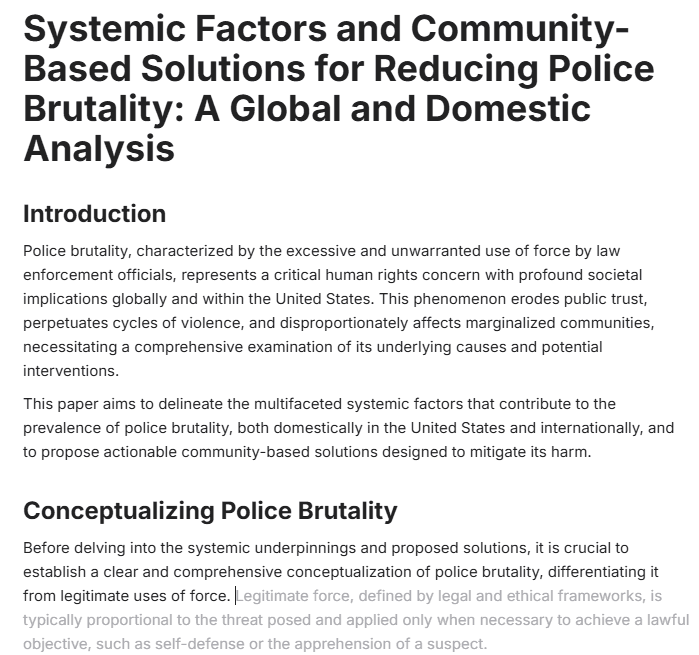
Para refinar o seu texto:
Leia as sugestões
Clique em Aceitar para inserir
Ou clique em Tentar novamente para um ângulo diferente
Passo 4: Mantenha o ritmo
Com o seu esboço definido, desenvolva cada pilar parágrafo por parágrafo.
Revise as sugestões da Jenni enquanto escreve. Aceitar o que fizer sentido, ou clique em Tentar novamente para um ângulo diferente, até que o ensaio pareça autenticamente seu.
Chega de página em branco, apenas progresso constante.
As soluções para a brutalidade policial começam consigo
A brutalidade policial continua a ser um dos desafios mais sérios enfrentados por sociedades que afirmam proteger os direitos civis, manter a justiça e construir a confiança comunitária. Das causas aos impactos, das histórias humanas às soluções, escrever sobre este tema ajuda a esclarecer factos, elevar vozes e impulsionar a reforma.
<CTA title="Comece o seu ensaio sobre brutalidade policial agora" description="Dê forma à sua voz sobre o uso da força pela polícia com a Jenni — organizado, perspicaz e impactante." buttonLabel="Experimente a Jenni gratuitamente" link="https://app.jenni.ai/register" />
Com exemplos estruturados como os acima e a orientação da Jenni, você pode transformar um tema difícil num ensaio claro, persuasivo e relevante.