Por
Justin Wong
—
Visão Geral do Estilo de Referência de Oxford: Notas de Rodapé, Bibliografia e Guia de Citação

Justin Wong
Chefe de Crescimento
Formado com um Bacharelado em Negócios Globais e Artes Digitais, com Menor em Empreendedorismo

A escrita académica precisa de honestidade, estrutura e confiança. Uma forma de o conseguir é usar o estilo de referenciação Oxford. Este método ajuda os autores a dar crédito a outros, mantendo o seu próprio texto limpo e legível.
Neste guia, vai aprender o que é a referenciação Oxford, como funciona e como a usar corretamente. Abordaremos notas de rodapé, bibliografias e erros comuns. Também verá exemplos simples de como citar livros, artigos e websites usando o estilo Oxford.
<CTA title="Domine a Referenciação Académica Rapidamente" description="Gere citações Oxford precisas em segundos com a Jenni AI, sem dores de cabeça com formatação nem notas de rodapé em falta." buttonLabel="Experimente a Jenni Grátis" link="https://app.jenni.ai/register" />
O que é o Estilo de Referenciação Oxford?
O estilo de referenciação Oxford (também chamado sistema documental-nota) usa notas de rodapé e uma bibliografia para mostrar de onde vem a informação. É popular nas humanidades, no direito e nas ciências sociais.
Quando usa este estilo, coloca pequenos números em sobrescrito no texto logo depois da frase citada ou parafraseada. Cada número corresponde a uma nota de rodapé no fundo da página. A primeira nota de rodapé fornece todos os detalhes da fonte. Referências posteriores à mesma fonte podem ser abreviadas. No final do trabalho, inclui uma bibliografia que lista todas as fontes por ordem alfabética do apelido do autor.
O estilo Oxford surgiu na Universidade de Oxford, onde a clareza e a precisão eram essenciais. Ao contrário de Harvard ou APA, a referenciação Oxford mantém o texto livre de longos parênteses no corpo do texto, tornando-o mais fácil de ler.
<ProTip title="💡 Dica Pro:" description="Use a referenciação Oxford quando quiser que o seu trabalho pareça limpo e fácil de ler." />
Porque o Estilo Oxford é Importante
Uma boa referenciação faz mais do que seguir regras. Mostra honestidade e respeito pelas ideias de outros autores. O sistema Oxford ajuda-o a manter-se claro e consistente.
Eis por que isso importa:
Mantém a escrita limpa: Os leitores concentram-se nas suas ideias, não em citações longas.
Mostra profundidade: As notas de rodapé podem incluir observações úteis ou comentários curtos.
Preserva a confiança: Cada ideia pode ser rastreada até à sua fonte.
Facilita a aprendizagem: Os leitores podem verificar as fontes para obter mais informações.
Por exemplo, um estudante de história pode usar a referenciação Oxford para explicar uma teoria, acrescentando fontes no rodapé sem interromper a narrativa.
Partes Principais do Sistema de Referenciação Oxford
1. Números em sobrescrito
Sempre que citar algo, adicione um número em sobrescrito logo após a frase ou citação. Estes números avançam por ordem ao longo de todo o documento.
Exemplo:
Muitos académicos acreditam que a educação altera a mobilidade social.¹
2. Notas de rodapé
As notas de rodapé aparecem no fundo da página. Na primeira vez que mencionar uma fonte, forneça todos os detalhes. Se a utilizar novamente mais tarde, encurte-a.
Exemplo (primeira citação):
¹ Peter Burke, History and Social Theory, 3rd edn (Cambridge: Polity Press, 2019), p. 45.
Exemplo (citação posterior):
² Burke, History and Social Theory, p. 112.
<ProTip title="📘 Lembrete:" description="Depois de citar uma fonte uma vez, use uma versão abreviada da próxima vez para manter as notas organizadas." />
3. Bibliografia
No final do seu ensaio ou relatório, liste todas as fontes por ordem alfabética.
Exemplo:
Burke, Peter. History and Social Theory, 3rd edn. Cambridge: Polity Press, 2019.
As notas de rodapé indicam números de página; a bibliografia não, exceto se listar um volume editado.
Regras de Formatação e Variações
Diferentes instituições podem ter regras ligeiramente diferentes, mas a maioria segue estas noções básicas.
Formatação Geral
Elemento | Regra |
Tipo de letra e tamanho | Use Times New Roman 12 pt ou semelhante. |
Espaçamento entre linhas | Texto com espaçamento duplo, notas de rodapé com espaçamento simples. |
Números das notas de rodapé | Mantenha a numeração contínua. |
Aspas | Aspas simples (‘ ’) para citações curtas; aspas duplas (“ ”) apenas dentro de citações. |
Citações em bloco | Recuar citações longas (40 ou mais palavras), sem aspas. |
Números de página | Inclua sempre ao citar ou parafrasear páginas específicas. |
<ProTip title="✍️ Nota:" description="Na referenciação Oxford, a pontuação fica dentro das aspas, não depois delas." />
“Ibid.” e Títulos Curtos
Se citar a mesma fonte novamente logo após a nota anterior, pode usar Ibid. em vez de a escrever por extenso.
Exemplo:
¹ John Tosh, The Pursuit of History, 6th edn (London: Routledge, 2015), p. 78.
² Ibid., p. 79.
Alguns professores preferem títulos curtos em vez de “Ibid.” para maior clareza ao ler versões digitais.
Como Citar Diferentes Tipos de Fonte
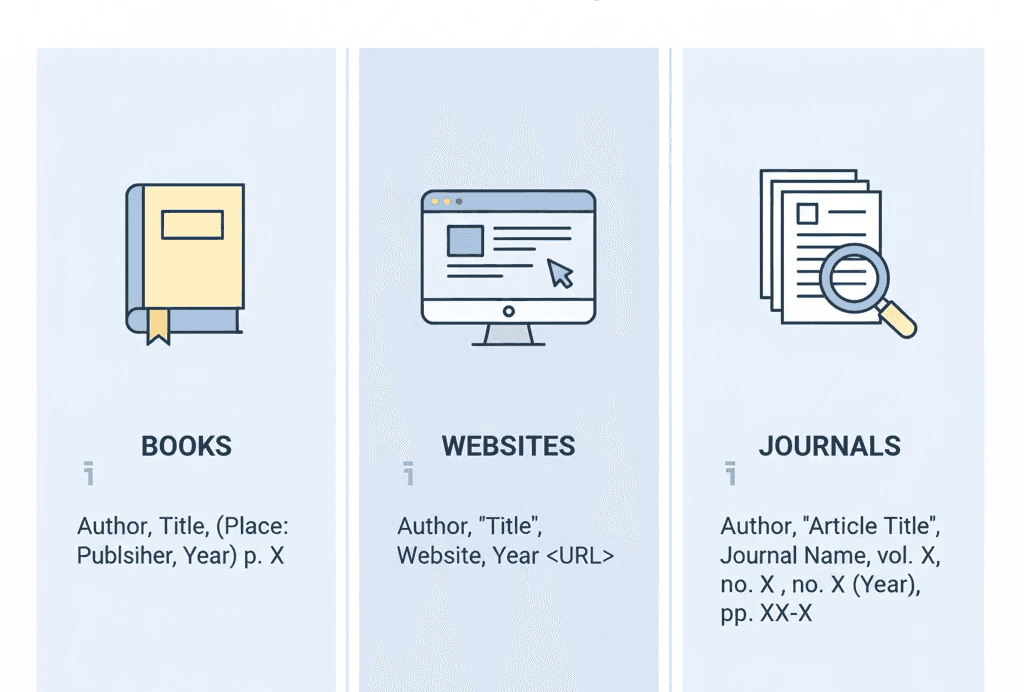
Cada tipo de fonte tem a sua própria estrutura. Aqui estão os exemplos mais comuns.
1. Livros
Nota de rodapé:
¹ Eric Hobsbawm, The Age of Revolution: Europe 1789–1848 (London: Weidenfeld & Nicolson, 1962), p. 33.
Bibliografia:
Hobsbawm, Eric. The Age of Revolution: Europe 1789–1848. London: Weidenfeld & Nicolson, 1962.
2. Livros Editados
Nota de rodapé:
² Roger Scruton (ed.), The Oxford Companion to Philosophy (Oxford: Oxford University Press, 2005), p. 215.
Bibliografia:
Scruton, Roger, ed. The Oxford Companion to Philosophy. Oxford: Oxford University Press, 2005.
3. Capítulos de Livro
Nota de rodapé:
³ Mary Beard, ‘Roman Laughter and Power’, in Laughter and the Ancient World, ed. by J. Hall (Cambridge: Cambridge University Press, 2014), pp. 45–58 (p. 47).
Bibliografia:
Beard, Mary. ‘Roman Laughter and Power’. Em Laughter and the Ancient World, editado por J. Hall, 45–58. Cambridge: Cambridge University Press, 2014.
4. Artigos de Revista
Nota de rodapé:
⁴ Linda Woodbridge, ‘The Shadow of Hamlet’s Father’, Studies in English Literature, 48.2 (2008), pp. 265–290 (p. 270).
Bibliografia:
Woodbridge, Linda. ‘The Shadow of Hamlet’s Father’. Studies in English Literature, 48 no. 2 (2008): 265–290.
<ProTip title="🗞️ Dica Pro:" description="Adicione sempre o volume e o número da edição quando citar um artigo de revista." />
5. Sítios Web
Nota de rodapé:
⁵ National Archives, ‘World War II Documents’, UK Government Archives, https://www.nationalarchives.gov.uk/ww2/ [consultado em 25 de outubro de 2025].
Bibliografia:
National Archives. ‘World War II Documents’. UK Government Archives. https://www.nationalarchives.gov.uk/ww2/ [consultado em 25 de outubro de 2025].
6. Revistas Online
Nota de rodapé:
⁶ Maria Lopez, ‘Digital Humanities and Archival Research’, Journal of Modern Studies [Online], 7 (2022), https://jms.edu/lopez2022.
Bibliografia:
Lopez, Maria. ‘Digital Humanities and Archival Research’. Journal of Modern Studies [Online], 7 (2022). https://jms.edu/lopez2022.
7. Artigos de Jornal
Nota de rodapé:
⁷ Jane Bennett, ‘Ethics in Contemporary Politics’, The Guardian, 15 de julho de 2024, p. 12.
Bibliografia:
Bennett, Jane. ‘Ethics in Contemporary Politics’. The Guardian, 15 de julho de 2024.
Citações Diretas e Indiretas
Citações Diretas
Use aspas simples para citações curtas. Para as longas, use um bloco recuado e retire as aspas.
Exemplo:
Como escreveu Foucault, ‘o poder está em toda a parte, não porque abranja tudo, mas porque vem de toda a parte’.⁸
Citações Indiretas
Mesmo que reformule uma ideia com as suas próprias palavras, tem de citar a fonte.
Exemplo:
Os académicos concordam que as normas sociais ajudam a moldar o poder na vida quotidiana.⁹
<ProTip title="🧠 Dica Pro:" description="Cite sempre ideias parafraseadas para evitar plágio." />
Erros Comuns a Evitar
Até os escritores cuidadosos podem cometer erros de citação. Estes são os mais comuns.
1. Misturar Diferentes Estilos
Não alterne entre Oxford e Harvard ou APA no mesmo trabalho. Escolha um e use-o em todo o lado.
2. Falta de Números de Página
Adicione sempre números de página quando usar ou discutir um ponto específico de uma fonte.
3. Pontuação Errada
A referenciação Oxford usa vírgulas entre as partes de uma citação e um ponto final no fim.
4. Omitir Datas de Acesso
Quando citar websites ou artigos online, inclua a data de acesso, porque as páginas web podem mudar.
5. Repetir Citações Completas
Depois da primeira menção, use a forma abreviada (autor + título curto + número de página).
<ProTip title="⚠️ Lembrete:" description="Antes de submeter, verifique todo o documento à procura de erros de formatação nas citações." />
Estilo Oxford vs Outros Sistemas de Referenciação
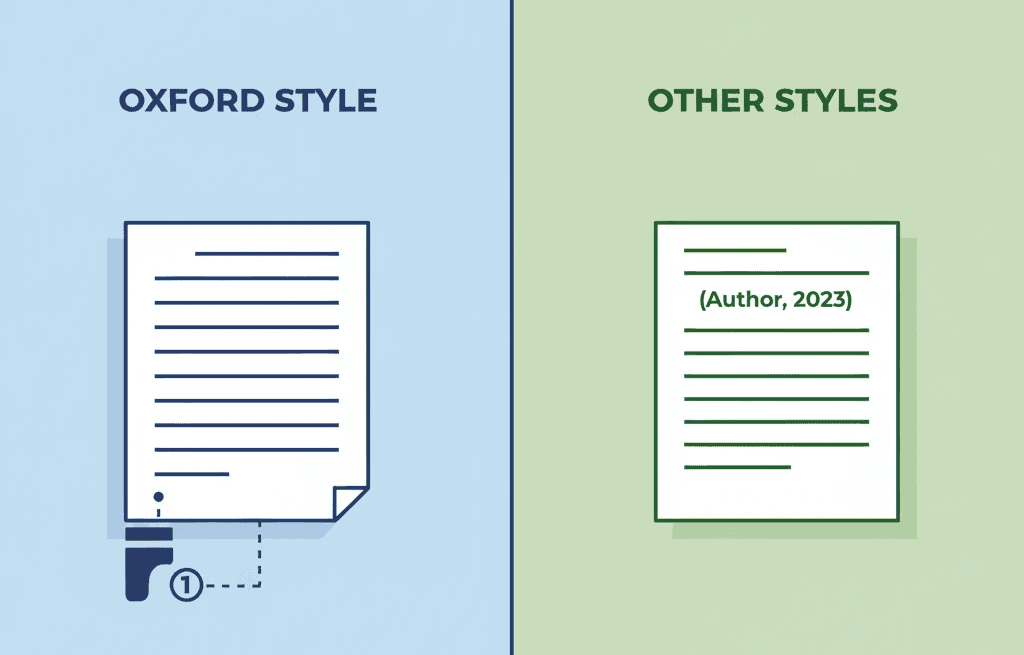
Diferentes sistemas de citação servem diferentes áreas. Veja como o Oxford se compara com Harvard e APA. Para uma abordagem de notas e bibliografia estreitamente relacionada, consulte o nosso guia de citações em estilo Chicago.
Característica | Estilo Oxford (Sistema de Notas de Rodapé) | Harvard / APA (Autor-data) |
Citações no texto | Números em sobrescrito ligados às notas de rodapé | Autor + ano entre parênteses |
Legibilidade | Alta – o texto mantém-se limpo | Menor – as citações interrompem o fluxo |
Áreas | Humanidades, Direito, Teologia | Ciências, Ciências Sociais |
Local da citação | Notas de rodapé + Bibliografia | No texto + Lista de referências |
Citação repetida | Título curto ou “Ibid.” | Autor + ano repetidos |
Use Oxford quando a sua disciplina valoriza profundidade e fluidez. Use Harvard ou APA para textos mais curtos e mais carregados de investigação.
<ProTip title="📚 Nota:" description="Consulte sempre o guia da disciplina; alguns departamentos usam notas finais em vez de notas de rodapé." />
Lista de Verificação: Como Aplicar a Referenciação Oxford
✅ Formatação
Os números em sobrescrito vêm depois da pontuação.
As notas de rodapé têm espaço simples e uma fonte menor.
Bibliografia ordenada pelo apelido.
✅ Citações
Primeira nota: detalhes completos.
Notas seguintes: forma abreviada.
“Ibid.” apenas quando usado duas vezes seguidas.
✅ Citações textuais
Aspas simples para curtas, recuadas para longas.
Inclua sempre números de página.
✅ Fontes Digitais
Inclua o URL completo e a data de acesso.
Identifique as revistas online como “[Online]”.
✅ Consistência
Mantenha a mesma pontuação e o mesmo formato em todo o lado.
<ProTip title="🧾 Dica Pro:" description="A Jenni AI pode verificar a consistência das citações e corrigir automaticamente pequenos erros de formatação." />
Quando Usar o Estilo Oxford
A referenciação Oxford funciona melhor quando:
Escreve em humanidades, direito ou teologia.
O seu professor ou editor o pede.
Precisa de incluir pequenas notas ou traduções nas notas de rodapé.
Prefere uma escrita limpa, quase narrativa, sem poluição no corpo do texto.
Se escreve em ciências, medicina ou psicologia, normalmente é exigido outro estilo, como APA ou Vancouver.
Referenciação Oxford na Era Digital

Com a aprendizagem online e a publicação digital, a referenciação exige mais cuidado do que nunca. Ferramentas como geradores de citações e a Jenni AI podem poupar tempo — se estiver a avaliar software de citação vs referenciação manual, esta análise pode ajudar. Se gerir fontes no Zotero ou no Mendeley, a integração da Jenni AI com o Zotero e o Mendeley pode ajudar a manter a sua biblioteca organizada enquanto escreve. Mas continua a precisar de verificar por si detalhes como a pontuação e o itálico.
As ferramentas automatizadas podem falhar pequenos erros, como a capitalização (The Guardian vs the Guardian). A funcionalidade de escrita com base primeiro no esboço da Jenni ajuda-o a planear e a citar com precisão sem perder a estrutura.
Exemplo: Referenciação Oxford em Ação
Aqui está um pequeno parágrafo de exemplo que mostra como a referenciação Oxford aparece dentro de um trabalho.
Os historiadores debatem há muito as causas da Revolução Francesa.¹ Alguns, como Hobsbawm, defendem que a mudança económica enfraqueceu os velhos sistemas,² enquanto outros apontam para as novas ideias do Iluminismo.³
Notas de rodapé:
¹ Peter Jones, Revolutions and the Modern World (Cambridge: CUP, 2020), p. 14.
² Eric Hobsbawm, The Age of Revolution: Europe 1789–1848 (London: Weidenfeld & Nicolson, 1962), p. 33.
³ Sarah Maza, Thinking About the French Revolution (Oxford: OUP, 2019), p. 51.
No fim, a sua bibliografia lista as três obras por ordem alfabética.
Vantagens e Desvantagens
✅Vantagens
Mantém a escrita organizada e fácil de ler.
Fornece referências detalhadas através de notas de rodapé.
Permite pequenos comentários nas notas.
Ideal para ensaios com citações longas ou análise.
📉Desvantagens
Pode levar tempo a formatar manualmente.
Não é ideal para escrita apenas online.
É complexo para investigação com muitos dados.
Ainda assim, o estilo Oxford é claro, elegante e profissional quando bem aplicado.
Dominar o Estilo de Referenciação Oxford para Clareza e Credibilidade
O estilo de referenciação Oxford ajuda os autores a manterem-se honestos, organizados e claros. Usa notas de rodapé, números em sobrescrito e uma bibliografia para mostrar exatamente de onde vem a informação.
<CTA title="Construa Citações Oxford Perfeitas" description="Use a Jenni AI para formatar e verificar as suas notas de rodapé, encurtar citações repetidas e organizar a sua bibliografia em segundos." buttonLabel="Começar Grátis com Jenni" link="https://app.jenni.ai/register" />
Quer seja estudante, investigador ou escritor profissional, dominar a referenciação Oxford mostra respeito pelas suas fontes e fortalece a confiança do leitor. Com ferramentas como a Jenni AI, pode formatar as suas citações rapidamente, mantendo o trabalho limpo e correto.