Dwara
Justin Wong
—
Critical Review Structure: Academic Writing Ke Liye Clear Framework

Justin Wong
Vikas Prabhari
Graduated kiya Bachelor's me Global Business & Digital Arts, Minor me Entrepreneurship

Ek critical review ko successful banane ke liye ek clear structure ki zaroorat hoti hai. Isme char main sections hone chahiye: ek introduction, work ki summary, aapka critical analysis, aur ek conclusion. Yeh framework aapko kisi cheez ka sirf description dene se aage badhkar uski khoobiyon aur khamiyon par dhang se judgment dene me madad karta hai.
Harvard Writing Center jaisi jagahon se mili research bhi is baat ka samarthan karti hai, jo dikhati hai ki organized reviews zyada clear hote hain aur aksar behtar grades dilate hain.
Bahut se students ke paas achhe ideas hote hain par unhe ek logical flow me present karne me dikkat aati hai. Yeh guide aapko framework dikhayegi, examples degi, aur step-by-step apply karne ka tareeqa samjhayegi. Agar aap outline se shuru karna chahte hain, toh AI essay outline generator likhne se pehle in charo sections ko map karne me aapki madad kar sakta hai.
<CTA title="Write a Clear Critical Review" description="Turn complex papers into structured critical reviews with clarity and strong analysis" buttonLabel="Try Jenni Free" link="https://app.jenni.ai/register" />
Critical Review Structure Kya Hota Hai?
Ek critical review structure asal me kya karta hai? Yeh ek plan hai ki aap kisi text ko step-by-step kaise samjhenge aur uspar judgment denge. Zyadatar academic formats me char core sections hote hain: ek introduction, ek summary, analysis, aur ek conclusion. Yeh sirf fuzool ka kaam nahi hai. Yeh us tareeqe ko darshata hai jis tarah scholars se sochne ki umeed ki jaati hai.
University of New South Wales ek helpful critical review guide provide karti hai jo samjhati hai ki ek strong review objective summary aur subjective evaluation ke beech balance banata hai, jahan analysis ko paper ka sabse bada hissa hona chahiye.
Aap ise ek argument taiyar karne ki tarah samajh sakte hain. Aapki summary sabut (evidence) pesh karti hai. Aur aapka analysis woh jagah hai jahan aap apna case banate hain ki woh sabut kya sabit karta hai.
Structure critical hone ka asli kaaran
Bina structure ke ek review aksar ek disorganized list ban jata hai. Author ke bataye har point ko sirf describe karte rehna aasan hai, jo ki ek true critical review ke bajaye ek annotated bibliography jaisa dikhne lagta hai.
Ek defined framework ise rokta hai. Yeh aapko ideas ko sirf list karne ke bajaye unhe aapas me connect karne par majboor karta hai. Yeh aapke argument ko logically aage badhaye rakhta hai.
Sabse zaroori baat, yeh aapko apni khud ki interpretation develop aur showcase karne ke liye push karta hai, jo ki instructors grading ke waqt dekhte hain.
<ProTip title="💡 Pro Tip:" description="Write your analysis before polishing the summary to avoid over summarizing" />
Universities me critical reviews ke liye use hone wale standard four-part structure ka breakdown yahan diya gaya hai.
Section | Purpose | % of Word Count |
Introduction | Context + thesis judgment | 10–15% |
Summary | Objective overview | 20–30% |
Critical Analysis | Evaluation of strengths and weaknesses | 50–70% |
Conclusion | Final judgment and implications | 10–15% |
Yeh framework ainvayi nahi hai. Yeh zyadatar journal critiques me expected format se match karta hai aur common academic grading rubrics ke sath directly align hota hai.
Step-by-Step Critical Review Framework
Yahan critical review likhne ke liye ek practical, step-by-step framework diya gaya hai. Yeh process repeatable hai aur standard academic expectations ko follow karta hai.
Step 1: Ek focused introduction se shuru karein
Text aur uske author ko saaf taur par identify karke shuru karein. Sirf utna hi context dein jitna zaroori ho. Phir, apna overall judgment ya thesis turant btaein.
Ek strong introduction jaldi se teen sawalon ke jawab deta hai:
Text kis baare me hai?
Iska main argument kya hai?
Aapka verdict kya hai?
For example: "Apni 2022 ki study me, Smith ne argue kiya hai ki remote work flexible scheduling ke zariye productivity badhata hai. Halanki survey data kaafi compelling hai, lekin paper ka chhota sample size iske broader conclusions ko kamzor karta hai."
Yeh opening judgment aapke poore review ko guide karta hai.
<ProTip title="🧠 Reminder:" description="State your judgment early so readers understand your evaluation direction" />
Step 2: Objectively summarize karein
Yeh section poori tarah se descriptive hai. Aapka goal yeh prove karna hai ki aap us work ko judge karne se pehle use achhe se samajhte hain. Kisi bhi tarah ka opinion ya critique add karne se bachein.
Ek achhi summary me yeh sab shamil hona chahiye:
Author ka central argument.
Unka present kiya hua key evidence.
Unka use kiya gaya methods ya approach.
Text ka overall structure.
Example: "Smith ka analysis technology companies ke 500 employees ke survey responses par based hai, jisme unki reported productivity ko remote work par switch karne se pehle aur baad me compare kiya gaya hai."
Agar aapko revise karne ke liye ek quick baseline chahiye, toh ek AI summarizer pehli baar me ek objective overview generate kar sakta hai jise aap original text se verify kar sakte hain.
Agar aap bade academic work me summaries ko organize karne me struggle kar rahe hain, toh resources jaise how to write literature review outline aapko critique me badhne se pehle ideas ko zyada clearly structure karne me madad kar sakte hain. Agar aap sure nahi hain ki critical review isse kaise alag hai, toh hamara critical review vs literature review comparison dekhein.
Step 3: Apna critical analysis build karein
Yeh aapke review ka main section hai. Sirf random achhe aur bure points ki list mat banayein. Apne evaluation ko specific criteria ke aaspas organize karein, jaise:
Evidence ki quality aur sufficiency.
Methodology ki validity.
Conclusions ki relevance.
Potential biases ya unstated assumptions.
Ek common mistake yeh sochna hai ki critique ka matlab sirf kamiyan nikalna hai. Ek balanced analysis strengths aur weaknesses dono ko acknowledge karta hai, aur sabse zaroori, unka significance samjhata hai. Aur zyada detailed, evidence-based models ke liye, humare critique paper examples dekhein.
For instance:
Strength: 500 participants ka hona survey data ko zyada reliable banata hai.
Weakness: Sirf tech firms par focus karna study ki applicability ko limit karta hai.
Interpretation: Yeh narrow scope doosri industries, jaise manufacturing ya healthcare, me productivity ko samajhne ke liye is paper ki value ko kam karta hai.
Agar aapka writing bahut zyada descriptive lag raha hai, toh ho sakta hai aap common source synthesis mistakes literature reviews me phans rahe hain, jahan ideas ko analyze aur connect karne ke bajaye sirf list kiya jata hai.
<ProTip title="⚡ Note:" description="Always explain why a strength or weakness matters for the argument" />
Step 4: Ek concise conclusion ke sath end karein
Aapke conclusion ko sirf aapke introduction ko repeat nahi karna chahiye. Iske bajaye, ise aapke analysis ke key points ko synthesize karke aapke final judgment ko reinforce karna chahiye.
Ise:
Aapke overall evaluation ko restate karna chahiye.
Aapke critique se sabse important insights ko highlight karna chahiye.
Aapke analysis ke implications ya "so what" ko suggest karna chahiye.
Example: "Halanki Smith ki research tech sector ke andar productivity trends par useful data provide karti hai, iska limited demographic focus ise remote work par chal rahi wider academic debate me ek definitive contribution dene se rokta hai."
Yahan naye arguments introduce na karein. Yeh aapka final synthesis hai.
Critical Reviews Likhne Ke Asli Struggles
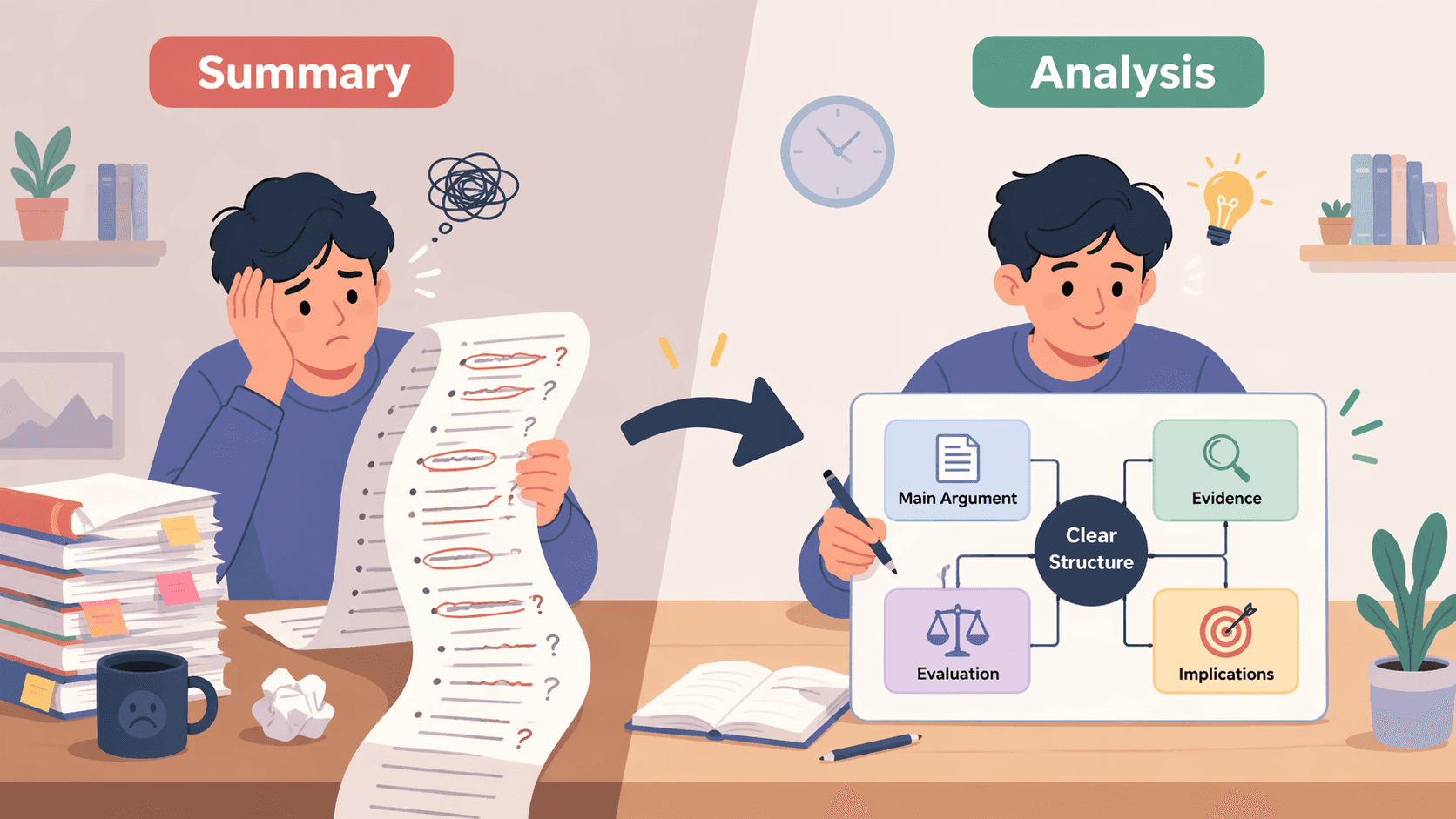
Students aksar critical review ke peeche ki theory toh jaante hain lekin jab unhe likhne ki baari aati hai toh practical problems face karte hain. Yeh woh asli execution problems hain jinki log online baat karte hain.
"Main bas har cheez ko summarize karne lagta hoon"
Yeh sabse badi complaint hai. Apne paper ka zyadatar hissa sirf yeh samjhane me bita dena aasan hai ki author ne kya kaha.
Oxford Brookes University ka unke critical analysis in academic reviews guide me ek useful breakdown is baat ko reinforce karta hai ki summary nahi, balki evaluation aapke writing par dominate hona chahiye.
Ek seedha sujhaav: pehle apni objective summary likhein. Phir, wapas jaakar sirf un specific claims, pieces of evidence, ya methods ko highlight karein jinki aap charcha karna chahte hain. Apni discussion ko sirf unhi highlighted points par expand karein.
"Mera review ek disconnected list jaisa lagta hai"
Yeh tab hota hai jab aap points ko bina link kiye present karte hain. Ek review alag-alag observations ki bullet-point list nahi banna chahiye.
Aise likhne ke bajaye:
Study ka dataset strong hai.
Methodology me weaknesses hain.
Conclusion unclear lagta hai.
Ideas ko connect karne ki koshish karein: "Halanki study ek strong dataset par bani hai, iske design me methodological flaws iske final conclusions par trust karna mushkil banate hain." Yeh alag-alag statements ko ek coherent argument me badal deta hai.
"Mujhe sure nahi hai ki 'critical' ka sahi matlab kya hai" Critical hone ka matlab negative hona nahi hai. Iska matlab evaluative hona aur specific sawal poochhna hai.
University College London ki writing a critical review effectively jaisi guidance explain karti hai ki kaise bina sirf criticize kiye strengths aur weaknesses dono ko assess kiya jaye.
Apne mindset ko "Author ne kya kaha?" se badalkar in sawalon par laayein:
Diya gaya evidence main claim ko kitne achhe se support karta hai?
Kya argument me koi logical gaps hain?
Kaun se perspectives ya counter-evidence missing ho sakte hain?
Yeh sawal poochhna aapke writing ko simple description se genuine analysis ki taraf le jata hai.
<ProTip title="🔥 Insight:" description="Ask why after every point to turn summary into analysis" />
Viral Frameworks aur Rubric Hacks Jo Kaam Karte Hain
Bahut se students jo strong reviews likhte hain, woh bas seedhe type karna shuru nahi karte. Woh apni thinking ko guide karne ke liye ek specific model ka use karte hain, jo actual writing ko kaafi simple bana deta.
Aise approaches jaise ki ek narrative literature review dikhate hain ki kaise ideas ko ek clear structure me organize karne se analysis zyada coherent aur follow karne me aasan ho sakta hai.
Five-question evaluation model
Yeh aapke critique ko structure karne ka ek common aur effective method hai. Aap paanch seedhe sawalon ke jawab dete hain, aur har jawab aapke analysis ka ek section ban sakta hai.
Author ka main claim kya hai? (Core argument ko restate karein.)
Ise support karne ke liye woh kis evidence ka use karte hain? (Unke primary sources, data, ya examples ko list karein.)
Woh evidence kitna strong aur reliable hai? (Uski quality, source, aur sufficiency ko evaluate karein.)
Kya missing hai ya overlooked hai? (Gaps, counterarguments, ya alternative perspectives ko identify karein.)
Yeh analysis kyun matter karta hai? (Iske implications, importance, ya limitations par discuss karein.)
Inhe order me answer karne se shuruat se ek logical, critical argument build hota hai.
Criteria ko apne structure ke roop me use karna Aap apne analysis section ko directly un criteria ke aaspas organize kar sakte hain jinhe aap evaluate kar rahe hain. Generic headings ke bajaye, un specific elements ka use karein jinpar aap judge kar rahe hain.
For example, aapki subheadings yeh ho sakti hain:
Evaluation of the Evidence
Review of the Methodology
Assessment of Relevance and Contribution
Yeh approach ek clear, organized framework banata hai jo directly common marking rubric points ko address karta hai.
Logic ko apply karna: ek mini-example
Aap kisi bhi point ke logic ko ek simple teen-part me break kar sakte hain jo ek paragraph ka core banta hai.
Evidence: Study multiple companies se strong survey data ka use karti hai.
Method: Halanki, isme participants ki koi longitudinal tracking nahi hai.
Impact: Yeh methodological choice findings ko short-term insights tak limit karti hai, jisse long-term effects unexamined reh jaate hain.
Yeh "evidence-method-impact" pattern analytical paragraphs build karne ka ek compact tareeqa hai, aur yeh academic peer review me use hone wale feedback format se kaafi milta-julta hai.
Structured Critical Review Ka Example

Ek chhootey example ke zariye dekhiye ki yeh structure practice me kaise kaam karta hai.
Introduction Ek 2021 ki study me, Johnson ne Europe bhar me climate policies ki effectiveness ko evaluate kiya hai. Comparative data robust hai, par paper ka 2015 se pehle ke sources par dependent rehna iske conclusions ki strength ko kamzor karta hai.
Summary Research das European nations ke emissions data ko analyze karti hai. Johnson policy review aur statistical modeling ke combination ka use karke assess karte hain ki kis approach ne best results diye.
Critical Analysis Study ki breadth iski ek clear strength hai; das countries ko compare karna comparative insight ke liye ek solid ground deta hai.
Sabse badi weakness data ki age me hai. Primary taur par pre-2015 figures par rely karne ke kaaran, analysis emissions patterns me aaye significant changes ko account me nahi leta, jo Intergovernmental Panel on Climate Change ki halia reports me documented hain.
Yeh dated information current policy decisions ko guide karne ke liye is paper ki usefulness ko limit karti hai.
Conclusion Halanki Johnson ka kaam cross-national comparison ke liye ek valuable framework offer karta hai, iska outdated empirical foundation contemporary academic aur policy discussions ke liye iski relevance ko kam karta hai.
Strong Critical Review Ke Liye Checklist
Submit karne se pehle, is checklist ko zaroor run karein. Yeh ek complete critical review ke core elements ko cover karti hai.
Introduction me clear thesis: Kya aapne apna overall judgment pehle hi bta diya hai?
Objective summary: Kya aapki summary sirf facts par stick karti hai, bina kisi critique ya opinion ke?
Evidence-based analysis: Kya aapka evaluation specific evidence par built hai, is explanation ke sath ki points kyun matter karte hain?
Balanced critique: Kya aapne strengths aur weaknesses dono ko address kiya hai?
Logical flow: Kya aapke ideas aapas me connect hokar ek coherent argument banate hain, bajaye sirf points ko list karne ke?
Definitive conclusion: Kya aapka end ek clear final synthesis deta hai aur aapke judgment ko restate karta hai?
Agar inme se koi bhi element missing hai, toh aapke review ka structure kamzor ho jayega.
<ProTip title="✅ Checklist Tip:" description="If your analysis is shorter than your summary you need more evaluation" />
Apne Critical Review Ko Bina Ruke Flow Me Likhein
Aap likhna shuru karte hain, phir har section par second guess karne lagte hain, sochte hain ki kya yeh bahut zyada descriptive hai ya utna sharp nahi hai. Yeh aapke flow ko torta hai. Ek strong structure aapke ideas ko moving rakhta hai, taaki har part pichle part par build ho sake aur aapka analysis forced lagne ke bajaye clear lage.
<CTA title="Structure Your Critical Review Faster" description="Organize your academic critique with clear outlines and focused evaluation" buttonLabel="Try Jenni Free" link="https://app.jenni.ai/register" />
Agar aap format ke baare me bina zyada soche focused rehna chahte hain, toh Jenni likhte waqt cheezon ko track par rakhne me aapki madad kar sakti hai. Yeh aapke structure ko support karti hai jabki argument par control aapka hi rehta hai, taaki aapka review clean aur confident lage.