От
Нейтан Ойюнг
—
SMART Research Objectives: Clear Goals for Better Studies

Нейтан Ойюнг
Старший бухгалтер в EY
Получила степень бакалавра в области бухгалтерского учета, окончила аспирантуру по специальности «Бухгалтерский учет»

SMART research objectives turn a fuzzy idea into a solid plan. They keep your study on track and ensure the results actually mean something. Without them, a project can easily go off course or end up being useless.
This guide shows you how to write SMART objectives for any research project, thesis, or proposal.
<CTA title="Write Clear Research Objectives" description="Turn vague ideas into precise research goals with structured guidance and zero confusion." buttonLabel="Try Jenni Free" link="https://app.jenni.ai/register" />
What SMART Research Objectives Really Mean
SMART objectives are more than just an acronym. They’re a practical framework that gives your study a clear direction, moving it from a broad idea to a concrete plan. They define the exact goals (Specific), how you'll track progress (Measurable), if they're realistic (Achievable), why they matter (Relevant), and the deadline (Time-bound). This structure cuts through the vagueness that can sink a project.
The World Health Organization notes that structured planning, where clear objectives are central, can increase project success rates by more than 30% in research fields.
For a deeper dive into the mechanics of this framework, a guide on writing SMART goals provides excellent professional context.
What does "Specific" actually mean?
This is about turning a topic into a target. A specific objective answers the basic questions: Who is involved? What exactly are you doing? Where? How will you do it? It replaces general terms with precise, actionable language.
For example, don't just say "study ergonomics." A specific objective would be: Measure changes in lumbar posture for 50 office workers using wearable motion sensors over a two-week period.
This precision directly shapes your research design, telling you exactly what data to collect and which methods to use.
<ProTip title="💡 Pro Tip:" description="Define variables early to avoid rewriting objectives later in your research process." />
Measurable: Tracking your results
A measurable objective means you can put a number to it. It uses concrete indicators, like percentages, scores, or specific statistical outputs, so you can track progress and know when you’ve succeeded.
For instance:
Reduce average reported back pain scores by 20%, as measured by the Borg CR-10 scale.
Achieve 95% inter-rater reliability for all observational coding.
These metrics are the backbone of evaluation, making them essential for qualitative vs quantitative research where the type of data dictates the measurement tool.
Putting it all together: Achievable, Relevant, and Time-Bound
An objective must also be realistic. Is it achievable with your budget, skills, and timeframe? Is it relevant to the actual gaps in your field? And when is it due?
A goal that's too ambitious usually fails during the execution phase. A complete SMART objective weaves all five criteria together.
Here’s what that looks like in practice:
By December 2026, analyze posture improvements in 40 assembly line workers using ANOVA, targeting a statistically significant 15% reduction in average shoulder flexion angles.
This single sentence confirms the goal is feasible, directly addresses a known ergonomic issue, and sets a firm deadline.
Research Aim vs Objectives: Why the Difference Matters
Mixing up your aim and objectives can create a weak proposal structure. Knowing the difference brings immediate clarity.
The research aim is your broad, overarching purpose, the "what" of your entire study. Research objectives are the specific, actionable steps that get you there, the "how."
Element | What it is | Example |
Research Aim | The broad purpose | To improve workplace ergonomics in manufacturing. |
Research Objectives | The specific, actionable steps | 1. Measure lumbar posture changes in 50 workers. |
Academic guides, including the Oxford graduate application guide, stress that a clear, logical structure for objectives directly impacts how a thesis or proposal is evaluated.
How they connect
Your aim is the destination. Your objectives are the turn-by-turn directions. Every single objective must directly support the aim by aligning with your research paradigms.
If they don't line up, you risk scope creep, where your project balloons beyond its original intent, and you may end up with data that doesn't coherently answer your central question.
<ProTip title="📌 Reminder:" description="Limit objectives to five maximum to keep your research focused and manageable." />
How to Write SMART Research Objectives Step by Step
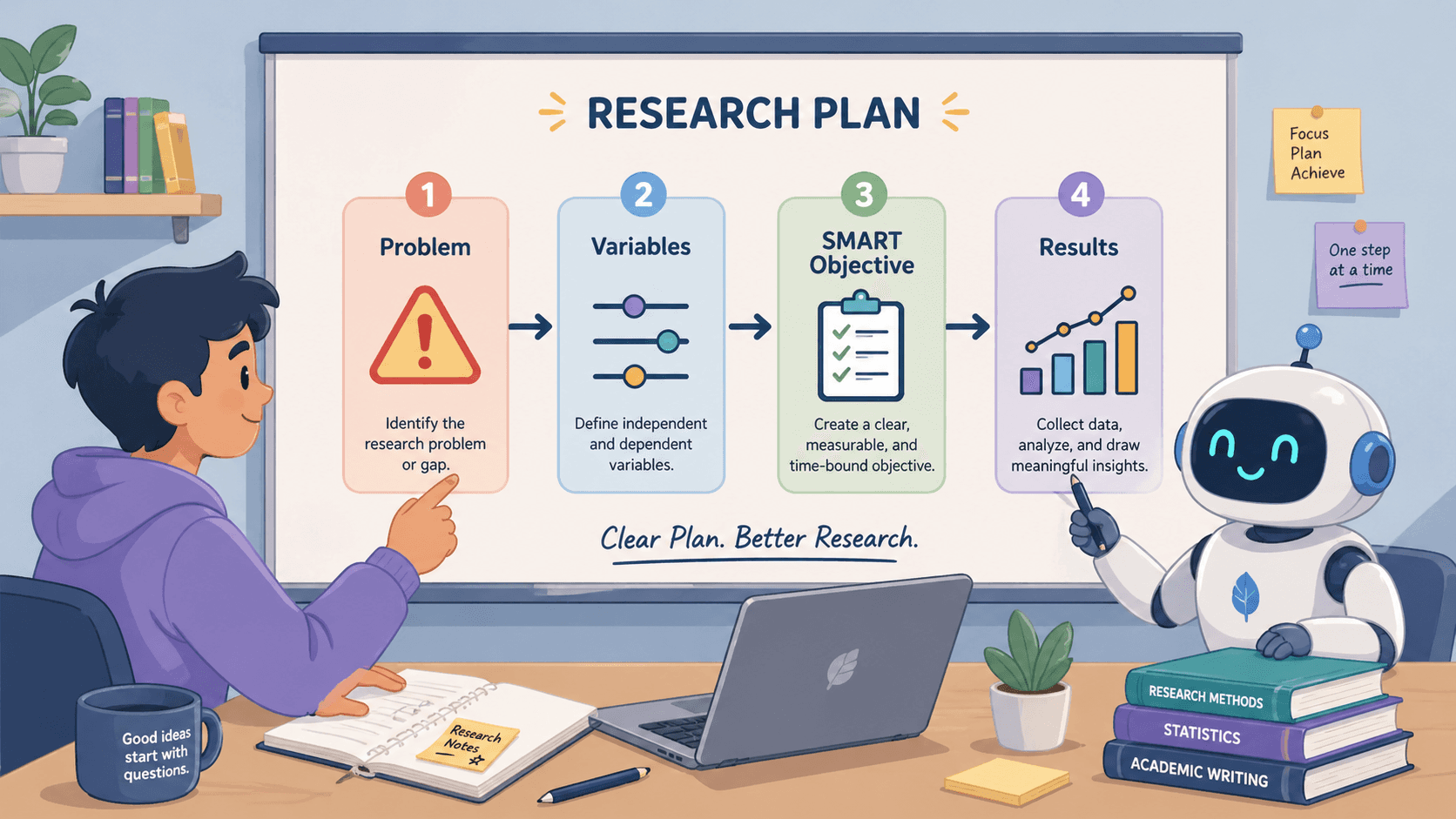
Turning a broad idea into a solid, actionable goal requires a clear process. Follow these steps to build objectives that hold up.
Step 1: Ground it in the problem
Every objective must stem from a defined research problem. If it doesn't, your work becomes a series of unrelated tasks. Example problem: High incidence of musculoskeletal disorders reported by office staff.
Step 2: Pin down your variables
Decide what you'll change, what you'll measure, and how you'll measure it. This is about making your goal concrete.
Independent variable: The factor you manipulate (e.g., a new ergonomic chair).
Dependent variable: The outcome you track (e.g., changes in lower back pain scores).
Measurement tool: How you'll capture data (e.g., the Oswestry Disability Index survey).
Step 3: Apply the SMART filter
Take your draft objective and check it against each letter. For an easy-to-follow reference, you might use a SMART 101 checklist to ensure you haven't missed a component.
Specific: Is it clear who is involved and what is being done?
Measurable: Can you quantify the result?
Achievable: Is it realistic with your time, budget, and skills?
Relevant: Does it directly address the problem from Step 1?
Time-bound: What is the deadline for completion?
Step 4: Test for feasibility
Ambition often outruns reality. Academic reports indicate that more than 40% of thesis delays are linked to objectives that were too broad or complex from the start.
This is why learning how to write research question boundaries is just as important as the objective itself.
Ask yourself: Is the required sample size practical? Can you actually get the data you need? Does the timeline make sense?
Step 5: Lock in the alignment
Your final objective shouldn't stand alone. It must clearly and directly connect back to your core research questions and hypotheses, and it must match the methodology you plan to use. This tight integration is what makes a proposal convincing.
<ProTip title="💡 Pro Tip:" description="Use milestone planning to break large objectives into weekly tasks for easier progress tracking." />
SMART Research Objectives Examples (Across Methods)
Seeing how the framework applies in various contexts is the best way to learn. Here are examples adapted for different types of studies.
For a quantitative study
This example focuses on measurement, variables, and statistical outcomes.
Objective: To measure the effect of ergonomic chair intervention on lower back pain scores for 60 administrative employees, targeting a 25% reduction as measured by a visual analog scale over an 8-week trial period.
For a qualitative study
Here, the goal is depth of understanding, but the objective still needs clear boundaries.
Objective: To explore the lived experiences and perceptions of workplace ergonomics among 20 remote office workers, using semi-structured interviews, with data collection completed by March 2027.
For a mixed-methods study
This combines approaches, requiring a clear structure for both parts. Phase 1 (Quantitative): Survey 100 software developers to quantify self-reported posture habits and pain incidence.
Phase 2 (Qualitative): Conduct in-depth follow-up interviews with 15 survey participants to gain insight into behavioral drivers and barriers.
Complete all primary data collection within a 6-month window.
For an educational study
Applied research in fields like education uses the same principles of specificity and measurement.
Objective: To assess the impact of gamified learning software on engagement, aiming for 15% increase in average student participation scores across one academic semester in three 10th-grade biology classes.
SMART Objectives Checklist for Research Clarity
Before you finalize anything, run your objectives through this simple validation. It's a quick way to spot gaps and fix them.
Criterion | The key question to ask | Before (Vague) | After (SMART) |
Specific | What exactly are you doing, and with whom? | Study posture. | Measure neck flexion angles in 30 data entry typists. |
Measurable | How will you put a number on the result? | Improve worker health. | Reduce average self-reported pain scores by 2 points on a 10-point scale. |
Achievable | Is this realistic with your resources? | Conduct a global survey. | Survey 100 manufacturing workers at a single plant. |
Relevant | Does this directly address your core problem? | Promote any exercise. | Implement a stretching protocol targeting movements linked to common workplace shoulder injuries. |
Time-bound | When will this be completed? | Analyze the data later. | Complete data analysis and submit a final report by April 30, 2027. |
Use this table as a final proofing step. If your objective doesn't pass each row, it likely needs another revision to be truly clear and actionable.
<ProTip title="🧠 Note:" description="Review objectives after your literature review to ensure alignment with existing research gaps." />
Common Mistakes in SMART Research Objectives

A solid structure can still fall apart if you overlook a few critical errors. These are the most frequent issues to watch for.
1. Using vague language - Words like "improve," "analyze," or "understand" are too broad on their own. They need to be anchored by a clear metric.
Don't say "understand employee satisfaction." Say "identify the top three factors influencing employee satisfaction scores through exit interviews."
2. Setting an unrealistic scope - This is the fastest way to guarantee a project stalls. An objective must fit your actual resources, time, budget, and access. Planning a "global multi-country survey" for a six-month master's thesis is a classic example of a goal doomed from the start.
3. Misaligning with your method - Your objective dictates your methodology, and vice versa. If they clash, your data won't work. You can't have an objective to "explore deep personal experiences" but choose a methodology limited to a multiple-choice survey. The tool won't capture what you need.
4. Forgetting the 'why' (relevance) - An objective must solve a specific piece of your research problem. If it doesn't address a genuine gap in knowledge or practice, it's just busywork.
Reviewers, like those at the National Institutes of Health, consistently flag a lack of clear relevance as a major reason for rejecting proposals.
Citing established planning frameworks, such as those used by the World Health Organization, which stress measurable outcomes, can help ground your objectives in accepted practice.
Are SMART Objectives Limiting Creativity?
It's a valid debate. While SMART goals bring essential structure, some argue they can box in truly exploratory or innovative work.
The argument for flexibility
Critics, including researchers in creative fields, say the framework is too rigid. The logic is that discovery often follows a winding path, not a straight line.
Discussions in academic forums and platforms like Reddit frequently note that in areas like design or theoretical physics, a simple "do your best" or "explore this concept" goal can be more effective.
Some studies, referenced in places like MIT research blogs, suggest that for open-ended, creative problem-solving, less restrictive goals can actually lead to more novel outcomes.
Where SMART objectives hold their ground
The framework excels in situations that demand precision and accountability. For structured tasks, think clinical trials, most business analytics, or policy impact assessments, the clarity, measurability, and deadlines imposed by SMART criteria are non-negotiable.
They keep projects focused and stakeholders aligned.
The practical takeaway: choose your tool
The key is to match the tool to the task.
Use SMART objectives when your outcomes need to be measurable, when there's strict accountability (like with funding), and when deadlines are fixed.
Adopt a more flexible framework when you're in a genuine exploratory phase, when generating novel ideas is the primary aim, or when the end results are fundamentally uncertain.
In practice, the best approach is often a hybrid. You might start with broad, creative exploration to define the territory, then use SMART objectives to rigorously test the most promising ideas that emerge. It’s not an either-or choice, but a question of which tool to use, and when.
<ProTip title="⚖️ Reminder:" description="Combine SMART with flexible thinking for exploratory research to avoid limiting innovation." />
Make Your Objectives Work From the Start
You’re trying to pin down your research goals, but vague ideas can slow everything and make your direction feel off. It gets frustrating fast. Without clear objectives, it’s easy to lose focus and spend time fixing things later instead of making progress now.
<CTA title="Refine Your Research Objectives" description="Create clear, measurable research goals faster with structured writing support." buttonLabel="Try Jenni Free" link="https://app.jenni.ai/register" />
That’s where Jenni can step in and help you shape goals that are clear and usable. It guides you as you write so your objectives stay aligned with your study from the start. Instead of going back and forth, you move ahead with a plan that actually supports your work.