От
Джастин Вонг
—
Inductive Reasoning Explained: Patterns, Examples, and Uses

Джастин Вонг
Руководитель отдела маркетинга и роста
Получила степень бакалавра в области глобального бизнеса и цифровых искусств, а также дополнительную специализацию в сфере предпринимательства

Inductive reasoning starts with specific facts and builds up to a general idea. You use it every day, like figuring out a faster route to work after trying different streets. It’s also a core part of how science works, as the Stanford Encyclopedia of Philosophy explains.
This article covers what inductive reasoning means, shows clear examples, and contrasts it with deduction. We'll look at its use in research, point out typical mistakes, and give tips to make your own reasoning stronger.
<CTA title="Master Inductive Reasoning Faster" description="Turn observations into clear logical conclusions using structured prompts and guided thinking tools." buttonLabel="Try Jenni Free" link="https://app.jenni.ai/register" />
What Is Inductive Reasoning and Why It Matters
Inductive reasoning is a way of thinking that builds a general rule from specific examples. The results are likely, but not guaranteed. It's a "bottom-up" process, where you let the facts suggest the pattern instead of starting with a theory.
In simpler terms, it's like trying to guess what a movie is about after watching only the first ten minutes. You're piecing together a bigger story from the scenes you've seen.
For those looking for a deep dive into the formal mechanics of this logic, the logic inductive entry provides a comprehensive philosophical breakdown.
Take this everyday case: you see that your bus arrives late three times in one week. You might decide the bus schedule is unreliable. That's an inductive conclusion. It could be right, but a holiday or bad weather that week could have caused the delays.
This kind of logic is used all over, because it’s how we learn from experience.
In science, researchers often use it to form initial hypotheses from raw data.
In medicine, a doctor identifies a probable illness by recognizing a cluster of symptoms in a patient.
In business, analysts forecast sales by spotting trends in past quarterly reports.
In learning, a student grasps a math concept by working through several similar problems.
The National Science Foundation emphasizes that inductive reasoning is fundamental to the 'discovery' phase of science, where researchers form hypotheses from initial observations.
<ProTip title="💡 Pro Tip:" description="Always treat inductive conclusions as flexible hypotheses not fixed truths." />
The Bottom Up Reasoning Process Step by Step
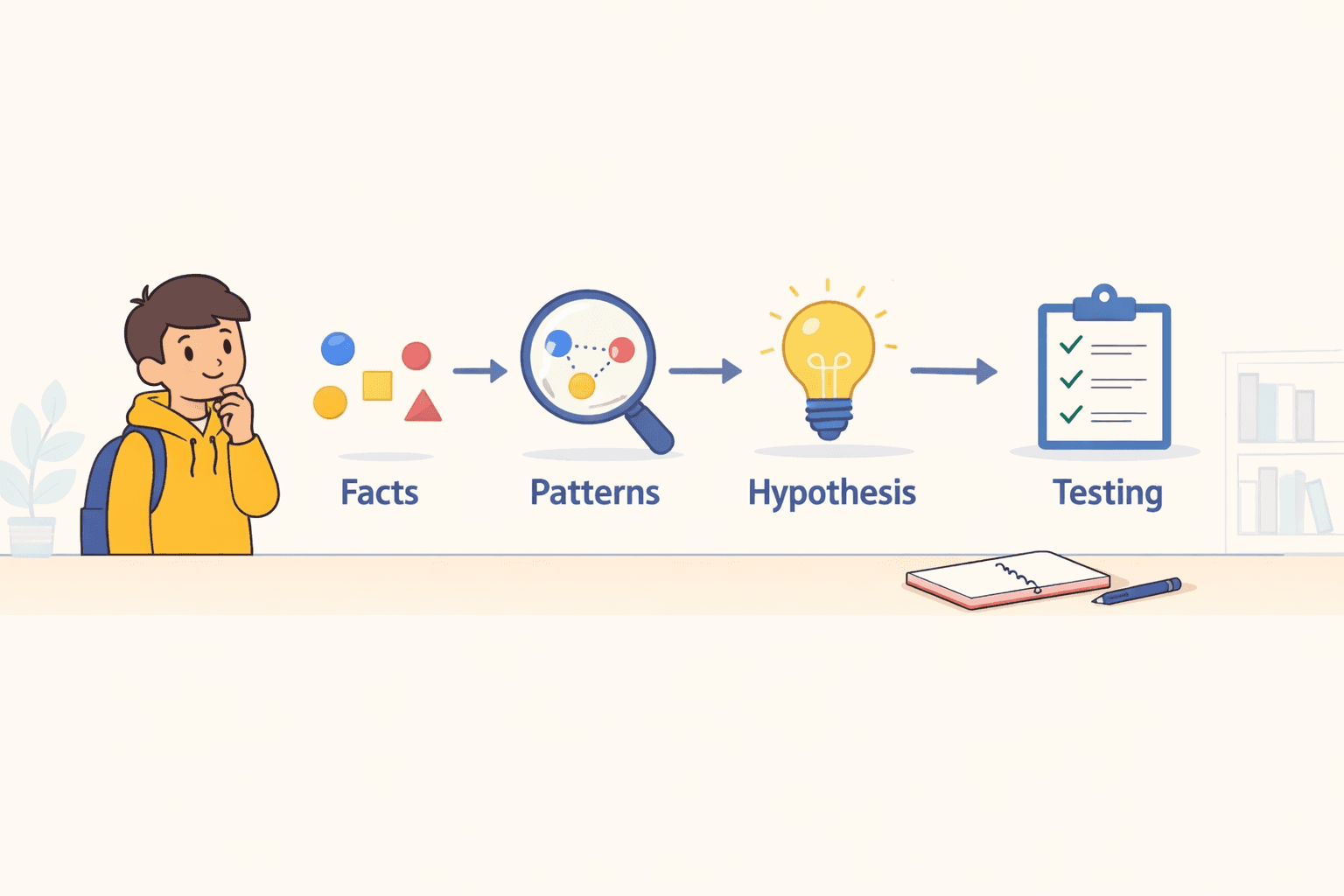
Inductive reasoning isn't magic; it's a method. You start with details and work your way up to a big idea. Here's how it typically unfolds.
Step 1: Gather the Facts
You start by collecting specific information from real situations, such as surveys, observations, or experiments. The quality and variety of this data matter because they form the base of your reasoning.
Step 2: Identify Patterns
Next, you look through the data to find what repeats or stays consistent. This step is about noticing connections, similarities, or trends across different cases.
Step 3: Form a Tentative Conclusion
Using the patterns you found, you create a possible explanation or general rule. This is not final, it is a likely conclusion based on limited evidence.
Example: If most customers ignore a product display, you may suggest the display is ineffective.
When starting a study, knowinghow to write research questions effectively often depends on these initial inductive observations.
Step 4: Test and Refine
Finally, you compare your conclusion with new evidence. If new data supports it, the idea becomes stronger. If not, you revise or reject it. This keeps the reasoning flexible and open to improvement.
Inductive reasoning builds ideas step by step from evidence, but conclusions stay open to change as more information appears.
<ProTip title="📌 Reminder:" description="Stronger inductive arguments rely on larger and more diverse data sets." />
Types of Inductive Reasoning Explained
Inductive thinking isn't one single thing. It shows up in a few distinct styles, each with its own way of building a case from evidence.
Generalization (Enumerative Induction)
You take what you learn from a smaller group and apply it to a larger one. Polls and surveys use this method constantly. The strength of the conclusion depends heavily on how well your sample represents the whole population.
Example: A survey of 200 voters suggests most residents support a project.
Causal Reasoning
This involves identifying cause-and-effect relationships by observing consistent patterns between events. When one factor repeatedly appears before another, it is suggested as the cause. However, it still requires careful testing to avoid false assumptions.
Example: Research showing a strong link between smoking and lung cancer.
Analogical Reasoning
This draws conclusions by comparing two similar situations and assuming what works in one may work in the other. It is helpful in problem-solving and teaching, but can be unreliable if the situations are not truly similar in important ways.
Example: Applying a successful teaching method from history class to a biology lesson.
Statistical Induction
This uses mathematical data and probability to draw conclusions from large datasets. It is more precise and formal than simple generalization and is widely used in science, economics, and technology.
Example: Machine learning systems predicting outcomes based on large datasets.
A quick overview:
Type | What it does | Real-world case |
Generalization | Extends a sample's traits to a whole group | Predicting election results from a poll |
Causal Reasoning | Proposes a cause from repeated correlation | Linking sugary drinks to weight gain |
Analogical Reasoning | Transfers a solution based on similarity | Applying a successful business tactic from one store to another |
Statistical Induction | Uses probability models to infer patterns | A weather forecast model predicting next week's rain |
<ProTip title="💡 Pro Tip:" description="Use multiple types of inductive reasoning to strengthen your conclusions." />
Inductive vs Deductive Reasoning: Key Differences
These two types of logic are often mentioned together, but they work in opposite directions and give you different kinds of answers.
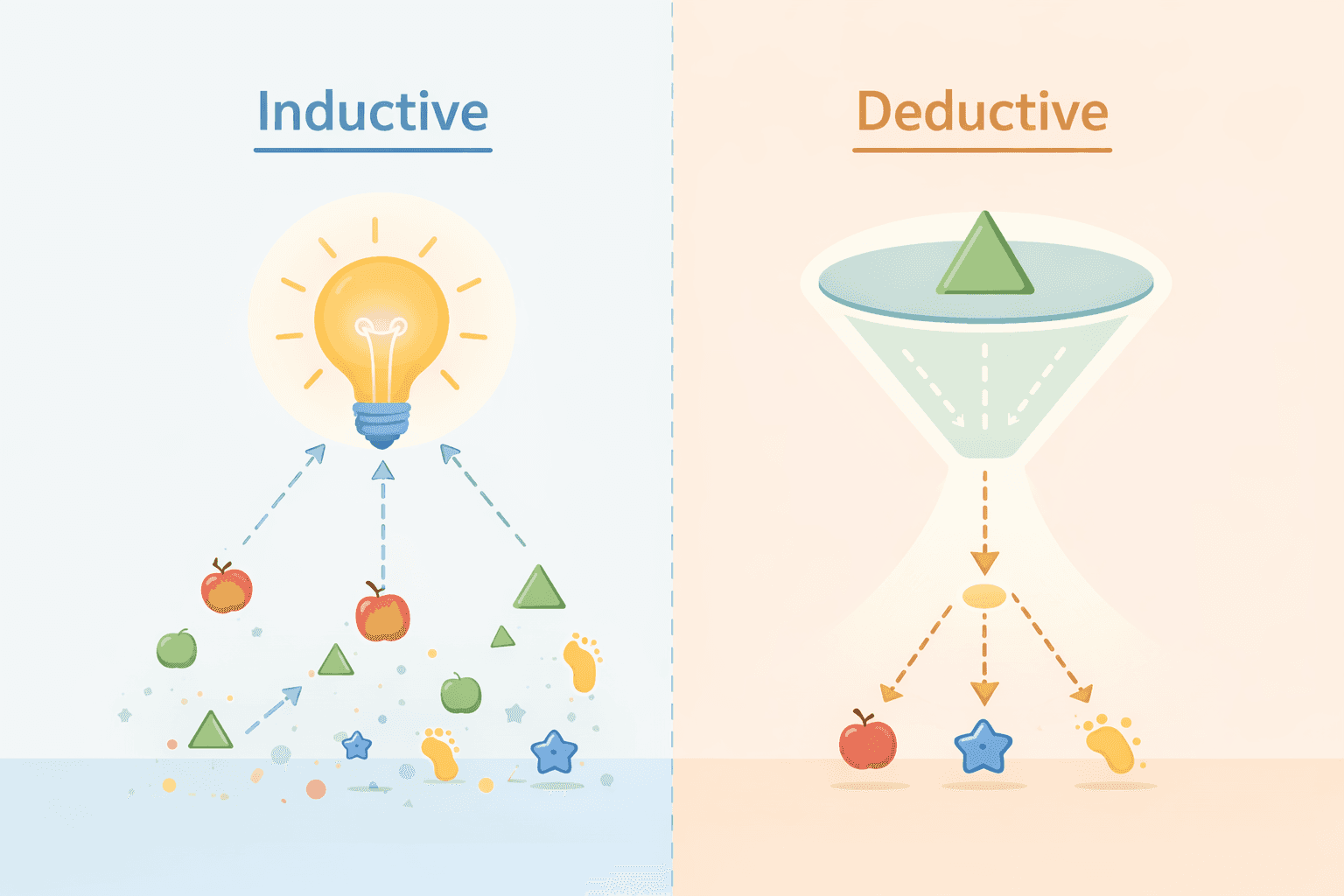
Inductive reasoning starts with details and builds up to a broad idea. Deductive reasoning begins with a general rule and applies it down to a specific case.
Here’s a side-by-side look:
Feature | Inductive Reasoning | Deductive Reasoning |
Direction | Specific facts → General conclusion | General principle → Specific conclusion |
Certainty | Likely, but not guaranteed | Certain, provided the logic is valid |
Purpose | To find new patterns or theories | To test an existing idea or rule |
Example | Seeing sales rise after several ads, you conclude advertising works. | Knowing that all store sales rise after ads, you predict this ad will boost sales. |
You can see how they play out in a single scenario. An inductive approach might note that several patients got better after a new treatment, suggesting it's effective.
Induction: Looks at specific cases (e.g., patients improving after treatment) and suggests a possible pattern or rule (the treatment may be effective). It is flexible and can change with new evidence.
Deduction: Starts with a known rule (the treatment works for all patients) and applies it to a case, producing a certain conclusion if the logic is correct. It is more fixed and definite.
How they work together: Induction often creates new ideas or hypotheses, while deduction tests them.
This interplay is a hallmark of different research paradigms that dictate how we acquire knowledge. The mix-up happens because both are logical processes.
The real separator is the level of certainty they provide. Induction is flexible and open to revision with new facts. Deduction is definitive; if your starting rule is true and your logic is sound, the conclusion is locked in.
<ProTip title="📌 Reminder:" description="Use induction to generate ideas and deduction to test them." />
Inductive Reasoning in Research and Real Life
This way of thinking isn't just an academic concept. It's a practical tool in formal research and a quiet force behind countless daily choices.
In Formal Research
Inductive logic is fundamental to qualitative research. Instead of starting with a theory to prove, researchers begin by collecting raw data. They look for themes and repeated ideas within that information.
This is a common strategy when navigating the nuances of qualitative vs quantitative research, as the inductive approach allows the theory to emerge from the data itself.
Those patterns gradually suggest a new theory or framework. This method, known as grounded theory, literally grounds its conclusions in the observed evidence.
In Daily Life
You use inductive reasoning all the time, often without calling it by name.
You try a different commute route three times and find it's faster, so you adopt it as your new regular path.
You get a headache after drinking red wine on two occasions, so you decide to avoid it.
You notice the sky darkening and the wind picking up in a specific way, and you predict rain is coming soon. These are all small acts of reasoning from personal experience, building a personal rule from a few specific events.
In Technology and AI
Inductive processes are the engine of modern artificial intelligence, particularly in machine learning. A system is fed massive amounts of data, say, millions of labeled images. It analyzes this data to identify patterns (e.g., what features define a "cat").
It then uses those patterns to make predictions about new, unlabeled images. The system's ability to learn from examples and generalize is a form of inductive bias.
Recent scientific studies on cognitive processing suggest that our brains may handle these patterns in ways that AI developers are constantly trying to replicate.
Strengths and Limitations of Inductive Reasoning
Inductive reasoning is a useful tool, but it has built-in flaws. Knowing what it can and cannot do helps you use it more effectively.
Where It Excels
Its main strength is its openness. It doesn't need a complete picture to start working.
It's excellent for discovery. By looking at raw data, it can suggest entirely new ideas or theories that weren't considered before.
It can operate with partial information. You don't need all the facts to begin spotting a potential pattern.
It feels natural. This is how people often learn about the world, by noticing what happens and forming a rough rule from it.
This makes it the go-to method for generating initial hypotheses and for tackling problems where there's no obvious established answer.
Where It Falls Short
The biggest issue is its lack of certainty. An inductive conclusion is always a bet, not a guarantee.
The results are probable, not proven. New evidence can always overturn them.
It's easily skewed by bias. If you only look for data that supports your initial hunch, you'll confirm it, even if it's wrong.
It can produce bad generalizations. Jumping to a broad conclusion based on just a few examples is a common mistake, known as the hasty generalization fallacy.
For a closer look at how this applies to academic inquiry, exploring inductive reasoning in research can reveal how scholars move from specific observations to broader generalizations.
Building a Stronger Case
You can make an inductive argument more reliable by strengthening its foundation. A strong argument typically uses:
A large and representative set of data.
Examples from varied situations.
A clear, consistent pattern across that data.
A weak argument often suffers from:
A very small or narrow sample size.
Ignoring data that doesn't fit the preferred pattern.
Leaping to a conclusion too quickly.
<ProTip title="💡 Pro Tip:" description="Actively look for counterexamples to test your inductive conclusions." />
The Gap Between Using Induction and Using It Well
It's easy to say everyone uses inductive reasoning. The harder truth is that many people don't do it effectively.
You can see this in everyday arguments online or offline. Someone notices two similar events and declares a universal rule. Another person ignores a clear pattern because it contradicts what they already believe. These are failures of inductive logic.
What Good Reasoning Actually Requires
According to studies in cognitive science, successfully building a conclusion from evidence isn't automatic. It depends on several factors:
Having enough relevant experience to draw from.
Paying active attention to potential patterns in that experience.
Being willing to revise your initial conclusion when new facts come in.
Many people get stuck, especially when new evidence clashes with a pre-existing belief. They might cherry-pick data that supports their view or dismiss contradicting information, classic examples of biased reasoning.
Building the Skill
Improving your inductive thinking is a matter of deliberate practice, not just passive observation. It's a core part of critical thinking. You have to actively:
Question your starting assumptions. Why do you believe what you believe?
Scrutinize the evidence. Is your sample large and varied? Is the pattern consistent?
Be ready to adjust. Treat your conclusion as a temporary draft, not a final verdict.
Research from the American Psychological Association supports this. Their findings indicate that people who receive training in structured reasoning techniques, which include these steps, make more accurate decisions and are better at evaluating evidence.
How to Improve Your Inductive Reasoning Skills
You can get better at inductive reasoning. It takes conscious effort and a few straightforward habits.
Try These Exercises
Start by paying closer attention to the patterns around you.
Look at your own daily routines. What small events tend to lead to a productive day, or a frustrating one?
Resist forming a conclusion after just one or two examples. Force yourself to compare at least three or four similar situations.
Practice spotting the trend in simple data sets, like a week's worth of weather forecasts versus actual conditions, or your monthly spending totals.
A Simple Four-Step Checklist
When you're trying to build a general idea from specific facts, run through this process:
Collect sufficient evidence. A handful of cases isn't enough. Gather as many relevant observations as you can.
Find the real pattern. Is the connection between events consistent and clear, or is it fuzzy and occasional?
Think of other possibilities. Could there be a different explanation for what you're seeing? What evidence might contradict your initial hunch?
Put your idea to the test. Treat your conclusion as a working hypothesis. Seek out new situations to see if it holds up or falls apart.
A Quick Practice Scenario
Say you notice that three different projects at work stalled because of miscommunication between teams. Your inductive conclusion might be: Poor communication often leads to project delays. That's a reasonable start. The next, crucial step is to test it.
Look at other projects, both successful and failed ones. Was communication actually the main factor? Your initial rule might be confirmed, refined, or completely overturned.
<ProTip title="📌 Reminder:" description="Write down your reasoning steps to make patterns clearer and easier to evaluate." />
Turn Observations Into Clear Reasoning
You notice patterns but struggle to turn them into solid conclusions that make sense on paper. It's frustrating when your ideas feel loose and hard to explain clearly. That uncertainty shows in your writing.
<CTA title="Sharpen Your Reasoning Skills" description="Structure your ideas clearly and turn observations into strong arguments using guided writing support." buttonLabel="Try Jenni Free" link="https://app.jenni.ai/register" />
Inductive reasoning isn't about perfect certainty - it's about building the strongest possible case from available evidence. Gather sufficient data, spot real patterns, consider alternatives, and test your conclusions. That deliberate process turns scattered observations into arguments you can trust.