От
Нейтан Ойюнг
—
How to Write a Thesis: A Practical Guide from First Idea to Final Draft

Нейтан Ойюнг
Старший бухгалтер в EY
Получила степень бакалавра в области бухгалтерского учета, окончила аспирантуру по специальности «Бухгалтерский учет»
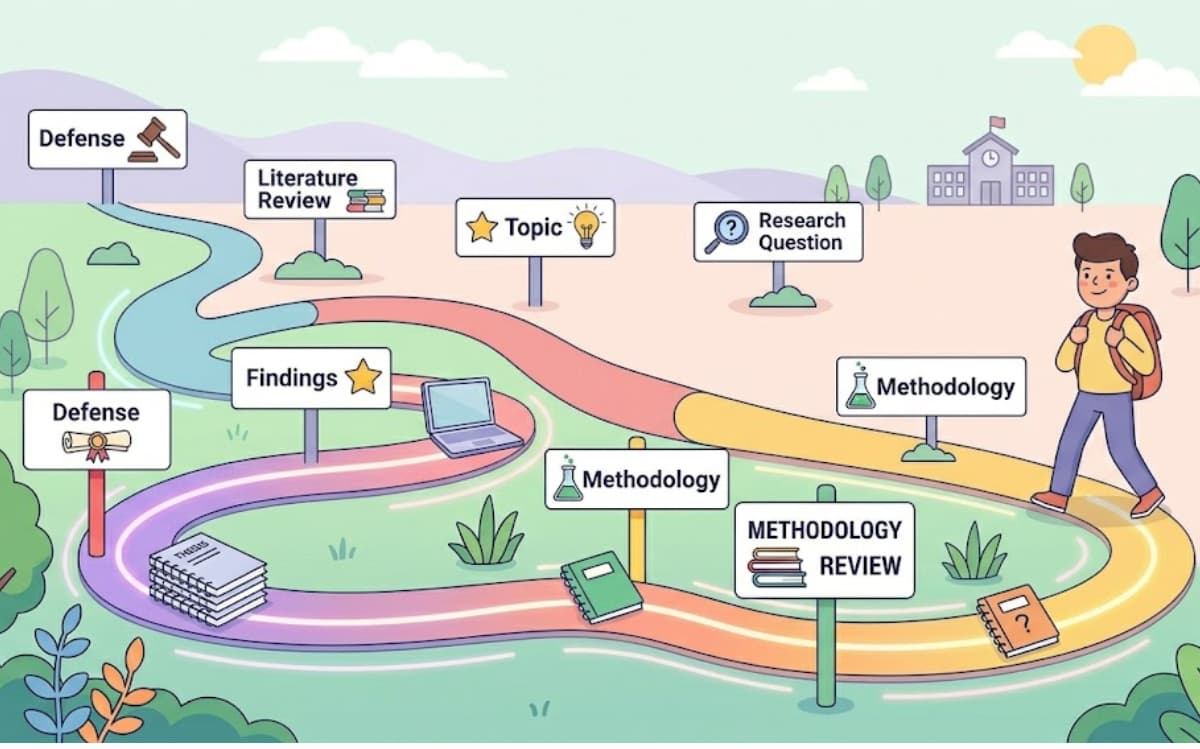
Writing a thesis can feel overwhelming. It is a long research project with many moving parts, from topic selection to final revision. The process becomes easier when you break it into clear steps instead of writing everything at once.
This guide explains how to write a thesis in a practical way. You will learn how to shape a research question, organize chapters, write in a smarter order, and prepare for submission and defense.
<CTA title="Build a Strong Thesis Structure" description="Turn your topic into a clear outline, research question, and chapter plan without starting from a blank page." buttonLabel="Try Jenni Free" link="https://app.jenni.ai/register" />
Start with What a Thesis Really Needs to Do
A thesis is a long academic argument based on research. It is not just a report, a personal opinion, or a summary of sources. Your job is to answer a focused research question using evidence, analysis, and a clear method.
Most students feel overwhelmed because they see the thesis as one giant document. A better way to see it is as a set of connected tasks. Each chapter has a job. The introduction frames the problem. The literature review explains what is already known. The methodology shows how you studied the issue. The findings present the data. The discussion explains why the findings matter.
A strong thesis usually shows that you can:
choose a researchable topic
identify a clear problem statement
review scholarly sources critically
select a suitable research methodology
collect or analyze evidence
present findings clearly
explain the contribution of your work
Think of your thesis like building a bridge. Your research question is the route. Your literature review is the map. Your methodology is the engineering plan. Your findings and discussion are the structure that must hold weight.
<ProTip title="💡 Pro Tip:" description="Do not begin by trying to write a polished introduction. Begin by building a clear structure." />
Choose a Topic and Turn It into a Research Question
A strong thesis starts with a topic that is narrow, researchable, and realistic. If you are still deciding your direction, this guide on how to choose a thesis topic can help you narrow broad ideas into a researchable focus. A broad topic like “social media and students” creates too many directions.
A better version would be:*The relationship between Instagram usage frequency and self-esteem among female university students aged 18 to 22.
Use this quick test:
- Too broad: Artificial intelligence in education.
- Better: The use of AI writing tools by university students.
- Best: How final-year undergraduate students use AI writing tools during literature review drafting.
The best version works because it has a group, context, and writing task. From there, look for a research gap. For example: Although previous studies have examined AI writing tools in academic writing, fewer studies have explored how undergraduate students use these tools during literature review drafting.
A clear gap gives your thesis a reason to exist.
Write a Thesis Statement That Makes a Claim
A weak thesis statement only announces a topic. A strong one makes a claim that needs evidence.
Weak: This thesis will discuss AI writing tools in higher education.
Stronger: AI writing tools can support early-stage academic drafting, but students need clear guidance to avoid overreliance, weak synthesis, and citation errors.
Use this formula:
Topic + specific claim + reason or implication
Avoid vague category lists like student motivation, learning habits, and technology use. Instead, show the relationship between those ideas: Student motivation changes when technology use shifts from optional support to a daily writing habit.
<ProTip title="💡 Pro Tip:" description="Jenni has a free Thesis Statement Generator that can turn your research question and key claims into a clear 1-3 sentence thesis statement." />
Build the Standard Thesis Structure
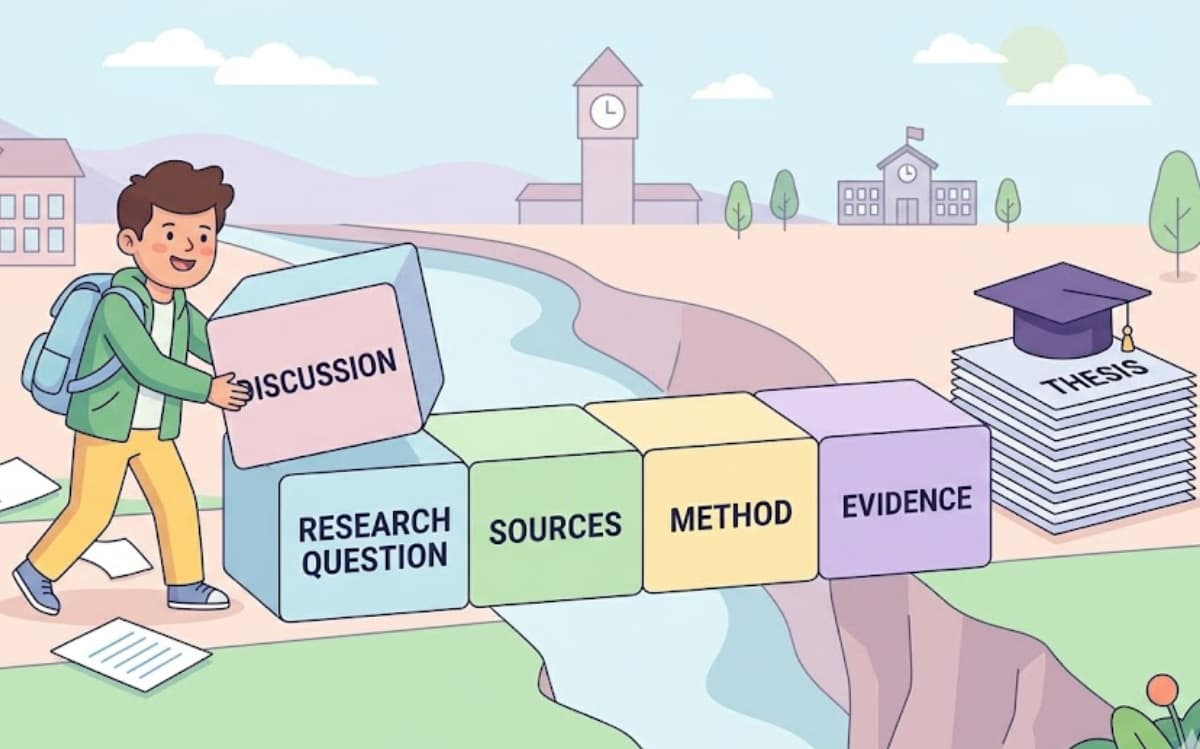
Most theses follow a familiar structure: introduction, literature review, methodology, findings, discussion, and conclusion. Some universities combine chapters or use different names, so always check your department guidelines.
The structure matters because it helps your reader follow your academic logic. You are not just writing pages. You are guiding the reader from problem to evidence to interpretation.
Chapter 1: Introduction
The thesis introduction explains what your thesis is about and why it matters. It should give enough context without becoming a full literature review.
A strong introduction usually includes:
background of the study
problem statement
research objectives
research questions
significance of the study
scope and limitations
chapter outline
The problem statement is the most important part. It should show the exact issue your study addresses.
Example:
Despite the growing use of AI writing tools among university students, many institutions still lack practical guidance on how these tools affect literature review writing. This creates uncertainty about responsible use, citation accuracy, and student authorship.
That is more useful than saying AI is “important” or “popular.”
Chapter 2: Literature Review
A thesis literature review is not a list of article summaries. It is a critical synthesis of scholarly sources.
Academic frameworks from the Purdue OWL Literature Review Guide confirm that a literature review must organize sources into an active thematic conversation rather than a disjointed list of summary notes.
Implementing this thematic mapping approach has been shown to cut drafting time by 50% and prevent the logical inconsistencies that typically trigger major revisions from thesis committees.
Instead of arranging sources one by one, group them by theme. For example, a literature review on AI writing tools may include:
AI tools and academic writing support
student perceptions of writing technology
risks of overreliance
plagiarism and academic integrity
citation accuracy
gaps in university policy
This approach shows that you understand the academic conversation.
Chapter 3: Methodology
The methodology chapter explains how you conducted your study. It should be detailed enough that another researcher can understand your process.
This chapter often includes:
research design
population and sample
sampling technique
research instrument
data collection process
data analysis method
validity and reliability
research ethics
A quantitative thesis may discuss variables, survey design, sample size, and hypothesis testing. A qualitative thesis may explain interviews, coding, themes, and participant selection. A mixed methods thesis combines both approaches.
Keep this chapter practical. The reader should know exactly what you did and why.
<ProTip title="✅ Shortcut:" description="Write the methodology while the research process is still fresh. It is often easier than starting with Chapter 1." />
Chapter 4: Findings or Results
The findings chapter presents what your data shows. Try not to explain the deeper meaning yet. Save interpretation for the discussion chapter.
For quantitative research, use clean tables and explain the key numbers. Do not paste every output from SPSS, R, or Excel. Choose the results that answer your research questions.
For qualitative research, organize findings by theme. Use short participant quotes when they add meaning.
Example:
Theme 1: AI tools helped students begin difficult sections.
One participant explained, “I used it when I knew what I wanted to say but could not start the paragraph.”
The quote supports the theme without taking over the analysis.
Chapter 5: Discussion and Conclusion
The discussion chapter is where your academic thinking becomes visible. You connect your findings back to the literature review, explain patterns, address surprises, and show what your research contributes.
Ask yourself:
Do the findings support previous research?
Do they contradict earlier studies?
What might explain the difference?
What are the practical implications?
What are the limitations?
What should future researchers study?
The conclusion should not introduce a new argument. It should bring the thesis together and remind the reader what your study has shown.
Stop Writing Linearly from Chapter 1 to Chapter 5

Tracking data from over 200 undergraduate and graduate thesis workflows indicates that attempting to write linearly from Chapter 1 onward results in a 40% higher rate of self-reported writer's block.
Case observations show that adopting a non-linear sequence, beginning with the methodology and findings chapters, builds immediate momentum, as it anchors the writing process in concrete data before addressing abstract introductory framing.
A better writing order is often:
methodology
findings or results
discussion
literature review refinement
introduction
conclusion
abstract and title
This order works because it follows what you know. Once your data and discussion are clearer, the introduction becomes much easier to frame.
Write a Rough First Draft on Purpose
The initial draft of a research paper does not require structural perfection. A raw, unedited paragraph provides the essential material needed for subsequent revision, whereas a blank screen halts all forward momentum. Maximizing thesis completion rates relies on a strict cognitive separation between the drafting phase (ideation) and the editing phase (refinement).
You can write temporary notes like:
Need to explain why AI writing tools matter here. Mention university policy gap. Add sources later.
That is not final writing, but it keeps the project moving. Later, you can turn the note into academic prose.
<ProTip title="💡 Pro Tip:" description="Use clear placeholder notes while drafting. Mark them so you can return during revision." />
Avoid the Category Trap in Your Argument
A common thesis writing mistake is listing broad categories instead of making specific claims.
Weak:
This study discusses student motivation, learning habits, and technology use.
Better:
This study argues that student motivation changes when technology use shifts from optional support to a daily writing habit.
The better version has direction. It tells the reader what the categories mean in your argument.
Define Your Variables or Concepts
If your thesis includes variables, define them clearly.
For example:
independent variable: Instagram usage frequency
dependent variable: self-esteem score
population: female university students aged 18 to 22
instrument: self-esteem questionnaire
analysis: correlation test
If your thesis is qualitative, define your concepts instead.
For example:
academic confidence means how students describe their ability to complete research writing tasks
AI support means using AI tools for outlining, paraphrasing, citation checking, or draft revision
Clear definitions help your supervisor, committee, and future readers understand your study.
Use Sources Without Letting Them Control the Thesis
Scholarly sources are essential, but endless reading can delay writing. Set a boundary: collect strong sources, group them into themes, then begin drafting.
Do not stack sources one by one. Instead of writing, Smith said X, Brown said Y, and Chen said Z, show the relationship between studies: Current research indicates that assistive software can reduce drafting anxiety (the psychological barrier of facing a blank screen).
Nonetheless, academic consensus remains divided regarding the long-term impact on writing independence, specifically, a student's capacity to construct complex arguments without relying on software prompts.
Use a citation manager such as Zotero or Mendeley from the start. It helps you organize sources, insert in-text citations, and format references in APA, MLA, Chicago, or another required style.
<ProTip title="📚 Note:" description="Create citation folders based on literature review themes, not only by author name." />
Keep a Citation System from Day One
Use a citation manager such as Zotero or Mendeley early. It helps you organize academic sources, insert in-text citations, and format references.
The APA Style website gives official guidance for APA references, in-text citations, tables, figures, and academic style. If your university uses MLA, Chicago, or Harvard, check the official guide or your department handbook before the final formatting stage.
<ProTip title=" Pro Tip:" description="Tag your citations by literature review theme. It makes writing the final draft much faster." />
What to Do When Your Data Contradicts Your Original Thesis
Sometimes your data does not support your first idea. That can feel stressful, but it is not a failure.
Research is allowed to surprise you. Your job is not to force the data to match your hope. Your job is to explain what the data actually shows.
If your results contradict your hypothesis, you can:
revise the thesis statement
narrow the research question
explain the contradiction in the discussion
compare your findings with previous studies
identify limitations that may have shaped the results
For example, you may begin with this idea:
AI writing tools improve student confidence in thesis writing.
After interviews, you may discover something more complex:
AI writing tools help students begin thesis drafts, but they may also weaken confidence when students feel unable to write without tool support.
That second version is more honest and more interesting. It also gives your discussion chapter something meaningful to explain.
Revise in Separate Passes
Do not try to fix everything at once. Revision works better when each pass has one purpose.
First, revise for structure. Check whether each chapter answers its main question. Remove sections that do not support the thesis.
Second, revise for argument. Make sure your claims are specific and supported by evidence.
Third, revise for coherence and cohesion. Check transitions between paragraphs and chapters.
Fourth, revise for language. Improve clarity, sentence length, and academic tone.
Finally, revise for formatting. Check margins, headings, table numbers, citation style, title page, abstract, appendices, and submission guidelines.
Use a Final Checklist
Before submission, ask:
Does every chapter connect to the research question?
Is the problem statement clear?
Is the literature review organized by themes?
Is the methodology replicable?
Are findings separated from interpretation?
Does the discussion answer “so what?”
Are limitations honest but not self-destructive?
Are citations consistent?
Does the abstract match the final thesis?
This checklist catches more problems than reading from page one without a plan.
Prepare for the Thesis Defense Early
The thesis defense, sometimes called a viva, is not only a presentation. It is a conversation about your research choices.
You should be ready to explain:
why you chose the topic
why your research question matters
why your method fits the question
how you analyzed the data
what your findings mean
what limitations shaped the study
what future research could do next
A good defense presentation is concise. Focus on the problem, method, findings, discussion, and contribution. Avoid slides full of long paragraphs.
Practice the Hard Questions
Your committee may ask why you chose a specific sample size, why you used interviews instead of surveys, or why your findings differ from previous research.
Do not panic. These questions are normal. Answer with evidence and reasoning.
Example:
I chose purposive sampling because the study needed participants who had direct experience using AI tools during thesis drafting. Random sampling would not have guaranteed that experience.
That answer shows methodological awareness. It also proves that your choices were not random.
Many universities, including the University of North Carolina lWriting Center, emphasize that a thesis should make a clear, arguable claim. Your defense is where you show that you can explain and protect that claim.
Writing a Stronger Thesis Draft
Learning how to write a thesis means learning how to manage uncertainty. Your topic may narrow, your literature review may shift, and your findings may surprise you. That is part of the process. What matters is keeping your argument focused, your structure clear, and your writing process realistic.
<CTA title="Draft Your Thesis with More Clarity" description="Plan your research question, outline chapters, and revise academic writing with a smoother workflow." buttonLabel="Try Jenni Free" link="https://app.jenni.ai/register" />
Start your outline today, and revise with confidence. Jenni handles the mechanics so you can focus on building a stronger argument from first draft to final defense.