От
Нейтан Ойюнг
—
How to Become a Medical Writer in 2026

Нейтан Ойюнг
Старший бухгалтер в EY
Получила степень бакалавра в области бухгалтерского учета, окончила аспирантуру по специальности «Бухгалтерский учет»
Medical writing has a circular entry problem. Employers want samples of medical writing, and you cannot produce samples of medical writing without an employer. Most career guides respond to this by telling you to "build a portfolio" and then moving on to the next heading.
This one does not. Below is the actual sequence, what each step costs in time and money, how to build three portfolio pieces with no client and no confidential data, and what the credential landscape really offers.
<CTA title="Build Your First Writing Sample Properly" description="Jenni helps you draft, structure, and cite a portfolio piece from a published paper" buttonLabel="Try Jenni Free" link="https://app.jenni.ai/register" />
The Five Steps, in Order
The order matters more than the speed. People who stall usually skipped step one and spent months building samples for a lane they had not chosen.
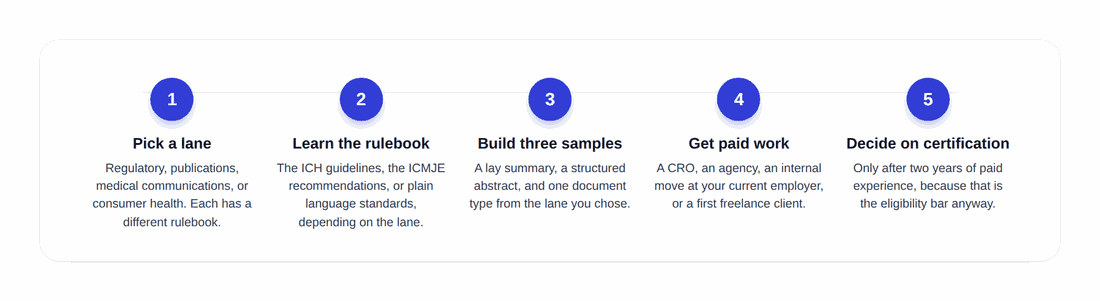
1. Pick a lane before you build anything
Regulatory writing, publication writing, medical communications, and consumer health writing hire differently, pay differently, and value different samples. A regulatory hiring manager will not be persuaded by a beautifully written patient leaflet. Choose based on what you already know: if you have bench or clinical research experience, regulatory and publications are the shorter walk. If your background is communication or journalism, medical communications and consumer health are.
2. Learn the rulebook for that lane
Every lane runs on documents you can read for free before anyone hires you. For regulatory, that is the ICH E3 guideline for clinical study reports and ICH E6 for good clinical practice. For publications, it is the ICMJE recommendations. For consumer work, the European Commission's Good Lay Summary Practice guidance is the best free readability standard in the field, and it sets a target most people find surprisingly demanding: understandable by a reader from about age 12 upwards.
Reading these is not preparation for the job. It is a large part of the job, and being able to say which guideline governs which document is a genuine interview advantage.
3. Build three samples
Three is the number. One shows range, three show consistency. What they should be is covered in its own section below, because it is where most people get stuck.
4. Get paid work
Four realistic routes exist. A contract research organization, which is the most reliable entry point because they train and they see every document type. A medical communications agency, which hires more readily from writing backgrounds. An internal move, if you already work at a company that has a medical writing function, which is by far the easiest path and the most overlooked. Or a first freelance client, usually a small biotech or an academic group that needs a manuscript tidied.
5. Decide about certification
Last, not first. The main US credential requires two years of paid experience before you are even eligible, so it cannot be a way in. Treat it as something you consider once you are already working.
<ProTip title="🚪 Way in:" description="If your current employer has a medical writing or medical affairs team, ask to write one document for them before you apply anywhere else. An internal sample with a real reviewer beats three self made ones" />
Do You Need a PhD, a Certificate, or a Certification?
These three get conflated constantly and they are completely different things.
A PhD is not required. The strongest evidence is structural: the Medical Writer Certified credential, the main certification in the field, asks only for a bachelor's or advanced degree in any field plus two years of paid medical communication experience. That said, AMWA has reported that around 78 percent of medical writers held an advanced degree as of 2019, so it is common. It functions as a shortcut for proving you can read primary literature, and a portfolio proves the same thing more slowly.
A certificate is a course completion. A certification is an examined credential. The European Medical Writers Association is admirably blunt about this distinction, stating that its certificates are not an endorsement of a person's professional competence and that holders should not describe themselves as EMWA certified. Get that wrong on a CV in front of someone who knows the field and it costs you.
Path | Time | Typical cost | What it actually buys you |
Self study plus a portfolio | 3 to 6 months | Close to nothing | The only thing every employer checks, which is samples |
University certificate | 3 to 12 months | Structure, deadlines, a cohort, and a line on the CV | |
MWC certification | Needs 2 years of paid experience first | Exam fee | Credibility with employers who know the credential exists |
Entry through a CRO | Immediate, if you get hired | Nothing, you are paid | Supervised training across many document types |
If you can only do one thing, do the portfolio. Every other route eventually asks to see one anyway.
<ProTip title="🎓 Credentials:" description="Ask any certificate program one question before paying: how many hours of your writing will a working medical writer review and mark up? If the answer is none, you are buying lecture content you could read for free" />
How to Build a Portfolio With No Client Work

This is the step everyone waves at. Here are three pieces you can write this month using only published material, no employer and no confidential data.
A plain language summary of a published trial. Take a recent phase 3 trial in an area you understand, and write 400 words explaining what was tested, what was found, and what was not established, for a reader with no medical background. Write it against the Good Lay Summary Practice guidance rather than to your own taste. This is the single most useful sample because it proves you can read a paper and control a claim at the same time.
A structured abstract of a paper that does not have one. Pick a paper published as an unstructured abstract and rewrite it into background, methods, results, conclusions, inside 250 words. It is a compression exercise, and compression is most of the job.
One document type from your chosen lane. For regulatory, write a mock ICH E3 synopsis from a published trial: the section list is public and the data is in the paper. For publications, write a manuscript discussion section. For medical communications, write a standard response letter answering a clinical question using published evidence.
Two rules for all three. Label them clearly as writing samples based on published data, so nobody thinks you took them from an employer. And show the sources: the value of a medical writing sample is not the prose, it is the evidence trail behind every sentence, which means every claim needs a credible source attached to it.
<ProTip title="🗂️ Portfolio:" description="Send two samples, not five. A hiring manager reads the first one properly and skims the rest, so your third best piece is actively working against you" />
How to Draft a Portfolio Piece With Jenni
Here is the workflow for the plain language summary, which is the piece worth writing first.
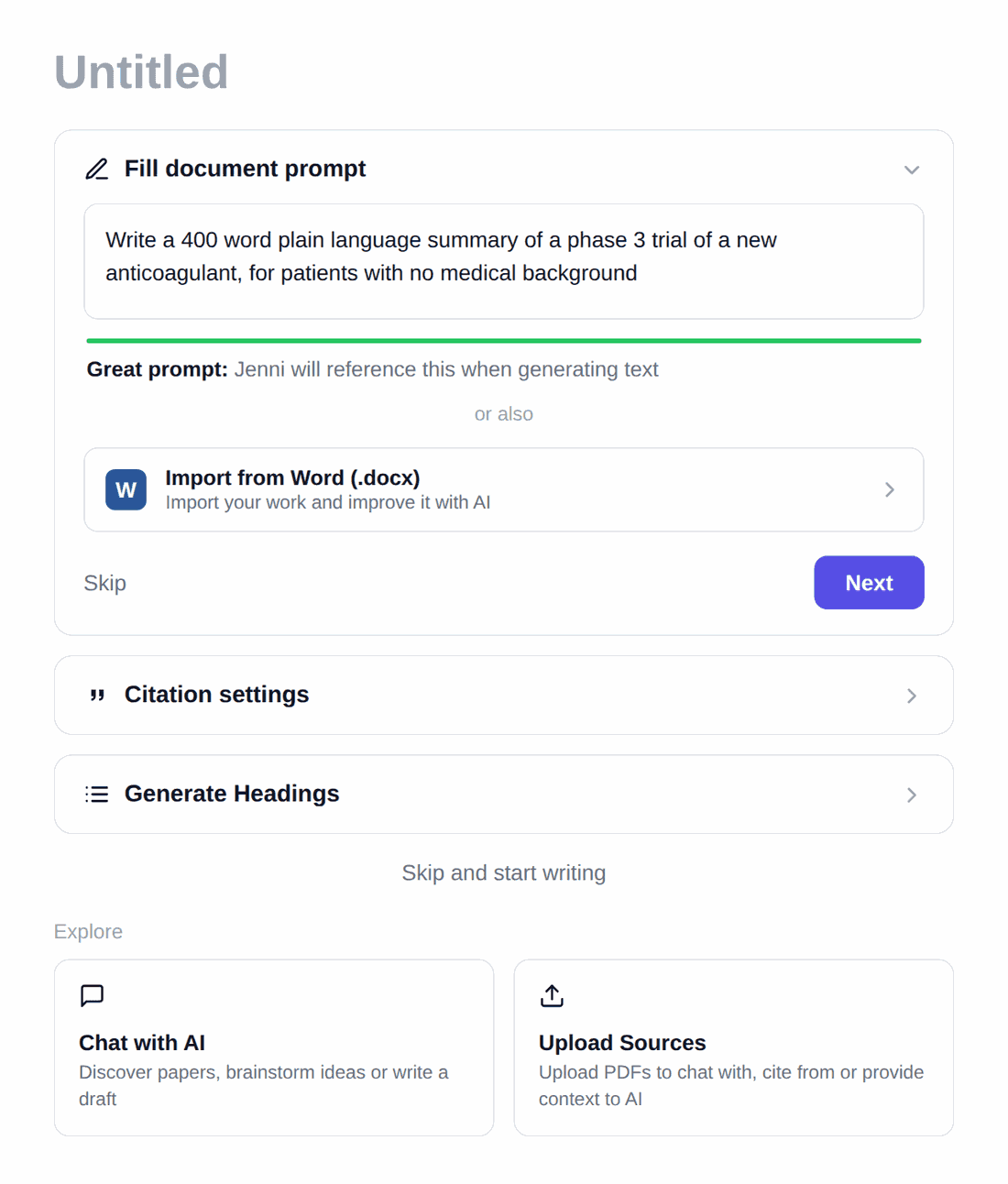
Step 1. Set up the document. Describe exactly what you are writing, for whom, and at what length. Specificity in the prompt is what stops the draft coming out generic.
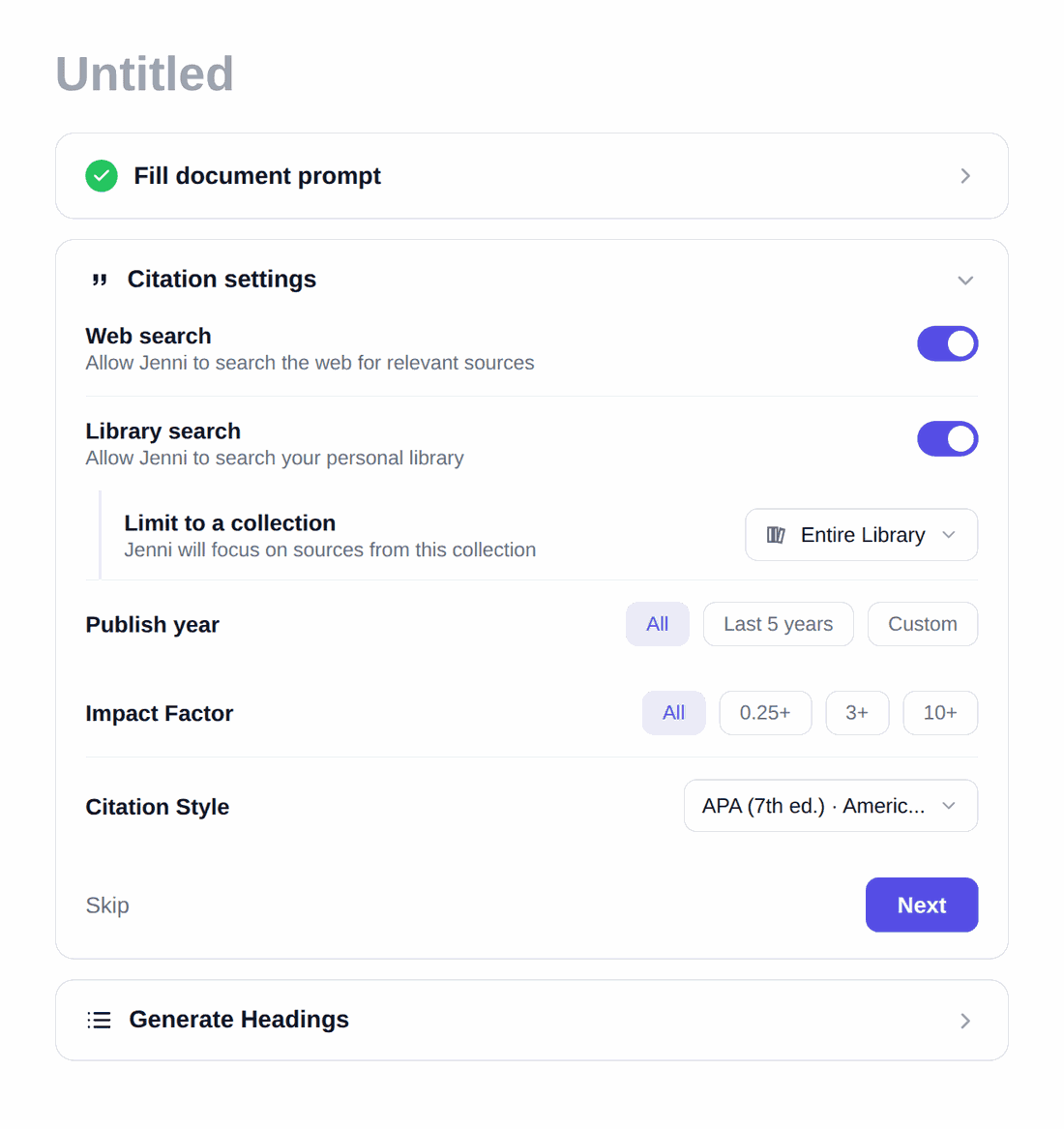
Step 2. Choose your citation settings. Pick the style your target audience expects and how many sources to draw on. Numeric styles are standard across medical publishing.
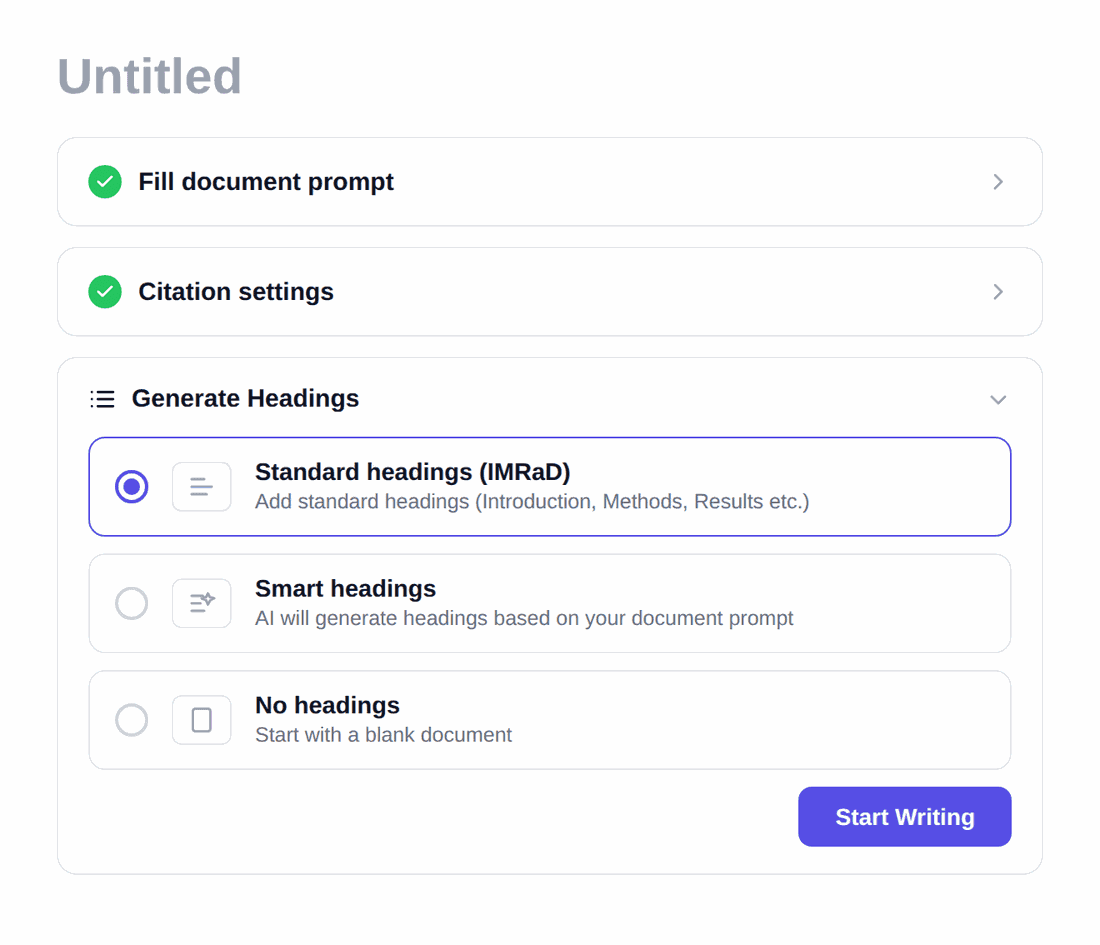
Step 3. Generate the headings. You get an outline you can edit before any prose exists. For a lay summary, replace the defaults with the plain questions a patient would actually ask: what was tested, who took part, what happened, what it means for me.
Step 4. Pull the trial paper into your library. Add the source by its PMID or DOI so the reference is correct from the start, then write each section against the paper rather than from memory.
Step 5. Review before you send it anywhere. Run Claim Confidence to catch anything you have stated more strongly than the data supports, which is the most common failure in a first lay summary, and Source Quality to check what you leaned on. Then read it aloud. If a sentence needs a second reading, a patient will not give it one.
What the First Year Actually Looks Like

Expect to spend it being edited. A single document may come back with comments from a statistician, a clinician, a regulatory lead, and occasionally a lawyer, and those comments will contradict each other. Reconciling them without losing the thread of the document is the skill that separates a first year writer from a second year one, and nobody arrives with it.
Expect the writing to be a minority of the time. Most of the work is reading source documents, chasing the correct version of a table, checking a number against its origin, and tracking what changed between drafts. Writers who enjoy that part progress quickly. Writers who only enjoy the sentences tend to burn out.
Expect the pay to be reasonable rather than dramatic at first. The Bureau of Labor Statistics has no category for medical writers specifically, and the nearest one, technical writers, reported a median of 91,670 dollars in May 2024 across a much broader population. Entry level medical writing generally starts well below that and moves up faster than most writing careers, particularly on the regulatory side.
<ProTip title="🧠 Learn this:" description="In your first month, learn to find the source of every number you are given. Knowing which table a figure came from will make you more useful than any amount of elegant phrasing" />
Start With One Document, Not a Plan
The people who make this transition successfully almost never do it by mapping the whole route first. They write one lay summary, show it to somebody who works in the field, get told what is wrong with it, and write a better one. Three rounds of that is worth more than a year of reading about the profession, and it costs nothing but the evenings.
<CTA title="Write the First Sample This Week" description="Draft it, cite it properly, and check every claim against the paper before anyone else reads it" buttonLabel="Try Jenni Free" link="https://app.jenni.ai/register" />
Pick a trial you find interesting, pull the paper, and write the 400 word version. Keep the tone controlled and the structure obvious, and pay attention to how the parts of the original paper map onto what you are producing. That mapping, from a dense results section to something a person can use, is the whole profession in miniature.