От
Нейтан Ойюнг
—
12 Grant Writing Tips to Strengthen Your Next Proposal

Нейтан Ойюнг
Старший бухгалтер в EY
Получила степень бакалавра в области бухгалтерского учета, окончила аспирантуру по специальности «Бухгалтерский учет»

Most grant writing advice fails the same test. "Tell a compelling story." "Follow the directions." "Proofread carefully." True, useless, and impossible to act on at four in the afternoon with a draft open in front of you.
So every writing tip below comes with the actual edit. A weak line, then the rewritten one, so you can see what changed rather than reading a description of what should. Three process tips come first, because a few of them decide the outcome before any writing starts.
<CTA title="Get the First Draft Out of the Way Faster" description="Jenni helps you structure and draft each section so your time goes into the argument, not the blank page" buttonLabel="Try Jenni Free" link="https://app.jenni.ai/register" />
Before You Write a Word
1. Find the scoring criteria first. Most funders publish how reviewers allocate points, and most applicants never look. If evaluation is worth 30 of 100 points, it is not a closing formality. Read the rubric before the narrative instructions, then make your headings match it.
2. Build the calendar backwards from four weeks early. The USDA National Institute of Food and Agriculture recommends a timeline that finishes at least four weeks before the submission deadline. That buffer is not padding. It is where the writing actually improves, and it is the only thing standing between you and a portal failure.
3. Call the program officer. Ask one question the guidelines genuinely do not answer. Most will take the call, most are helpful, and fifteen minutes will tell you more about fit than an afternoon of reading their website. It also means your application arrives from a name they recognize.
<ProTip title="⚖️ Balance check:" description="Compare your word count per section against the points available for it. If evaluation is worth 30 percent of the score and 5 percent of your narrative, you have a rebalancing job" />
While You Are Drafting
4. Put the number in the first sentence. Reviewers skim openings. Evidence buried in paragraph three may not be reached at all.
Before: "Our community faces significant challenges in early literacy, and the need for intervention has never been greater." After: "Thirty eight percent of third graders at our three partner schools read at grade level, against a district average of 61 percent."
5. Attach a source and a year to every figure. An unsourced statistic is worth less than no statistic, because it invites a reviewer to wonder what else you have not checked.
Before: "Studies show that early intervention improves reading outcomes." After: "A 2026 district assessment found that students receiving weekly tutoring gained 1.4 reading levels, against 0.7 for those who did not."
6. Replace adjectives with measurements. Words like substantial, significant, and extensive are placeholders sitting where a number belongs.
Before: "We have extensive experience managing large grants." After: "We have closed five grants between 25,000 and 120,000 dollars, each on schedule and with complete reporting."
The same substitution works on a whole family of phrases. These six show up in almost every first draft, and each one is a place where a fact should be.
Weak phrase | Why it costs you | Write instead |
"a significant need" | Nobody can score a feeling | The figure, its source, and its year |
"we hope to" | Signals you are not committing to the outcome | "We will", with a number attached |
"various stakeholders" | Reviewers assume nobody has actually agreed | The named partners, with letters attached |
"best practices" | Claims authority without offering evidence | The model name and who evaluated it |
"ongoing" | Hides the absence of a timeline | The start date and the cadence |
"leverage" | Almost always a longer word for a shorter one | The verb you actually mean |
7. Write objectives that can fail. If there is no way for an objective to turn out false twelve months from now, it is not an objective. It is a sentiment.
Before: "Increase community awareness of our services." After: "Enroll 180 students across three campuses by October 2026, with 65 percent attending 40 or more of the 56 sessions."
8. Keep sentences under twenty words. This is not a stylistic preference. The NIH states it directly in its own grant writing guidance, and it is the fastest single improvement available to most drafts.
Before: "In order to ensure that the program is able to reach the maximum possible number of eligible participants, we will be undertaking a comprehensive outreach effort in collaboration with our partner schools." After: "We will recruit through our three partner schools. Each site lead runs two enrollment sessions in September."
9. Make the budget narrative point back at the program. Every line should name the activity it pays for. Reviewers read the budget against the narrative, and a mismatch reads as carelessness even when it is a typo.
Before: "Personnel: 29,200 dollars." After: "Program coordinator, 0.5 FTE: 29,200 dollars. The coordinator runs all 168 sessions described in section four."
<ProTip title="🗂️ Swipe file:" description="Save every sentence a funder has quoted back at you in feedback or an award letter. Those are the lines that landed, and they are worth studying more than any generic example" />
Three Mistakes That Disqualify You Before Anyone Reads It
These are not scoring problems. They are administrative rejections, which means the quality of your writing never enters the conversation at all.
The wrong eligibility category. Entity type, geography, budget size, and years in operation are all common gates. Check each one against the guidelines in front of you, not against your memory of last year version of them.
A missing attachment. Determination letter, audited financials, letters of support, board roster. Build the attachment list on day one and treat it as part of the draft rather than as an errand for submission morning.
An overrun page limit. Funders enforce this mechanically. NSF caps the project description at fifteen pages, and NIH allows one page for Specific Aims. Portals frequently reject an oversized file outright instead of trimming it for you.
Before You Hit Submit
10. Cut ten percent after you finish. Do it as a matter of course, not because you are over the limit. The first casualties are almost always transitional sentences that carry no information, and the draft gets faster to read without losing anything.
11. Give it to somebody outside your field. Not to proofread. Ask them to tell you in one sentence what you are asking for and why it matters. If they cannot, a reviewer holding ten to twenty other proposals certainly will not.
12. Submit two days early. Federal portals queue badly in the final hours, and institutional sign off has a way of taking longer than promised. An application that fails to upload at 11:52pm is not a late application. It is not an application.
<ProTip title="📐 Fit the box:" description="Aim for 90 percent of the page limit rather than 100. A narrative crammed to the last line reads as rushed, and a reviewer working through fifteen of them notices the one that breathes" />
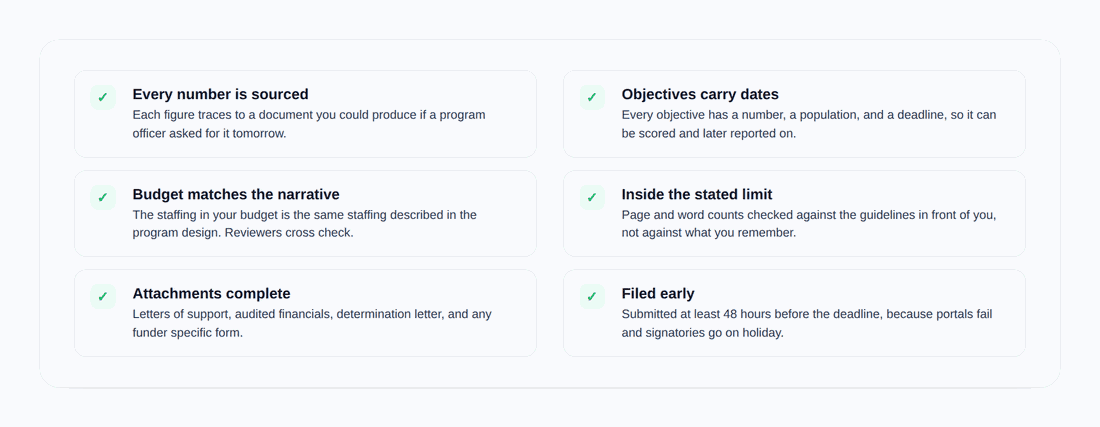
Run this last check before anything leaves your hands.
<ProTip title="🧾 Track it:" description="Log the hours you spend on every application alongside the outcome. After six submissions the pattern tells you which funder types actually pay for your time" />
The Tips That Matter Most Are the Boring Ones
If you only take three things from this list, take the calendar, the scoring criteria, and the habit of putting a sourced number in your opening sentence. Those three change outcomes. The rest is craft, and craft compounds: your fifth proposal will be visibly better than your first, largely because you will have learned what to leave out.
<CTA title="Write Your Next Proposal With Less Friction" description="Draft section by section with citations you can check, then tighten it before the deadline arrives" buttonLabel="Try Jenni Free" link="https://app.jenni.ai/register" />
When a proposal is declined, read the feedback against the National Institute of Allergy and Infectious Diseases distinction between fixable and hard to fix problems before deciding whether to resubmit. And keep working the fundamentals underneath all of this: a consistent formal tone, a clear sense of what counts as a credible source, and enough discipline about how the parts fit together that a reviewer never has to hunt for anything.