Oleh
Nathan Auyeung
—
Transition Words for Essay Writing: Clear Guide

Nathan Auyeung
Akuntan Senior di EY
Lulus dengan gelar Sarjana Akuntansi, menyelesaikan Diploma Pascasarjana Akuntansi

Strong essays need to be easy to follow. Transition words are what make that happen. They connect your ideas so your argument doesn’t feel like a list of random thoughts.
This guide shows you how to use these words correctly, how to avoid the usual errors, and how to build essays that flow logically from one point to the next. You'll get clear examples and a straightforward method you can apply immediately.
<CTA title="Improve Essay Flow Instantly" description="Use structured prompts to organize ideas and connect arguments clearly in every essay" buttonLabel="Try Jenni Free" link="https://app.jenni.ai/register" />
What Transition Words Actually Do in Essays
Transition words do real work in an essay. They aren’t just for decoration. Their job is to show the relationship between your ideas and walk a reader through your logic, one step at a time.
In academic writing, these words act as logical connectors. They tell the reader if you’re adding a point, showing a contrast, explaining something, or wrapping up.
The University of Waterloo’s writing center calls them “bridges” between ideas, which highlights how they build coherence. Without these connectors, even good ideas can seem disconnected.
For a deeper look at how to bridge these gaps, you can explore various tips and tools for transitions to see how different words function in different contexts. With them, your essay reads as one solid argument instead of a bunch of separate statements.
Why they matter more than students expect
A lot of students think transitions are optional. They’re not. Transitions actually shape how your argument is understood.
They make your writing clearer.
They hold your paragraphs together.
They steer the reader through your logical steps.
Writing centers such as Purdue OWL emphasize that transitions and transitional devices improve coherence and readability in academic essays. Essays that use clear transitions consistently get higher scores for readability and structure.
<ProTip title="💡 Pro Tip:" description="Use one clear transition per idea shift instead of adding one to every sentence" />
Types of Transition Words and How to Use Them
Transition words are grouped by what they do. Picking the right type is more important than using a fancy word.
Adding to your argument
These words help you build on a point or bring in new evidence. Words like furthermore, in addition, and also are common here.
Example:
Digital education improves access to learning. Furthermore, it can lower costs for institutions.
These words tell your reader the next idea supports the last one.
Showing a contrast
These words introduce a different view or point out a limitation.
Example:
Online learning gives students flexibility. However, it might mean less direct time with instructors. That can hurt student engagement in some courses.
See how however warns the reader the direction is changing? Without it, the second sentence seems to come out of nowhere.
<ProTip title="📌 Note:" description="Avoid repeating however in every paragraph use alternatives like nevertheless or in contrast" />
Explaining cause and effect
These words make the relationship between events or ideas clear. Words like therefore, consequently, and as a result fall into this group.
If you are writing a problem solution essay, these cause-and-effect transitions are essential for linking a specific issue to its proposed resolution.
Example:
The study had a small sample size. Therefore, its findings should be interpreted cautiously, particularly when applied to broader populations.
These connectors are key for analysis and showing how evidence leads to a conclusion.
Common Mistakes Students Make with Transition Words
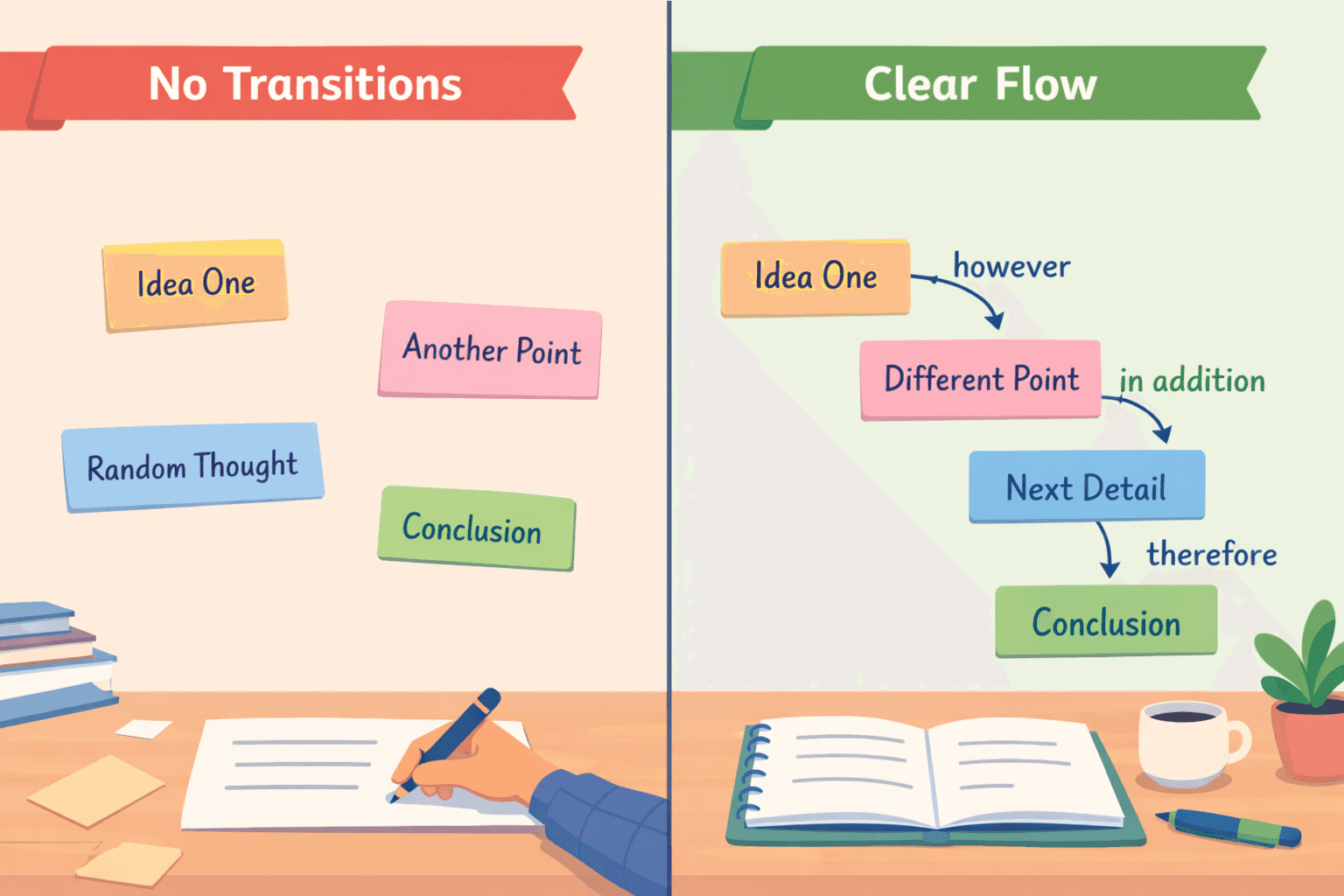
An essay can fall apart even with strong ideas. Often, it's the way students handle transitions that causes the problem. These words are meant to guide readers, but misusing them creates confusion instead of clarity.
Overusing transitions
A common habit is to sprinkle transitions into every single sentence. The result isn't smooth reading; it's a clunky, robotic rhythm.
Take this example:
❌ Firstly, the study is important. Secondly, it provides insight.
✅ The study is important because it provides key insights into user behavior.
This sequence feels like ticking boxes, not like building an argument. It sounds mechanical. A better approach is to use transitions only when you're actually shifting focus or connecting distinct points. Let the natural flow of your ideas do some of the work.
Using the wrong type of word
This mistake directly misleads the reader. Using a word that signals contrast when you're actually adding information, for instance, throws the logic off track.
To avoid this, it is helpful to use a phrasebank for signaling transition to ensure the word you choose matches the logic of your thought.
Here's an incorrect use:
The results were significant. However, they support previous findings.
The word "however" primes the reader for a contradiction or a twist. But the next sentence just reinforces an earlier point.
The disconnect creates a momentary confusion. In this case, a simple additive transition like "Furthermore" or "Also" would fit. Getting this wrong undermines your credibility.
Treating transitions as structural decoration
Transitions are not magic glue for a poorly built argument. If your paragraphs are out of order, slapping "therefore" between them won't fix the problem.
You must first understand how to structure an essay guide to ensure your ideas move in a sequence that makes sense before you try to connect them.
Think of transitions as road signs on a well-planned route. If the road itself is a maze, the signs just point drivers into more dead ends. First, make sure your ideas are organized in a clear, logical sequence.
Then, use transitions to highlight that existing structure and help the reader move through it smoothly. They clarify connections that are already there; they don't create connections that aren't.
<ProTip title="⚠️ Reminder:" description="Transitions support logic they do not replace clear argument structure" />
Transition Words vs Logical Structure
A transition word is like a connector, not a foundation. They work best when paired with strong structure. If the structure is weak, the connectors won't hold anything together.
Analogy: Building a bridge
Imagine your essay is a bridge. Each paragraph is a solid section of the span. Transition words are the joints, the bolts and welds, that connect those sections together.
The joints are essential, but if the sections themselves are poorly built or placed out of order, the connectors can't do their job. They just link flawed parts.
What strong structure looks like
A solid essay structure has three key features:
Clear topic sentences that tell the reader what each paragraph is about.
A logical progression of ideas, where one point naturally leads to the next.
Consistent development of your overall argument.
Transitions then reinforce these connections. They signal the moves you're already making. They don't create the moves themselves.
Weak vs. Strong Transition Use
Situation | Weak Approach | Strong Approach |
Adding ideas | Repeating "also" in every sentence. | Varying with "moreover," "furthermore," or sometimes just letting the idea flow without a word. |
Contrasting | Using "however" when you're actually adding support. | Matching the connector to the logic: "however" for a true contrast, "in fact" for reinforcement. |
Sequencing | Overusing "firstly, secondly, thirdly" like a list. | Using a natural progression, maybe starting with "To begin," then shifting to "Next," and only signaling major steps. |
Concluding | An abrupt, unmarked ending. | Using a simple "overall" or "finally" to frame the closing thought, not just "in conclusion." |
A well-structured essay uses transitions sparingly, but with precision. They should feel like helpful signs on a clear path, not like constant interruptions.
Transition Words Across Essay Sections
Different parts of an essay need different kinds of transitions. The words you use in the introduction won't fit in the body, and the body's words might feel odd in the conclusion.
Introductions
The introduction sets the direction and scope. Its transitions are about framing and stating intent. For a professional tone, many writers choose to use formal phrases instead of idioms in essays to establish credibility right from the start.
Examples include:
To begin with,
This essay examines,
The purpose of this paper is,
Here's how one works:
This essay examines the impact of social media on communication patterns.
It's direct. It tells the reader what's coming without any flourish.
Body Paragraphs
Body paragraphs need the widest range. They're where the argument actually moves. A paragraph's internal structure, topic sentence, evidence, explanation, requires smooth connections between those parts.
A common flow looks like this:
The topic sentence states the point.
Supporting evidence follows, often introduced by "For example," or "Specifically,".
An explanation then links the evidence back to the point, using "This shows that..." or "Therefore,...".
Transitions also connect one paragraph to the next. They signal a shift, an addition, or a contrast to the previous idea.
For instance:
Social media increases accessibility. Furthermore, it enables real-time communication.
The word "Furthermore" adds a new, related point onto the first one, building the argument step by step.
Conclusions
Conclusion transitions signal closure and synthesis. They're about wrapping things up, not introducing new ideas. They should feel final, but not overly dramatic.
Common options are:
In conclusion,
Overall,
Taken together,
An example:
Taken together, the evidence suggests that social media has both benefits and limitations.
The phrase "Taken together" implies you're looking at all the previous points as a single package, which is exactly what a conclusion should do.
<ProTip title="💡 Pro Tip:" description="Use fewer transitions in conclusions clarity matters more than variety" />
What Students Actually Struggle With
Students often look for long lists of transition words, thinking that's the solution. But their real problem is usually something else: flow.
From Reddit discussions
On forums, learners frequently say their essays feel "choppy" or "jumpy." They mention using connectors like "however" and "moreover," but the writing still doesn't read smoothly.
The issue isn't a lack of vocabulary. It's a misalignment. They're using a contrast word when their ideas are actually adding to each other, or using an additive word when there's no logical addition happening. The transition doesn't match the thought.
From YouTube tutorials
A common metaphor in writing tutorials is that transitions are "bridges between thoughts." That's a useful image, and it points to the core insight: individual sentences can be grammatically correct, yet still feel disconnected.
The bridge is missing. The transition word is supposed to be that bridge, but if the thoughts on either side aren't meant to be connected, the bridge just sits there, pointless.
The hard truth
This is the part many students don't want to hear. Using "furthermore" or "consequently" doesn't make your writing sound more advanced. It just makes the underlying structure more obvious.
If that structure is weak or confusing, the transitions will highlight the weakness. Clear reasoning is what makes writing coherent.
Transition words only serve to spotlight that reasoning, making it easier for the reader to follow. They don't create the reasoning itself.
Practical Strategy to Use Transition Words Effectively
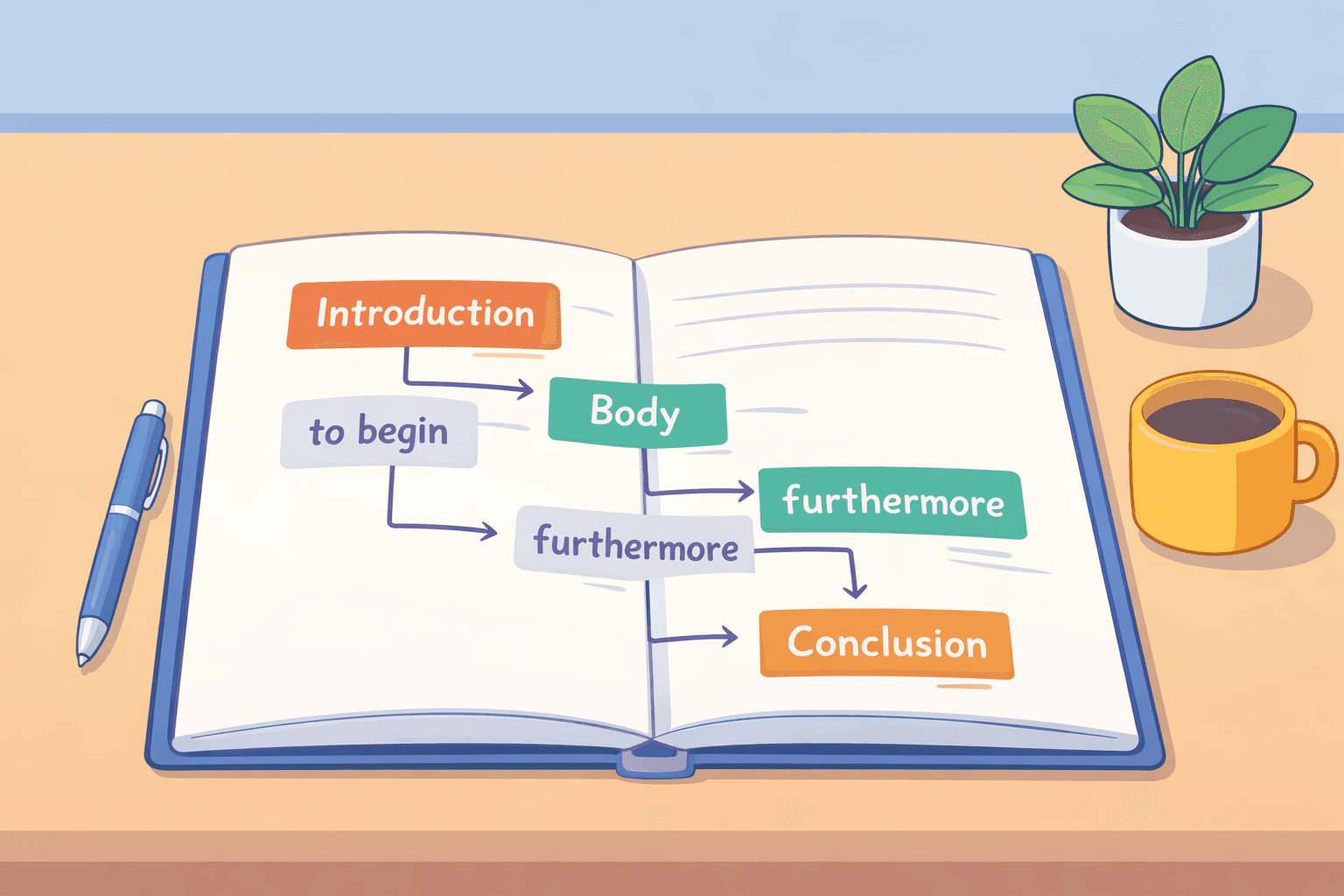
Memorizing long lists of words is a waste of time. A better approach is to use a simple, three-step method.
Step 1: Identify the relationship
Before you pick a word, ask yourself what you're actually doing between two sentences or paragraphs. Are you:
Adding more information?
Introducing a contrast or exception?
Explaining a cause or result?
Giving a specific example?
Figure out the logic first.
Step 2: Choose the correct connector
Once you know the function, match it to the right type of word.
Adding information: furthermore, also, in addition.
Contrasting ideas: however, on the other hand, conversely.
Explaining cause: therefore, consequently, as a result.
Giving examples: for instance, specifically, to illustrate.
Step 3: Keep it minimal
Don't use a transition just because you haven't used one in three sentences. Use them only when the connection between your ideas isn't immediately obvious. Sometimes, the best transition is no transition at all.
Example transformation
Look at these three short sentences:
Students face stress. They have deadlines. They feel pressure.
They're related, but the link is clumsy. Applying the method, the relationship is "giving an example" of the stress. A simple connector can tighten it up.
After:
Students face significant stress. In particular, tight deadlines increase pressure levels.
The second version uses fewer total words, but the connection is clearer. The transition "In particular" directs the reader's attention to a specific cause, improving the flow without adding clutter.
<ProTip title="📌 Note:" description="Focus on clarity before complexity simple transitions often work better" />
Transition Words vs “Sounding Smart”
A lot of students think using complex transition words will make their writing sound more academic or advanced. It usually doesn't work.
Why complexity fails
When you force complicated vocabulary into a simple argument, three things tend to happen:
Overuse creates repetition. You might end up using "furthermore" five times in one paragraph because it's the only "smart" word you know for adding ideas.
Misuse creates confusion. If you don't fully understand a word like "concomitantly," you'll probably use it incorrectly and confuse the reader.
It sounds unnatural. The writing becomes stiff and awkward, like someone wearing a formal suit to a casual event.
Academic writing isn't about using the fanciest words. It's about using the right words with precision.
A better approach
Use transitions that match your idea, not your ambition. Choose the word that fits the logical relationship you're creating, even if it's a simple one.
For example, in many contexts, "also" is perfectly clear and often better than "furthermore." It's direct and unobtrusive.
The rule is straightforward: clarity always outweighs sophistication. If a simple word makes your point easier to follow, use it. Your reader will thank you.
A Simple Template You Can Use
This basic structure can help you place transition words where they're actually useful, not just where you feel you should have one.
Introduction
To frame the topic: This essay examines…
To state your main argument: It will be argued that…
These are functional phrases. They tell the reader what you're doing.
Body Paragraph
Start with a clear Topic Sentence: This section evaluates… Then, as you develop the paragraph, use transitions based on what you're doing next:
To add a supporting point: Furthermore…
To introduce a contrasting view or limitation: However…
To show a cause or result: Therefore…
Conclusion
To signal you're wrapping up: In conclusion…
To summarize the main takeaway: Overall…
This framework puts transitions in key spots where they guide the reader through the structure of your argument. They serve a purpose, instead of just filling space between sentences.
Make Your Ideas Flow Without Forcing It
You try to connect every sentence, but the more transition words you add, the clunkier your writing feels. It breaks the flow. Readers notice. The goal isn't more transitions - it's the right transitions at the right moments.
<CTA title="Write Clear and Structured Essays" description="Organize ideas and apply transition words effectively using guided prompts" buttonLabel="Try Jenni Free" link="https://app.jenni.ai/register" />
Keep your structure clear first. Let the logical connections between your ideas guide where transitions belong. Add them sparingly, with precision, only when the relationship between thoughts isn't immediately obvious to the reader.
References:
https://owl.purdue.edu/owl/general_writing/mechanics/transitions_and_transitional_devices/index.html
https://www.phrasebank.manchester.ac.uk/signalling-transition/