Dwara
Justin Wong
—
Essays mein Idioms ki jagah Formal Phrases

Justin Wong
Vikas Prabhari
Graduated kiya Bachelor's me Global Business & Digital Arts, Minor me Entrepreneurship
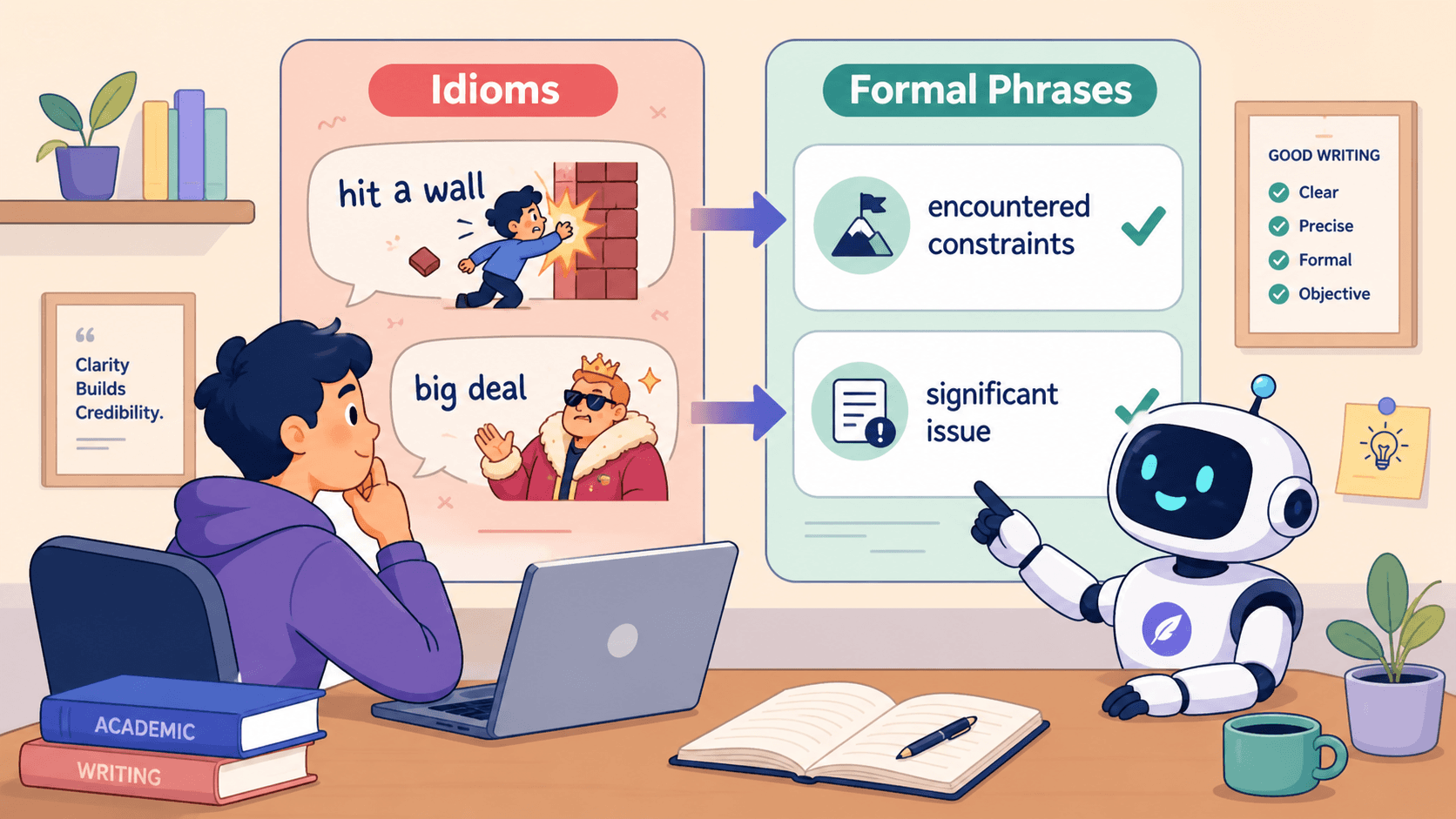
Apne essay mein idioms ki jagah formal phrases ka use karne se aapke ideas clarity aur precision ke saath communicate hote hain, jo expected academic standards ko meet karte hain. Yeh approach metaphorical language ko neutral, direct expressions se replace karke confusion ko prevent karti hai.
Students ke marks lose hone ka ek common reason weak arguments nahi, balki ek casual tone hai jo credibility ko damage karta hai. Yeh guide aapko dikhayegi ki kaise idioms ko replace karein, academic paraphrasing ka use karein, aur ek consistent formal style build karein. Specific techniques seekhne ke liye padhte rahein.
<CTA title="Write Formal Essays with Confidence" description="Transform casual phrases into clear academic language using structured prompts and guidance." buttonLabel="Try Jenni Free" link="https://app.jenni.ai/register" />
Formal Phrases Instead of Idioms Ka Actual Matlab Kya Hai
Formal phrases use karne ka matlab hai idioms ko literal, precise language se swap karna. Yeh aapke ideas ko clear banata hai aur cultural misunderstandings ko prevent karta hai.
The University of Manchester ka Academic Phrasebank is approach ko recommend karta hai, aur note karta hai ki academic readers ko explicit, structured language ki zaroorat hoti hai jise sabhi ek hi tarah se interpret karein.
Yeh shift academic style ko master karne ka ek key part hai, jo creative flair se zyada objectivity ko prioritize karta hai.
Idioms essays mein fail ho jaate hain kyunki yeh shared cultural knowledge par depend karte hain, jise academic writing avoid karti hai. Yeh rahe reasons ki yeh kyun ek problem hain:
Ambiguity: Inka meaning readers ke beech badal sakta hai.
Informality: Yeh ek conversational tone create karte hain, scholarly nahi.
Imprecision: Yeh exact point batane ki jagah imagery ka use karte hain.
Is example ko dekhein:
Idiomatic: “At the end of the day, education is a double-edged sword.”
Formal: “Ultimately, education has both advantages and disadvantages.”
Formal version idea ko directly state karne ke liye neutral, academic vocabulary ka use karta hai.
<ProTip title="💡 Pro Tip:" description="Always replace metaphor with literal meaning when converting idioms into formal writing" />
Common Idioms aur Unke Formal Alternatives
Yeh list aapke writing mein use karne ke liye direct replacements offer karti hai. Yeh practical substitutions aur academic paraphrases hain.
Time aur Conclusion Expressions
Aise phrases jo closure ya final point ko signal karte hain.
“At the end of the day” → Ultimately / In the final analysis
“When all is said and done” → In conclusion / Overall
“From day one” → From the outset
Ek quick example is shift ko dikhata hai:
Informal: “At the end of the day, the policy failed.”
Formal: “Ultimately, the policy was unsuccessful.”
Difficulty aur Limitations
Idioms problems ko overstate kar sakte hain. Academic writing ko unhe exactly name karna chahiye. Agar aap ek problem solution essay likh rahe hain, toh obstacles ke liye precise language ka use karna professional tone ke liye bahut zaroori hai.
“Bite off more than you can chew” → Exceed one’s capacity
“Run out of steam” → Lose momentum
“Hit a wall” → Encounter significant constraints
Ek sentence mein yeh kaisa dikhta hai:
Informal: “The project hit a wall.”
Formal: “The project encountered significant constraints.”
Importance aur Impact
Yeh emotional language ko objective phrasing ki taraf move karta hai. Academic language ko sach mein master karne ke liye, aapko impact ko metaphors se describe karne ke bajaye quantify karna seekhna hoga.
“Big deal” → Significant issue
“Game-changer” → Transformative development
“Make a big difference” → Have a substantial impact
<ProTip title="📌 Note:" description="Use words like significant substantial and considerable to replace emotional idioms" />
Agreement aur Comparison
Academic writing figures of speech ke bajaye explicit comparison ko favor karti hai.
“See eye to eye” → Agree / Hold similar views
“On the same page” → Share a common understanding
“Apples and oranges” → Not directly comparable
For instance:
Informal: “These ideas are apples and oranges.”
Formal: “These concepts are not directly comparable.”
Students ke Idioms Use Karne Par Marks Kyun Katte Hain
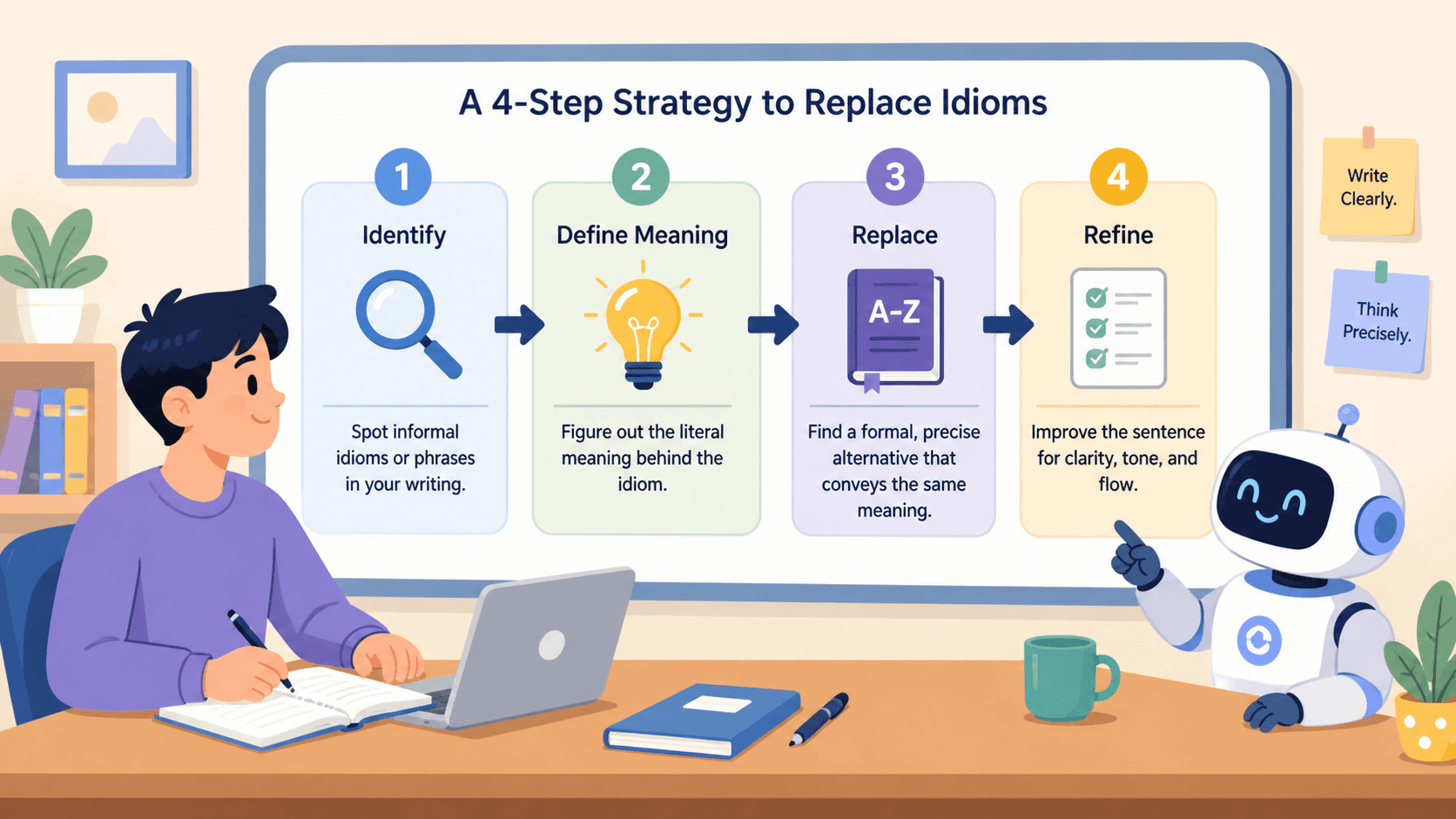
Students ke aksar informal language ke liye marks katte hain, bhale hi unke ideas clear hon. Yeh arbitrary nahi hai; yeh ek core academic standard hai. Levels of formality ko samajhne se aapko help milti hai yeh identify karne mein ki kab koi phrase university-level paper ke liye bahut casual hai.
English learners ke beech discussions dikhate hain frustration jab unhe "a lot" ya "I think" jaise phrases ke liye penalties milti hain. Formal writing guidelines consistently impersonal language aur objective phrasing par stress karti hain.
British Council ke IELTS criteria, example ke liye, higher scores ke liye formal tone, clear argumentation, aur accurate vocabulary require karte hain.
Core Problem: Tone, Intelligence Nahi
Idioms use karne se aapka argument strong nahi hota. Yeh usually formal style par control ki kami ko signal karta hai.
Academic writing ko ek courtroom ki tarah imagine karein. Aapke arguments ko precise, evidence se supported, aur neutral hona chahiye. Idioms casual conversation ki tarah sound karte hain, jo us evidence-based reasoning ko weak karta hai.
Ek Quick Comparison
Pehle: “I think this issue is a big deal and affects a lot of people.”
Baad mein: “This issue is a significant concern that affects a large number of individuals.”
Revised version formal expressions, impersonal constructions, aur precise vocabulary ka use karta hai.
<ProTip title="💡 Pro Tip:" description="Remove I think statements and replace them with evidence based or impersonal phrasing" />
“In My Opinion” Se Academic Sentence Starters Par Shift Hona
Idioms ko replace karne ka matlab overly personal expressions ko cut out karna bhi hai. Formal writing aapke personal view ke baare mein nahi hai; yeh ek objective case build karne ke baare mein hai.
Opinion State Karne Ke Liye Formal Alternatives
Personal phrases ko academic sentence starters aur stance expressions se swap karein. Yeh hain kuch direct swaps:
“In my opinion” → It can be argued that…
“I believe” → This suggests that…
“To my mind” → It is widely accepted that…
Yeh transition bahut aasan ho jata hai jab aap samajhte hain ki how to structure an essay guide, kyunki ek strong structure naturally objective claims ko support karta hai.
Ek short example mein difference dekhein:
Informal: “I think social media is harmful because it affects teenagers.”
Formal: “It can be argued that social media has a detrimental impact on adolescents.”
Second version sirf zyada formal sound nahi karta. Yeh idea ko ek aise position ke roop mein frame karta hai jo discussion ke liye open ho, jo ki academic arguments ka tarika hai.
Yeh Change Kyun Matter Karta Hai
Yeh shift un values ke sath align karta hai jise academic writing value karti hai: impersonal language, evidence-based claims, aur logical phrasing. Sentence ko "I think" se start karna immediately idea ko aapse, yaani writer se, anchor kar deta hai.
"It can be argued" ya "Research indicates" se start karna ise evidence ya logical line of reasoning se anchor karta hai, jo ki bahut zyada credible hai.
Follow Karne Ke Liye Ek Simple Pattern
Aap ek basic pattern ka use karke sentences ko structure kar sakte hain jo aapke argumentation ko improve karta hai:
Claim: It can be argued that social media use correlates with increased anxiety.
Evidence: Research indicates that adolescents reporting high social media engagement also report higher levels of stress.
Explanation: This suggests that the curated nature of online platforms may contribute to psychological pressure.
Yeh pattern (claim, evidence, explanation) formal reasoning vocabulary ka use karta hai aur focus ko argument par hi rakhta hai, us person par nahi jo ise bana raha hai.
YouTube aur Idioms Ko Lekar Confusion
Students ko bahut mixed advice milti hai. Kuch teachers kehte hain ki idioms ko har haal mein avoid karein. Dusre so-called "advanced idioms" use karne ki recommend karte hain. Yeh confusing hai.
Aapko basically do opposite cheezein boli jaati hain: har idiom ko ek formal phrase se replace karein, ya phir "acceptable" idiomatic expressions dhoodhne ki koshish karein. Practical answer inke beech mein kahin hai.
Jo Sach Mein Work Karta Hai
Kuch phrases safe hain aur academic writing mein commonly accepted hain. Yeh casual idioms nahi hain; yeh formal connectors ya set phrases hain.
On the one hand… on the other hand…
In light of…
With regard to…
Yeh standard academic collocations hain. Yeh aapke argument ko structure karne mein help karte hain bina informal sound kiye.
Jo Aapko Definitely Avoid Karna Chahiye
Aise idioms se door rahein jo slang, specific cultural references, ya pure emotional exaggeration par based hote hain.
Avoid: “This policy blew up in their face.”
Use: “This policy resulted in unintended negative consequences.”
Second version outcome ko directly aur neutrally state karta hai, jo aapke grade ke liye matter karta hai.
<ProTip title="📌 Reminder:" description="Not all idioms are equal use only those accepted as formal academic expressions" />
Idioms Ko Replace Karne Ke Liye Ek Step-by-Step Strategy
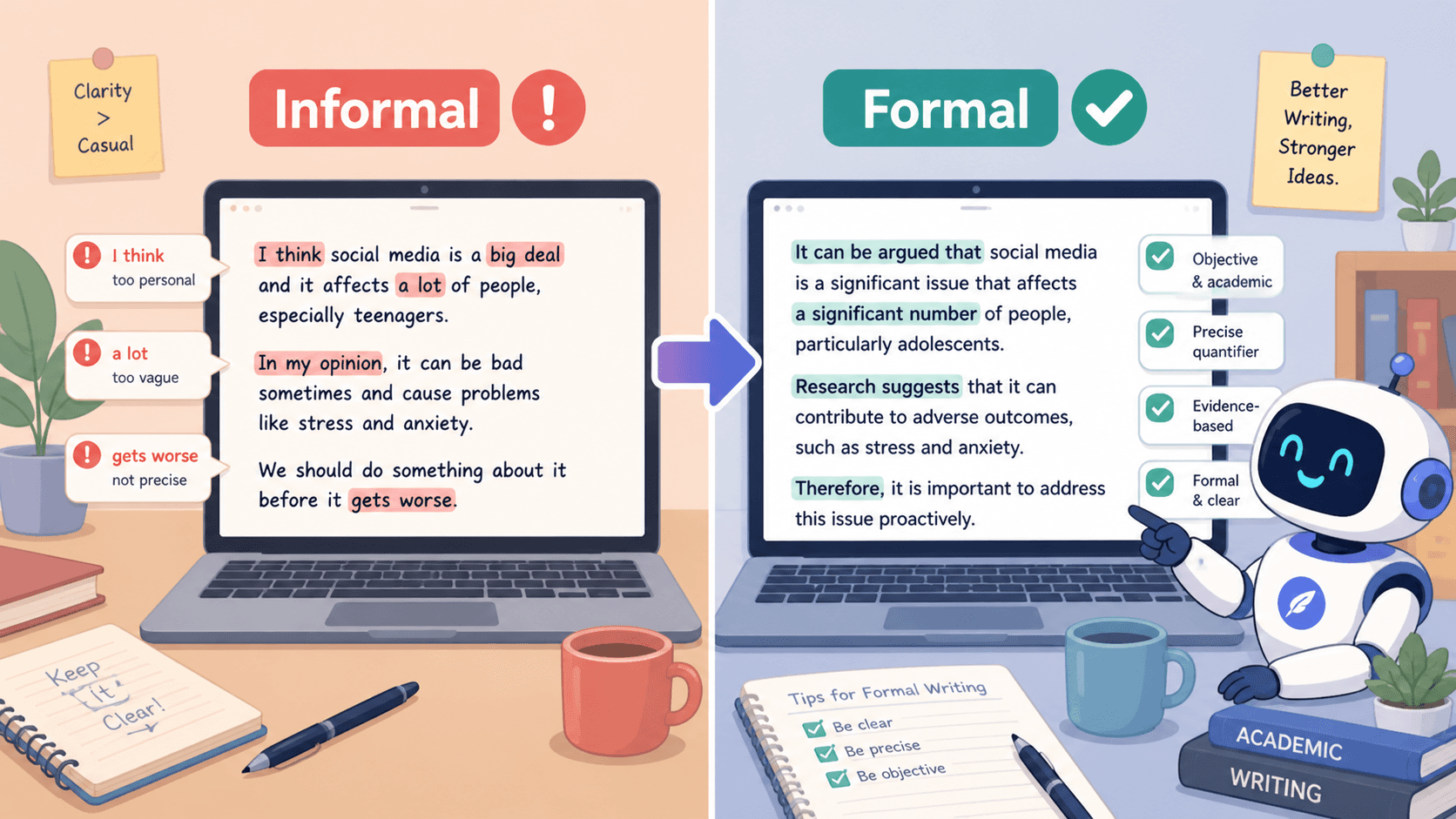
Yeh aapke apne essays ko revise karne ke liye ek practical process hai. Yeh systematic hai, toh aap ise kisi bhi draft par apply kar sakte hain.
Step 1: Informal Language Ko Identify Karein
Sabse pehle, apne text ko padhein aur jo bhi conversational sound kare use underline karein.
Common idioms (e.g., "at the end of the day")
Slang ya zyada casual words
Very common phrasal verbs (jaise "get better")
Personal phrases ("I think," "we believe")
Step 2: Exact Meaning Ko Define Karein
Har underlined phrase ke liye, apne aap se poochein: main yahan literal point kya banana chahta hoon? Figurative language ko ignore karein.
Example: "Hit a wall" ka simple matlab hai ki aapne kisi difficulty ya limitation ka samna kiya.
Step 3: Formal Equivalent Se Replace Karein
Us core meaning ko lein aur uske liye ek neutral, precise word dhoondhein.
difficulty ban sakta hai constraint ya obstacle.
importance ban sakta hai significance.
change ban sakta hai development ya shift.
Aap is list mein aur options dhoondh sakte hain: academic vocabulary for essays.
Step 4: Full Sentence Ko Refine Karein
Apne naye word ya phrase ko wapas sentence mein plug karein. Ise loud padhein. Kya yeh natural aur clear sound karta hai? Agar flow banane ke liye zaroorat ho toh aas-paas ke words ko adjust karein.
Full Process Ka Example:
Original Sentence: “The company hit a wall during expansion.”
Step 2 Meaning: The company faced a difficulty.
Step 3 Replacement: difficulty → constraint
Step 4 Refined Sentence: “The company encountered significant constraints during its expansion.”
Quick Reference Table
Idiom | Formal Phrase |
at the end of the day | ultimately |
a lot of | a significant number of |
big problem | major issue |
get better | improve |
deal with | address |
Yeh Method Kyun Effective Hai
Yeh isliye kaam karta hai kyunki aap pehle meaning par focus karte hain, na ki sirf ek list se kisi phrase ko replace karne par.
Yeh aapki writing ko forced ya unnatural sound karne se rokta hai. Aap idea ko ek academic register mein translate kar rahe hain, na ki sirf ek mechanical replacement kar rahe hain.
<ProTip title="💡 Pro Tip:" description="Always revise sentences after replacing idioms to maintain natural flow" />
Ek Formal Vocabulary System Build Karna
Achi academic writing ek system se aati hai, na ki sirf rote huye words ki list se. Language learning par research is baat ko support karti hai: aap single, fancy terms ko yaad rakhne ki koshish karne ke bajaye academic collocations (words jo naturally saath jaate hain) aur structured expressions par focus karke behtar results paate hain.
Aapko Sach Mein Kya Seekhna Chahiye
"Advanced idioms" ke baare mein bhool jayein. In categories par focus karein:
Academic connectors: furthermore, consequently, however
Reporting verbs: argue, indicate, demonstrate, suggest
Evaluation vocabulary: significant, limited, plausible, flawed
Cause and effect phrases: as a result of, leads to, contributes to
Contrast expressions: in contrast, on the other hand, whereas
Phrases Ke Saath Kaam Karein, Sirf Words Ke Saath Nahi
Sirf "impact" word mat seekhein. Common pairings ko study karke seekhein ki ise sentences mein actual mein kaise use kiya jata hai.
significant impact
empirical evidence
fundamental assumption
considerable variation
Language ke in chunks ko seekhne se do cheezein hoti hain. Yeh aapki writing ko clearer banata hai, kyunki aap standard academic phrasing ka use kar rahe hain. Yeh cohesion (tarika jisse aapke sentences link hote hain) ko bhi improve karta hai, kyunki yeh phrases aapke ideas ke liye natural connectors ke roop mein kaam karte hain.
Apna System Build Karne Ke Liye Ek Simple Routine
Yeh koi quick trick nahi hai. Yeh ek habit hai.
Apne field ke academic articles regularly padhein, bhale hi sirf kuch paragraphs.
Single words ke bajaye useful phrases ko note karein. "this lends support to..." ya "a widely held view is..." jaise whole expressions ko highlight ya likhein.
In naye phrases ka use karke apne sentences ko rewrite karein. Inhe actively try out karein.
Apne next essay mein in phrases ko reuse karein. Is tarah se yeh aapke notes se aapke active vocabulary mein move karte hain.
Yeh process time ke sath ek formal style build karta hai. Aap sirf idioms ko avoid nahi kar rahe hain; aap seekh rahe hain ki academic ideas ko conventionally kaise package aur present kiya jata hai.
Bina Overthinking Ke Apni Writing Ko Clear Rakhein
Aap har phrase ko second-guess karne lagte hain, simple words ko formal ones se swap karte hain jab tak ki aapke sentences stiff aur padhne mein mushkil na lagne lagein. Yeh aapko slow kar deta hai. Aur yeh dikhta bhi hai. Lekin academic writing ko forced complexity ki zaroorat nahi hoti - bas clear, direct meaning chahiye.
<CTA title="Improve Your Academic Writing Instantly" description="Turn informal phrases into structured academic language with guided writing support." buttonLabel="Try Jenni Free" link="https://app.jenni.ai/register" />
Pehle meaning par focus karein, phir tone ko clean karein. Ek baar mein ek idiom ko replace karein. Literal meaning ko define karein, ek precise alternative dhoondhein, aur sentence ko refine karein. Over time, yeh systematic approach bina aapki voice khoye natural, confident academic writing build karta hai.