Dwara
Nathan Auyeung
—
Essays ke liye Academic Vocabulary: Aur bhi Saaf Tarike se Likhein

Nathan Auyeung
Senior Accountant EY mein
Bachelor ka Accounting mein Graduation kiya, aur ek Postgraduate Diploma of Accounting bhi poora kiya
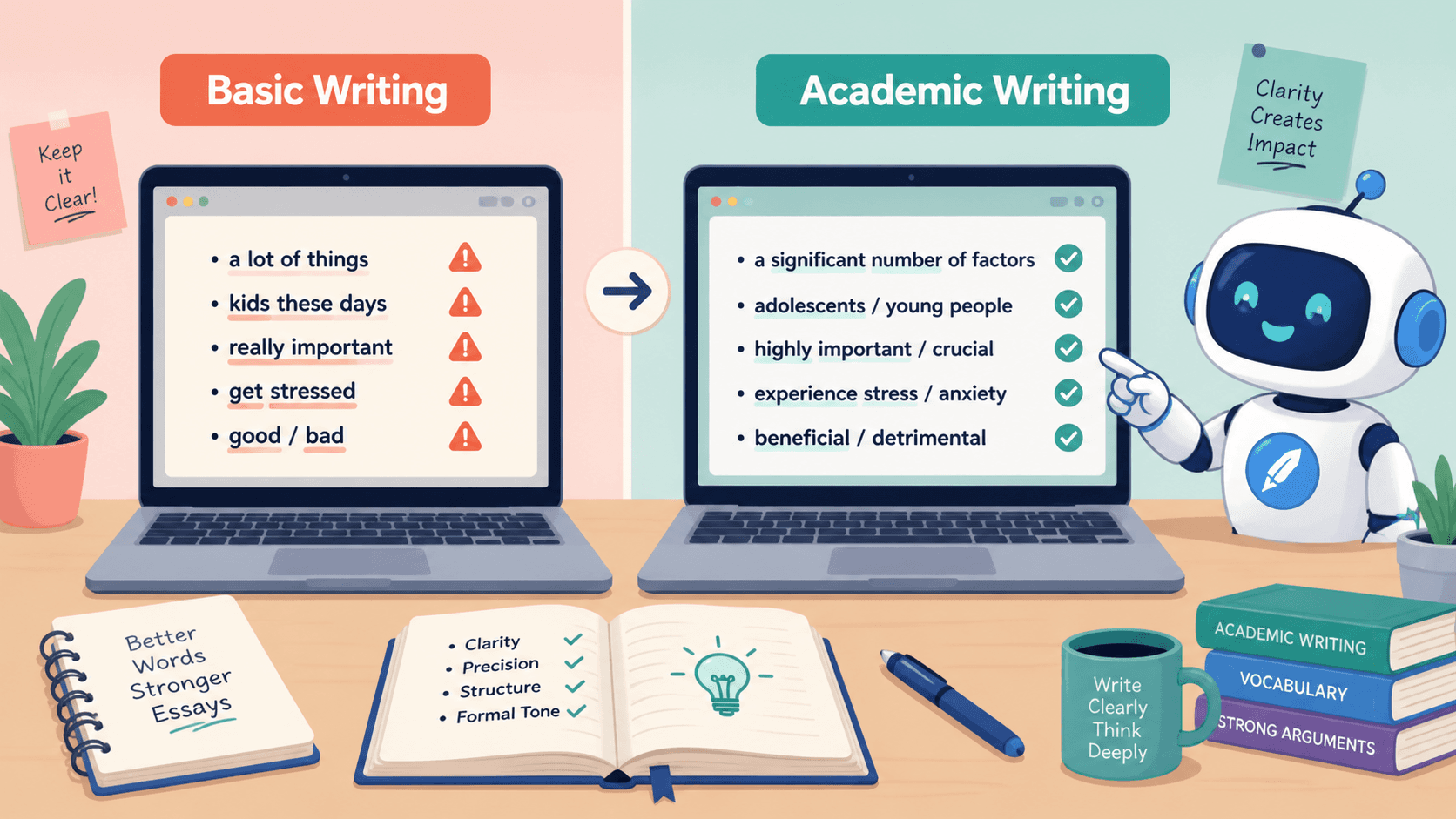
Academic vocabulary woh formal aur precise language hai jiski aapke essays ko zaroorat hoti hai. Yeh simple words ko structured, objective terms se badal deta hai jo arguments ko saaf taur par present karte hain.
Kayi students ke paas behtareen ideas hote hain, lekin kamzor vocabulary unhe peeche dhakel deti hai. Yeh guide practical categories, real examples, aur seedhi strategies ke sath saari confusion ko door karta hai.
<CTA title="Upgrade Your Academic Vocabulary" description="Generate structured, formal essay language with clarity and precision in minutes." buttonLabel="Try Jenni Free" link="https://app.jenni.ai/register" />
Essays Ke Liye Academic Vocabulary Ka Asli Matlab Kya Hai
Academic vocabulary ka matlab fancy sound karna nahi hai. Yeh woh structured, precise language hai jo aapke analysis ko clear banati hai. Ise arguments build karne ka ek toolkit samjhein, na ki sirf impressive words ki ek list.
University of Sydney writing center ki research se pata chalta hai ki jo students precise word choice aur common academic phrases (jise collocations kehte hain) par master karte hain, woh sirf bade synonyms dhoodhne waale students se behtar perform karte hain.
Apne word choice ko lekar ek conscious effort karna yeh ensure karta hai ki aap terms ko unke exact meaning ke basis par select kar rahe hain, na ki sirf unki complexity ke basis par.
Acche academic writing ke teen saaf traits hote hain. Yeh koi mystery nahi hai; aap iske patterns ko seekh sakte hain.
Yeh ek formal tone ka use karta hai, slang aur contractions se bachta hai.
Yeh reasoning ko explain karne ke liye analytical language par rely karta hai, na ki sirf opinion state karne par.
Yeh structured hota hai, reader ko logically guide karne ke liye clear transitions ka use karta hai.
Iska compare karein: “A lot of kids get stressed by social media” aur “A significant number of children experience stress related to social media use.”
Dusra version vague, conversational wording ko specific academic terms se badal deta hai. Asli goal yahi hai: precision ke zariye clarity, na ki complexity.
<ProTip title="💡 Pro Tip:" description="Focus on clarity first then upgrade vocabulary gradually instead of forcing complex words" />
Academic Vocabulary Ki Essential Categories
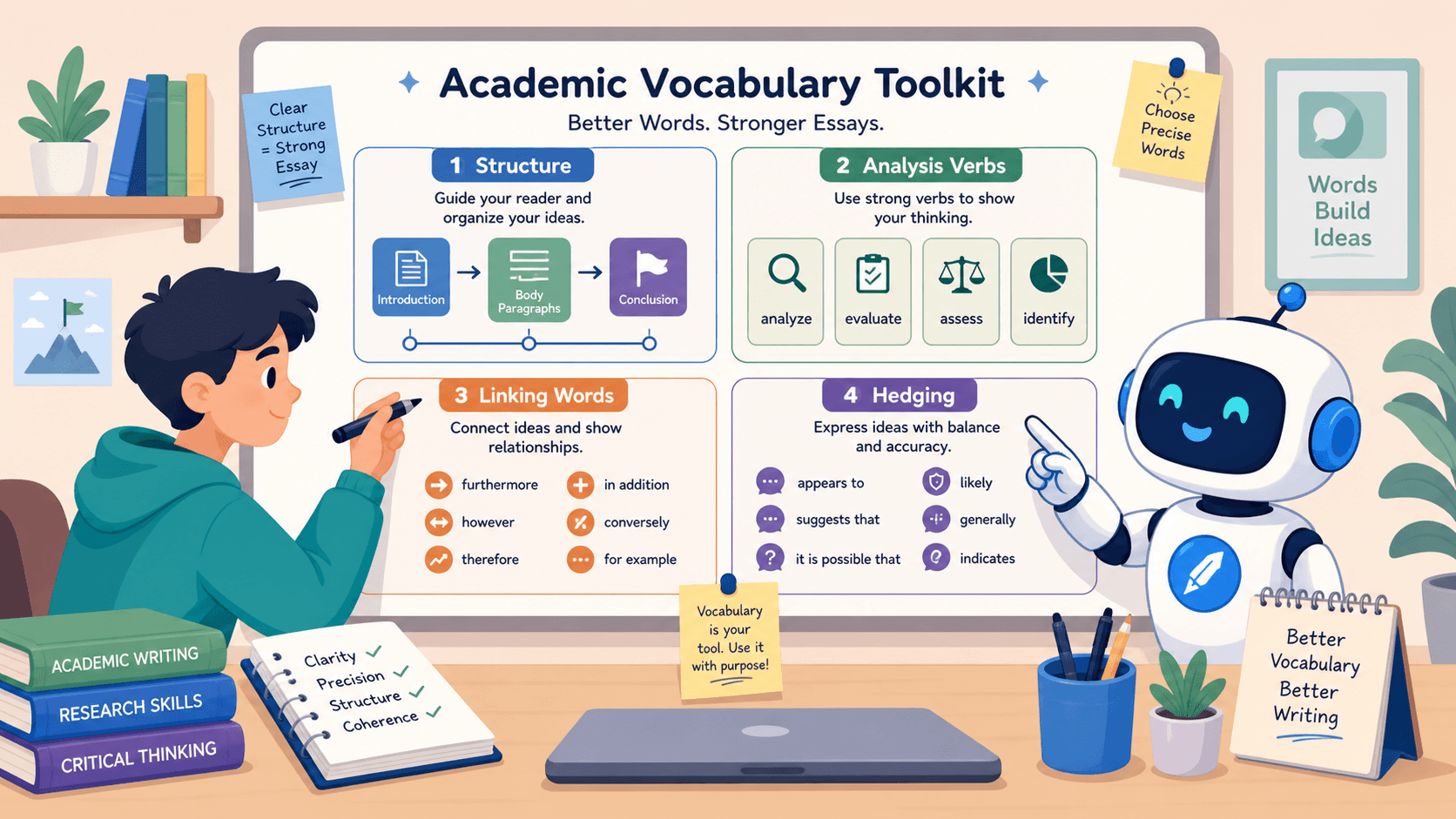
Chaliye academic vocabulary ko un groups mein divide karte hain jinhe aap sach mein use karenge. Har ek group aapki writing mein ek alag problem ko solve karta hai.
Structural aur organizational phrases
Yeh phrases aapke reader ko guide karte hain. Yeh signposts hain, filler nahi. For example, agar aap ek problem solution essay par kaam kar rahe hain, toh aap reader ko apni logic ke threw lead karne ke liye "This section proposes a viable remedy for..." jaise organizational phrases use kar sakte hain.
Dekhiye yeh ek real essay mein kaise kaam karte hain:
Ek introduction mein, aap likh sakte hain: "This essay examines the impact of social media on adolescent mental health."
Aapka thesis aur clear ho jata hai: "This essay argues that excessive social media use increases anxiety."
Body paragraph par move karte hue: "The following discussion evaluates key contributing factors."
Conclusion ke liye: "Overall, the evidence suggests a significant relationship."
Yeh aapke structure ko signal karte hain, jisse aapke argument ko follow karna aasan ho jata hai.
Academic verbs aur analytical language
"Shows" ya "talks about" jaise kamzor verbs ko bhool jaiye. Strong academic verbs aapki thinking ko show karte hain. Yeh clear categories mein aate hain:
Analysis verbs: analyze, evaluate, assess
Argumentation terms: argue, claim, contend
Explanation verbs: demonstrate, indicate, reveal
Research terminology: measure, identify, interpret
Difference dikha? "The study talks about sleep patterns" vague hai. "The study analyzes sleep patterns and identifies key variables" precise aur analytical hai.
Nominalization aur abstract nouns
Yeh ek formal trick hai: verbs ko nouns mein badalna.
analyze ban jata hai analysis
evaluate ban jata hai evaluation
investigate ban jata hai investigation
Yeh tone ko poori tarah badal deta hai. "Researchers investigated the problem" basic sound karta hai. "The investigation examines the problem" zyada scholarly sound karta hai. Aap is style ko academic papers mein har jagah dekhenge.
Is skill ko build karne ke liye, kayi writers high-level writing ke liye sabse effective nouns aur verbs dhoodhne ke liye ek academic word list ki help lete hain.
Linking words aur cohesive devices
Yeh aapke logical bridges hain. Ideas ko smoothly connect karne ke liye inka use karein, lekin iska overdo na karein, kyunki bahut zyada use karne se yeh robotic lagne lagta hai.
Addition: furthermore, moreover
Contrast: however, conversely
Cause and effect: therefore, consequently
Examples: for instance, specifically
Sequencing: first, subsequently
<ProTip title="📌 Note:" description="Use linking words selectively too many can make writing feel mechanical" />
Hedging language aur modality
Academic writing shayad hi kabhi absolutes mein deal karti hai. Yeh balanced aur credible sound karne ke liye cautious language ka use karti hai.
Ek absolute claim jaise "Social media causes anxiety" bahut zyada strong hai. Ek hedged version behtar hai: "Social media use appears to increase the risk of anxiety."
Aap inke sath hedge kar sakte hain:
Verbs: suggest, indicate, imply
Adverbs: generally, likely
Phrases: "It is possible that…" ya "The data seems to show…"
Yeh measured tone show karti hai ki aap apne topic ki complexity ko samajhte hain.
Kyun “Sounding Smart” Aksar Backfire Karta Hai
Essay mein “sound smart” karne ki koshish aksar backfire kar jati hai. Kayi students sochte hain ki advanced vocabulary bhar dene se reader impress hoga, lekin asli goal clear communication hai. Complex words ka overuse aksar sirf confusion create karta hai.
Yeh sirf ek guess nahi hai. Students ke beech ek popular Reddit discussion se pata chala ki kayi logo ne teachers ki strict "banned words" lists ko reject kar diya, yeh argue karte hue ki forced complexity help karne ke bajaye nuksaan zyada pahunchati hai. Unka point? Clarity sabse zyada matter karti hai.
Research bhi is baat ko support karti hai. British Council ki IELTS writing scores ki analysis mein paya gaya ki clarity aur coherence, yaani aapke ideas kitne logically flow karte hain, ek wide lekin poorly used vocabulary range ke mukable high score mein zyada contribute karte hain.
Students typically kuch key mistakes karte hain jab woh academic sound karne ki koshish karte hain:
Obscure words ka galat use: Bina matlab ya context ko poori tarah samjhe thesaurus se koi word utha lena.
Simple words ko bina wajah replace karna: "use" jaise perfectly clear word ko "utilize" jaise awkward word se badal dena.
Sentences ko formal synonyms se overload karna: Ek hi paragraph mein ek hi concept ke liye teen alag words ka use karna.
Natural collocations ko ignore karna: Aise words ko zabardasti ek sath laana jo English mein commonly ek sath nahi jaate.
In pitfalls se bachne ke liye, ek course pack ya ek structured guide ko follow karna helpful hota hai jo rote memorization ke bajaye context par zor deta hai. Sahi tarike se apply ki gayi precision hamesha messy complexity ko hara degi.
Is example ko dekhiye. Kaun sa sentence behtar hai?
Forced: “The implementation of ameliorative strategies facilitated amelioration.”
Clear: “The new strategies improved the situation.”
Dusra version undoubtedly stronger hai. Yeh idea ko directly aur effectively communicate karta hai. Pehla version mismatched formal terms ka ek jumble hai jo meaning ko chhupa deta hai.
Ise samajhne ka ek simple tareeqa hai. Vocabulary ek toolbox ki tarah hai. Ek hammer ek great tool hai, lekin tabhi jab aapko pata ho ki ise properly kaise swing karna hai.
Ek complex, specialized tool bekar hai agar aap iska function nahi samajhte. Academic vocabulary bhi isi tarah kaam karti hai.
Yeh sabse bade, sabse rare tools hone ke baare mein nahi hai. Yeh job ke liye sahi, precise tool chunne aur use control ke sath use karne ke baare mein hai. Sahi tarike se apply ki gayi precision hamesha messy complexity ko hara degi.
<ProTip title="💡 Pro Tip:" description="Use familiar academic words correctly instead of rare words incorrectly" />
Word Lists Se Real Usage Tak
"Academic words" ki ek list ko memorize karna aksar kaam nahi karta. Ek word ko jaan na alag baat hai; use ek sentence mein correctly use karna alag baat hai. Real improvement tab aati hai jab aap dekhte hain ki words ko actually ek sath kaise use kiya jata hai.
Corpus linguistics ki studies, jo real text ke bade databases ko analyze karti hain, paati hain ki students tab zyada tezi se seekhte hain jab woh common academic pairings ko study karte hain, jaise "empirical evidence" ya "significant correlation."
Yeh natural combinations, jinhe collocations kaha jata hai, fluent sound karne ka secret hain.
Toh, aapko sirf memorizing ke bajaye kya karna chahiye? List ko chhodiye. Is approach ko try karein:
Academic texts regularly padhein. Apne field ke journals se rozana kuch paragraphs padhna bhi help karta hai.
Ek smart vocabulary notebook banayein. Sirf words mat likhiye. Woh poora phrase likhiye jisme aapne unhe paya tha.
Words ko function ke according group karein. Apne "analysis verbs" aur "contrast phrases" ko ek sath rakhein.
Apne sentences ko rewrite karne ki practice karein. Ek simple idea lein aur use zyada precise banayein.
Sabse zyada collocations par focus karein. Words ko unke natural pairs mein seekhein.
For instance, sirf "evidence" word mat seekhein. Dekhein ki ise kaise use kiya jata hai:
strong evidence
empirical evidence
supporting evidence
to gather evidence
Functional language ki taraf yeh shift tab aasan hota hai jab aap pehle se hi ek essay guide ko structure karna jaante hain, kyunki ek solid layout aapki nayi vocabulary ke liye sahi "slots" provide karta hai.
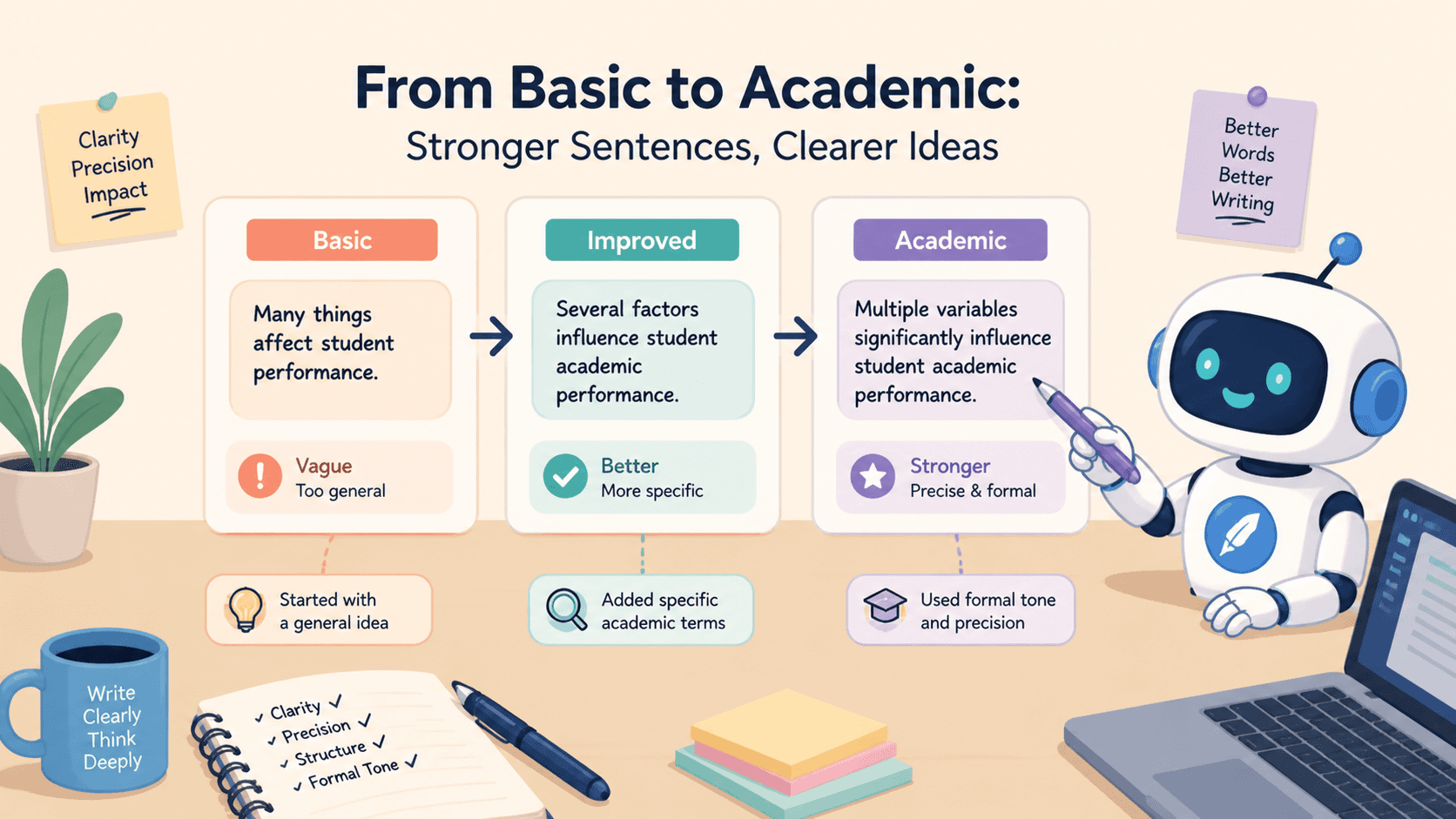
Aap is upgrade process ko action mein dekh sakte hain. Ek basic sentence se shuru karein: "Many things affect student performance."
Yeh vague hai. Pehla improvement: "Several factors influence student academic performance." Humne "things" ko "factors" se aur "affect" ko "influence" se badal diya hai.
Aur bhi behtar: "Multiple variables significantly influence student academic performance." Ab yeh aur zyada specific ("variables") hai aur isme ek key academic adverb ("significantly") shamil hai.
Har ek step sentence ko confusing banaye bina clarity, formality, aur specificity add karta hai.
Yahan ek quick look hai ki kaise simple swaps tone ko badal dete hain:
Basic Writing | Academic Writing |
a lot of | a significant number of |
things | factors / elements |
shows | demonstrates / indicates |
big | substantial / considerable |
bad | detrimental / adverse |
Yeh sabse fancy word use karne ke baare mein nahi hai. Yeh sabse accurate word chunne ke baare mein hai. "Detrimental" sirf "bad" ka ek fancy synonym nahi hai; iska specifically matlab hota hai harm pahunchana, jo ki aksar wahi precise meaning hota hai jiski aapko ek analytical context mein zaroorat hoti hai.
Social Platforms Vocabulary Learning Tools Ke Roop Mein
Yeh sach hai, aaj kal ke students sirf textbooks se nahi seekh rahe hain. YouTube aur X (formerly Twitter) jaise social platforms active roop se shape kar rahe hain ki log vocabulary kaise seekhte hain.
Research suggest karti hai ki in sites par English ka frequent, daily use ek badi vocabulary aur aksar behtar writing skills ke sath correlate karta hai.
Lekin ek catch hai: jo informal, fast-paced language aap online dekhte hain, use essay mein kaam karne ke liye conscious adjustment ki zaroorat hoti hai.
Aap in platforms se actually kya gain karte hain?
Repetition ke zariye familiarity: Short, repeated exposure aapko bina zyada effort ke common language patterns ko absorb karne mein help karta hai.
YouTube par structured lessons: Kayi channels academic phrases, essay structure, aur IELTS jaise tests mein specific scores ko improve karne ki strategies par focused tutorials offer karte hain.
X par rapid exposure: Yeh platform aapke samne tezi se language ki ek badi variety fenkta hai, professional jargon se lekar slang tak.
Halaanki, iska ek clear trade-off bhi hai. Jabki yeh exposure aapki vocabulary range ko widen kar sakta hai, mostly social media ka casual, conversational tone academic writing ke liye required formal style mein interfere kar sakta hai.
Aap bina realize kiye ek sentence ko "So, yeah..." se shuru kar sakte hain. Iska matlab hai ki aapko us informal language ke beech active roop se gears switch karna seekhna hoga jo aap consume karte hain aur un formal expressions ke beech jinhe aapko produce karna hai.
Practical approach simple hai: social platforms ko input ke roop mein use karein, apne output ke liye ek model ke roop mein nahi. Language ko absorb karne ke liye widely padhein aur sunein, lekin jab aap likhne baithein, toh consciously ek formal register mein shift ho jayein.
Jo aapne dekha hai uske basis par sentences likhne ki practice karein, lekin unhe ek academic tone ke sath rewrite karein.
Yeh balance, informally consume karna lekin formally produce karna, language par flexible control build karta hai. Aur woh control, yeh jaan na ki kab kis word ka use karna hai, sirf ek list ko memorize karne se kahi zyada matter karta hai.
<ProTip title="📌 Reminder:" description="Separate informal reading habits from formal writing practice to maintain academic tone" />
Academic Vocabulary Use Karne Ke Liye Ek Simple Template
Academic vocabulary apply karne ke liye yahan ek seedha template hai. Ise ek basic scaffold ki tarah samjhein, jise aap apne ideas se bharte hain.
Introduction Structure
“This essay examines the relationship between sleep deprivation and academic performance.”
“This paper argues that remote work increases productivity for specific industries.” Agar zaroorat ho toh aap ek cautious note add kar sakte hain: “It is suggested that these factors may be interconnected.”
Body Paragraph Structure
Topic Sentence: Paragraph ke focus ko declare karein. “This section evaluates the primary economic causes.”
Presenting Evidence: Apna proof introduce karein. “The data indicates a sharp decline,” ya “Smith’s study demonstrates this effect.”
Linking Ideas: Add karne ke liye “Furthermore” ya contrast karne ke liye “However” jaise precise transition words for essay writing ka use karein. Yeh high-level academic work ke liye zaroori logical flow ko build karta hai.
Conclusion Structure
“In conclusion, the evidence suggests a strong correlation.”
“Overall, these findings highlight the need for further research into policy solutions.”
Yeh framework sabse fancy words use karne ke baare mein nahi hai. Yeh ek logical argument create karne ke liye clear, purposeful language use karne ke baare mein hai. Yeh aapko har sentence ke function ke baare mein sochne par majboor karta hai, jo naturally aapke structure aur coherence ko improve karta hai.
Essays Ke Liye Waqt Ke Sath Academic Vocabulary Kaise Build Karein
Ek strong academic vocabulary raaton-raat build nahi hoti. Yeh ek gradual process hai. Sabse effective method ek thesaurus ko ratna nahi hai, balki focused repetition aur real use hai.
Academic corpora se students kaise seekhte hain is par research se pata chalta hai ki apni khud ki writing mein nayi vocabulary ko actively reuse karna, sirf padhne ya memorize karne ke mukable long-term retention ko 30% se zyada improve karta hai.
Ek long-term strategy ke liye, saikdo words seekhne ke baare mein bhool jaiye. Iske bajaye consistent rahiye.
Har essay mein 5–10 naye words ya phrases seekhein. Aise words chunein jo directly aapke topic se related hon.
Unhe deliberately reuse karein apne agle kuch assignments mein. Yeh practice bahut key hai.
Function par focus karein, difficulty par nahi. "factor" ya "indicate" jaise precise words kisi obscure word se zyada useful hote hain.
Apni common mistakes ko track karein. Kya aap hamesha "affect" aur "effect" mein confuse hote hain? Ise note karein.
Apne teacher ke feedback ko dhyan se review karein, khaskar word choice par.
Aap ek chote example mein cumulative effect dekh sakte hain. Education ke baare mein likhne wala ek student ek basic sentence se shuru kar sakta hai:
“Good teaching helps students learn better.”
Thodi practice ke baad, woh ise revise kar sakte hain:
“Effective teaching strategies enhance student learning outcomes.”
Shift ko dekhiye. Unhone ek vague adjective ("good") ko ek precise adjective ("effective") se badal diya. Unhone ek simple verb ("helps") ko ek stronger verb ("enhance") mein badal diya.
Unhone statement ko zyada formal aur specific banane ke liye abstract nouns ("strategies," "outcomes") ka use kiya.
Har ek change apne aap mein chota hai, lekin ek sath, writing ke tone aur clarity par iska impact turant notice kiya ja sakta hai. Vocabulary isi tarah grow karti hai: ek waqt mein ek precise substitution.
<ProTip title="💡 Pro Tip:" description="Track words you use often and upgrade them with more precise academic alternatives" />
Academic Language Ko Force Kiye Bina Saaf Likhein
Strong academic vocabulary ka matlab fancy sound karna nahi hai - iska matlab precision aur clarity ke sath likhna hai. Structural phrases, analytical verbs, aur hedging language par master karke, aap vague ideas ko persuasive arguments mein transform kar sakte hain.
<CTA title="Write Smarter Academic Essays" description="Turn simple ideas into structured academic writing with clear and precise language." buttonLabel="Try Jenni Free" link="https://app.jenni.ai/register" />
Chote changes se shuru karein. Ek waqt mein ek vague word ko badlein. Apne purane essays ko review karein aur kamzor verbs ko upgrade karein. Waqt ke sath, yeh chote substitutions ek confident, authoritative academic writing mein compound ho jate hain.