Oleh
Justin Wong
—
What Is Grant Writing? A Beginner's Guide

Justin Wong
Head of Growth
Lulus dengan gelar Sarjana di bidang Global Business & Digital Arts, Minor di bidang Kewirausahaan

Most explanations of grant writing describe it as storytelling. That is half true and it leaves out the part that decides the outcome. Grant writing is the work of proving, in a format somebody else designed, that a specific problem exists and that you are the right organization to spend money on it.
It is a real skill with real odds attached, and almost nobody publishes the odds. This guide covers what the work actually involves, how the funding cycle runs, what your realistic chances are, and whether it is worth doing as a career.
<CTA title="Turn a Funding Idea Into a Structured Draft" description="Jenni helps you outline and write proposals with citations you can trace back to the source" buttonLabel="Try Jenni Free" link="https://app.jenni.ai/register" />
What Is Grant Writing?
Grant writing is the process of preparing a formal request for funding from a government agency, foundation, or corporation, following that funder's own rules about structure, length, and evidence. The money is a grant rather than a loan, so it is not repaid, but it comes with obligations: you spend it on what you said you would, and you report back on what happened.
The defining constraint is that you do not control the format. A funder publishes what they want, in what order, in how many pages, and reviewers score you against criteria they wrote. Good grant writing is therefore closer to answering an exam than to writing an essay. The Ohio State University extension guide describes the discipline as 80 percent planning and 20 percent writing, which sounds like an exaggeration until you have done one.
What Does a Grant Writer Actually Do?
Very little of the job is writing prose. A typical week is closer to research, arithmetic, and chasing people for documents.
Prospecting. Finding funders whose stated priorities match work you are already doing, rather than inventing a program to chase money
Reading guidelines. Eligibility, deadlines, page limits, allowable costs, and the scoring rubric if one is published
Gathering evidence. Local data, service records, letters of support, partner commitments, audited financials
Budgeting. Building numbers that match the program described in the narrative, line for line
Writing and cutting. Drafting each section, then removing a third of it to fit the limit
Reporting. After an award lands, documenting what the money did
That last item matters more than new writers expect. Funders renew relationships, not proposals. An organization with clean reporting on a 40,000 dollar grant is in a far better position to ask for 120,000 next time.
<ProTip title="🧭 Start here:" description="Before you write anything, find the funder scoring criteria. If they publish a rubric, your section headings should mirror it exactly" />
How the Grant Cycle Works
Every funder differs in the details, but the sequence is consistent enough to plan around.
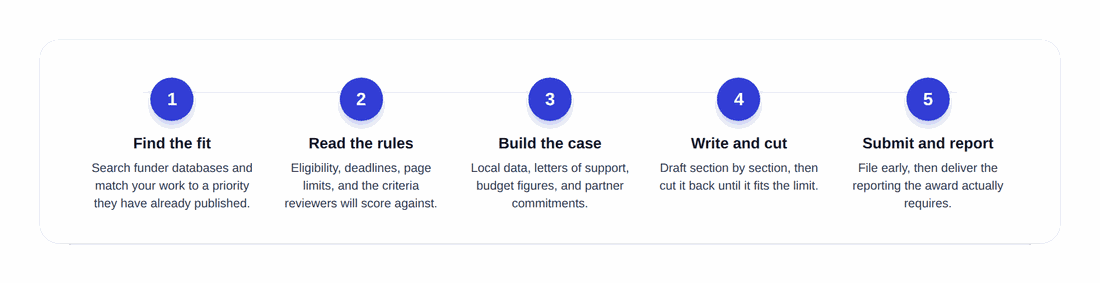
The timescale is the part people underestimate. Federal awards commonly run six to nine months from deadline to notice. Foundations move faster, though many only make decisions when their board meets, which can be quarterly. Build your cash flow assuming the money arrives late, because it usually does.
<ProTip title="🗓️ Budget the wait:" description="Assume the money lands a quarter later than the funder implies. Organizations that plan cash flow around the promise rather than the pattern get caught every single year" />
What Are the Odds, Honestly?
This is the number no beginner guide prints, so here it is.
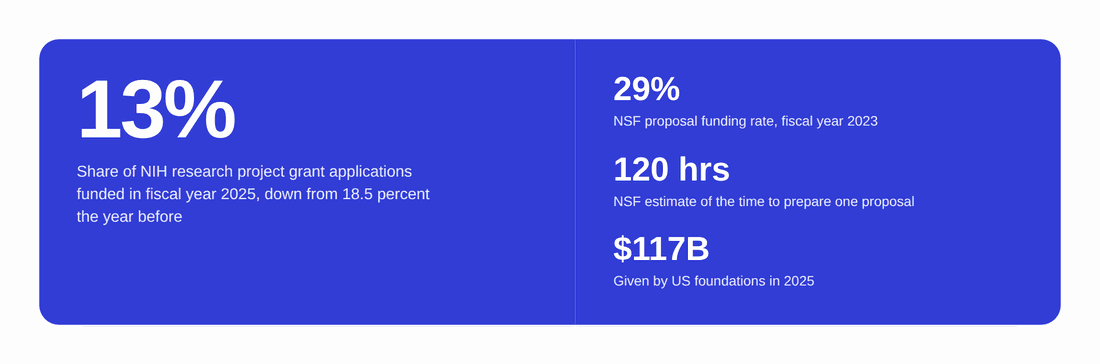
The National Institutes of Health funded 13.0 percent of research project grant applications in fiscal year 2025, against 18.5 percent the year before. The National Science Foundation is more forgiving: its merit review digest for fiscal year 2023 reports 11,056 awards from 38,340 competitive proposals, a funding rate of 29 percent.
Now put that next to the cost. NSF's own public burden statement estimates 120 hours to prepare and submit one proposal, and a survey of 195 academics published in PLOS ONE found an average of 116 principal investigator hours plus 55 co investigator hours per application. Three working weeks, for a one in four to one in eight chance.
That arithmetic is not a reason to avoid grants. Foundations gave 117.15 billion dollars in 2025, and Grants.gov lists over 1,000 federal programs distributing more than 500 billion dollars a year. It is a reason to be selective. Two carefully targeted applications beat six generic ones, every time.
<ProTip title="📊 Reality check:" description="Track your own win rate from the first application. Without it you cannot tell whether a rejection means fix the writing or stop applying to that funder" />
Is Grant Writing a Career?
Yes, and a reasonably well-paid one. The Bureau of Labor Statistics does not track grant writers separately, so they fall under writers and authors, a category with a median pay of 72,270 dollars a year as of May 2024. In practice, compensation splits three ways.
Path | How you get paid | What it takes to start |
In house staff role | Salary, usually blended with wider development duties | Strong writing plus real knowledge of one funding area |
Freelance or contract | Project fee, hourly rate, or a monthly retainer | A portfolio, ideally including two or three funded proposals |
Consulting firm | Salary plus a managed client load | Experience across several funder types and reporting regimes |
One rule holds across all three, and new freelancers break it constantly: do not accept a percentage of the award. The Association of Fundraising Professionals Code of Ethical Standards is explicit, requiring members to decline commissions or compensation based on a percentage of funds raised. Many funders will not accept a budget containing one, and it damages your standing with the people you most need to trust you.
Certification is optional but visible. The Grant Professional Certified credential requires you to accumulate 120 of a possible 170 points across education, professional experience, continuing education, and community involvement before you can even sit the exam, which combines a 175-question paper with a 90-minute writing exercise. It is a genuine signal, not a weekend course.
The Skills That Actually Matter
Ask ten working grant writers and the list converges. Writing ability is on it, but rarely first.
Reading comprehension under pressure. Most disqualifications are administrative. Wrong eligibility category, missing attachment, blown page limit. Nobody reads the guidelines twice and regrets it.
Comfort with numbers. If your budget contradicts your narrative, the reviewer notices before they finish. You do not need accounting training, but you do need to be able to defend every line.
Compression. The NIH allows one page for Specific Aims and twelve for the Research Strategy, limits published on its page limits page. Writing to a hard cap is a distinct skill and it improves with practice faster than anything else on this list.
Sourcing. Every claim you make will be read by someone who knows the field. Knowing what counts as a credible source and citing it properly separates a fundable proposal from an earnest one.
<ProTip title="🔁 Do this first:" description="Rewrite one page of a rejected proposal down to half its length without losing a fact. It is the fastest way to learn what your writing was carrying that nobody needed" />
Where to Start if You Are New to It
Start inside an organization you already understand. The hardest part of a first proposal is not the prose, it is knowing which numbers are true and where to find them, and that knowledge is local. Volunteer to write the need statement for a small local ask, then read the feedback carefully. If your application is declined, the National Institute of Allergy and Infectious Diseases publishes a useful distinction between fixable and hard to fix problems, and knowing which one you have tells you whether to revise or move on.
<CTA title="Write Your First Proposal With Real Support" description="Draft, structure, and cite a full grant application without starting from a blank page" buttonLabel="Try Jenni Free" link="https://app.jenni.ai/register" />
After that it is repetition. The second proposal takes half as long as the first, the fifth reads noticeably better, and by the tenth you will be reading guidelines for what they leave out. Along the way, the habits that make any research writing work, a consistent formal tone and a firm grip on how the parts of a document fit together, carry over almost entirely.