Oleh
Nathan Auyeung
—
Grant Proposal Example: A Full Sample, Section by Section

Nathan Auyeung
Akuntan Senior di EY
Lulus dengan gelar Sarjana Akuntansi, menyelesaikan Diploma Pascasarjana Akuntansi

Search for a grant proposal example and you will find directories. The University of California Santa Barbara has one. The University of Chicago has one. The National Institutes of Health has an excellent one. Every result is a list of links to PDFs, which is useful on a Tuesday afternoon and useless at eleven at night three days before a deadline.
So here is a complete proposal, written out on the page. It is illustrative rather than real, built to match what a mid size community foundation typically funds, and each section is followed by a short note on why it is written the way it is. Links to genuine funded proposals are at the end, where you can compare.
<CTA title="Write Your Proposal With Sources You Can Verify" description="Jenni drafts section by section and shows you where every claim came from" buttonLabel="Try Jenni Free" link="https://app.jenni.ai/register" />
The Scenario
Every number below is invented, but the shape of the request is typical. A small literacy nonprofit is asking a local community foundation to fund an after school tutoring program at three elementary schools.
Applicant | Riverbend Literacy Alliance, a 501(c)(3) founded in 2014 |
Funder | Calder Community Foundation, Education Initiative |
Amount requested | 45,000 dollars |
Period | Twelve months, October 2026 to September 2027 |
Program | Read Forward, after school literacy tutoring for grades two to four |
The Proposal, Section by Section
The indented text is the proposal itself. The paragraph after each one explains the choice behind it.
Executive Summary
Riverbend Literacy Alliance requests 45,000 dollars from the Calder Community Foundation to operate Read Forward, an after school literacy program serving 180 students in grades two through four at Marlow, Kingsbury, and East Ridge elementary schools during the 2026 to 2027 school year. Only 38 percent of third graders at these three campuses read at grade level, compared with 61 percent across the district. Read Forward pairs each student with a trained tutor for two 45 minute sessions per week across 28 weeks. By June 2027, we expect 70 percent of enrolled students to gain at least one full reading level on the district benchmark assessment.
Why it works: five sentences carry the funder, the amount, the population, the timeframe, and the outcome. A board member who reads nothing else still knows exactly what they are approving.
Statement of Need
Third grade reading proficiency is the strongest single predictor of on time high school graduation, and in the Riverbend corridor that predictor is flashing red. District assessment data from spring 2026 shows 38 percent of third graders at Marlow, Kingsbury, and East Ridge reading at grade level, against a district average of 61 percent. All three campuses serve neighborhoods where more than 70 percent of students qualify for free or reduced price meals.
The gap widened after the county cut its after school enrichment line item in 2024, which ended tutoring at two of the three schools. No other provider currently operates a literacy program in these attendance zones. A second grade teacher at Kingsbury keeps a waiting list of eleven families who ask her each fall where their child can get reading help. At present there is nowhere to send them.
Why it works: one wide claim, one district figure, one campus figure, and one detail small enough to remember. It also answers the question reviewers ask silently: why is nobody else already doing this?
<ProTip title="🎯 Aim for:" description="One statistic from outside your organization and one from inside it. External data proves the problem is real, internal data proves it is yours to solve" />
Goals and Objectives
Goal: raise reading proficiency among elementary students in the Riverbend corridor so that more children enter fourth grade able to read in order to learn.
Objective 1: enroll 180 students across three campuses by October 2026, with at least 65 percent attending 40 or more of the 56 scheduled sessions. Objective 2: by June 2027, 70 percent of students who complete the program gain at least one reading level on the district benchmark assessment. Objective 3: recruit and train 60 volunteer tutors by September 2026, each completing 12 hours of instruction in the district approved tutoring model.
Why it works: the goal is directional and unmeasurable, which is fine, because that is what goals are. The three objectives underneath each carry a number and a date, so a reviewer can score them and you can be held to them.
Program Design
Read Forward runs for 28 weeks, October through May, at all three campuses. Students attend two 45 minute sessions per week immediately after dismissal, in space donated by each school.
Each session follows the district approved guided reading protocol: 10 minutes of phonics review, 25 minutes of one to one reading with a tutor, and 10 minutes of independent practice. Tutors are volunteers drawn from Riverbend State University education students and from three partner congregations, and each completes 12 hours of training before being matched with a child.
A 0.5 full time equivalent program coordinator manages recruitment, scheduling, and tutor supervision across all three sites, supported by one site lead per campus at eight hours per week. Letters of support from all three principals appear in Appendix B.
Why it works: a reviewer can picture the room. Named model, named partners, exact staffing, exact hours. Specificity is the cheapest credibility available to a small organization.
Evaluation Plan
Attendance is recorded by site leads in a shared tracker at the end of each session and reviewed monthly by the program coordinator. Reading level data comes from the district fall and spring benchmark assessments, released to us under a data sharing agreement already in place through 2028.
Success is defined in advance: 65 percent average attendance among enrolled students, and 70 percent of completers gaining at least one reading level. We will report against both figures in writing to the Foundation within 60 days of the school year ending. Tutor retention and family survey results will be reported as context rather than as success measures.
Why it works: it names the instrument, the owner, the cadence, and the threshold. It also separates success measures from context, a distinction most proposals blur and most funders notice.
<ProTip title="📝 Note:" description="Write your evaluation plan before your program design is final. If a promised outcome cannot be measured with data you can actually get, change the promise now rather than in the final report" />
Budget Narrative
Program coordinator, 0.5 FTE for twelve months: 29,200 dollars. The coordinator schedules all 168 annual sessions, supervises tutors, and manages the data sharing agreement described in the evaluation plan.
Site leads, three positions at eight hours per week for 28 weeks: 9,700 dollars. Site leads run daily operations at each campus.
Books and leveled readers: 4,200 dollars, or roughly 23 dollars per enrolled student, replacing a classroom set consumed each year.
Tutor training and background checks: 1,900 dollars, covering 60 volunteers at approximately 32 dollars each.
Total request: 45,000 dollars. Riverbend Literacy Alliance contributes in kind space coordination and insurance valued at 6,800 dollars.
Why it works: every line traces back to an activity named elsewhere in the proposal, and the per unit math is visible. A round number with no denominator behind it is an invitation to be questioned.
Organizational Background
Founded in 2014, Riverbend Literacy Alliance operates on an annual budget of 890,000 dollars with seven full time staff and roughly 140 active volunteers. Our summer reading program has served the same three campuses since 2019, reaching 1,100 students to date.
We have administered five prior grants between 25,000 and 120,000 dollars, including two federal subawards, each closed on schedule with complete financial and programmatic reporting. Audited financials for fiscal 2025 and the current board roster appear in Appendix A.
Why it works: it answers a risk question rather than telling a story. Budget size, staff size, comparable grants managed, and a clean closeout record are the four facts a program officer is quietly checking.
What Separates a Strong Need Statement From a Weak One
If you only rewrite one section of your proposal, rewrite this one. It is where reviewers form their opinion, and it is where most drafts go wrong in the same predictable ways.
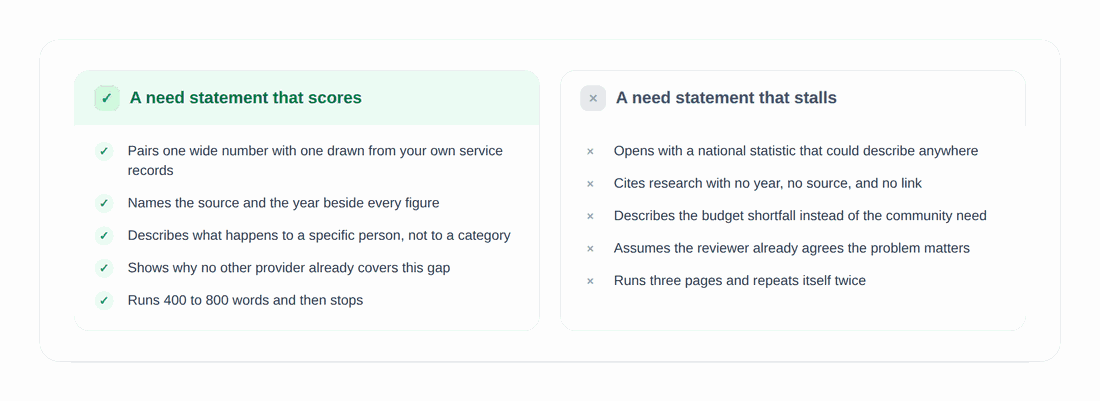
Here is the same opening written badly and then written well.
Before. "Literacy is a critical issue facing our nation today. Studies show that children who cannot read by third grade face serious challenges later in life. Our organization has been unable to meet the growing demand for our services due to limited funding."
After. "District assessment data from spring 2026 shows 38 percent of third graders at our three partner campuses reading at grade level, against a district average of 61 percent. Tutoring ended at two of those campuses when the county cut its enrichment line item in 2024, and no other provider serves those attendance zones."
The first version has no year, no source, and no place. It also ends by describing the organization's problem instead of the community's, which quietly tells the funder they are covering a shortfall rather than buying an outcome. The second version can be checked. That is the whole difference, and checking is exactly what a reviewer does. Being able to point at a credible source for every figure is worth more than another paragraph of urgency.
<ProTip title="🚩 Red flag:" description="If you can swap your organization name for another one and the need statement still reads correctly, it is not a need statement yet" />
Where to Find Real Funded Proposals
Invented samples are useful for shape. Funded ones are useful for calibration, because they show you the level of detail a reviewer actually accepted. These four collections are free and worth the download time.
Source | What is in it | Best for |
Funded R01, R21, K, and F applications, several with the reviewers' summary statements attached | Biomedical and health research | |
Three annotated proposals, including an NSF graduate fellowship and a local foundation grant | Seeing the reasoning marked up | |
Samples grouped by funder: NEH, NIH, NSF, Department of Education, USDA | Federal applications | |
Requests for proposals from state and federal agencies alongside proposal samples | Seeing what funders ask for before you write |
The NIH collection is the most instructive of the four, because the summary statements let you read the reviewers' criticisms next to the text that drew them. That pairing is rare and it is free.
<ProTip title="💡 Pro Tip:" description="Read a funded proposal and a rejected one from the same program if you can get both. The difference is almost never writing quality, it is specificity" />
Borrow the Shape, Not the Sentences
The reason a sample helps is that it shows you how much detail is enough. Most first drafts are not badly written, they are underspecified: a real program described in language general enough to belong to anyone. Copy the structure above, then replace every invented number with one you can source from your own records, your district, or public data. If a sentence survives that swap unchanged, it was not saying anything.
<CTA title="Turn Your Notes Into a Complete Draft" description="Outline, draft, and cite your proposal in one place, then check every claim before you submit" buttonLabel="Try Jenni Free" link="https://app.jenni.ai/register" />
Once the draft exists, the work shifts to tightening it. Keeping a consistent formal tone across sections written at different times is harder than it sounds, and the same discipline that governs the parts of a research paper or a persuasive proposal applies here. Write it early, read it aloud once, and hand it to somebody who does not work in your field.