Oleh
Justin Wong
—
Common Literature Review Mistakes and How to Avoid Them

Justin Wong
Head of Growth
Lulus dengan gelar Sarjana di bidang Global Business & Digital Arts, Minor di bidang Kewirausahaan
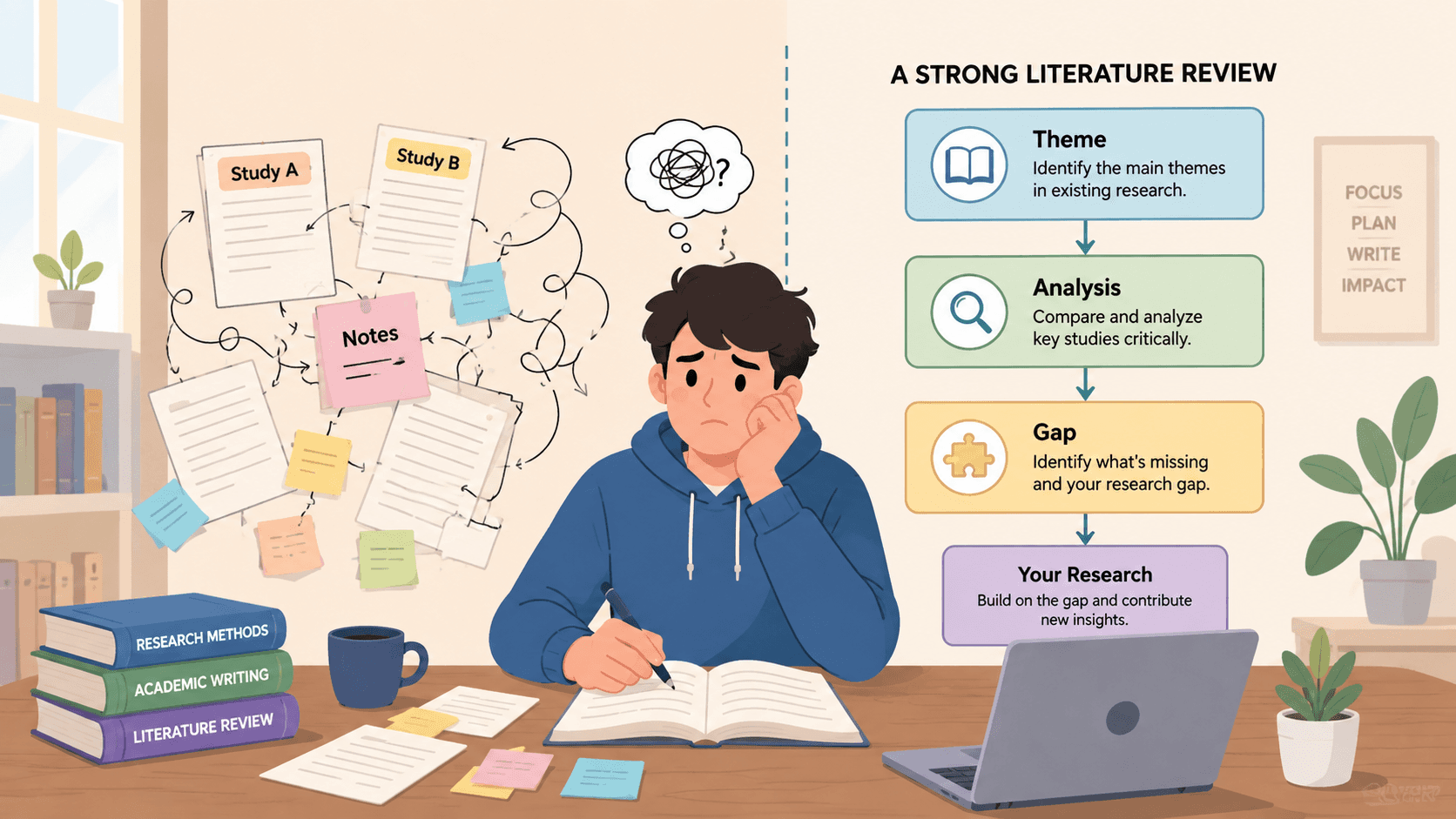
Many students put in the hours, reading study after study, only to end up with a literature review that feels scattered. The problem isn't a lack of effort. It's usually a handful of structural and analytical mistakes that drain the work of its clarity and force.
This guide outlines those common errors, like failing to build a real argument from your sources, and gives you straightforward fixes. You'll see how to transform a pile of notes into a coherent, analytical review that actually supports your own research.
<CTA title="Write a Focused Literature Review" description="Turn scattered research into a clear structured argument without confusion or overload." buttonLabel="Try Jenni Free" link="https://app.jenni.ai/register" />
What Makes Literature Review Mistakes So Common?
It usually starts with a simple misconception: thinking a literature review is just a summary of what you've read. It's not. Its real job is to build a solid, evidence-based argument for your own work.
The University of Toronto Writing Centre points out that a literature review synthesizes research, it doesn't just list it. But it's easy to fall into the trap of writing "Smith says this, then Jones says that," without ever connecting the dots.
Most literature review mistakes trace back to one fundamental misunderstanding about the purpose of the review itself.
The root of the problem
Many students approach it like keeping a reading log. This leads directly to a weak structure and surface-level analysis.
Imagine you're building a bridge. Each study you read is a steel beam. If you just pile beams on the riverbank with no blueprint, you won't get across. The review is that blueprint, it shows how all the pieces fit together to support your project.
For some projects, following a narrative literature review format can help weave these sources into a story, provided you maintain a strong analytical focus.
Common signs you're stuck
You've read thirty papers, but you're more confused than when you started.
Your draft is just a series of paragraphs that all begin with "According to..."
You can't pinpoint what's actually missing from the existing research.
This isn't about working hard enough. It's about missing the framework to turn reading into a real argument.
<ProTip title="💡 Pro Tip:" description="Define your research question before reading more papers to avoid overload and confusion." />
The Most Common Literature Review Mistakes
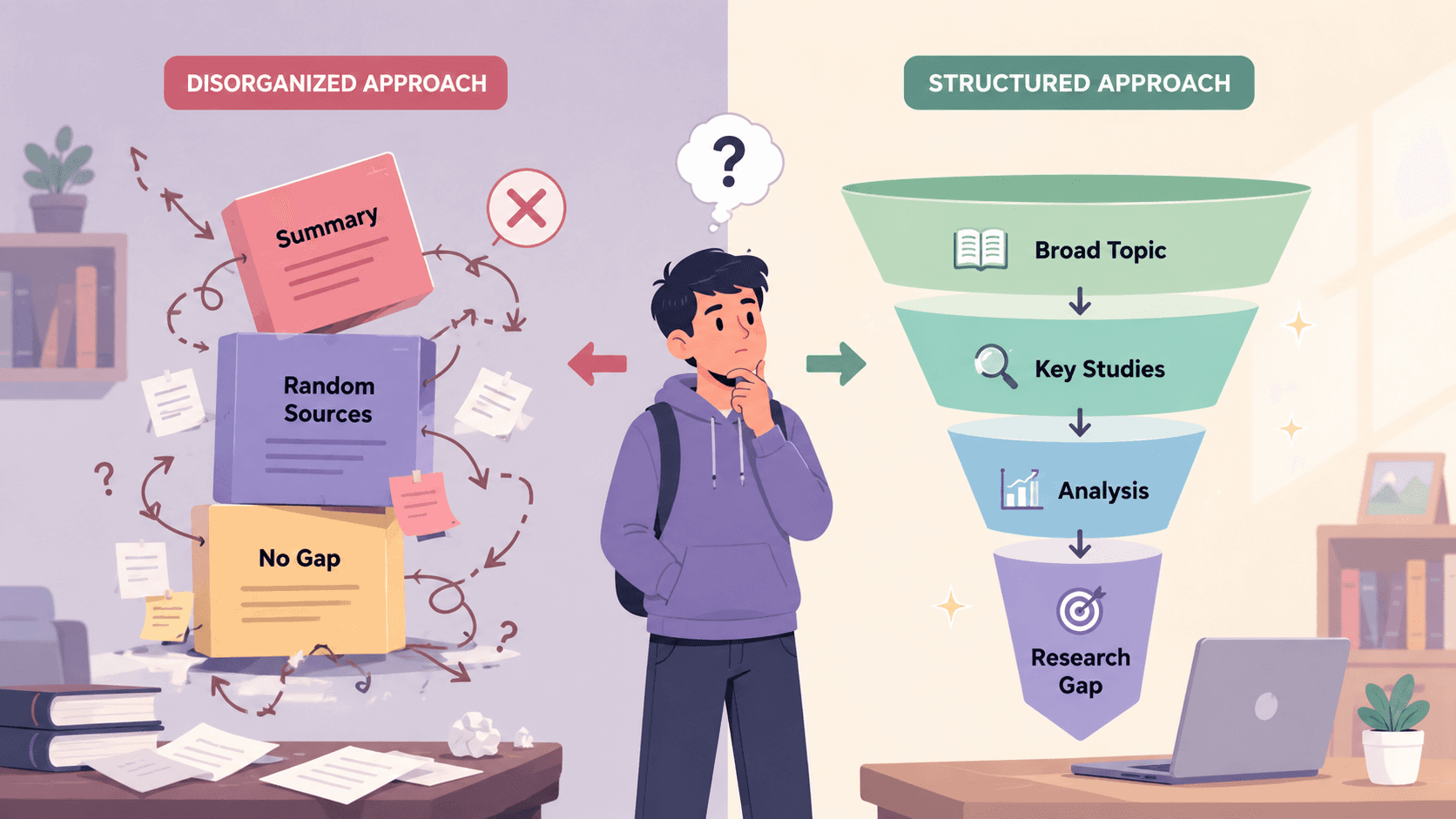
Getting the structure wrong can drain your review of its power. Here are the three most critical pitfalls.
1. Starting with a vague question
A fuzzy research question dooms the whole process. If you don't know exactly what you're looking for, every source seems important. This leads to information overload and a weak, meandering argument.
Too broad: "I am studying social media effects."
Focused: "I am analyzing how Instagram use affects academic performance among college students."
The second version gives you a filter. It tells you exactly which studies to keep and which to set aside.
2. Summarizing instead of analyzing
This is the classic trap. The review turns into a list: "Author A found X. Author B found Y. Author C argued Z." It reads like an annotated bibliography, not a coherent narrative.
The goal isn't to catalogue; it's to synthesize. A strong review compares findings and connects themes. To avoid a simple list, you must understand the critical review structure which prioritizes evaluation over description.
3. Skipping the critical evaluation
Many reviews report findings as simple facts. But academic writing demands you question them. Was the sample size reliable? Could the method have introduced bias?
Following a step-by-step literature review guide can help ensure you don't miss these evaluative steps.
Was the sample size too small to be reliable?
Could the research method have introduced bias?
Do the findings hold up in different contexts?
As the Harvard College Writing Center notes, this critical analysis is what separates advanced academic work from a basic summary. Without it, your review lacks credibility.
<ProTip title="💡 Pro Tip:" description="Always ask what are the strengths and limits of each study before including it in your review." />
4. Relying on poor sources
The quality of your sources directly shapes the credibility of your review. Using weak or irrelevant material undermines your entire argument from the start.
Common problems include building a case on non-academic blogs, using only the first few search results, or avoiding hard-to-access journal articles.
A strong review needs a solid foundation. It should reference the key, established studies in the field (seminal works) alongside current research to show you understand the full conversation.
5. Missing the gap
This might be the most crucial error. A literature review must do more than report what's already known; it has to pinpoint what isn't.
If you finish your review without clearly stating what question remains unanswered or what problem hasn't been solved, your own research project appears unnecessary. You have to explicitly identify the gap your work will address.
Quick Summary of Key Literature Review Errors
Mistake | What actually happens | The result |
Vague research question | You have no clear filter for sources. | A scattered, weak argument. |
Summary-based writing | You just list what each author said. | No real synthesis or analysis. |
Weak source evaluation | You report findings without questioning them. | The review lacks critical credibility. |
Missing key studies | Your review is built on an incomplete picture. | It leaves obvious academic gaps. |
No research gap | You don't state what's missing. | Your own work seems unnecessary. |
These problems tend to build on each other. A vague question leads to poor source selection, which results in a summary list that never finds a gap. It's a chain reaction that weakens the entire project.
Structural Problems That Break Your Literature Review
You can have all the right sources and still produce a confusing mess if the structure fails. One way to prevent this is by creating a detailed how to write literature review outline before you begin the drafting process.
The "messy funnel"
A well-structured review usually follows a funnel. It starts with the broad context of your topic.
Narrows down to the specific theories and key debates, and finally arrives at the precise gap your research will fill. When this logical flow is missing, the review feels disorganized and aimless.
Mixing everything into one pot
A common error is to blend different types of information in a single section. You might combine general background, theoretical concepts, and specific study findings all together. This forces the reader to constantly switch mental gears.
It's clearer to give each section a dedicated role: here's the theory, here are the empirical studies that tested it, here's where they disagree.
When the flow breaks down
Abrupt jumps between ideas destroy coherence. You need to use reflective literature review techniques to ensure you are connecting the dots for the reader.
For instance, discussing a sociological theory in one paragraph and then, without transition, listing findings from a psychology experiment in the next. The reader is left wondering how the two connect.
This lack of logical flow is one of the most frequent and damaging errors, turning a potential argument into just a collection of points.
<ProTip title="💡 Pro Tip:" description="Use clear transitions to show how one idea leads to the next in your argument." />
Research Strategy Mistakes That Weaken Your Review
A solid literature review is built on a solid search. If your strategy is weak from the start, the final work will be too.
Shallow searching
It's easy to fall into a limited search pattern. Maybe you only use Google Scholar, or you stick with one or two basic keywords and just take the first twenty results.
This almost guarantees you'll miss important, foundational studies. Key papers aren't always the most cited or the easiest to find.
Not tracking your process
A review that doesn't explain how you found your sources lacks transparency. To be credible, and to let others check or build on your work, you need to document your method. Which databases did you search?
What specific keywords and combinations did you try? What rules did you use to decide if a source was relevant or not? Spelling this out is good academic practice.
Getting the scope wrong
This is a balancing act. A scope that's too broad ("the history of education") leads to a superficial review that can't cover anything in depth.
A scope that's too narrow ("math test scores in one Ohio high school in 2018") might miss the wider context and theoretical debates. The right scope is focused enough for deep analysis but wide enough to show where your specific topic fits.
Writing and Citation Mistakes You Cannot Ignore
Even if your research is solid, sloppy writing can sink it. There are a few common pitfalls that trip up students, and you can't afford to ignore them.
Plagiarism and Patchwriting
This isn't just about copying a whole paragraph. It includes tweaking a few words in someone else's sentence and calling it your own, or stitching together bits from different sources without clear attribution.
Both are serious academic offenses. The usual slip-ups are:
Paraphrasing that's too close to the original text.
Simply forgetting to add a citation where one is needed.
Citing the wrong source, like referencing a textbook that summarized a study, instead of the original study itself.
Inconsistent Referencing
Mixing citation styles is a red flag for professors. It shows you weren't paying attention. You might use APA format in one paragraph, switch to MLA in the next, and throw in a Harvard-style reference at the end.
Keeping everything uniform according to your required style guide is a basic, but crucial, detail.
Clumsy Academic Style
When the writing itself is weak, your good ideas get lost. The main culprits here are:
Sentences that are too long and tangled, making the point hard to follow.
Repeating the same idea in slightly different words, which pads the essay but adds nothing.
Using an informal, conversational tone where a formal, precise one is expected. These problems muddle your argument and leave the reader confused about what you're actually trying to say.
<ProTip title="💡 Pro Tip:" description="Keep sentences short and precise to improve clarity and academic tone." />
The Gap Problem: Why Many Reviews Fail at the End
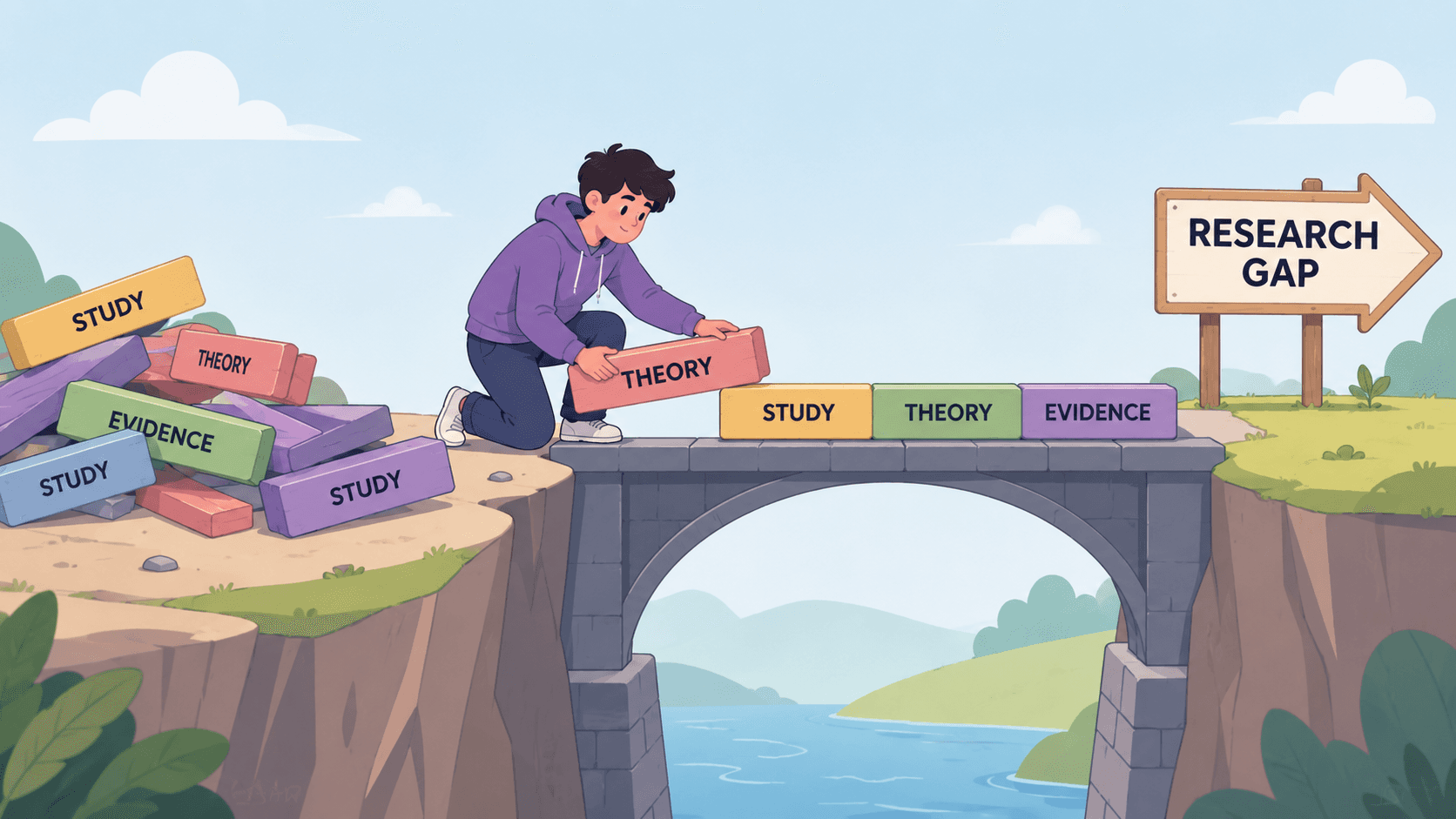
A literature review often falls apart at the very end, when it can't pinpoint a clear research gap. This is where many students stumble.
What a Real Gap Actually Is
A research gap isn't simply saying "not many people have studied this." It's a specific, missing piece of knowledge that prevents us from fully understanding a problem. Take this example: There are plenty of studies on how social media affects learning.
But if no one has looked at whether those effects differ between, say, engineering students and history students, that's a genuine gap. It's a question that needs answering before we can draw any broader conclusions.
Why It Gets Missed
Students usually miss the gap for a few reasons. They might just summarize each study they find without really analyzing them. Or they focus so much on describing the existing research that they never step back to compare the findings against each other.
If you don't synthesize the information, putting it together to see what's known and what's not, the gap will stay hidden.
From Mistakes to Mastery: A Simple Framework
You can avoid the common pitfalls by using a straightforward plan. This framework moves you from just collecting information to building a real argument.
A Step-by-Step Method
Start with a sharp research question. Everything else follows from this.
Search widely. Use several academic databases and try different keyword combinations.
Organize the studies you find by their common themes or ideas.
Don't just list them. Compare what they say and critique their methods or conclusions.
Look for patterns across the studies, and pay attention to where their findings contradict each other.
Use those patterns and contradictions to pinpoint exactly what knowledge is missing, your research gap.
This process forces you to analyze, not just summarize. It turns a list of sources into a foundation for your own work.
What This Means in Practice
Improving your literature review isn't about adding more words. It's about a change in how you think and write.
You make a few key shifts:
From simply listing studies to building a coherent argument.
From trying to read everything to selecting sources strategically.
From summarizing what others said to analyzing what it all means.
That change in approach is what actually improves your academic writing. It's the difference between a report and a contribution.
Stop Letting Your Literature Review Fall Apart
You've read a lot, but your ideas still feel scattered. The connections aren't clear. It's frustrating when everything you gathered doesn't turn into a strong argument - and it shows in your writing.
<CTA title="Turn Research Into Clear Arguments" description="Structure your literature review with clarity and confidence using guided writing support." buttonLabel="Try Jenni Free" link="https://app.jenni.ai/register" />
Improving your literature review isn't about adding more sources. It's about shifting from summary to synthesis. Start with a sharp question, organize by themes, critique methods, and pinpoint the gap. That shift makes your work easier to follow and much more convincing.