Oleh
Nathan Auyeung
—
Academic Vocabulary for Essays: Write More Clearly

Nathan Auyeung
Akuntan Senior di EY
Lulus dengan gelar Sarjana Akuntansi, menyelesaikan Diploma Pascasarjana Akuntansi
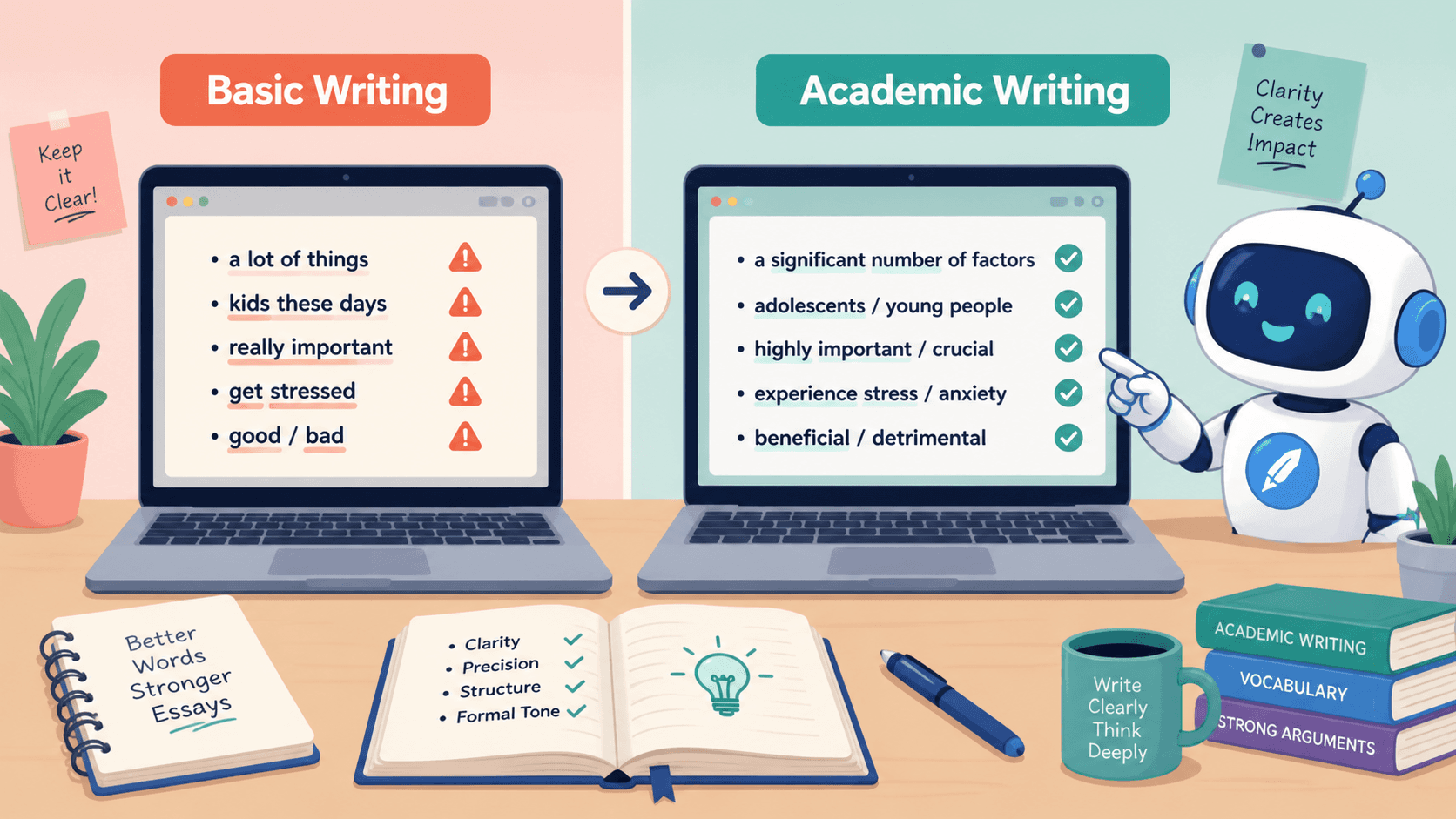
Academic vocabulary is the formal, precise language your essays need. It swaps simple words for structured, objective terms that present arguments clearly.
Many students have great ideas, but weak vocabulary holds them back. This guide cuts through the confusion with practical categories, real examples, and straightforward strategies.
<CTA title="Upgrade Your Academic Vocabulary" description="Generate structured, formal essay language with clarity and precision in minutes." buttonLabel="Try Jenni Free" link="https://app.jenni.ai/register" />
What Academic Vocabulary for Essays Really Means
Academic vocabulary isn't about sounding fancy. It's the structured, precise language that makes your analysis clear. Think of it as a toolkit for building arguments, not a list of impressive words.
Research from the University of Sydney writing center finds that students who master precise word choice and common academic phrases, called collocations, outperform those just hunting for big synonyms.
Making a conscious effort regarding your word choice ensures that you are selecting terms based on their exact meaning rather than just their complexity.
Good academic writing has three clear traits. It's not a mystery; you can learn the patterns.
It uses a formal tone, avoiding slang and contractions.
It relies on analytical language to explain reasoning, not just state opinion.
It's structured, using clear transitions to guide the reader logically.
Compare “A lot of kids get stressed by social media” with “A significant number of children experience stress related to social media use.”
The second version swaps vague, conversational wording for specific academic terms. That’s the real goal: clarity through precision, not complexity.
<ProTip title="💡 Pro Tip:" description="Focus on clarity first then upgrade vocabulary gradually instead of forcing complex words" />
The Essential Categories of Academic Vocabulary
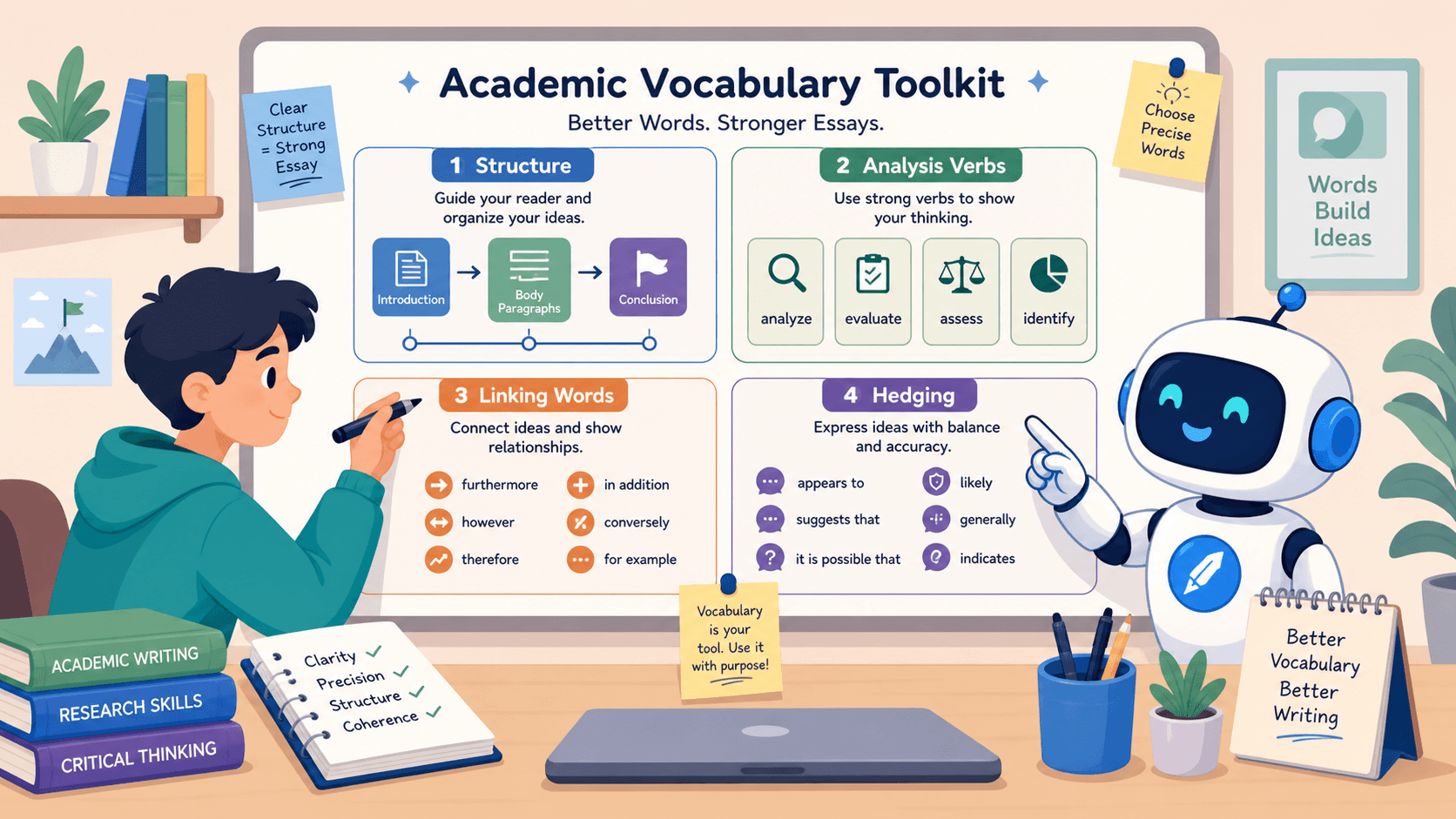
Let's break down academic vocabulary into the groups you'll actually use. Each one solves a different problem in your writing.
Structural and organizational phrases
These phrases guide your reader. They're signposts, not filler. For example, if you are working on a problem solution essay, you might use organizational phrases like "This section proposes a viable remedy for..." to lead the reader through your logic.
Look at how they work in a real essay:
In an introduction, you might write: "This essay examines the impact of social media on adolescent mental health."
Your thesis becomes clearer: "This essay argues that excessive social media use increases anxiety."
Moving to a body paragraph: "The following discussion evaluates key contributing factors."
For a conclusion: "Overall, the evidence suggests a significant relationship."
They signal your structure, making your argument easy to follow.
Academic verbs and analytical language
Forget weak verbs like "shows" or "talks about." Strong academic verbs show your thinking. They fall into clear categories:
Analysis verbs: analyze, evaluate, assess
Argumentation terms: argue, claim, contend
Explanation verbs: demonstrate, indicate, reveal
Research terminology: measure, identify, interpret
See the difference? "The study talks about sleep patterns" is vague. "The study analyzes sleep patterns and identifies key variables" is precise and analytical.
Nominalization and abstract nouns
This is a formal trick: turning verbs into nouns.
analyze becomes analysis
evaluate becomes evaluation
investigate becomes investigation
It changes the tone completely. "Researchers investigated the problem" sounds basic. "The investigation examines the problem" sounds more scholarly. You'll see this style everywhere in academic papers.
To build this skill, many writers consult an academic word list to find the most effective nouns and verbs for high-level writing.
Linking words and cohesive devices
These are your logical bridges. Use them to connect ideas smoothly, but don't overdo it, too many feels robotic.
Addition: furthermore, moreover
Contrast: however, conversely
Cause and effect: therefore, consequently
Examples: for instance, specifically
Sequencing: first, subsequently
<ProTip title="📌 Note:" description="Use linking words selectively too many can make writing feel mechanical" />
Hedging language and modality
Academic writing rarely deals in absolutes. It uses cautious language to sound balanced and credible.
An absolute claim like "Social media causes anxiety" is too strong. A hedged version is better: "Social media use appears to increase the risk of anxiety."
You can hedge with:
Verbs: suggest, indicate, imply
Adverbs: generally, likely
Phrases: "It is possible that…" or "The data seems to show…"
This measured tone shows you understand the complexity of your topic.
Why “Sounding Smart” Often Backfires
Trying to “sound smart” in an essay often backfires. Many students think packing in advanced vocabulary will impress a reader, but the real goal is clear communication. Overusing complex words usually just creates confusion.
This isn't just a guess. A popular Reddit discussion among students showed many rejecting strict "banned words" lists from teachers, arguing that forced complexity hurts more than it helps. Their point? Clarity matters most.
Research backs this up. The British Council's analysis of IELTS writing scores found that clarity and coherence, how logically your ideas flow, contribute more to a high score than a wide but poorly used vocabulary range alone.
Students typically make a few key mistakes when they try to sound academic:
Using obscure words incorrectly: Picking a word from a thesaurus without fully understanding its meaning or context.
Replacing simple words unnecessarily: Swapping a perfectly clear word like "use" for a more awkward one like "utilize."
Overloading sentences with formal synonyms: Cycling through three different words for the same concept in one paragraph.
Ignoring natural collocations: Forcing words together that don't commonly go together in English.
To avoid these pitfalls, it is helpful to follow a course pack or a structured guide that emphasizes context over rote memorization. Precision, applied correctly, will always beat messy complexity.
Look at this example. Which sentence is better?
Forced: “The implementation of ameliorative strategies facilitated amelioration.”
Clear: “The new strategies improved the situation.”
The second version is undeniably stronger. It communicates the idea directly and effectively. The first is a jumble of mismatched formal terms that obscures the meaning.
Here's a simple way to think about it. Vocabulary is like a toolbox. A hammer is a great tool, but only if you know how to swing it properly.
A complex, specialized tool is useless if you don't understand its function. Academic vocabulary works the same way.
It's not about having the biggest, rarest tools. It's about choosing the right, precise tool for the job and using it with control. Precision, applied correctly, will always beat messy complexity.
<ProTip title="💡 Pro Tip:" description="Use familiar academic words correctly instead of rare words incorrectly" />
From Word Lists to Real Usage
Memorizing a list of "academic words" doesn't usually work. Knowing a word is one thing; using it correctly in a sentence is another. Real improvement comes from seeing how words are actually used together.
Studies in corpus linguistics, which analyzes huge databases of real text, find that students learn faster when they study common academic pairings, like "empirical evidence" or "significant correlation."
These natural combinations, called collocations, are the secret to sounding fluent.
So, what should you do instead of just memorizing? Ditch the list. Try this approach:
Read academic texts regularly. Even a few paragraphs a day from journals in your field helps.
Build a smart vocabulary notebook. Don't just write words. Write down the whole phrase you found them in.
Group words by function. Keep your "analysis verbs" and "contrast phrases" together.
Practice rewriting your own sentences. Take a simple idea and make it more precise.
Focus on collocations above all. Learn words in their natural pairs.
For instance, don't just learn the word "evidence." Learn how it's used:
strong evidence
empirical evidence
supporting evidence
to gather evidence
This shift towards functional language is easier when you already know how to structure an essay guide, as a solid layout provides the right "slots" for your new vocabulary.
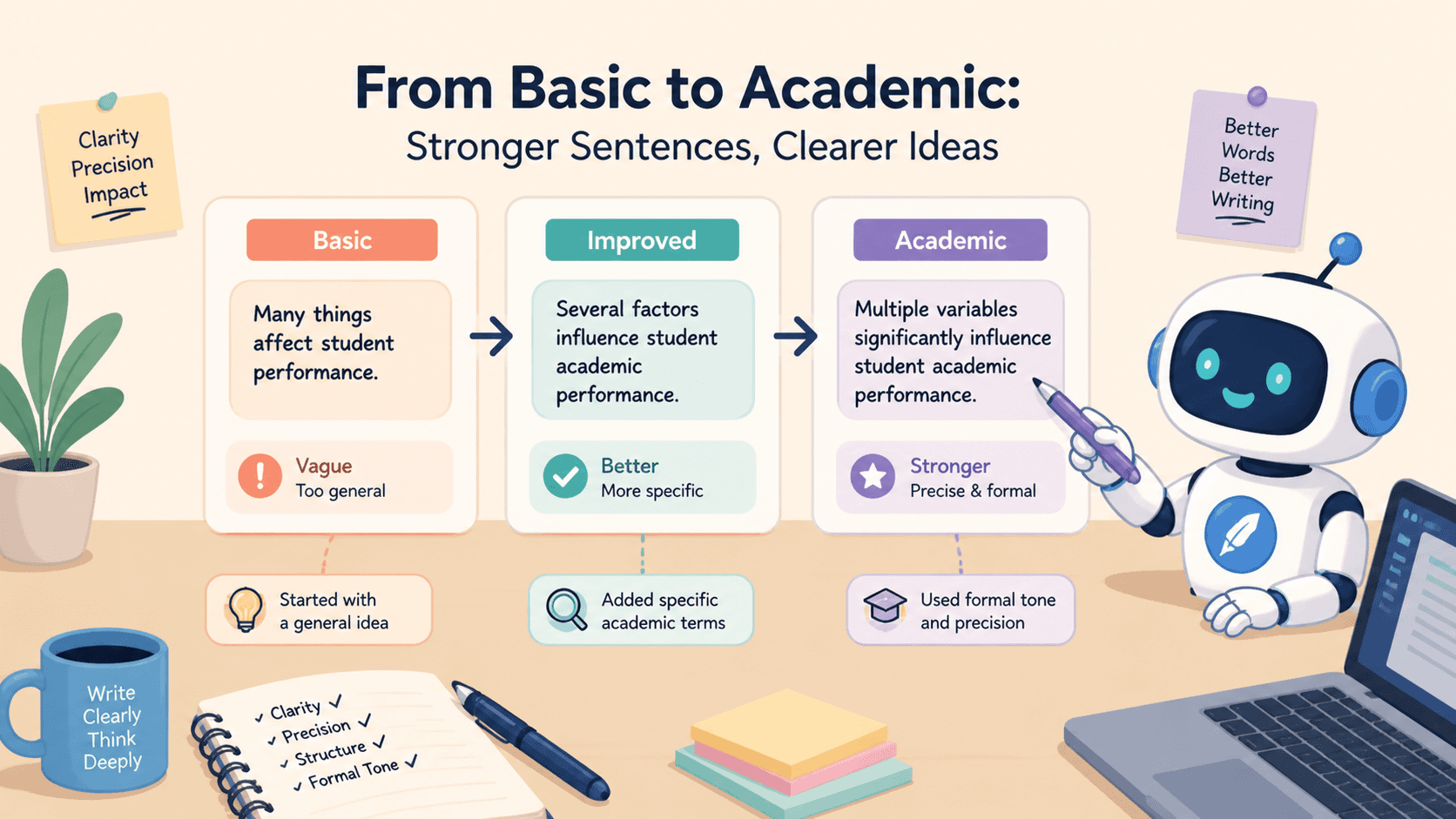
You can see the upgrade process in action. Start with a basic sentence: "Many things affect student performance."
That's vague. First improvement: "Several factors influence student academic performance." We've swapped "things" for "factors" and "affect" for "influence."
Better yet: "Multiple variables significantly influence student academic performance." Now it's more specific ("variables") and includes a key academic adverb ("significantly").
Each step adds clarity, formality, and specificity without making the sentence confusing.
Here's a quick look at how simple swaps change the tone:
Basic Writing | Academic Writing |
a lot of | a significant number of |
things | factors / elements |
shows | demonstrates / indicates |
big | substantial / considerable |
bad | detrimental / adverse |
This isn't about using the fanciest word. It's about choosing the most accurate one. "Detrimental" isn't just a fancy synonym for "bad"; it specifically means causing harm, which is often the precise meaning you need in an analytical context.
Social Platforms as Vocabulary Learning Tools
It's true, students today aren't just learning from textbooks. Social platforms like YouTube and X (formerly Twitter) are actively shaping how people pick up vocabulary.
Research suggests that frequent, daily use of English on these sites does correlate with a bigger vocabulary and often better writing skills.
But there's a catch: the informal, fast-paced language you see online needs conscious adjustment to work in an essay.
What do you actually gain from these platforms?
Familiarity through repetition: Short, repeated exposure helps you absorb common language patterns almost without trying.
Structured lessons on YouTube: Many channels offer focused tutorials on academic phrases, essay structure, and strategies for improving specific scores on tests like the IELTS.
Rapid exposure on X: The platform throws a huge variety of language at you quickly, from professional jargon to slang.
There's a clear trade-off, though. While this exposure can widen your vocabulary range, the casual, conversational tone of most social media can interfere with the formal style required for academic writing.
You might start a sentence with "So, yeah..." without realizing it. This means you have to learn to actively switch gears between the informal language you consume and the formal expressions you need to produce.
The practical approach is simple: use social platforms as input, not as a model for your output. Read and listen widely to absorb language, but when you sit down to write, consciously shift into a formal register.
Practice writing sentences based on what you've seen, but rewrite them with an academic tone.
This balance, consuming informally but producing formally, builds flexible control over language. And that control, knowing when to use which word, matters far more than just memorizing a list.
<ProTip title="📌 Reminder:" description="Separate informal reading habits from formal writing practice to maintain academic tone" />
A Simple Template for Using Academic Vocabulary
Here’s a straightforward template for applying academic vocabulary. Think of it as a basic scaffold, you fill it with your own ideas.
Introduction Structure
“This essay examines the relationship between sleep deprivation and academic performance.”
“This paper argues that remote work increases productivity for specific industries.” You can add a cautious note if needed: “It is suggested that these factors may be interconnected.”
Body Paragraph Structure
Topic Sentence: Declare the paragraph's focus. “This section evaluates the primary economic causes.”
Presenting Evidence: Introduce your proof. “The data indicates a sharp decline,” or “Smith’s study demonstrates this effect.”
Linking Ideas: Use precise transition words for essay writing like “Furthermore” to add or “However” to contrast. This builds the logical flow necessary for high-level academic work.
Conclusion Structure
“In conclusion, the evidence suggests a strong correlation.”
“Overall, these findings highlight the need for further research into policy solutions.”
This framework isn't about using the fanciest words. It's about using clear, purposeful language to create a logical argument. It forces you to think about the function of each sentence, which naturally improves your structure and coherence.
How to Build Academic Vocabulary for Essays Over Time
Building a strong academic vocabulary doesn't happen overnight. It's a gradual process. The most effective method isn't cramming a thesaurus, but focused repetition and real use.
Research on how students learn from academic corpora shows that actively reusing new vocabulary in your own writing improves long-term retention by more than 30% compared to just reading or memorizing.
For a long-term strategy, forget about learning hundreds of words. Be consistent instead.
Learn 5–10 new words or phrases per essay. Choose ones directly related to your topic.
Reuse them deliberately in your next few assignments. This practice is key.
Focus on function, not difficulty. A precise word like "factor" or "indicate" is more useful than an obscure one.
Track your common mistakes. Do you always confuse "affect" and "effect"? Note it.
Review your teacher's feedback carefully, especially on word choice.
You can see the cumulative effect in a small example. A student writing about education might start with a basic sentence:
“Good teaching helps students learn better.”
After some practice, they could revise it to:
“Effective teaching strategies enhance student learning outcomes.”
Look at the shift. They swapped a vague adjective ("good") for a precise one ("effective"). They turned a simple verb ("helps") into a stronger one ("enhance").
They used abstract nouns ("strategies," "outcomes") to make the statement more formal and specific.
Each change is small on its own, but together, the impact on the tone and clarity of the writing is immediately noticeable. That's how vocabulary grows: one precise substitution at a time.
<ProTip title="💡 Pro Tip:" description="Track words you use often and upgrade them with more precise academic alternatives" />
Write Clearly Without Forcing Academic Language
Strong academic vocabulary isn't about sounding fancy - it's about writing with precision and clarity. By mastering structural phrases, analytical verbs, and hedging language, you can transform vague ideas into persuasive arguments.
<CTA title="Write Smarter Academic Essays" description="Turn simple ideas into structured academic writing with clear and precise language." buttonLabel="Try Jenni Free" link="https://app.jenni.ai/register" />
Start with small changes. Swap one vague word at a time. Review your old essays and upgrade weak verbs. Over time, these small substitutions compound into confident, authoritative academic writing.